
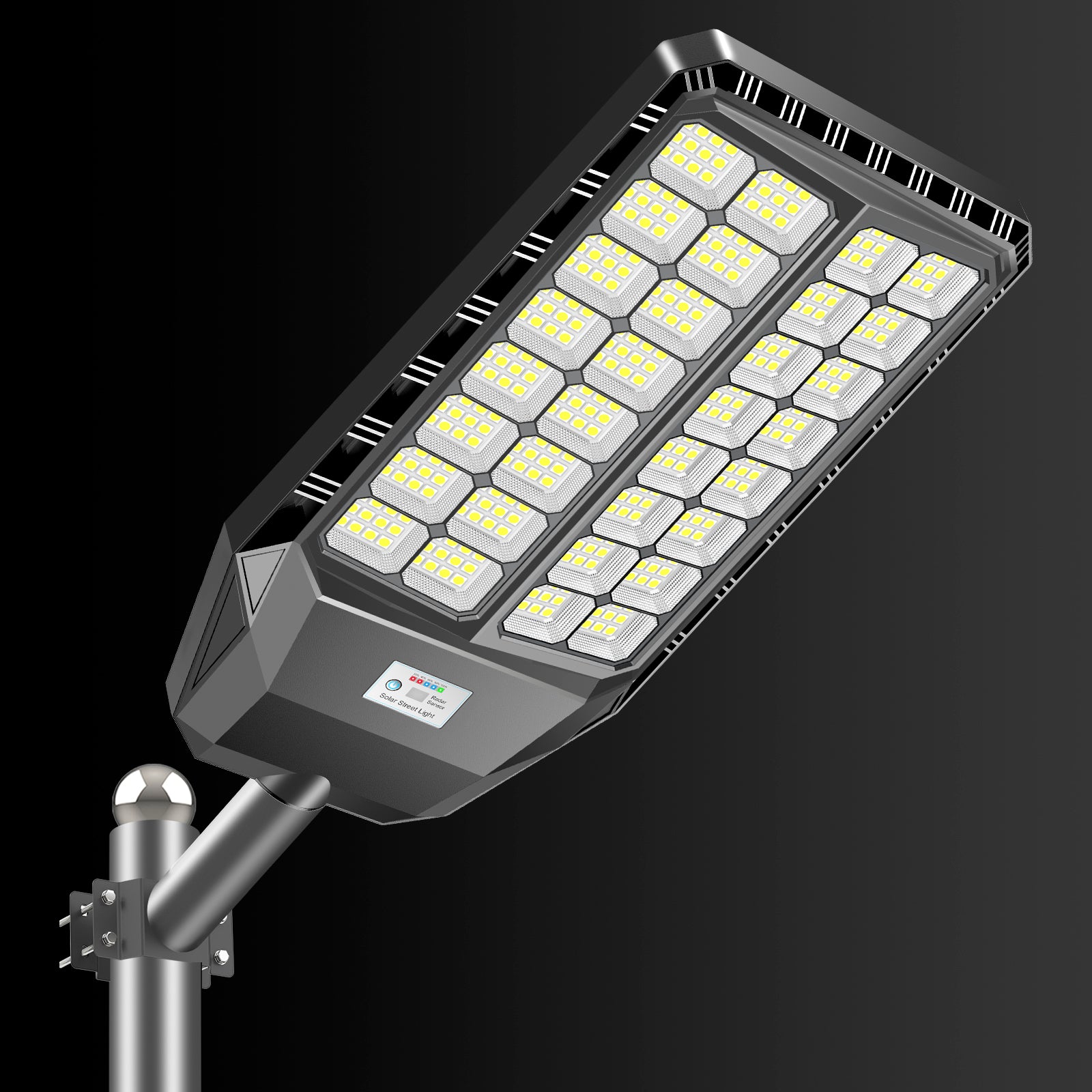







Nobody Talks About This When You Buy a Solar Street Light
You read the spec sheet. You check the lumens, the wattage, the IP rating. Maybe you even look at the warranty. But there's one number that quietly determines how long your solar street light actually works — and most listings bury it in fine print or skip it entirely.
That number is cycle life.
Every rechargeable battery has one. It's the number of times the battery can fully charge and discharge before its capacity drops below a usable threshold — typically 80% of original capacity. After that point, your light starts turning off earlier, running dimmer, and eventually failing to make it through the night.
For solar street lights, which charge and discharge once every single day, cycle life translates directly into years of service. And the difference between a 500-cycle battery and a 3,000-cycle battery isn't a minor spec detail — it's the difference between replacing your light every 18 months or every 8 years.
Let's break this down properly.
What Is a Battery Cycle, Exactly?
A cycle is one complete charge-and-discharge sequence. For a solar street light, that's straightforward: the sun charges the battery during the day, and the light draws it down at night. One day = one cycle.
But here's where it gets nuanced. A "cycle" doesn't have to be 100% to 0%. Partial cycles count too, just proportionally. If your battery goes from 100% to 50% and back to 100%, that's half a cycle. If it goes from 100% to 80% (because it was a cloudy day and the light ran in dim mode), that's a shallow cycle — and shallow cycles are much gentler on battery chemistry than deep ones.
This is why smart dimming modes aren't just about saving energy. They're about extending battery life by keeping discharge depth shallow on most nights.

The Three Battery Chemistries and Their Cycle Lives
Not all solar street light batteries age the same way. The chemistry inside the pack determines almost everything about longevity.
LiFePO4 (Lithium Iron Phosphate) — The Long-Haul Choice
This is what you'll find in quality solar street lights, including our entire lineup. LiFePO4 batteries are rated for 2,000 to 3,000 cycles at 80% depth of discharge. At one cycle per day, that's 5.5 to 8+ years of daily use before capacity drops to 80%.
What makes LiFePO4 special isn't just the cycle count — it's the stability. These batteries don't degrade sharply. They lose capacity gradually and predictably. A 3,000-cycle LiFePO4 battery at cycle 2,500 still has around 85% of its original capacity. Compare that to other chemistries that fall off a cliff after their rated cycles.
LiFePO4 also handles temperature extremes better than standard lithium-ion. It won't swell or vent in summer heat, and it retains more capacity in winter cold. For outdoor solar applications in the US — where a light might see 110°F in Phoenix and 0°F in Minneapolis — this thermal stability matters enormously.
Standard Lithium-Ion (NMC/NCA) — Higher Energy, Shorter Life
Some solar street lights use standard lithium-ion chemistry, often in 6V configurations. These typically offer 500 to 1,000 cycles at 80% DoD — roughly 1.5 to 3 years of daily use. Energy density is higher (more watt-hours per kilogram), which is why you see larger capacity packs like 6V 48AH in this format.
The tradeoff: they degrade faster, especially in heat. A lithium-ion pack in a black solar housing sitting in direct Arizona sun can see internal temperatures that accelerate aging significantly.
Lead-Acid — Avoid for Permanent Installations
Lead-acid batteries are rated for 200 to 500 cycles — less than two years of daily use under ideal conditions. They're heavy, they don't like cold, and they degrade fast when discharged deeply. If a solar street light is suspiciously cheap (under $30), it's almost certainly lead-acid inside. Fine for occasional use, not for a light you're counting on every night.

Real-World Cycle Life: What the Numbers Mean for Your Installation
Let's translate cycle ratings into actual years for each product in our lineup.
Hykoont BC006 60W Solar Street Light — $55 to $269
Battery: 3.2V 6AH LiFePO4 | Charge time: 6–8h | Runtime: 16–24h
The BC006 uses a LiFePO4 pack rated for 2,000+ cycles. At one cycle per day, that's 5.5+ years before capacity drops to 80%. For a residential driveway or pathway light, this is more than adequate — most homeowners replace or upgrade lights for aesthetic reasons long before the battery gives out.
The 6AH capacity is modest, which actually works in its favor for longevity: the light's smart dimming mode means it rarely deep-discharges the battery. Shallow cycles extend real-world life well beyond the rated minimum.
Hykoont TW016 160W Solar Street Light — $79.99
Battery: 6V 20AH | Charge time: 5–6h | Runtime: 15–24h
The TW016 is our entry-level high-output option. At $79.99 for a 160W light, it's a strong value play for small parking lots or commercial driveways. The 6V 20AH battery provides solid reserve capacity, and the 2-year warranty reflects the expected service window for this tier.
Practical lifespan: plan for 3–5 years of reliable service, with gradual runtime reduction after that. For a light at this price point, that's an excellent cost-per-year of illumination.
Hykoont BC020C 150W Solar Street Light — $79 to $159
Battery: 3.2V 20AH LiFePO4 | Charge time: 6–8h | Runtime: 18–24h
The BC020C steps up to a larger LiFePO4 pack. With 20AH at 3.2V, it stores about 64Wh — enough to run the 150W light in smart mode for a full night with reserve to spare. LiFePO4 chemistry puts the cycle life at 2,000–3,000 cycles, or 5.5 to 8+ years of daily use.
This is a particularly good choice for cloudy-climate installations (Pacific Northwest, Great Lakes region) where the battery gets partial charges frequently. LiFePO4 handles partial-state-of-charge cycling much better than lithium-ion.
Hykoont BC024 180W Solar Street Light — $159 to $289
Battery: 3.2V 25AH LiFePO4 | Charge time: 6–8h | Runtime: 18–36h
The BC024 is our most popular commercial-grade option. The 25AH LiFePO4 battery is the largest in our 3.2V lineup, giving it the deepest reserve and the most resilience against consecutive cloudy days. Rated cycle life: 2,000–3,000 cycles, or 5.5 to 8+ years.
The extended low-power runtime of up to 36 hours means this light almost never deep-discharges its battery under normal conditions — which pushes real-world cycle life toward the upper end of the range. For a parking lot or commercial property that needs reliable lighting year-round, this is the sweet spot of capacity, longevity, and price.
Hykoont TW024 240W Solar Street Light — $99 to $509
Battery: 6V 48AH | Charge time: 5–8h | Runtime: 12–30h
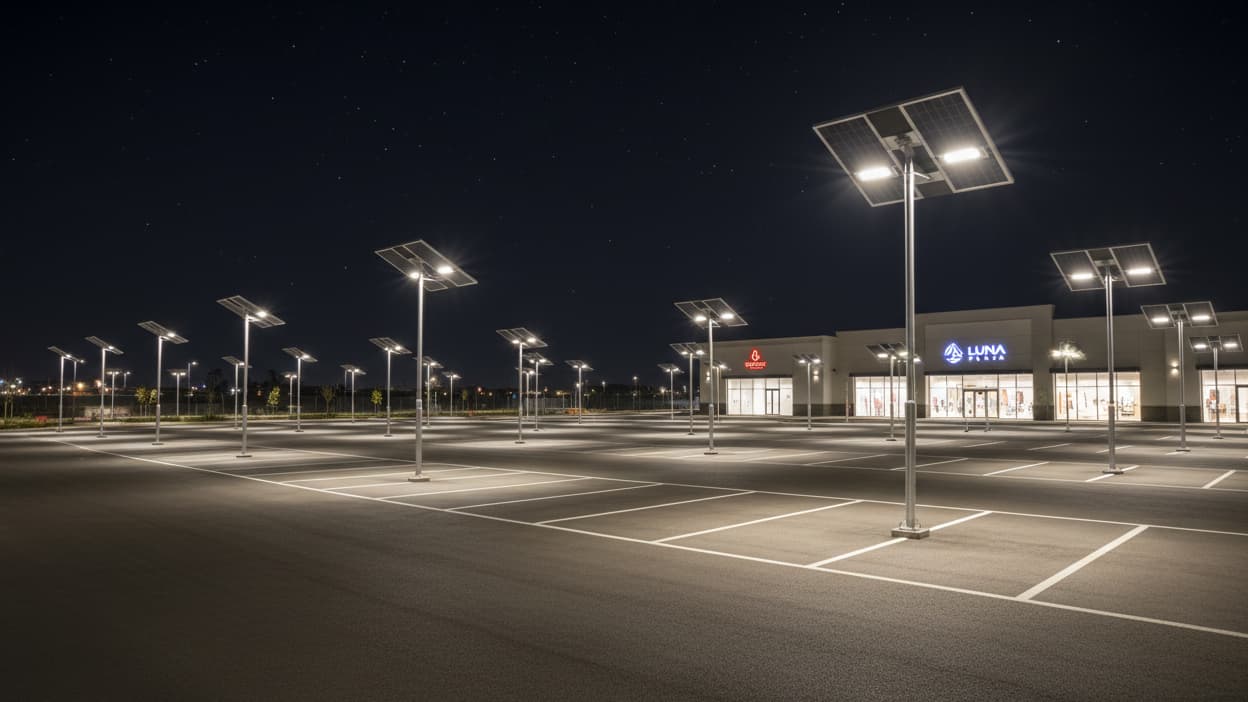
The TW024 carries the largest battery in our lineup — 6V 48AH, storing approximately 288Wh. This is a high-output light designed for wide-area coverage: 33,600 lumens across a large parking lot, warehouse yard, or rural road.
The 6V lithium-ion pack is rated for 1,000–2,000 cycles under normal conditions, translating to 3 to 5+ years of daily use. The large capacity means the battery rarely gets deeply discharged, which extends practical life beyond the rated minimum. Three-year warranty included.
Hykoont TW040 400W Solar Street Light — $179 to $339
Battery: 6V 48AH | Charge time: 5–8h | Runtime: 12–30h
The TW040 is our flagship — 56,000 lumens, 400W, same 6V 48AH battery as the TW024 but pushing significantly more output. At this wattage, the battery works harder on full-brightness nights, which means discharge depth is higher than on lower-wattage models.
For industrial applications (warehouse yards, large commercial properties, rural intersections) where maximum output is non-negotiable, the TW040 delivers. Expect 3 to 5 years of reliable service with the 3-year warranty covering the critical early period.

The Depth of Discharge Factor: Why Your Light's Smart Mode Matters More Than You Think
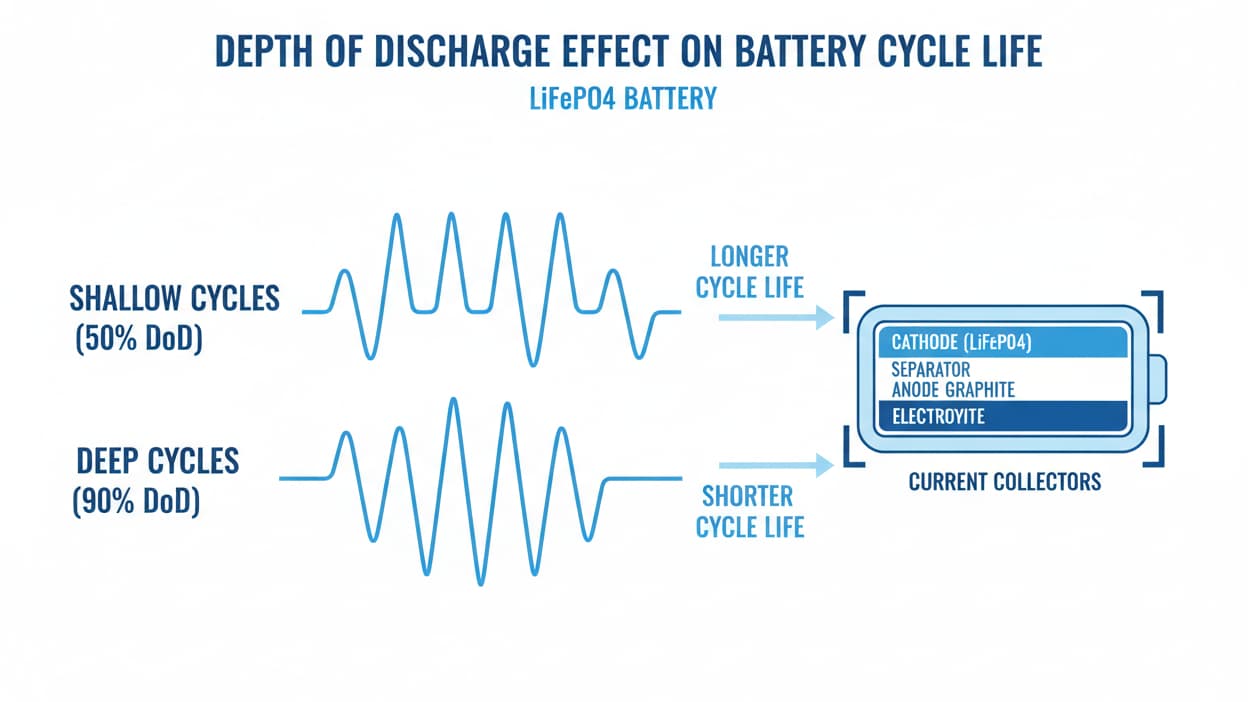
Cycle life ratings assume a specific depth of discharge (DoD) — usually 80%. But here's the thing: the relationship between DoD and cycle life isn't linear. It's exponential.
A LiFePO4 battery discharged to 80% DoD every night might last 2,000 cycles. The same battery discharged to only 50% DoD could last 4,000+ cycles. Discharged to 100% DoD every night? Maybe 1,200 cycles.
This is why the motion-sensing and timer modes on every Hykoont solar street light aren't just energy-saving features — they're battery life extension features. When the light dims to 30% brightness during low-traffic hours, it's drawing the battery down much more slowly. A night that would have been a 90% discharge at full power becomes a 40% discharge in smart mode.
In practical terms: a light that runs in smart dimming mode will outlast an identical light running at full power all night by 50–100% in battery cycle life.

Temperature's Effect on Cycle Life: The Climate Factor
Battery chemistry doesn't exist in a vacuum. Temperature is the second biggest factor in real-world cycle life, after depth of discharge.
Heat Accelerates Aging
Every 15°F (8°C) increase in average operating temperature roughly halves battery cycle life. A LiFePO4 battery rated for 2,000 cycles at 77°F (25°C) might only deliver 1,200 cycles if it regularly operates at 110°F (43°C) — which is entirely possible for a solar light housing in Phoenix or Las Vegas in July.
Mitigation: choose lights with well-ventilated housings and avoid mounting in locations that trap heat (enclosed alcoves, south-facing walls with no airflow). LiFePO4 handles heat better than standard lithium-ion, but it's not immune.
Cold Reduces Capacity (But Not Cycle Life)
Cold weather temporarily reduces battery capacity — a LiFePO4 pack might deliver only 80% of its rated capacity at 14°F (-10°C). But cold doesn't accelerate aging the way heat does. A battery in Minnesota will actually last longer in terms of cycle count than the same battery in Arizona, assuming it's not being deeply discharged to compensate for reduced capacity.
If you're in a cold climate, size your battery with a 15–20% buffer to account for winter capacity reduction. The BC024's 25AH pack or the TW024's 48AH pack give you that buffer built in.

Signs Your Solar Street Light Battery Is Aging
Batteries don't fail suddenly — they fade gradually. Here's what to watch for:
- Shorter runtime: The light turns off 1–2 hours earlier than it used to, even after a full sunny day of charging.
- Dimmer output in the second half of the night: The battery voltage drops faster under load as capacity decreases.
- Slower recovery after cloudy days: A fresh battery bounces back after 2–3 cloudy days. An aging battery may take a full week of sun to recover.
- Light doesn't reach full brightness: Even with motion triggered, the light seems less bright than when new. This can indicate the battery can't sustain the peak current draw.
If you notice these symptoms within the warranty period (3 years for most Hykoont models), contact us — battery performance issues are covered.
How to Maximize Your Solar Street Light Battery's Cycle Life
You can't stop a battery from aging, but you can slow it down significantly with a few simple practices.
1. Install with Unobstructed Southern Exposure
In the Northern Hemisphere, solar panels should face south for maximum daily charging. A panel that gets 6 hours of direct sun charges the battery fully and keeps discharge depth shallow. A panel in partial shade might only get 3 hours of effective charging, forcing the battery to deep-discharge every night — cutting cycle life significantly.
2. Clean the Solar Panel Every 3–6 Months
Dust, pollen, bird droppings, and grime reduce panel efficiency. A panel covered in a thin film of dust can lose 15–25% of its charging output. That means the battery gets a partial charge every day, which over time means deeper nightly discharges and faster aging.
A quick wipe with a damp cloth twice a year costs nothing and can add a year or more to battery life.
3. Use Smart Dimming Mode as Your Default
All Hykoont solar street lights support time-based dimming and motion-triggered full brightness. Set the light to dim to 30–50% during low-traffic hours (say, midnight to 5 AM) and trigger full brightness on motion. This alone can reduce average nightly discharge depth from 80% to 40–50%, potentially doubling battery cycle life.
4. Avoid Locations That Trap Heat
Mounting a solar light on a south-facing wall with no airflow, or inside a metal enclosure, can raise operating temperatures by 20–30°F above ambient. Over years of operation, this heat exposure significantly accelerates battery aging. Choose mounting locations with natural airflow around the housing.
5. Don't Run at Maximum Wattage Unless You Need To
If you have a 400W TW040 lighting a residential driveway, you're running the battery hard every night for more output than you actually need. Consider using the remote control to set a lower power mode for your actual use case. The battery will thank you with extra years of service.

When to Replace vs. When to Repair
At some point, every solar street light battery reaches end of life. Here's how to think about the replace-vs-repair decision:
Replace the battery if: The light is otherwise in good condition (housing intact, LED still bright, solar panel clean and undamaged) but runtime has dropped significantly. A battery replacement can restore full performance at a fraction of the cost of a new light.
Replace the whole light if: The LED output has degraded (LEDs are rated for 50,000 hours — about 13 years at 10 hours/night), the housing has cracked or lost its IP rating, or the solar panel has delaminated or cracked. At that point, a new light makes more economic sense.
For most quality solar street lights, the battery is the first component to reach end of life. The LED and housing typically outlast the battery by years.
The Real Cost of Battery Cycle Life: A 10-Year Comparison
Let's run the numbers on two hypothetical lights — one with a 500-cycle lead-acid battery and one with a 2,500-cycle LiFePO4 battery — over 10 years.
- Lead-acid light at $40: Battery fails after ~18 months. Replace the light: $40. Repeat 6–7 times over 10 years. Total cost: $240–$280, plus the hassle of repeated replacements.
- LiFePO4 light (BC006) at $55–$269: Battery lasts 5.5–8 years. One replacement cycle over 10 years at most. Total cost: $110–$538, but with consistent, reliable performance throughout.
The math gets even more favorable for higher-end models. A BC024 at $289 that runs reliably for 7+ years costs about $41/year. A cheap light that needs replacing every 18 months at $40 costs $32/year — but with constant maintenance headaches and inconsistent performance.
For commercial installations where lighting reliability affects safety and security, the LiFePO4 premium pays for itself quickly.
Product Summary: Cycle Life at a Glance
- BC006 60W ($55–$269): 3.2V 6AH LiFePO4 — 2,000–3,000 cycles — 5.5–8+ years daily use
- TW016 160W ($79.99): 6V 20AH — 3–5 years daily use — 2-year warranty
- BC020C 150W ($79–$159): 3.2V 20AH LiFePO4 — 2,000–3,000 cycles — 5.5–8+ years daily use
- BC024 180W ($159–$289): 3.2V 25AH LiFePO4 — 2,000–3,000 cycles — 5.5–8+ years daily use
- TW024 240W ($99–$509): 6V 48AH — 1,000–2,000 cycles — 3–5+ years daily use
- TW040 400W ($179–$339): 6V 48AH — 1,000–2,000 cycles — 3–5+ years daily use
Frequently Asked Questions
Q: How many cycles does a LiFePO4 solar street light battery last?
LiFePO4 batteries used in quality solar street lights are typically rated for 2,000 to 3,000 cycles at 80% depth of discharge. At one charge-discharge cycle per day, that translates to 5.5 to 8+ years of daily use before capacity drops to around 80% of original.
Q: What happens to a solar street light battery after it reaches its cycle limit?
The battery doesn't suddenly stop working — it gradually loses capacity. After 2,000–3,000 cycles, a LiFePO4 battery typically retains about 80% of its original capacity. The light will still work, but runtime will be shorter. You'll notice it turning off earlier or running dimmer in the second half of the night.
Q: Does cold weather reduce solar street light battery life?
Cold weather temporarily reduces battery capacity (by 10–20% at very low temperatures) but doesn't significantly accelerate aging. Heat is the bigger enemy — high operating temperatures accelerate chemical degradation. LiFePO4 handles both extremes better than standard lithium-ion.
Q: How can I extend my solar street light battery life?
The most impactful steps: use smart dimming mode to reduce nightly discharge depth, install with unobstructed southern exposure for full daily charging, clean the solar panel every 3–6 months, and avoid mounting in locations that trap heat. These practices can extend real-world battery life by 30–50% beyond the rated minimum.
Q: Is it worth replacing the battery in a solar street light, or should I buy a new one?
If the light's housing, LED, and solar panel are in good condition, replacing the battery is usually the better value. The LED in a quality solar street light is rated for 50,000 hours — about 13 years at 10 hours/night — so it typically outlasts the battery significantly. Check with the manufacturer for replacement battery availability.
Q: Why does my solar street light stop working after a few cloudy days?
This usually indicates the battery capacity is insufficient for your climate's typical cloudy-day stretches, or the battery has aged and lost capacity. If the light is relatively new, consider upgrading to a model with a larger battery (like the BC024 with 25AH or TW024 with 48AH). If the light is several years old, battery replacement may restore performance.
Q: What's the difference between battery cycle life and battery calendar life?
Cycle life is how many charge-discharge cycles a battery can handle before significant degradation. Calendar life is how long a battery lasts based on time alone, regardless of use — typically 5–10 years for LiFePO4. For solar street lights used daily, cycle life is usually the limiting factor, not calendar life.
Q: Do solar street lights with larger batteries last longer?
Not necessarily in terms of cycle count — but larger batteries tend to experience shallower discharge cycles, which extends real-world life. A 48AH battery powering a 240W light discharges less deeply each night than a 6AH battery powering a 60W light at the same relative output level. Shallow cycles are gentler on battery chemistry.
Q: How do I know what battery chemistry is in my solar street light?
Check the product spec sheet or listing. LiFePO4 batteries are typically listed as "3.2V" systems. Standard lithium-ion packs are often listed as "3.7V" (per cell) or "6V" systems. Lead-acid will usually be listed explicitly or implied by a very low price point. When in doubt, contact the manufacturer.
Q: Does the 3-year warranty cover battery degradation?
Hykoont's 3-year warranty covers manufacturing defects, including battery performance issues that fall outside normal degradation curves. Normal capacity loss over time (gradual reduction after thousands of cycles) is expected behavior and not covered. Premature failure — a battery losing 50% capacity in year one, for example — would be covered. Always document performance issues with photos or video when filing a warranty claim.

Leave a comment
This site is protected by hCaptcha and the hCaptcha Privacy Policy and Terms of Service apply.