








Let's Be Honest — Battery Specs Are Confusing
You're shopping for a solar street light. You find a product that says "6V 48AH battery" and another that says "3.2V 25AH." Both claim they'll run all night. One costs $99, the other $289. Which one actually keeps your parking lot lit at 3 AM after two cloudy days in Seattle?
That's the question nobody's answering clearly. Most product pages throw numbers at you without context. This guide is different. We're going to walk through battery capacity the way an electrician would explain it to a homeowner — no jargon walls, no fluff.
By the end, you'll know exactly what to look for, what to ignore, and which light fits your specific situation.
What "Battery Capacity" Actually Means for Solar Street Lights
Battery capacity is measured in amp-hours (AH). Think of it like a gas tank. A 25AH battery holds more energy than a 6AH battery — but just like a truck and a motorcycle can both have "full tanks" and travel very different distances, the wattage of your light determines how fast that tank drains.
Here's the simple math:
- Runtime (hours) = Battery Capacity (AH) × Battery Voltage (V) ÷ Light Wattage (W)
So a 3.2V 25AH battery powering a 180W light gives you roughly 0.44 hours at full power. But wait — that's not how solar street lights work. They use motion-sensing and dimming modes to stretch that runtime dramatically. At 30% power (motion-off mode), that same battery runs the light for nearly 15 hours.
This is why the "working time" spec on a solar light listing (like "18–24 hours") assumes smart power management — not full-blast operation all night.

The Three Battery Chemistries You'll See (And Which One Wins)
Not all solar street light batteries are created equal. Here's what's actually inside most lights on the market:
1. LiFePO4 (Lithium Iron Phosphate) — 3.2V Systems
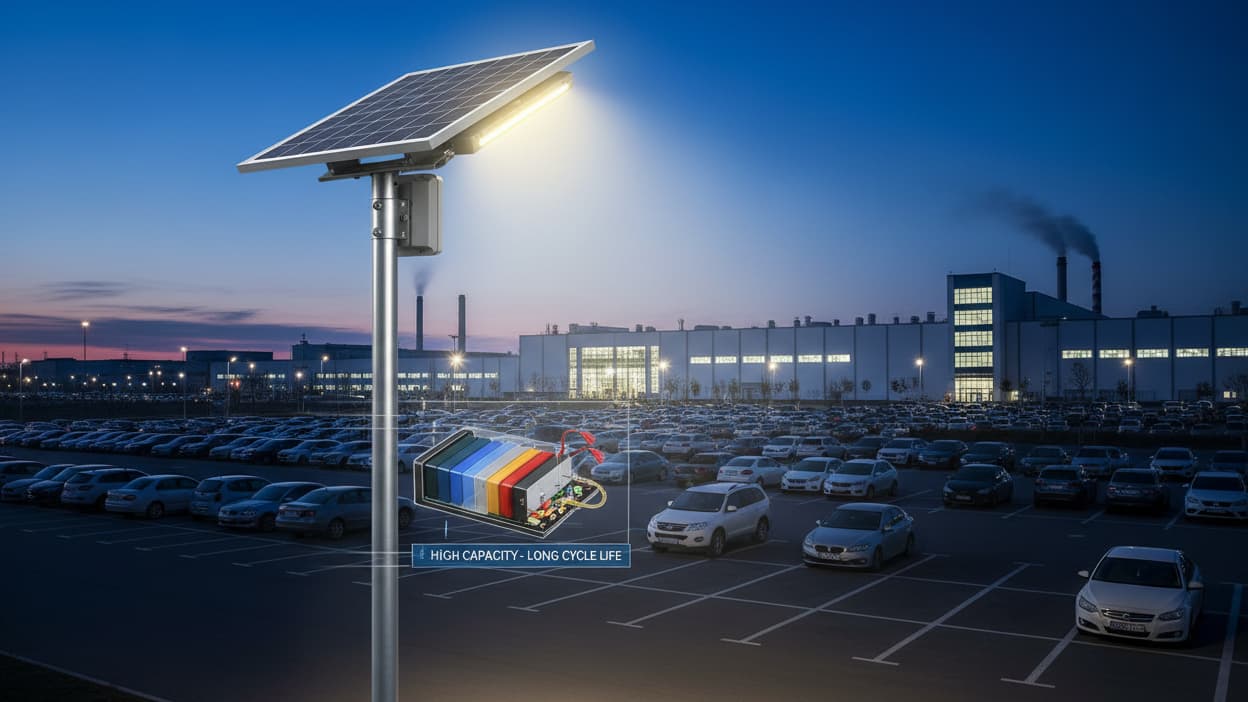
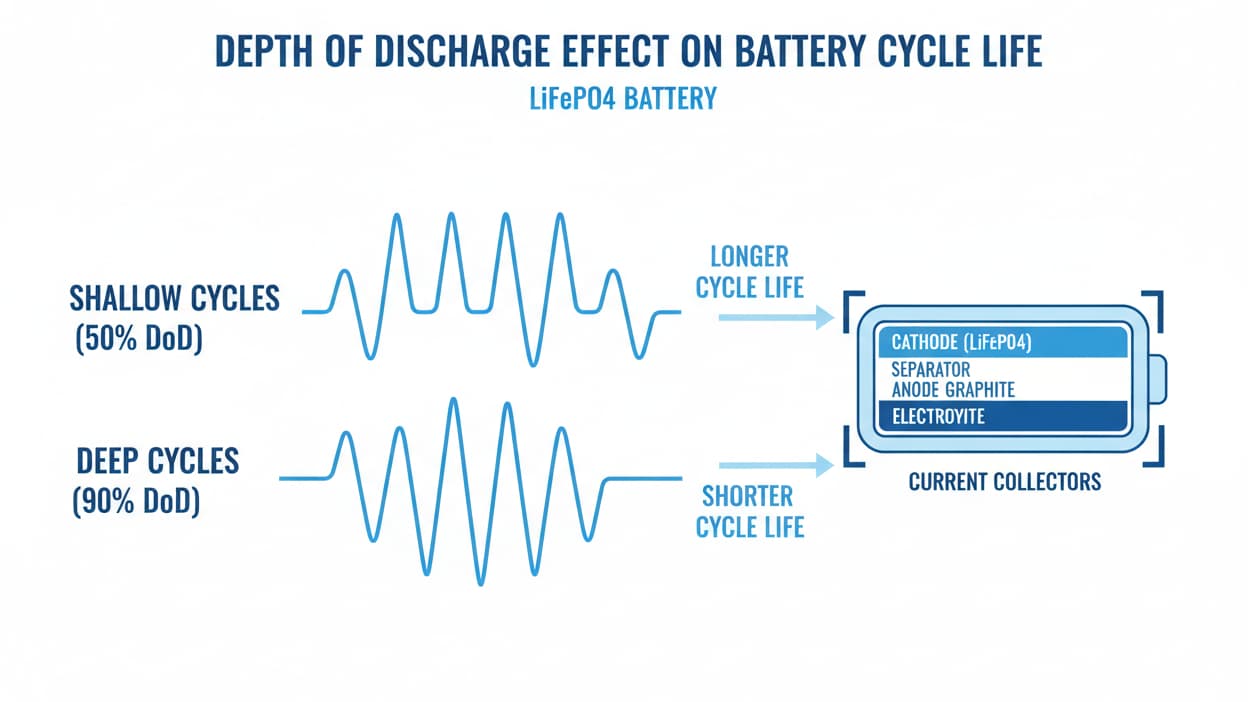
This is the gold standard for outdoor solar lighting. LiFePO4 batteries are thermally stable (they don't catch fire in summer heat), have a lifespan of 2,000–3,000 charge cycles, and perform well in cold weather. When you see "3.2V 25AH" on a spec sheet, that's LiFePO4.
Our BC024 180W Solar Street Light ($159–$289) uses a 3.2V 25AH LiFePO4 battery. It charges in 6–8 hours and runs 18–24 hours on a full charge — up to 36 hours in low-power mode during cloudy stretches.
2. Lithium-Ion (6V Systems)
Higher voltage, higher energy density. A 6V 48AH battery stores significantly more energy than a 3.2V 25AH — roughly 288Wh vs. 80Wh. These are used in higher-wattage lights that need to run longer or at higher brightness.
The Hykoont TW024 Solar Street Light ($99–$509) runs on a 6V 48AH battery, powering 240W of LEDs for 12–30 hours depending on mode. The TW040 ($179–$339) uses the same 6V 48AH pack but pushes up to 400W and 56,000 lumens.
3. Lead-Acid (Avoid These)
Cheap, heavy, and they degrade fast in temperature extremes. If a solar street light under $40 claims "long battery life," it's probably lead-acid. Skip it for any permanent installation.
How Many Backup Days Do You Actually Need?
This is the question that separates a light that works from one that leaves you in the dark after a cloudy weekend.
"Backup days" refers to how many consecutive cloudy days the battery can sustain the light without any solar recharge. Here's a rough guide by US region:
- Southwest (AZ, NM, CA desert): 1–2 backup days is usually enough. You get 5–6 peak sun hours most of the year.
- Southeast / Midwest: 2–3 backup days. Summers are sunny but winters get overcast.
- Pacific Northwest / Northeast: 3–5 backup days. Seattle averages only 2.4 peak sun hours in December. You need a bigger battery relative to your wattage.
A light like the Hykoont BC006 ($55–$269) with its 3.2V 6AH battery and 60W output is well-matched for sunny climates — it charges in 6–8 hours and runs 16–24 hours. In Portland in January? You'd want to step up to the BC020C 150W ($79–$159) with its 3.2V 20AH battery for more reserve capacity.

Wattage vs. Battery: Finding the Right Ratio
Here's a practical framework. For every watt of LED output, you want roughly 0.1–0.15 AH of battery capacity at 3.2V (or 0.05–0.08 AH at 6V) to get through a full night with 2 backup days built in.
Let's check our lineup against this benchmark:
| Model | Wattage | Battery | Stored Energy | Claimed Runtime | Price |
|---|---|---|---|---|---|
| BC006 | 60W | 3.2V 6AH | ~19Wh | 16–24h | $55–$269 |
| TW016 | 160W | 6V 20AH | ~120Wh | 15–24h | $79.99 |
| BC020C | 150W | 3.2V 20AH | ~64Wh | 18–24h | $79–$159 |
| BC024 | 180W | 3.2V 25AH | ~80Wh | 18–36h | $159–$289 |
| TW024 | 240W | 6V 48AH | ~288Wh | 12–30h | $99–$509 |
| TW040 | 400W | 6V 48AH | ~288Wh | 12–30h | $179–$339 |
Note: Runtime figures assume smart dimming/motion modes, not full-power operation all night.
What the "Working Time" Spec Really Tells You
When a product says "working time: 12–30 hours," that range isn't vague marketing. It reflects two real operating modes:
- 12 hours: Full brightness, motion detection active, light stays at 100% all night. This is your worst-case scenario for battery drain — useful for high-traffic commercial areas.
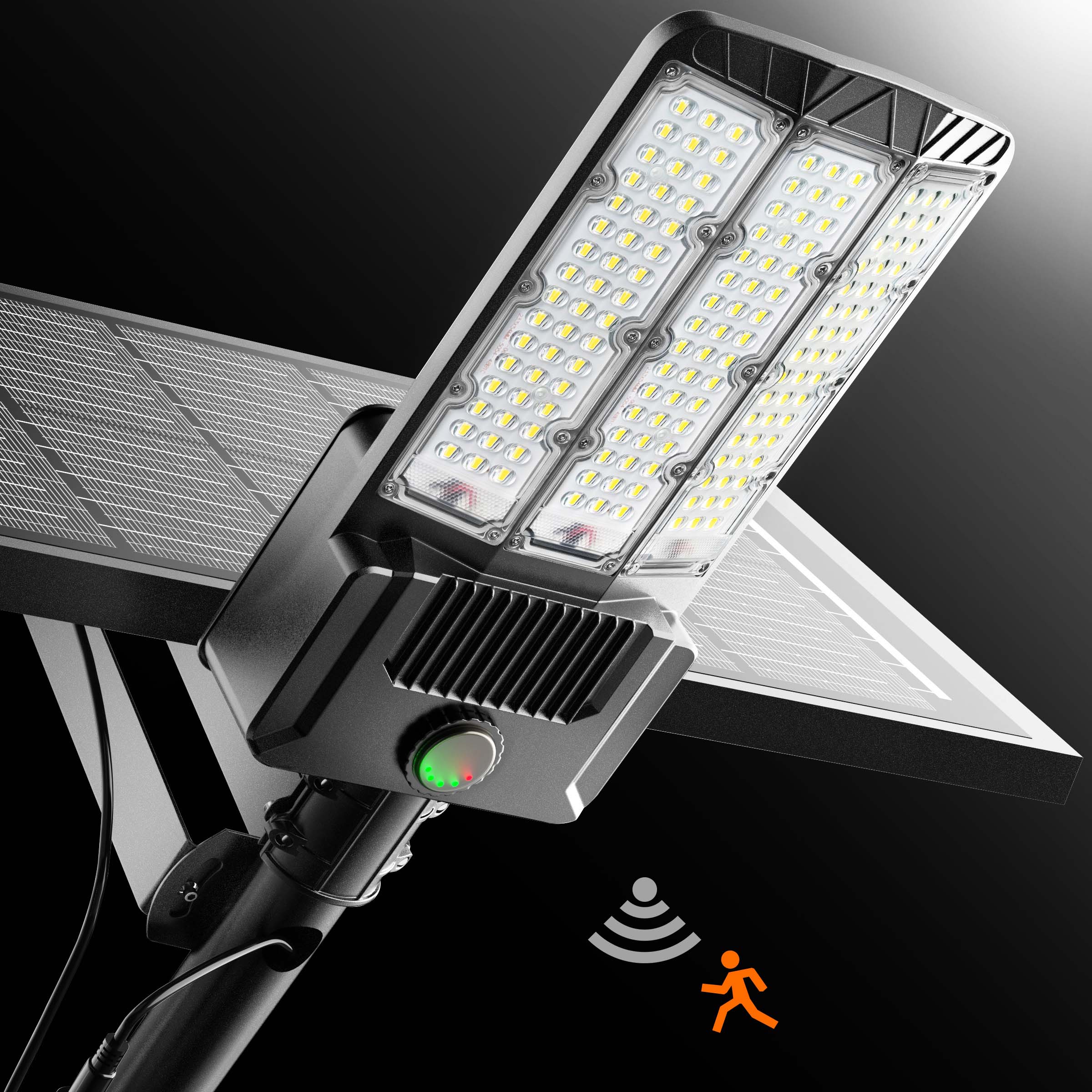
- 30 hours: Dim mode (typically 30–50% brightness) when no motion is detected, full brightness triggered by movement. This is the default smart mode and what most residential and light commercial users actually experience.
For a driveway or residential street, the 30-hour figure is more realistic. For a busy parking lot or loading dock that sees foot traffic all night, plan around the 12-hour number.

Charge Time: Why 5–8 Hours Matters More Than You Think
All of our solar street lights charge in 5–8 hours of direct sunlight. That aligns well with the US average of 4–6 peak sun hours in most regions during summer. But here's the catch:
Peak sun hours ≠ total daylight hours. A partly cloudy day in Chicago might give you 3 peak sun hours even though the sun is up for 14 hours. Your battery only gets a partial recharge.
This is why backup capacity matters. A light with a larger battery (like the TW024's 6V 48AH) can absorb two or three partial-charge days and still run through the night. A light with a smaller battery (like the BC006's 3.2V 6AH) needs consistent sun to maintain full runtime.
Practical tip: If you're in a region with frequent overcast days, prioritize battery capacity over raw wattage. A 150W light with a 20AH battery will outperform a 240W light with a 10AH battery in Seattle in November.
Installation Scenarios: Matching Battery Capacity to Your Use Case
Residential Driveway or Pathway (Low Traffic)
Best fit: BC006 60W ($55–$269) or BC020C 150W ($79–$159)
You don't need 400W to light a driveway. The BC006's 7,200 lumens is plenty for a 20–30 foot path, and its 3.2V 6AH battery handles a typical night easily. If you want more coverage or live somewhere cloudier, the BC020C's 20AH battery gives you more cushion without a big price jump.
Parking Lot or Commercial Property (Moderate Traffic)
Best fit: BC024 180W ($159–$289) or TW016 160W ($79.99)
For a small-to-medium parking lot, you want consistent brightness with motion-triggered full power. The BC024's 24,300 lumens covers a wide area, and the 25AH battery handles the variable load well. The TW016 at $79.99 is a strong value play if you're outfitting multiple poles.
Street Lighting, Large Lots, or Industrial Areas (High Traffic)
Best fit: TW024 240W ($99–$509) or TW040 400W ($179–$339)
The TW024 and TW040 both run on 6V 48AH batteries — the largest in our lineup. At 33,600 and 56,000 lumens respectively, these are built for wide-area coverage. The TW040 in particular is overkill for most residential applications but ideal for warehouse yards, large parking structures, or rural road lighting where you need maximum throw.

IP66 Rating: Why It Matters for Battery Longevity
Every light in our lineup carries an IP66 rating. That means dust-tight and protected against powerful water jets — not just rain, but pressure washing. This matters for battery longevity because moisture ingress is the #1 cause of premature battery failure in outdoor solar lights.
Cheap lights rated IP44 or IP54 will let humidity into the battery compartment over time, accelerating degradation. IP66 keeps the internals dry through years of outdoor exposure.

How Long Will the Battery Last Before It Needs Replacing?
LiFePO4 batteries (used in our 3.2V models) typically last 2,000–3,000 charge cycles. At one cycle per day, that's 5–8 years of daily use before capacity drops below 80%. The 6V lithium-ion packs in our TW-series lights have a similar lifespan under normal conditions.
All Hykoont solar street lights carry a 3-year warranty (2 years on the TW016), which covers manufacturing defects including battery performance issues.
To maximize battery life:
- Install in a location with unobstructed southern exposure (in the Northern Hemisphere)
- Clean the solar panel every 3–6 months to maintain charging efficiency
- Avoid installing under tree canopy that blocks midday sun
- Use the built-in timer/dimming modes rather than running at full power all night
Quick Reference: Which Light for Which Battery Need?
- Tightest budget, sunny climate: BC006 at $55 — 3.2V 6AH, 60W, 16–24h runtime
- Best value for most homeowners: TW016 at $79.99 — 6V 20AH, 160W, 15–24h runtime
- Cloudy-climate residential: BC020C at $79–$159 — 3.2V 20AH, 150W, 18–24h runtime
- Small commercial / parking lot: BC024 at $159–$289 — 3.2V 25AH, 180W, 18–36h runtime
- Large area, maximum reserve: TW024 at $99–$509 — 6V 48AH, 240W, 12–30h runtime
- Industrial / maximum output: TW040 at $179–$339 — 6V 48AH, 400W, 12–30h runtime
Frequently Asked Questions
Q: What does AH mean on a solar street light battery?
AH stands for amp-hours — it's a measure of how much charge the battery can store. A higher AH rating means more stored energy and longer potential runtime, but the actual runtime also depends on the light's wattage and operating mode.
Q: Is a 6V 48AH battery better than a 3.2V 25AH battery?
In terms of stored energy, yes — significantly. A 6V 48AH battery stores about 288Wh, while a 3.2V 25AH stores about 80Wh. However, the 3.2V LiFePO4 chemistry is more thermally stable and may last longer in extreme temperatures. The right choice depends on your wattage needs and climate.
Q: How many nights can a solar street light run without sun?
Most quality solar street lights are designed for 2–3 backup days in low-power/dimming mode. Lights with larger batteries (like the TW024 with 6V 48AH) can stretch further. In consistently cloudy climates, prioritize battery capacity over wattage.
Q: Why does my solar street light dim at night even though it was fully charged?
This is normal and intentional. Smart solar street lights use motion-sensing and timer modes to dim when no activity is detected, preserving battery for the full night. Full brightness triggers when motion is sensed. This is how a 180W light can run for 18–36 hours on a single charge.
Q: How long does it take to charge a solar street light battery?
Most Hykoont solar street lights charge in 5–8 hours of direct sunlight. This aligns with average peak sun hours across most of the US. In winter or overcast conditions, charging may be partial — which is why backup battery capacity matters.
Q: Can I replace the battery in a solar street light?
In most cases, yes — though it depends on the model. LiFePO4 and lithium-ion batteries used in quality solar street lights are standard form factors. Check with the manufacturer for replacement part availability. Hykoont offers a 3-year warranty that covers battery performance issues.
Q: What's the difference between 3.2V and 6V solar street light batteries?
3.2V typically indicates LiFePO4 chemistry — safer, more stable in temperature extremes, longer cycle life. 6V systems are usually lithium-ion with higher energy density, better suited for high-wattage lights that need large reserves. Both are reliable; the choice depends on your wattage and climate requirements.
Q: Does cold weather affect solar street light battery performance?
Yes. Lithium batteries lose capacity in cold temperatures — typically 10–20% at 14°F (-10°C). LiFePO4 handles cold better than standard lithium-ion. If you're in Minnesota or Montana, factor in a 15–20% capacity buffer when sizing your battery.
Q: How do I know if my solar street light battery is failing?
Signs include: lights turning off earlier than usual, noticeably dimmer output in the second half of the night, or lights not reaching full brightness even after a sunny day. Most quality lights have a 3-year warranty — contact the manufacturer if you notice these symptoms within the warranty period.
Q: Is a higher-wattage solar street light always better?
Not necessarily. A 400W light with a small battery will underperform a 150W light with a large battery in cloudy conditions. Match your wattage to your actual illumination needs, then choose a battery capacity that provides 2–3 backup days for your climate. Bigger isn't always better — balanced is better.

Leave a comment
This site is protected by hCaptcha and the hCaptcha Privacy Policy and Terms of Service apply.