







You've probably seen the spec sheets. "High-capacity lithium battery." "Long-lasting LiFePO4 cell." "Advanced energy storage." But what does any of that actually mean when you're buying solar street lights for a parking lot, a campus walkway, or a rural roadway?
Here's the honest answer: the battery chemistry inside a solar light determines almost everything — how long it lasts, how it performs in January, whether it's a fire risk, and whether you'll be replacing it in three years or still running strong in twelve.
This guide is for facility managers, procurement teams, and property owners who want to make a smart, long-term decision — not just buy the cheapest fixture and hope for the best.
First, Let's Talk About What a Solar Light Battery Actually Does
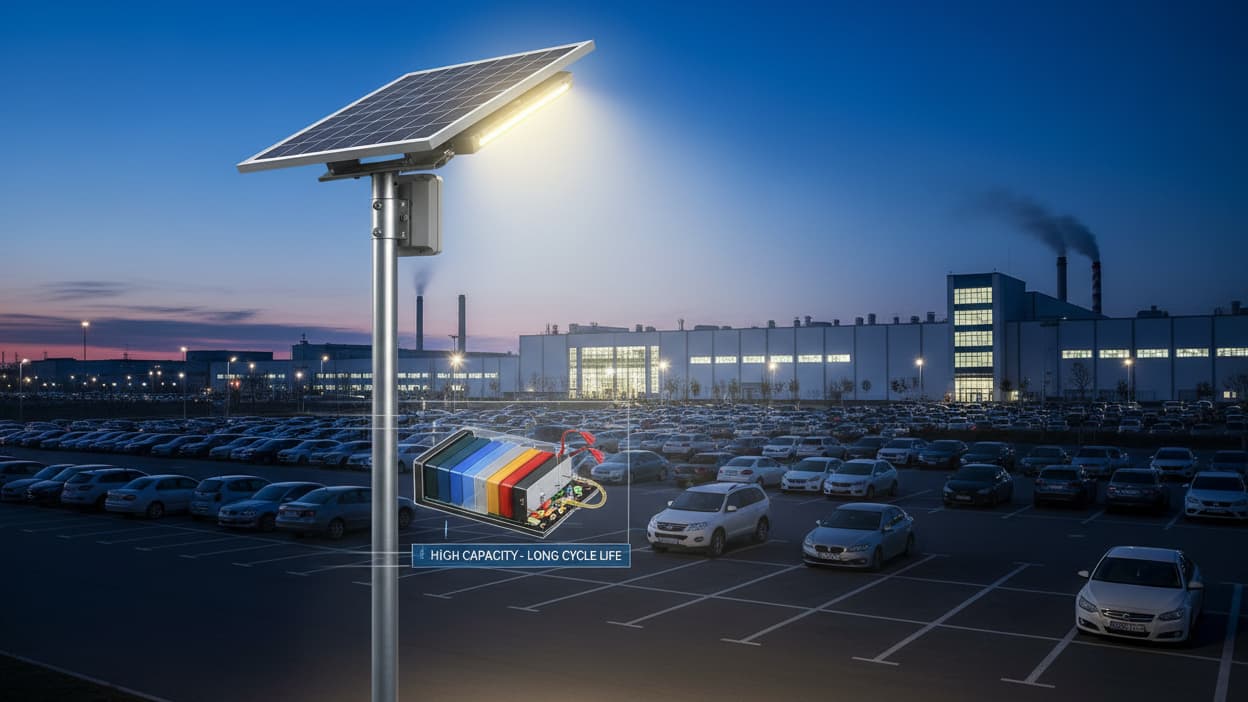
A solar light's battery isn't just a storage tank. It's the operational core of the entire system. During daylight hours, the solar panel charges the battery. After dark, the battery powers the LED. The battery management system (BMS) controls charge rates, discharge depth, temperature compensation, and protection against overcharge or short circuit.
If the battery degrades fast, your light dims early in the night. If it fails in cold weather, your parking lot goes dark in February — exactly when you need it most. If it's a thermal runaway risk, you've got a liability issue on your hands.
So when you're comparing solar lights, the battery chemistry isn't a footnote. It's the whole story.
LiFePO4 vs. Lithium-ion: The Core Difference
Both are lithium-based. Both are rechargeable. But they use different cathode materials, and that changes everything about how they behave in the real world.
Lithium-ion (Li-ion) — Typically NMC or NCA Chemistry
Standard lithium-ion batteries — the kind in your laptop or older power tools — use nickel manganese cobalt (NMC) or nickel cobalt aluminum (NCA) cathodes. They're energy-dense, which means you can pack a lot of capacity into a small, lightweight cell. That's great for consumer electronics where size matters.
For outdoor solar infrastructure, though, the tradeoffs start to show:
- Cycle life: 500–1,000 full charge/discharge cycles before significant capacity loss
- Temperature sensitivity: Performance drops noticeably below 32°F (0°C); capacity can fall 20–30% in cold climates
- Thermal stability: Higher risk of thermal runaway under overcharge, physical damage, or extreme heat
- Lifespan in solar applications: Typically 3–5 years before replacement is needed
LiFePO4 (Lithium Iron Phosphate) — The Commercial-Grade Choice
LiFePO4 uses an iron phosphate cathode. It's less energy-dense than NMC, so the cells are slightly larger and heavier for the same capacity. But for fixed outdoor infrastructure, that's a non-issue. What you gain is substantial:
- Cycle life: 2,000–4,000+ cycles — often 4–8x longer than standard Li-ion
- Temperature performance: Maintains 80–90% capacity down to 14°F (-10°C); better cold-weather resilience
- Thermal stability: Extremely stable chemistry — no thermal runaway risk under normal operating conditions
- Lifespan in solar applications: 8–12 years, often matching or exceeding the LED lifespan
For a commercial solar street light that's going to sit on a pole in a parking lot for the next decade, LiFePO4 isn't a premium upgrade — it's the baseline requirement.

The Numbers That Actually Matter for Commercial Buyers
Cycle Life and Total Cost of Ownership
Let's say you're installing 20 solar street lights across a commercial property. A fixture with a standard Li-ion battery might need battery replacement every 3–4 years. A LiFePO4 unit might go 10+ years without touching the battery.
Battery replacement for a commercial solar fixture typically runs $40–$80 per unit in parts, plus labor. Over a 10-year period:
- Li-ion scenario: 2–3 replacements × 20 units × $60 avg = $2,400–$3,600 in battery costs alone
- LiFePO4 scenario: 0 replacements in the same period = $0
That's before you factor in the labor cost of accessing pole-mounted fixtures, which can run $50–$150 per unit depending on height and location.
Cold Climate Performance
If you're in the northern US — Minnesota, Michigan, Colorado, the Pacific Northwest — cold-weather battery performance isn't a theoretical concern. It's a real operational issue.
Standard Li-ion batteries can lose 20–30% of their effective capacity at temperatures below freezing. That means a light rated for 12 hours of runtime might only deliver 8–9 hours on a cold January night. LiFePO4 cells, by contrast, maintain most of their rated capacity well below freezing, with only modest losses even at 14°F (-10°C).
For parking lots, pathways, and roadways that need consistent illumination through winter, this isn't a minor spec difference — it's the difference between a light that works and one that doesn't.
Safety and Liability
Thermal runaway in lithium batteries — the chain reaction that leads to fire — is a real risk with NMC/NCA chemistry under certain conditions: overcharging, physical damage, manufacturing defects, or extreme heat. It's rare, but it happens, and the consequences can be severe.
LiFePO4 chemistry is inherently more stable. The iron-phosphate bond is stronger and doesn't release oxygen during decomposition, which is what feeds thermal runaway in other lithium chemistries. For fixtures mounted in public spaces — parking structures, school campuses, municipal roadways — that safety margin matters.

What This Looks Like in Real Products
Let's get specific. Here are some of the commercial solar street lights we carry that use LiFePO4 batteries, along with what they're best suited for:
High-Output Commercial Street Lighting

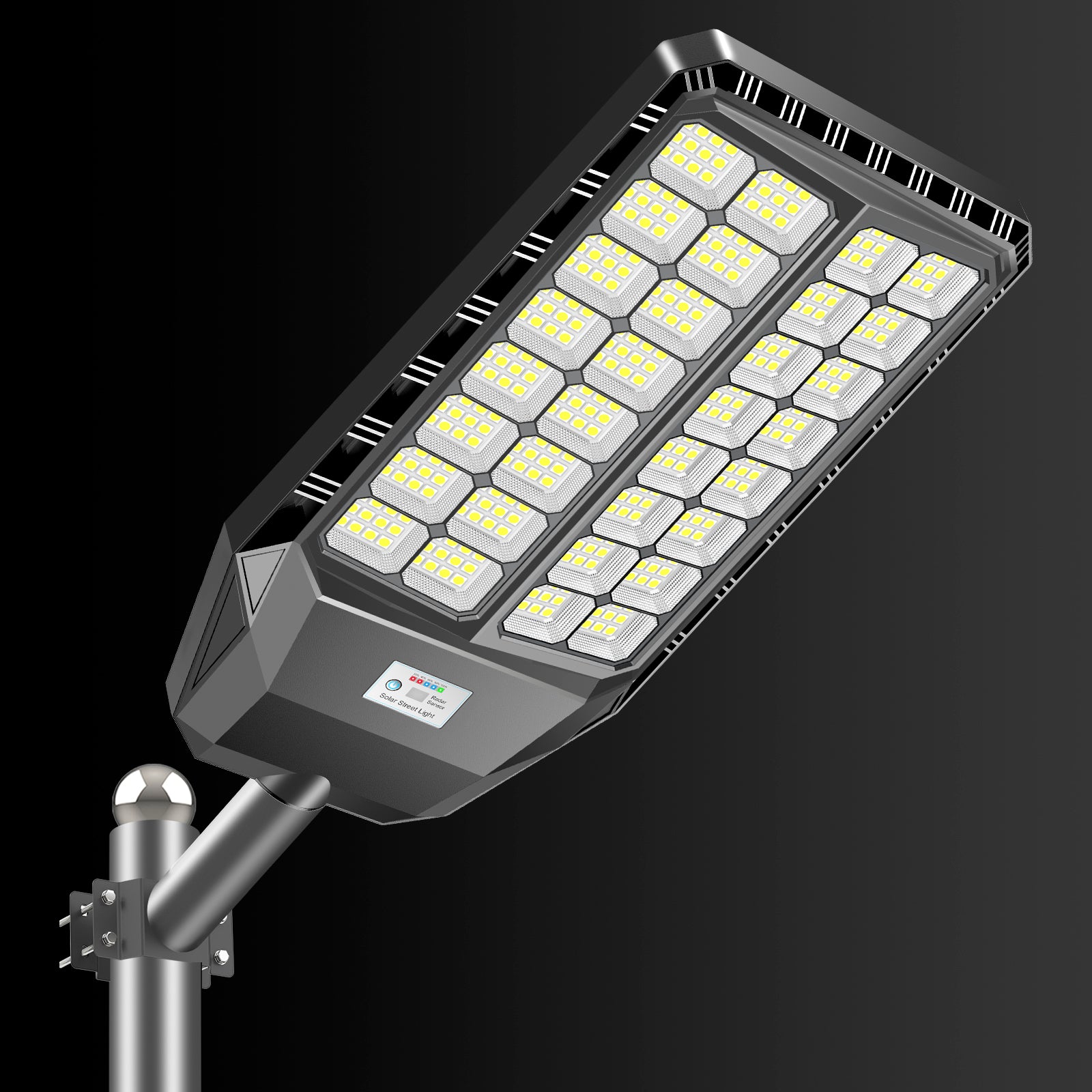
Hykoont TW030 300W Solar Street Light — 42,000 Lumens, 2-Pack — $289.00
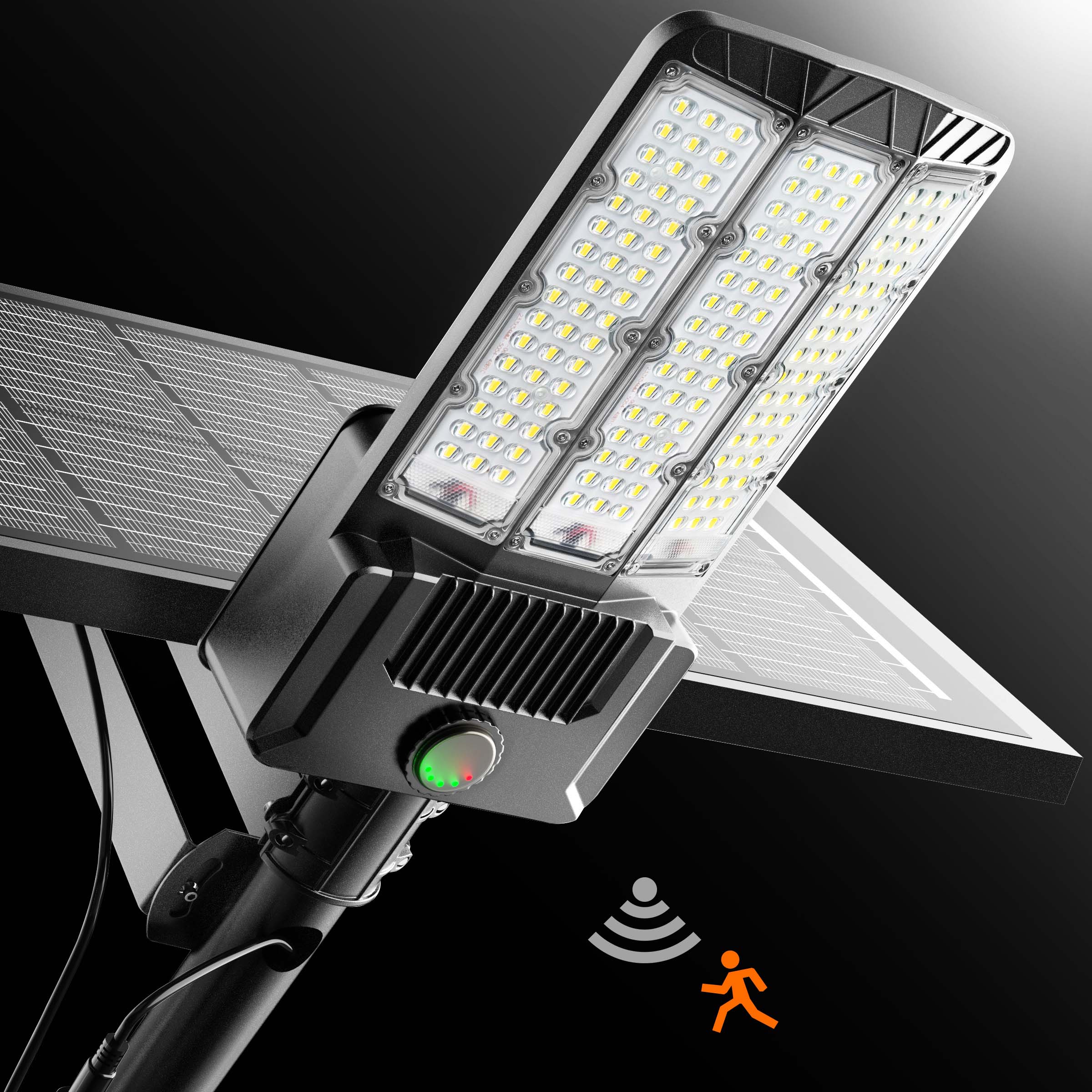
This is the workhorse for large commercial applications: parking lots, roadways, industrial yards. At 42,000 lumens per fixture and a 300W monocrystalline solar panel, it's built for areas that need serious light output. The dusk-to-dawn sensor handles automatic on/off, and the LiFePO4 battery pack is sized for multiple cloudy days of reserve capacity. At $144.50 per fixture in the 2-pack, it's one of the most cost-effective high-output commercial solar options available.
→ Also available as a single unit for $142.00

Mid-Range Commercial: Parking Lots and Campus Pathways

Hykoont BM024 160W Solar Street Light — 21,600 Lumens, 2-Pack — $199.00
A solid mid-range option for campus walkways, residential streets, and smaller parking areas. The BM024 delivers 21,600 lumens from a 160W panel — enough to cover a standard parking bay or 20-foot pathway section. At $99.50 per unit in the 2-pack, it hits a sweet spot between output and cost for medium-scale deployments.
Entry-Level Commercial: Driveways, Pathways, Small Lots

Hykoont SZ300 Commercial Solar Street Light — 400W, 60,000LM — $145.00
Don't let the entry price fool you — the SZ300 is a die-cast aluminum fixture with a monocrystalline solar panel and LiFePO4 battery. At 60,000 lumens and 400W panel capacity, it punches well above its price point. Ideal for property owners who need commercial-grade performance without a commercial-grade budget.
The "But LiFePO4 Costs More" Objection
Yes, fixtures with LiFePO4 batteries typically cost more upfront than comparable units with standard Li-ion cells. The premium varies, but you're often looking at 15–30% more at the point of purchase.
Here's how to think about that:
A $100 solar light with a Li-ion battery that needs replacement in 3 years has a real 10-year cost of $100 + $60 (battery) + $75 (labor) = $235, assuming one replacement cycle. A $130 LiFePO4 fixture that runs for 10 years without battery service has a 10-year cost of $130.
That's not a close call. And that's before you factor in the operational disruption of scheduling maintenance on pole-mounted fixtures, the risk of a battery failure leaving a section of your property dark, or the liability exposure of a thermal event in a public space.
For commercial infrastructure — where you're installing 10, 20, or 50+ fixtures — the math gets even more compelling at scale.
How to Read a Solar Light Spec Sheet (Without Getting Fooled)
Not every manufacturer is upfront about battery chemistry. Here's what to look for:
Green Flags
- Explicitly states "LiFePO4" or "lithium iron phosphate" — not just "lithium battery"
- Specifies battery capacity in Wh (watt-hours), not just mAh (which can be misleading without voltage context)
- Lists cycle life (look for 2,000+ cycles)
- Includes operating temperature range (look for performance data below 32°F)
- Has IP65 or IP66 waterproof rating for the battery compartment
Red Flags
- Just says "lithium battery" with no chemistry specified
- Lists capacity only in mAh without voltage
- No cycle life data
- No operating temperature specs
- Unusually low price for the claimed output (often a sign of undersized or low-quality cells)
Installation Considerations for Commercial Deployments
Pole Height and Spacing
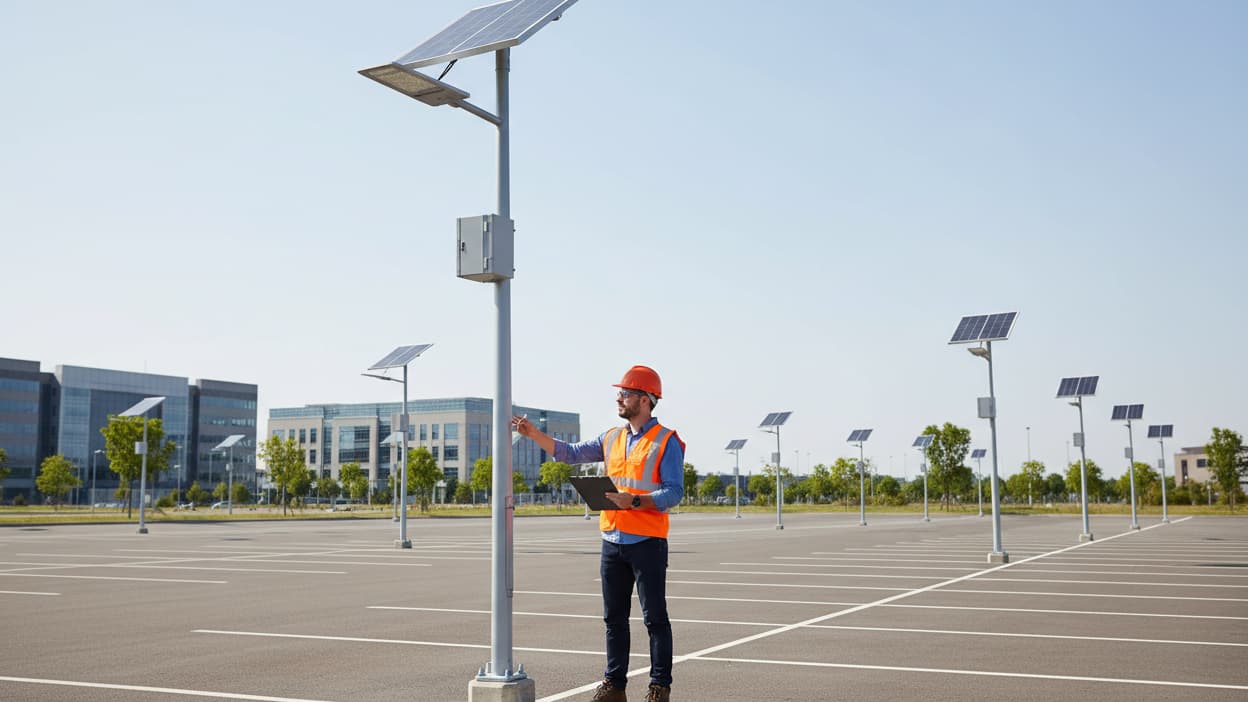
For parking lots, the standard recommendation is pole heights of 15–25 feet with spacing of 60–100 feet between fixtures, depending on lumen output and the required foot-candle level. Most commercial parking lots target 1–5 foot-candles at ground level; security-sensitive areas may require 5–10 foot-candles.
Higher-output fixtures like the TW030 (42,000 lumens) can cover larger spacing intervals, reducing the total number of poles needed — which directly reduces your installation cost.
Panel Orientation
In the continental US, solar panels should face south (or within 15–20° of south) and be tilted at an angle roughly equal to your latitude. For most of the US, that's 30–45°. Many commercial solar street lights have adjustable panel angles — use them.
Cloudy Day Reserve
Look for fixtures that specify "cloudy day reserve" — typically 3–5 days. This tells you how many consecutive overcast days the battery can sustain full-night operation. In the Pacific Northwest or Great Lakes region, this matters more than in Arizona.
Motion Sensing vs. Dusk-to-Dawn
For security-critical areas (parking structures, building perimeters), dusk-to-dawn operation at full brightness is usually preferred. For pathways and low-traffic areas, motion-sensing modes that dim to 20–30% and brighten on detection can significantly extend battery reserve — effectively giving you more runtime per charge cycle.

The Environmental Angle (Since You're Already Going Solar)
LiFePO4 batteries don't contain cobalt — a mineral with significant ethical and environmental concerns in its mining supply chain. NMC and NCA lithium-ion batteries do. If your organization has ESG commitments or sustainability reporting requirements, LiFePO4 is the cleaner choice on that front as well.
LiFePO4 cells are also more recyclable and less hazardous at end of life than cobalt-containing chemistries. For a 10-year infrastructure investment, that matters.
Ready to Spec Your Project?
Whether you're outfitting a single parking lot or planning a multi-site rollout, the right battery chemistry is the foundation of a solar lighting system that actually delivers on its promises. Here are the products we'd recommend starting with:
Our Top Commercial Solar Street Light Picks
🔆 TW030 300W / 42,000LM — 2-Pack — $289.00
Best for: Large parking lots, roadways, industrial sites
🔆 TW030 300W / 42,000LM — Single Unit — $142.00
Best for: Single-pole installations, phased rollouts
🔆 BM024 160W / 21,600LM — 2-Pack — $199.00
Best for: Campus pathways, residential streets, mid-size lots
🔆 SZ300 400W / 60,000LM — $145.00
Best for: Budget-conscious commercial buyers who won't compromise on quality
🔆 BD006 Commercial Solar Street Light — $179.00
Best for: Alloy-body durability, mono solar panel, high-lumen output
→ Browse the full commercial solar lighting catalog
Frequently Asked Questions
1. How do I know if a solar light uses LiFePO4 or standard lithium-ion?
Check the product spec sheet or listing for the specific battery chemistry. "LiFePO4" or "lithium iron phosphate" should be explicitly stated. If the listing just says "lithium battery" without specifying the chemistry, that's often a sign it's standard Li-ion — or the manufacturer doesn't want you to know. All Hykoont commercial fixtures specify battery chemistry in the product details.
2. How long do LiFePO4 batteries last in solar street lights?
In real-world solar applications with daily charge/discharge cycles, LiFePO4 batteries typically last 8–12 years before capacity drops below 80% of original rating. That's 2,000–4,000+ cycles, compared to 500–1,000 cycles for standard Li-ion. Most commercial solar street lights are designed so the battery lifespan matches or exceeds the LED lifespan.
3. Do solar street lights work in cold climates?
Yes — with the right battery. LiFePO4 batteries maintain 80–90% of their rated capacity at temperatures down to 14°F (-10°C). Standard Li-ion batteries can lose 20–30% capacity in the same conditions. If you're in a northern US climate, LiFePO4 is essentially a requirement for reliable winter performance.
4. What's the minimum lumen output for a commercial parking lot?
The Illuminating Engineering Society (IES) recommends a minimum of 1 foot-candle (fc) average maintained illuminance for basic parking lots, with 0.1 fc minimum at any point. Security-sensitive areas typically target 2–5 fc average. A 42,000-lumen fixture like the TW030 can cover approximately 4,000–6,000 sq ft at 1 fc, depending on mounting height and beam pattern.
5. Can I mix solar street lights with different wattages on the same property?
Yes. It's common to use higher-output fixtures (like the TW030 at 42,000 lumens) for main traffic areas and lower-output units for pedestrian pathways or perimeter lighting. Each fixture operates independently, so mixing models doesn't create any electrical compatibility issues.
6. How many cloudy days can a commercial solar street light handle?
Most commercial-grade LiFePO4 solar street lights are designed for 3–5 days of cloudy-day reserve at full operation. This means the battery is sized to power the light through multiple consecutive overcast days without solar recharging. In regions with extended cloudy periods (Pacific Northwest, Great Lakes), look for fixtures that specify 5+ days of reserve.
7. Are solar street lights eligible for federal tax incentives?
Commercial solar installations — including solar-powered lighting — may qualify for the federal Investment Tax Credit (ITC) under Section 48 of the tax code. The current ITC rate for commercial solar is 30% (as of 2024–2025 under the Inflation Reduction Act). Consult your tax advisor to confirm eligibility for your specific installation, as requirements vary by project type and ownership structure.
8. What IP rating should I look for in a commercial solar street light?
For outdoor commercial applications, look for IP65 at minimum — this means the fixture is dust-tight and protected against water jets from any direction. IP66 (protection against powerful water jets) is better for exposed coastal or high-rainfall locations. The battery compartment should carry the same or higher IP rating as the fixture body.
9. How do I calculate how many solar street lights I need for my parking lot?
A rough starting point: divide your total parking lot area (in square feet) by the coverage area per fixture. For a 42,000-lumen fixture mounted at 20 feet, expect coverage of approximately 4,000–5,000 sq ft per pole at 1 fc average. For a 10,000 sq ft lot, you'd need roughly 2–3 fixtures. For precise photometric calculations, request an IES file from the manufacturer and run it through free tools like AGi32 or DIALux.
10. What's the warranty on Hykoont commercial solar street lights?
Hykoont commercial solar street lights come with manufacturer warranty coverage on both the fixture and battery. Check the individual product listing for specific warranty terms, as they vary by model. For commercial procurement, contact us directly for volume pricing and extended warranty options.
Have a project you're speccing out? We're happy to help with fixture selection, quantity estimates, and volume pricing. Reach out to our commercial team — we respond within one business day.

Leave a comment
This site is protected by hCaptcha and the hCaptcha Privacy Policy and Terms of Service apply.