






The Mosquito Problem Nobody Talks About Honestly
You spend $800 on a new patio set. You string up lights, buy a nice outdoor rug, maybe even get a fire pit going. And then the moment you sit down with a plate of food, the mosquitoes show up like they were invited.
Here's what most outdoor living guides won't tell you: there's no single magic solution. Mosquito control on a patio or in a gazebo is a layered problem, and it needs a layered answer. The good news? Once you understand what actually works — and why — you can put together a setup that genuinely keeps the bugs at bay all summer.
This guide is written for people who eat outside regularly, not just on special occasions. If you're hosting a weekly family dinner on the deck, running a backyard BBQ every weekend, or just want to drink your morning coffee in peace, this is for you.
Why Mosquitoes Love Your Patio (And Your Gazebo Even More)
Before you can fix the problem, it helps to understand why patios and gazebos are such mosquito magnets in the first place.
You're the Attraction
Mosquitoes are primarily drawn to carbon dioxide — the CO₂ you exhale with every breath. When you're sitting still at a dinner table, you're essentially a stationary CO₂ beacon. Add body heat and the lactic acid from your skin, and you're basically a mosquito buffet sign.
Gazebos Create Sheltered Microclimates
Mosquitoes hate wind. A gazebo, by design, blocks wind and creates a calm, sheltered space. That's exactly what mosquitoes prefer for flying and feeding. The same feature that makes your gazebo comfortable for you makes it comfortable for them.
Standing Water Nearby
Mosquitoes breed in standing water — and they don't need much. A clogged gutter, a low spot in the lawn that holds water after rain, a forgotten bucket, even a plant saucer. If any of these are within 100 feet of your patio, you're essentially living next to a mosquito nursery.
Warm, Humid Evenings
Mosquitoes are most active at dawn and dusk, and they thrive in warm, humid conditions. Summer evenings on the patio — especially in the South, Midwest, and coastal areas — are peak mosquito hours. This isn't a coincidence; it's biology.

The Layered Defense Strategy: How to Actually Keep Mosquitoes Away
The most effective approach combines multiple methods working together. Think of it like a security system — each layer catches what the others miss.
Layer 1: Eliminate Breeding Sites (The Foundation)
This is the step most people skip because it's not as satisfying as buying a product. But it's the most impactful thing you can do. Walk your property and eliminate every source of standing water you can find:
- Empty and scrub birdbaths weekly (mosquito eggs hatch in 7–10 days)
- Clean gutters so water drains freely
- Fill low spots in the lawn with topsoil
- Store buckets, wheelbarrows, and containers upside down
- Change water in pet bowls daily
- Add a fountain or aerator to decorative ponds — mosquitoes can't lay eggs in moving water
Do this first. Everything else works better when you've cut off the mosquito supply chain at the source.
Layer 2: UV Bug Zappers — Your Primary Defense
A quality UV bug zapper is the workhorse of any serious outdoor mosquito control setup. Here's why they work: UV light at the right wavelength (around 365nm) is irresistible to flying insects. They fly toward it, make contact with the electric grid, and that's the end of that mosquito.
The key word is quality. Cheap zappers use generic bulbs that don't emit the right UV spectrum. They catch moths and beetles but miss a significant portion of the mosquito population. A well-designed triple-tube UV zapper with the correct wavelength is a different product entirely.
For patio and gazebo use specifically, you want a zapper that:
- Can be hung from a beam or pergola (not just staked in the ground)
- Runs automatically at dusk without you having to remember to turn it on
- Is weatherproof enough to handle summer rain
- Doesn't require an extension cord running across your dining area
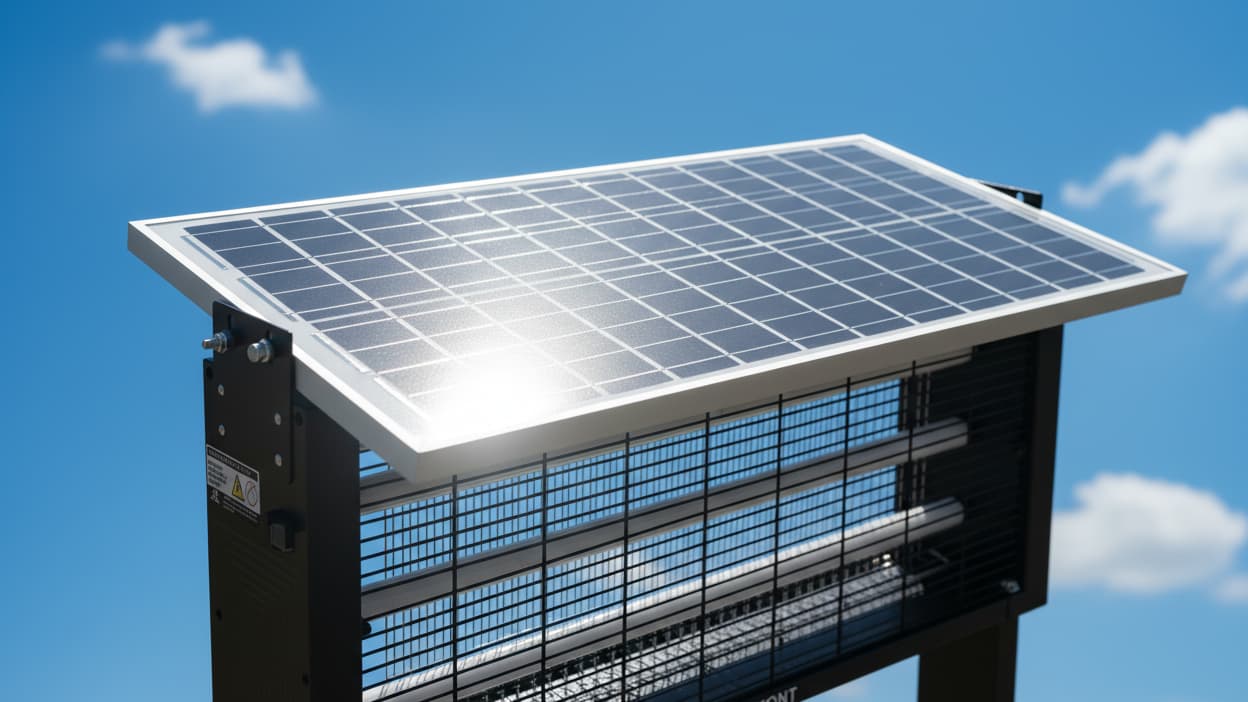
Solar-powered models check all of these boxes. They charge during the day and run all night — no cords, no electricity costs, no manual operation.

Our Top Pick for Patios: Hykoont 19W Solar LED Bug Zapper Standard

Price: $119.00
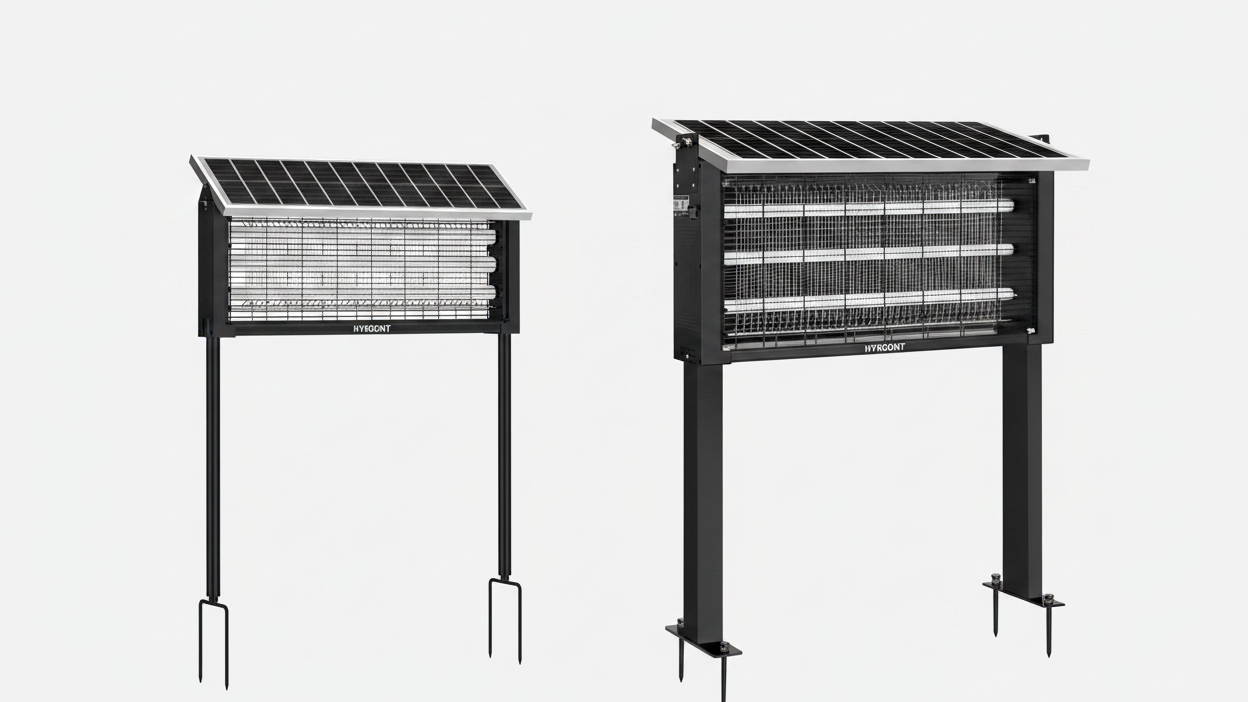
This is the one we'd put on a patio or in a gazebo without hesitation. The 19W solar panel keeps the triple UV tubes running all night after a day of charging, and the dual mounting design — ground stake or hanging hook — means you can position it exactly where it does the most good.
For a gazebo specifically, hang it from the center beam or a corner post at about 6–7 feet high. That puts the UV light at the height where mosquitoes are most active, and it draws them toward the zapper rather than toward you at the table.
The IPX4 weather resistance rating means it handles summer rain without issue. Leave it up all season — it's built for it.
- ✅ Triple UV tubes for maximum mosquito attraction
- ✅ Hanging hook + ground stake — perfect for gazebos and patios
- ✅ 19W solar panel — runs all night on a full day's charge
- ✅ IPX4 weatherproof — stays out all season
- ✅ Dusk-to-dawn automation — zero manual effort
👉 Shop the 19W Patio Bug Zapper — $119.00


For Larger Patios and Open Decks: Hykoont 30W Solar LED Bug Zapper Pro

Price: $219.00
If your outdoor dining area is on a large open deck, a sprawling patio, or you're dealing with a serious mosquito pressure situation (near water, in a humid climate, or in the South), step up to the 30W Pro.
The larger solar panel means faster charging and longer runtime — important if your setup gets partial shade during the day. The triple UV tubes run at higher output than the Standard model, pulling insects from a wider radius. And the dusk-to-dawn sensor means it's always on when you need it, always off when you don't.
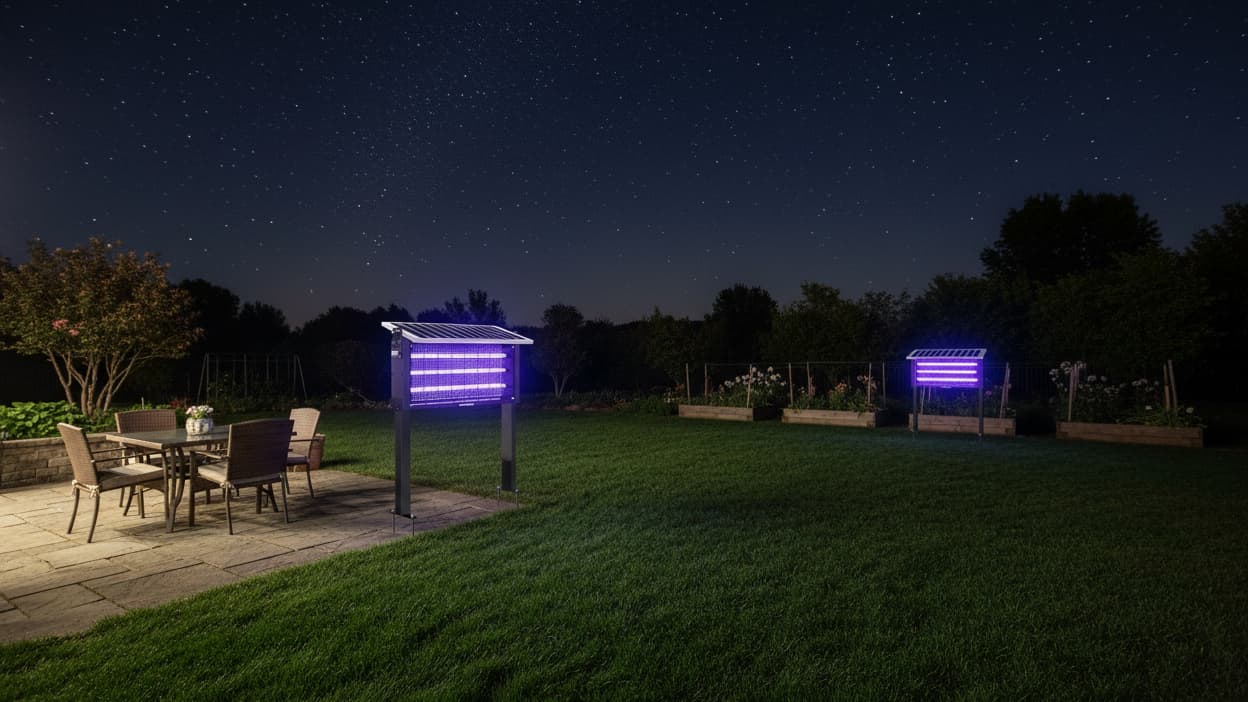
For a large patio setup, stake it at the far edge of the dining area — you want it attracting bugs away from the table, not right next to where people are sitting. Pair it with the 19W Standard hung inside a gazebo or pergola for complete coverage of both zones.
- ✅ 30W solar panel — faster charge, longer runtime
- ✅ Triple UV tubes at higher output — wider coverage radius
- ✅ Dusk-to-dawn sensor — fully automatic
- ✅ Heavy-duty weatherproof construction
- ✅ Ideal for large decks, open patios, and high-pressure mosquito environments
👉 Shop the 30W Pro Bug Zapper — $219.00

Layer 3: Perimeter Lighting That Doesn't Attract Bugs
Here's something most people don't think about: standard white porch lights and string lights actually attract insects. The broad-spectrum white light draws moths, gnats, and yes — mosquitoes — right to your dining area.
The fix is to use warm-toned or amber lighting for your ambient patio lights (bugs are far less attracted to wavelengths above 550nm), and let your UV bug zapper handle the insect attraction duty from a distance.
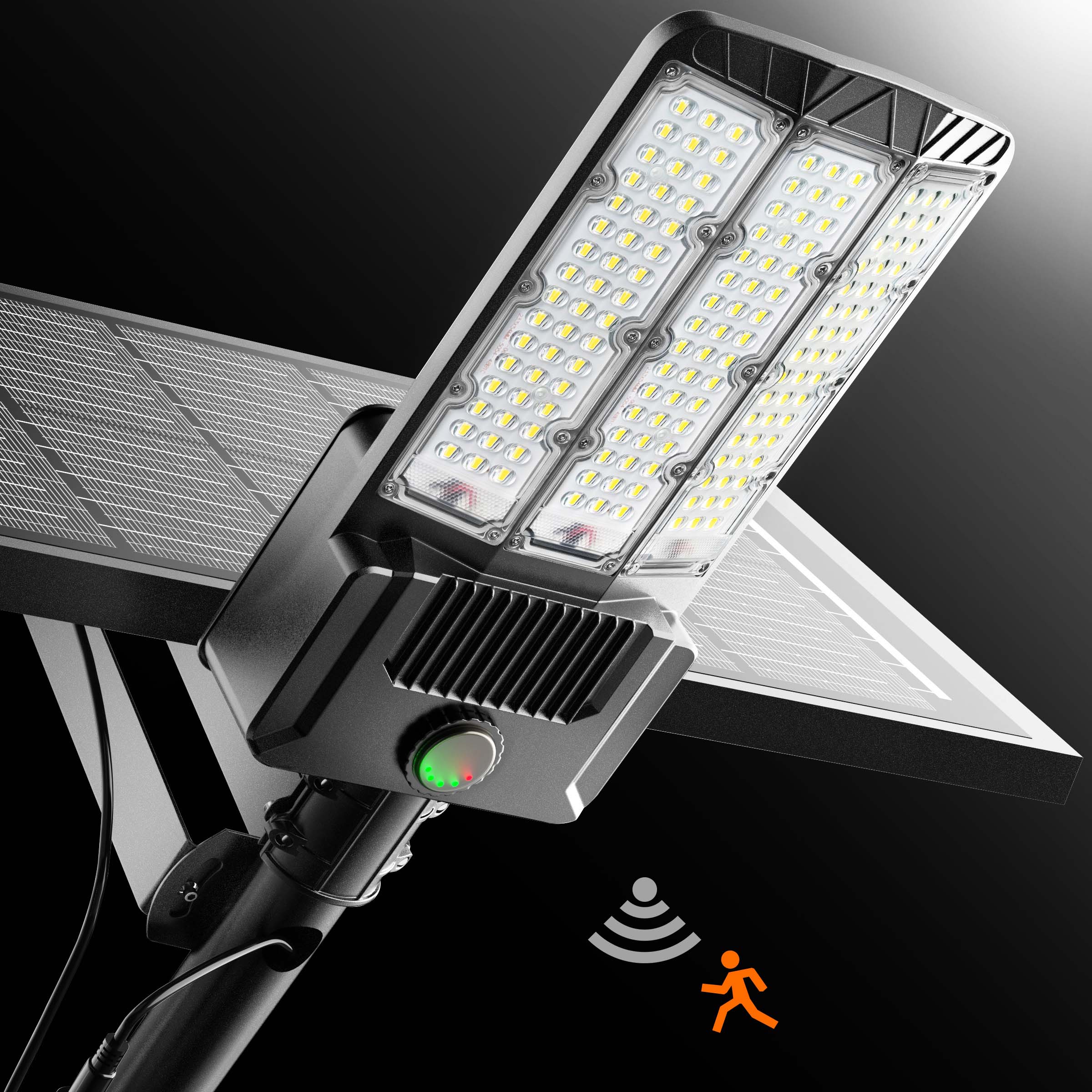
For perimeter lighting that adds security without creating a bug magnet, a solar wall light with motion sensing is a smart addition. It only activates when needed, uses warm or neutral light, and doesn't run all night drawing insects.

Hykoont AMS193 270° Wide Angle 3-Head Solar Wall Light — from $25.00 (1-pack) / $39.99 (2-pack)
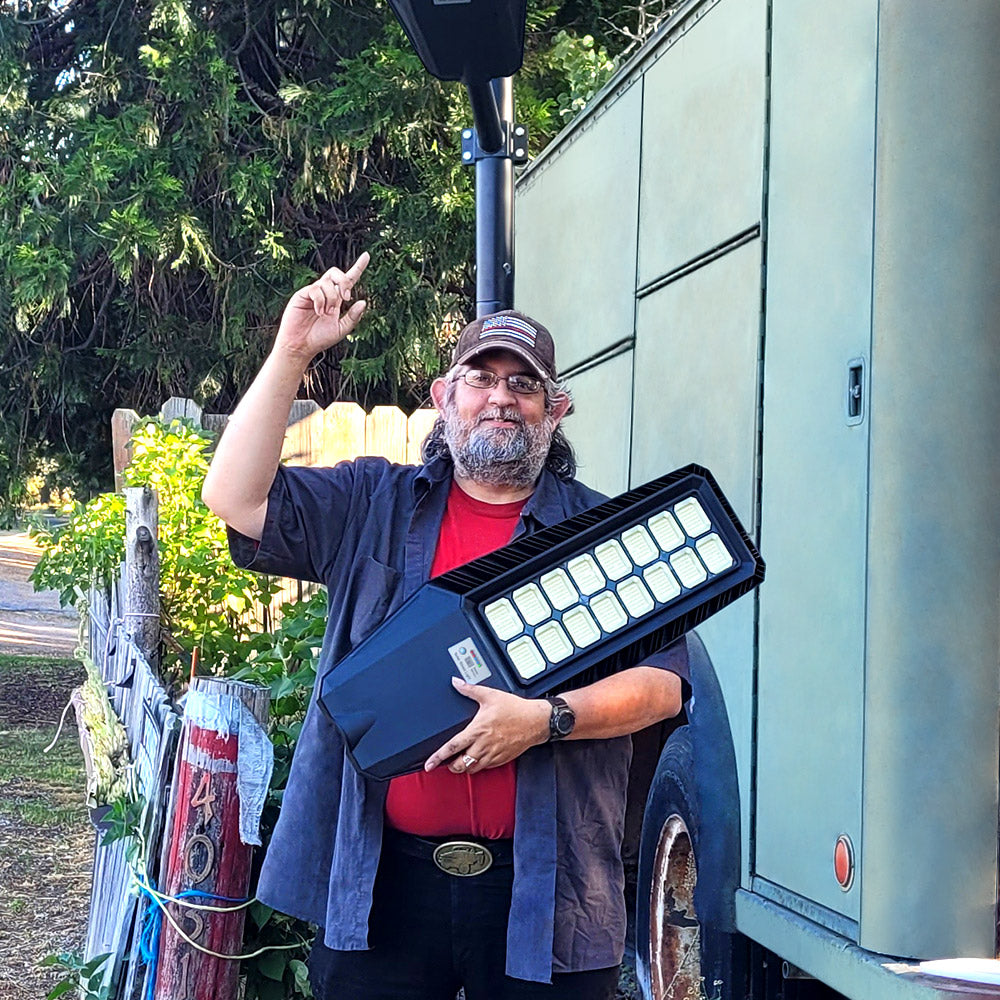
The AMS193 covers a 270° wide angle with three independently adjustable heads, so you can direct light exactly where you need it — along a fence line, toward a gate, or across a dark corner of the yard. The replaceable battery design means you're not replacing the whole unit when the battery eventually degrades. Three lighting modes let you choose between always-on, motion-only, or a combination.
For patio mosquito control, use these along the perimeter fence or on the house wall — away from the dining table — so you're not pulling insects toward your seating area with bright white light.
- ✅ 270° wide-angle coverage with 3 adjustable heads
- ✅ Replaceable battery — long-term value
- ✅ 3 lighting modes including motion-only
- ✅ Available in 1, 2, 4, 6, and 10-pack configurations
- ✅ 3000LM output — genuinely useful security lighting
👉 Shop the AMS193 Solar Wall Light — from $25.00
Layer 4: Physical Barriers for Gazebos
If you have a gazebo, you have a structural advantage that open patios don't: walls (or at least posts) you can attach things to. Use that.
Mosquito Netting Curtains
Sheer mosquito netting panels that hang from the gazebo roof to the floor create a physical barrier that's surprisingly effective. They let air flow through, don't block the view significantly, and can be tied back when you don't need them. For evening dining, drop the curtains and you've created a nearly mosquito-free enclosure.
Oscillating Fans
Mosquitoes are weak fliers. A fan running at medium speed creates enough airflow to make it difficult for them to navigate toward you. Position a fan to blow across the dining table — not just at you, but across the space. This disrupts their flight path and disperses the CO₂ plume that attracts them in the first place.
Citronella — The Right Way
Citronella candles and torches do work, but only in the immediate vicinity (within about 3 feet). They're not going to protect your whole patio. Use them as a close-range supplement — one or two candles on the dining table itself — rather than as your primary defense. Citronella torches placed around the perimeter of the patio add another layer to the overall system.
The Complete Patio Mosquito Control Setup: A Room-by-Room Breakdown
Small Patio or Balcony (Under 300 sq ft)
One Hykoont 19W Standard bug zapper hung at 6–7 feet, positioned at the far end of the space from your seating. Two citronella candles on the table. A small oscillating fan. That's your complete setup — simple, effective, and under $150 total.
Medium Patio or Deck (300–800 sq ft)
One Hykoont 19W Standard hung near the primary seating area, one Hykoont 30W Pro staked at the lawn edge or far perimeter. AMS193 wall lights on the house wall or fence for ambient lighting that doesn't attract bugs. Fan running across the dining table. Total investment: around $350–400 for a setup that genuinely works.
Large Patio + Gazebo Combo
Hykoont 19W Standard hung inside the gazebo from the center beam. Hykoont 30W Pro staked at the lawn perimeter, 30–40 feet from the gazebo. AMS193 wall lights on the perimeter fence. Mosquito netting curtains on the gazebo. Fan inside the gazebo. This is the full-coverage setup for serious outdoor entertainers.
Placement Rules That Actually Matter
Even the best bug zapper underperforms if it's in the wrong spot. Here are the placement rules that make the biggest difference:
Distance from Seating: 15–25 Feet
Your bug zapper should attract insects away from where you're sitting, not right next to your head. Position it at least 15 feet from your primary seating area — ideally at the edge of the space or beyond. The UV light draws bugs toward the zapper; you want that to happen away from the table.
Height: 5–8 Feet
Most mosquitoes fly below 6 feet. Mounting a zapper at 10+ feet reduces its effectiveness. For hanging installation in a gazebo, aim for 6–7 feet from the ground — right in the mosquito flight zone.
Away from Competing Light Sources
Porch lights, string lights, and lanterns compete with your zapper's UV attraction. The more competing light sources near the zapper, the less effective it is. Position your zapper away from other lights, or switch your ambient lighting to warm amber tones that don't compete with UV.
Solar Panel Orientation
For solar models, the panel needs direct sun to charge fully. South-facing orientation is ideal in the US. If your patio is shaded, position the unit where the solar panel gets the most sun during the day, even if that means the zapper body is slightly in shade.
Seasonal Timing: When to Set Up and When to Pack Up
In most of the continental US, mosquito season runs from roughly April through October, with peak activity in June, July, and August. Here's a practical seasonal timeline:
Early April: Set up your bug zappers before mosquito season peaks. Getting them in place early means they're already running when the first wave of mosquitoes emerges.
May–September: Peak season. Run your zappers every night. Check and empty the collection tray every 1–2 weeks.
October: As temperatures drop below 50°F consistently, mosquito activity drops sharply. You can leave solar zappers out through mild fall weather.
November–March: In cold climates (USDA zones 1–7), bring solar bug zappers indoors to protect the lithium battery from repeated freeze-thaw cycles. In warm climates (zones 8–11), you may have year-round mosquito activity and can leave units deployed.
What Doesn't Work (Save Your Money)
The mosquito control market is full of products that sound good but don't deliver. Here's what to skip:
Ultrasonic repellers: Multiple peer-reviewed studies have found no evidence that ultrasonic devices repel mosquitoes. The science simply doesn't support them.
Bug zappers with white light only: Standard white-light zappers catch moths and beetles but are far less effective against mosquitoes than UV-specific models. If it doesn't specify UV wavelength, it's probably not optimized for mosquitoes.
Citronella alone: Citronella has a real but limited effect — roughly 3 feet of protection. Using it as your only defense on a 500 sq ft patio is like using an umbrella to waterproof a house.
Mosquito-repelling plants: Lavender, basil, and lemongrass do contain compounds that mosquitoes dislike, but the concentration in a living plant is far too low to have a meaningful effect on a patio. Nice to have, not a solution.
The Real Cost of Mosquito Season
Let's talk about what doing nothing actually costs you. If mosquitoes are bad enough that you avoid eating outside, you're not getting value from your patio furniture, your outdoor kitchen, your string lights, or any of the other outdoor living investments you've made. A $119–$219 bug zapper that lets you use your outdoor space comfortably all summer is a bargain compared to the alternative.
And unlike bug spray — which you're buying every season, applying to your skin, and smelling all evening — a solar bug zapper is a one-time purchase that runs on sunlight. The math is pretty straightforward.
Ready to Take Back Your Patio?
The right setup depends on your space, but here's the short version: start with a quality UV bug zapper positioned away from your seating, eliminate standing water nearby, and add a fan and citronella candles at the table for close-range protection. That combination works.
For most patios and gazebos, the Hykoont 19W Standard is the right starting point. For larger spaces or high-pressure mosquito environments, step up to the 30W Pro — or run both.
Shop 19W Patio Bug Zapper — $119.00 Shop 30W Pro Bug Zapper — $219.00
Frequently Asked Questions
Q: Where is the best place to put a bug zapper on a patio?
A: Position it 15–25 feet from your primary seating area, at a height of 5–8 feet. You want it attracting insects away from where you're sitting. For a gazebo, hang it from a corner post or beam rather than directly above the dining table.
Q: Do bug zappers actually work on mosquitoes?
A: Yes — quality UV bug zappers with the correct wavelength (around 365nm) do attract and kill mosquitoes. They're most effective as part of a layered approach that also includes eliminating standing water and using fans to disrupt mosquito flight patterns near seating areas.
Q: How long do solar bug zappers run at night?
A: After a full day of charging, quality solar bug zappers like the Hykoont 19W Standard and 30W Pro run all night — typically 8–12 hours depending on battery capacity and UV output level. On partially cloudy days, runtime may be reduced to 4–6 hours.
Q: Can I leave my solar bug zapper out in the rain?
A: Yes, if it has an appropriate weather resistance rating. The Hykoont 19W Standard carries an IPX4 rating, which means it handles rain and splashing water without damage. Leave it out all season — that's what it's designed for.
Q: How far away from the table should a bug zapper be?
A: At least 15 feet, ideally 20–25 feet. The zapper attracts insects toward it — you want that attraction happening away from your dining area, not right next to your food and guests.
Q: Do I need more than one bug zapper for a large patio?
A: For patios larger than about 1,000 sq ft, or for setups that include both a gazebo and an open deck area, two units give you significantly better coverage. One inside the gazebo, one at the lawn perimeter, covers both zones effectively.
Q: What's the difference between a bug zapper and a mosquito trap?
A: Bug zappers use UV light to attract insects to an electric grid. Mosquito traps typically use CO₂ or octenol (a chemical attractant) to mimic human breath and lure mosquitoes into a capture chamber. Both work; bug zappers are generally lower maintenance and more cost-effective for patio use. Mosquito traps can be more targeted for mosquitoes specifically but require consumable attractants.
Q: Will a bug zapper attract more mosquitoes to my yard?
A: It attracts insects to the zapper, not to your yard in general. Mosquitoes are already in your yard — the zapper intercepts them before they reach you. Position it at the perimeter of your space and it acts as a barrier, not a beacon that draws bugs from miles away.
Q: How often do I need to clean a bug zapper?
A: Every 1–2 weeks during peak season. Most models have a removable collection tray at the bottom. Empty it regularly — a full tray reduces effectiveness and can become unsanitary. A quick brush-out of the UV tubes every few weeks keeps output at full strength.
Q: Are solar bug zappers as powerful as plug-in models?
A: Current-generation solar bug zappers like the Hykoont 30W Pro deliver UV output comparable to many plug-in models, without the cord management issues. The trade-off is that performance depends on solar charging — in heavily shaded locations or during extended cloudy periods, a plug-in model may be more reliable. For most American backyards with reasonable sun exposure, solar is the better choice.
Stop letting mosquitoes decide when your outdoor dining season ends. The right setup makes your patio and gazebo genuinely usable all summer — not just on the rare nights when the bugs aren't bad.
Shop 19W Standard — $119.00 Shop 30W Pro — $219.00 Shop AMS193 Wall Light — from $25.00


Leave a comment
This site is protected by hCaptcha and the hCaptcha Privacy Policy and Terms of Service apply.