









Let's be honest — most parking lot lighting conversations start with a utility bill that's gotten out of hand.
You're paying to light a surface that sits empty half the night. The fixtures are aging. The electrician quotes are eye-watering. And somewhere in the back of your mind, you've wondered whether solar could actually handle this.
The short answer: yes, if you pick the right system. The longer answer is what this article is about.
We're going to walk through what separates a high-lumen solar parking lot light that actually works from one that dims out by 2 AM, why backup battery capacity matters more than panel wattage, and which specific models are worth your money in 2025.
Why Parking Lots Are One of the Best Use Cases for Solar Lighting
Parking lots have a few characteristics that make them unusually well-suited for solar:
- Open sky exposure. No tree canopy, no building shadows blocking the panels during peak sun hours.
- Flat, predictable surfaces. Pole placement is straightforward. You're not working around landscaping or architectural constraints.
- High trenching costs avoided. Running conduit across a large asphalt lot can cost $15–$40 per linear foot. A 200-foot run to a remote corner? That's $3,000–$8,000 before you've bought a single fixture.
- Consistent nightly usage. Parking lots need light from dusk to dawn — exactly the operating profile solar backup systems are designed for.
The math changes fast when you eliminate the trenching cost and the monthly electricity draw. A well-specified solar system typically pays for itself in 2–4 years, then runs essentially free for the next decade.

The Backup Battery Question: Why It's the Most Important Spec Nobody Talks About
Here's where a lot of buyers get burned.
They see a fixture rated at 300W and 42,000 lumens and assume it'll run all night. What they don't check is the battery capacity — and whether that battery can actually sustain full output through a cloudy stretch.
What "backup battery" actually means in a solar parking lot light
Every solar light has a battery. The question is whether it's sized to be a true backup — meaning it can carry the light through multiple consecutive overcast days — or just a same-night buffer that dims aggressively after midnight.
The key specs to look at:
- Battery capacity (mAh or Ah): Higher is better. A 48,000mAh (48Ah) battery at 6V stores significantly more energy than a 20Ah unit.
- Battery chemistry: LiFePO4 (lithium iron phosphate) is the commercial standard. It handles 2,000–4,000 charge cycles vs. 300–500 for standard lithium-ion. In a parking lot light that charges and discharges every single day, this difference is the gap between a 3-year replacement and a 10-year service life.
- Working hours at rated output: Look for lights that specify 15–24 hours of working time. That covers dusk-to-dawn in winter when nights run 14+ hours.
- Rainy day reserve: Quality commercial fixtures are rated for 3–5 consecutive cloudy days. This is the real backup spec.
The three lighting modes that actually matter
A good solar parking lot light isn't running at full blast all night — that would drain the battery by 3 AM. Instead, look for intelligent mode management:
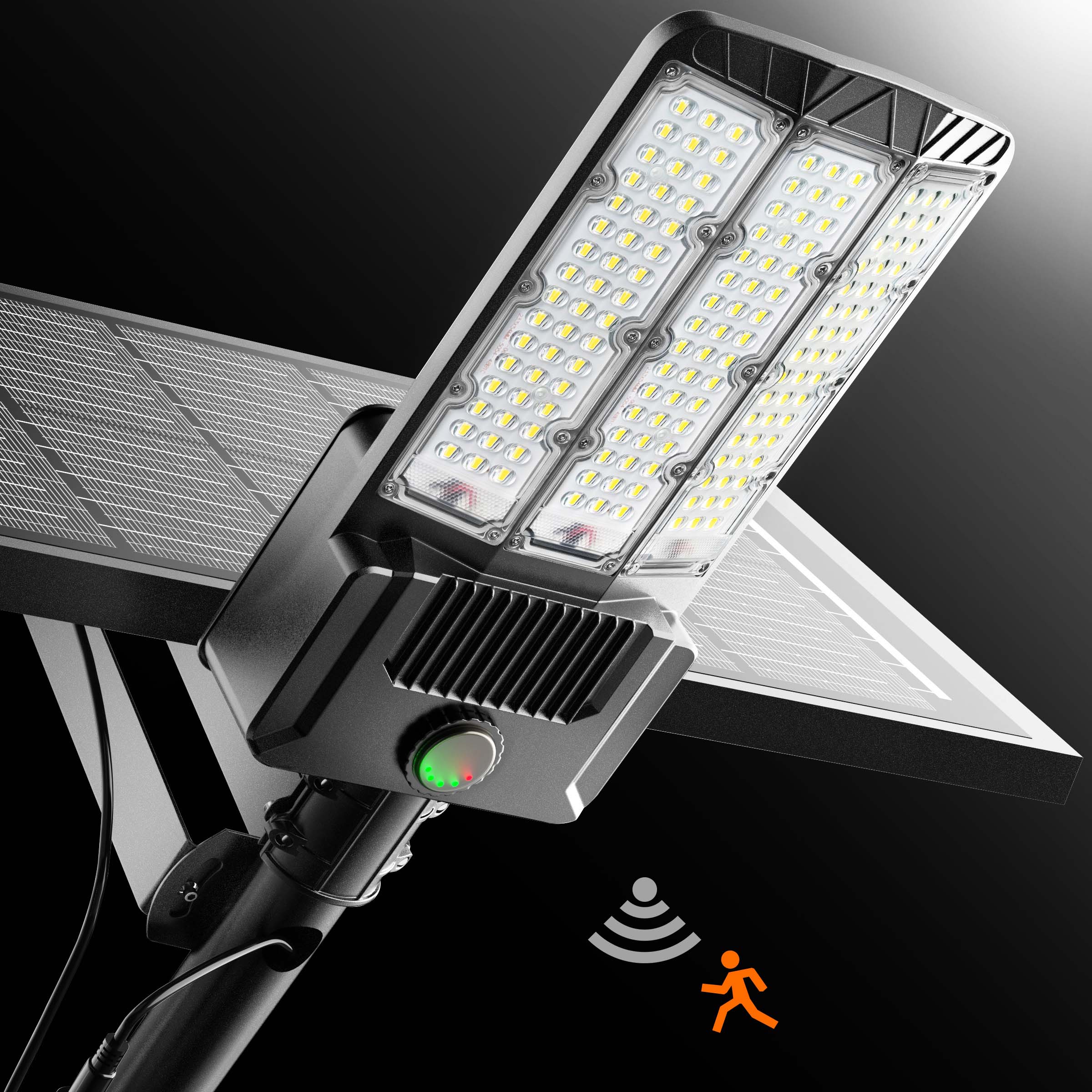
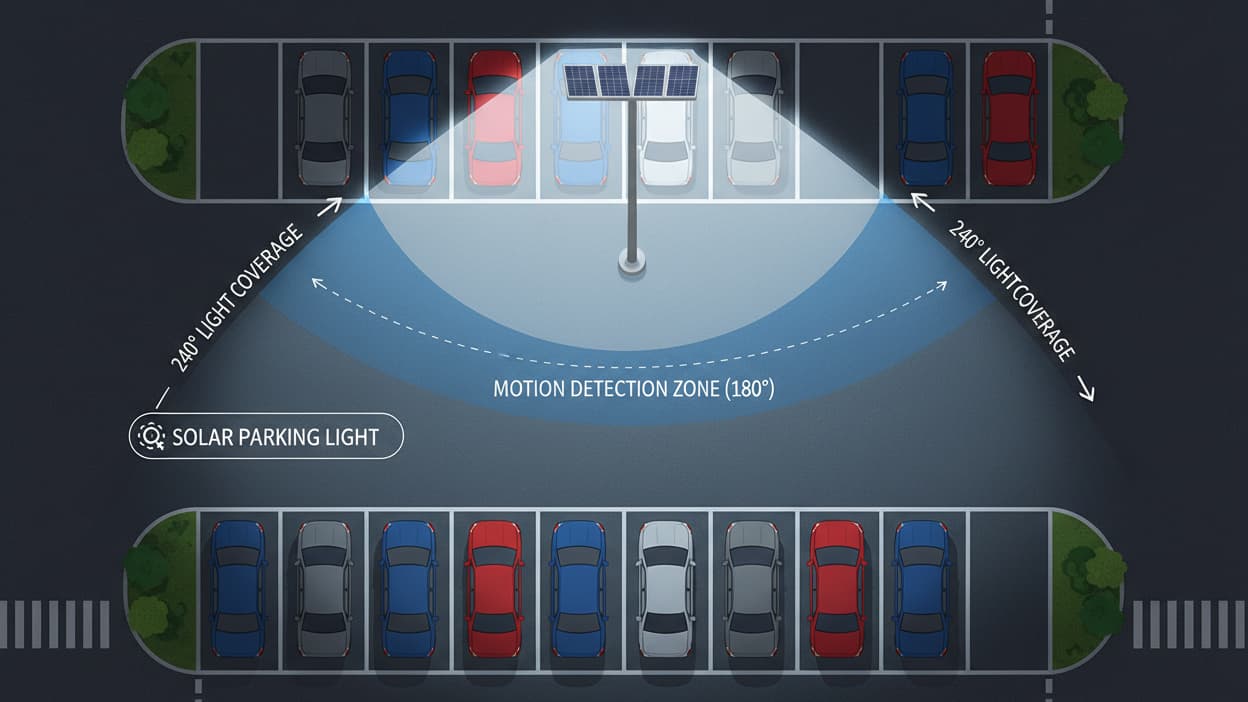
- Motion sensor mode: Dims to 30–50% when the lot is empty, jumps to 100% when a vehicle or person enters the detection zone. Extends battery life dramatically.
- Dusk-to-dawn mode: Constant illumination from sunset to sunrise. Best for high-traffic lots where motion sensing would be constantly triggering.
- Timing mode: Full brightness during peak hours (say, 6 PM–11 PM), reduced output overnight. Useful for lots that are busy in the evening but empty after midnight.
The ability to switch between these modes based on season or usage pattern is what separates a commercial-grade fixture from a residential one.

Lumen Output: What's Actually Enough for a Parking Lot?
The Illuminating Engineering Society (IES) recommends a minimum of 1–2 foot-candles for basic parking lot illumination, with 3–5 foot-candles for higher-security or high-traffic areas.
Translating that to fixture output depends on mounting height and beam angle. Here's a rough working guide:
- 15–20 ft mounting height: 15,000–25,000 lumens covers a standard parking bay cluster
- 20–25 ft mounting height: 25,000–45,000 lumens for wider coverage
- 25–30 ft mounting height: 45,000–60,000+ lumens for large commercial lots
Wide beam angles (120°–240°) spread light more efficiently across flat surfaces. Narrow beams waste output on vertical throw. For parking lots specifically, look for fixtures with 120°–240° beam spread.
The Products That Actually Deliver
Here are the specific models we'd recommend for US commercial parking lot applications, based on real specs — not marketing copy.
1. Hykoont TW030 — 300W / 42,000 Lumens / 48,000mAh Battery

This is the fixture we'd put at the top of the list for mid-to-large parking lots. The 48,000mAh battery is the largest in this class — it's what lets this light run dusk-to-dawn even after a cloudy day without dimming.
Key specs:
- 300W solar panel, 42,000 lumens output
- 6V / 48,000mAh LiFePO4 battery
- 240° wide-angle beam — covers more surface per pole than narrow-beam alternatives
- 3 modes: motion sensor, dusk-to-dawn, timing
- IP66 weatherproof rating
- 3-year warranty
Best for: Large commercial parking lots, shopping centers, industrial facilities, campuses
Price: $142.00 (single) / $289.00 (2-pack)
👉 Shop TW030 Single Unit — $142.00
👉 Shop TW030 2-Pack — $289.00 (Save $5 vs. 2x single)
2. Hykoont SZ300 — 400W / 60,000 Lumens / 50Ah Battery

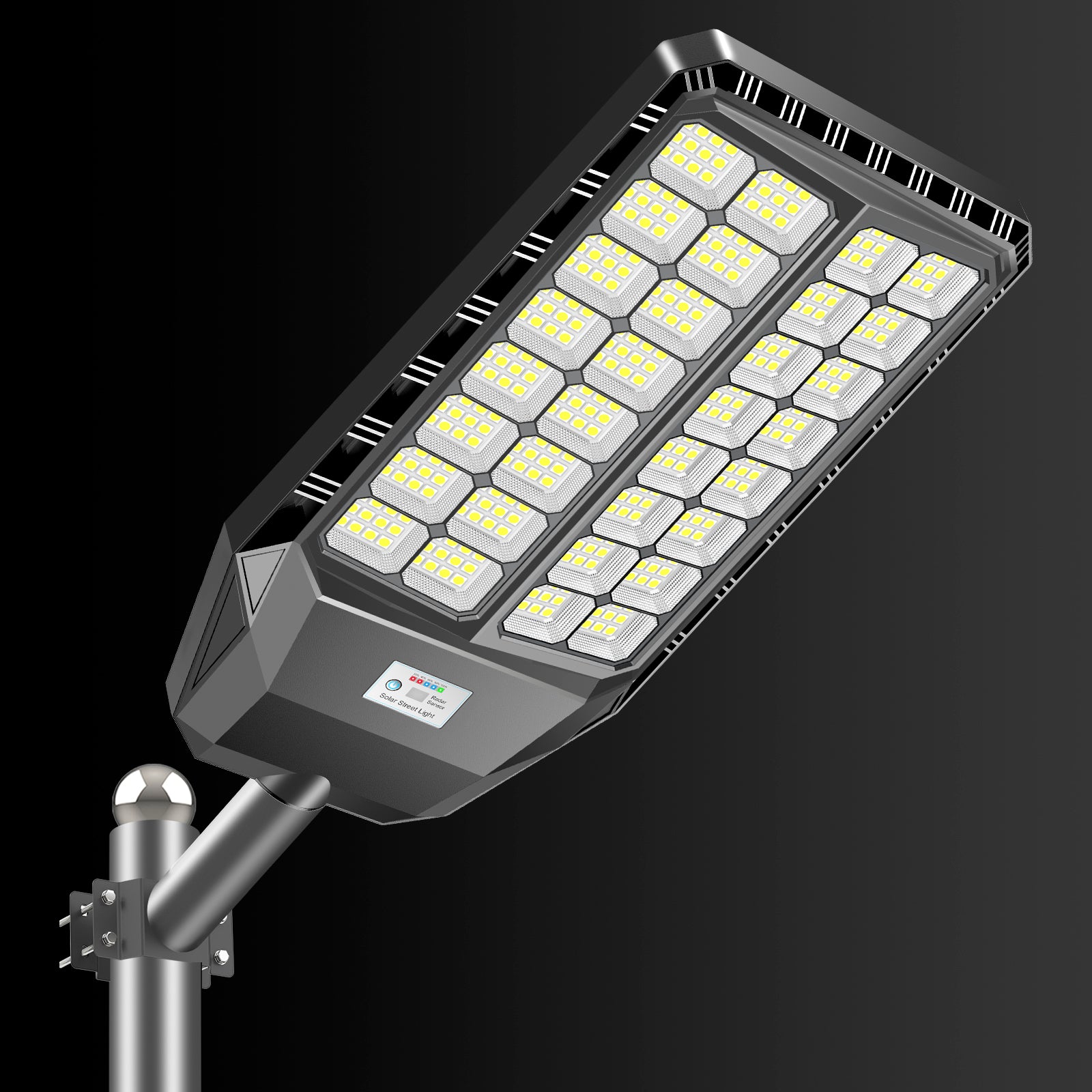
When you need to light a large lot from a single pole — or you're mounting at 25+ feet — the SZ300 is the answer. At 60,000 lumens, it's one of the highest-output solar fixtures available at this price point.
The die-cast aluminum housing isn't just a durability feature — it's a thermal management feature. LED efficiency drops with heat. Aluminum dissipates heat faster, which means the SZ300 maintains its rated lumen output longer into the night than plastic-housed alternatives.
Key specs:
- 400W monocrystalline solar panel, 60,000 lumens
- 50Ah battery capacity
- 144D SMD 5054 LED array
- 6–8 hour charge time, 15–24 hour working time
- IP66 rated, die-cast aluminum housing
- 3-year warranty
Best for: Large commercial lots, warehouses, logistics yards, municipal parking structures
Price: $145.00 (single) / $293.00 (2-pack)
👉 Shop SZ300 Commercial Solar Light — Starting at $145.00
3. Hykoont BM024C — 160W / 26,000 Lumens / Multiple Pack Options

Not every parking lot needs 60,000 lumens. For smaller lots — apartment complexes, small retail, church parking, HOA common areas — the BM024C hits a sweet spot of output, battery life, and price.
The 6500K color temperature is worth noting. That's a cool daylight white that renders colors accurately and improves camera footage quality — relevant if you have security cameras covering the lot.
Key specs:
- 160W panel, 26,000 lumens at 6500K
- 6V / 22Ah battery
- 1152D SMD 5730 LED beads
- 5–6 hour charge, 15–24 hour working time
- IP66 rated
- 3-year warranty
Best for: Small-to-medium parking lots, residential complexes, churches, small retail
Price: $79.00 (1-pack) / $159.00 (2-pack) / $229.00 (3-pack) / $309.00 (4-pack)
4. Hykoont BC024 — 180W / 24,300 Lumens

The BC024 sits between the BM024C and the TW030 in output — a good fit for mid-size lots where you want more coverage per pole but don't need the full 42,000-lumen output of the TW030.
Key specs:
- 180W panel, 24,300 lumens
- 3.2V / 25Ah LiFePO4 battery
- 960D SMD 5730 LED beads
- 6–8 hour charge, 18–24 hour working time
- IP66 rated
- 3-year warranty
Price: $159.00 (single) / $289.00 (2-pack)
👉 Shop BC024 — $159.00 / $289.00 (2-pack)
Installation: What Nobody Tells You Until You're Already Committed
Solar parking lot lights are genuinely easier to install than grid-tied fixtures — but there are a few things worth knowing before you order.
Pole selection
Most commercial solar street lights mount on a 3–4 inch diameter pole. The fixtures themselves typically weigh 15–35 lbs depending on panel size. Make sure your pole is rated for the wind load in your area — ASCE 7 wind maps are the reference standard in the US. In hurricane-prone coastal areas, you'll want poles rated for 130+ mph wind exposure.
Panel angle
In the continental US, solar panels should face south and be tilted at an angle roughly equal to your latitude. In Texas (latitude ~30°), that's a 30° tilt. In Minnesota (latitude ~45°), closer to 45°. Most integrated solar street lights have adjustable panel brackets — use them.
Spacing
For a 42,000-lumen fixture at 20-foot mounting height with a 240° beam, you can typically space poles 60–80 feet apart and maintain adequate foot-candle levels across the lot. For tighter coverage requirements (security-critical areas), reduce spacing to 40–50 feet.
No permit required?
In most US jurisdictions, solar lighting that doesn't connect to the grid doesn't require an electrical permit. Always verify with your local AHJ (Authority Having Jurisdiction), but this is one of the significant administrative advantages of solar over grid-tied systems.

Total Cost of Ownership: Running the Numbers
Let's compare a realistic scenario: lighting a 20-space parking lot with 4 fixtures.
Grid-tied LED option
- Fixture cost: 4 × $200 = $800
- Trenching and electrical: $8,000–$15,000 (estimate for a remote lot)
- Annual electricity: 4 fixtures × 150W × 12 hrs/night × 365 days × $0.13/kWh = ~$340/year
- 5-year total: $9,500–$16,500
Solar option (Hykoont TW030 2-pack × 2)
- Fixture cost: 2 × $289 = $578
- Installation: pole purchase + labor, typically $1,500–$3,000 for 4 poles
- Annual electricity: $0
- 5-year total: $2,078–$3,578
5-year savings: $7,000–$13,000. That's not a rounding error.
And that's before accounting for any applicable federal ITC (Investment Tax Credit) or state rebate programs, which can reduce your net cost by 30% or more on commercial installations.
Red Flags to Watch For When Shopping
The solar lighting market has a lot of noise. Here's what to watch for:
- "Equivalent wattage" claims. A fixture listed as "500W equivalent" may only draw 100W from the panel. Look for actual panel wattage and actual lumen output — not equivalency marketing.
- No battery chemistry specified. If a listing doesn't tell you whether the battery is LiFePO4, lithium-ion, or lead-acid, that's a red flag. LiFePO4 is the only chemistry worth considering for commercial applications.
- Lumen claims without beam angle. 50,000 lumens concentrated in a 60° beam is useless for a parking lot. You need wide-angle output — 120° minimum, 240° preferred.
- No IP rating. Any outdoor commercial fixture should be IP65 minimum. IP66 is the standard for parking lot applications where fixtures may be hit by pressure washing or heavy rain.
- Warranty under 2 years. A quality solar fixture should carry a 3-year minimum warranty. Shorter warranties signal low confidence in the product's longevity.

Which Model Is Right for Your Lot?
Here's a quick decision framework:
- Small lot (under 20 spaces), budget-conscious: BM024C at $79–$309 depending on pack size
- Mid-size lot (20–50 spaces), balanced performance: BC024 at $159–$289 or TW030 at $142
- Large commercial lot (50+ spaces), maximum output: SZ300 at $145–$293
- Multi-lot project or bulk purchase: Contact us for wholesale pricing
All of these ship to the continental US. Most customers receive within 5–10 business days.
→ Shop All Solar Parking Lot Lights
Frequently Asked Questions
Q: How many lumens do I need for a commercial parking lot?
A: The IES recommends 1–5 foot-candles depending on the security level of the area. For a standard commercial lot at 20-foot mounting height, fixtures in the 21,000–42,000 lumen range with wide beam angles (120°–240°) typically meet or exceed this standard. High-security areas like hospital parking or transit hubs should target the higher end.
Q: Will these lights work through cloudy weather?
A: Yes — the key is battery capacity. The TW030's 48,000mAh battery and the SZ300's 50Ah battery are sized to carry the light through 3–5 consecutive overcast days when used in motion-sensor or timing mode. In dusk-to-dawn mode, expect 1–2 cloudy days of reserve. For areas with extended cloudy seasons (Pacific Northwest, Great Lakes), motion-sensor mode is recommended.
Q: Do I need a permit to install solar parking lot lights?
A: In most US jurisdictions, off-grid solar lighting doesn't require an electrical permit since it doesn't connect to the utility grid. However, you may still need a building permit for pole installation depending on your municipality. Always check with your local AHJ before installation.
Q: How long do the batteries last before replacement?
A: LiFePO4 batteries in these fixtures are rated for 2,000–4,000 charge cycles. At one cycle per day, that's 5–11 years of battery life. Real-world performance varies with temperature extremes, but LiFePO4 is significantly more durable than standard lithium-ion in outdoor applications.
Q: What pole height should I use?
A: For parking lot applications, 15–25 feet is the typical range. The TW030 and SZ300 perform well at 20–25 feet. Lower mounting heights (15 feet) work for smaller lots or tighter spacing requirements. Taller poles require fewer fixtures but need to be rated for higher wind loads.
Q: Can I use these in cold climates?
A: LiFePO4 batteries perform significantly better in cold weather than lithium-ion alternatives. They maintain usable capacity down to around -4°F (-20°C), though capacity does reduce somewhat at extreme temperatures. For Minnesota, Wisconsin, or similar climates, LiFePO4 is the right chemistry — and all the fixtures listed here use it.
Q: How do I calculate how many fixtures I need?
A: A rough starting point: one 42,000-lumen fixture with a 240° beam at 20-foot height covers approximately 4,000–6,000 sq ft of parking surface at IES-compliant levels. Divide your total lot square footage by that number for a baseline fixture count, then adjust for lot shape, obstacles, and security requirements.
Q: Are these eligible for federal tax credits?
A: Commercial solar installations may qualify for the federal Investment Tax Credit (ITC), which currently offers a 30% credit on qualifying solar equipment costs. Consult your tax advisor to confirm eligibility for your specific installation — requirements vary based on how the system is classified and how it's used.
Q: What's the difference between the TW030 and the SZ300?
A: The TW030 (42,000 lumens, $142–$289) is the better value for most mid-size commercial lots. The SZ300 (60,000 lumens, $145–$293) is designed for larger lots where you need maximum coverage per pole, or for higher mounting heights (25+ feet). The SZ300's die-cast aluminum housing also provides better thermal management for sustained high-output operation.
Q: Do these come with mounting hardware?
A: Yes — all fixtures include mounting brackets and hardware for standard pole installation. Poles are sold separately. Most customers use 3–4 inch diameter steel poles, which are widely available from electrical supply distributors or online.
The Bottom Line
High-lumen solar parking lot lights with backup batteries have crossed the threshold from "interesting alternative" to "obvious choice" for most US commercial applications. The technology is mature, the battery chemistry is proven, and the economics are straightforward.
The main thing that trips people up is underspecifying the battery. Don't buy a fixture based on panel wattage alone — look at the battery capacity, the chemistry, and the working hours at rated output. That's where the real performance difference lives.
If you're lighting a mid-to-large lot, the TW030 2-pack at $289 is where we'd start. If you need maximum output from fewer poles, the SZ300 at $145 is the commercial-grade answer.
Questions about your specific lot? Drop us a message — we're happy to help you spec the right system.

Leave a comment
This site is protected by hCaptcha and the hCaptcha Privacy Policy and Terms of Service apply.