










The night the light went out at 4 a.m.
Picture a gravel drive in January. The light clicks on at dusk, looks perfectly healthy at dinner, and is gone before the first delivery truck arrives. It is tempting to blame the battery. Sometimes that is exactly the problem. But often the battery is simply keeping the books: it cannot spend energy the panel never collected.
That is the real question behind dual solar panels versus single panels for winter outdoor lighting. Not, “Which looks more powerful in a product photo?” Rather: can this particular site put enough useful energy into storage during a short, imperfect winter day to get through a long winter night?
If you are lighting a US farm entrance, private road, parking area, warehouse approach, or long driveway, here is a more useful way to choose. We will look at the whole energy budget, where dual panels can help, where a well-positioned single panel can still win, and which HYKOONT products fit different sizes of job. Prices below are the listed USD prices checked while preparing this article; confirm the live product page before ordering.
Primary keyword: solar street lights for winter driveways and parking areas. Long-tail question: why does my solar street light turn off early in winter, and how can dual-panel charging help?
First, winter changes both sides of the equation
A summer evening gives a solar light two favors: a long charging window and a shorter lighting shift. Winter flips both. The sun sits lower; nearby trees, rooflines, signs, and buildings throw longer shadows; clouds may linger for days; snow can cover the panel. Meanwhile the light may need to run for twelve to fourteen hours rather than eight or nine. One bad charging day is not necessarily a crisis. Three in a row can be.
It helps to stop thinking in terms of a panel “being in the sun” and start thinking in terms of useful daily harvest. A panel can see daylight without producing its rated output. The advertised panel wattage is a laboratory rating under standardized conditions, not the amount it will deliver every hour on a gray December afternoon. A 50 W array does not create 50 W continuously from sunrise to sunset. Site exposure, sun angle, shading, wiring, controller behavior, dirt, and snow all matter.
The other half is consumption. A light drawing substantial power at full brightness all night needs much more energy than the same fixture using a timed dimming schedule or motion-triggered boost. The easiest way to make a winter setup work is often to combine better charging with smarter spending, rather than chasing the biggest printed lumen number.

What a second panel actually buys you
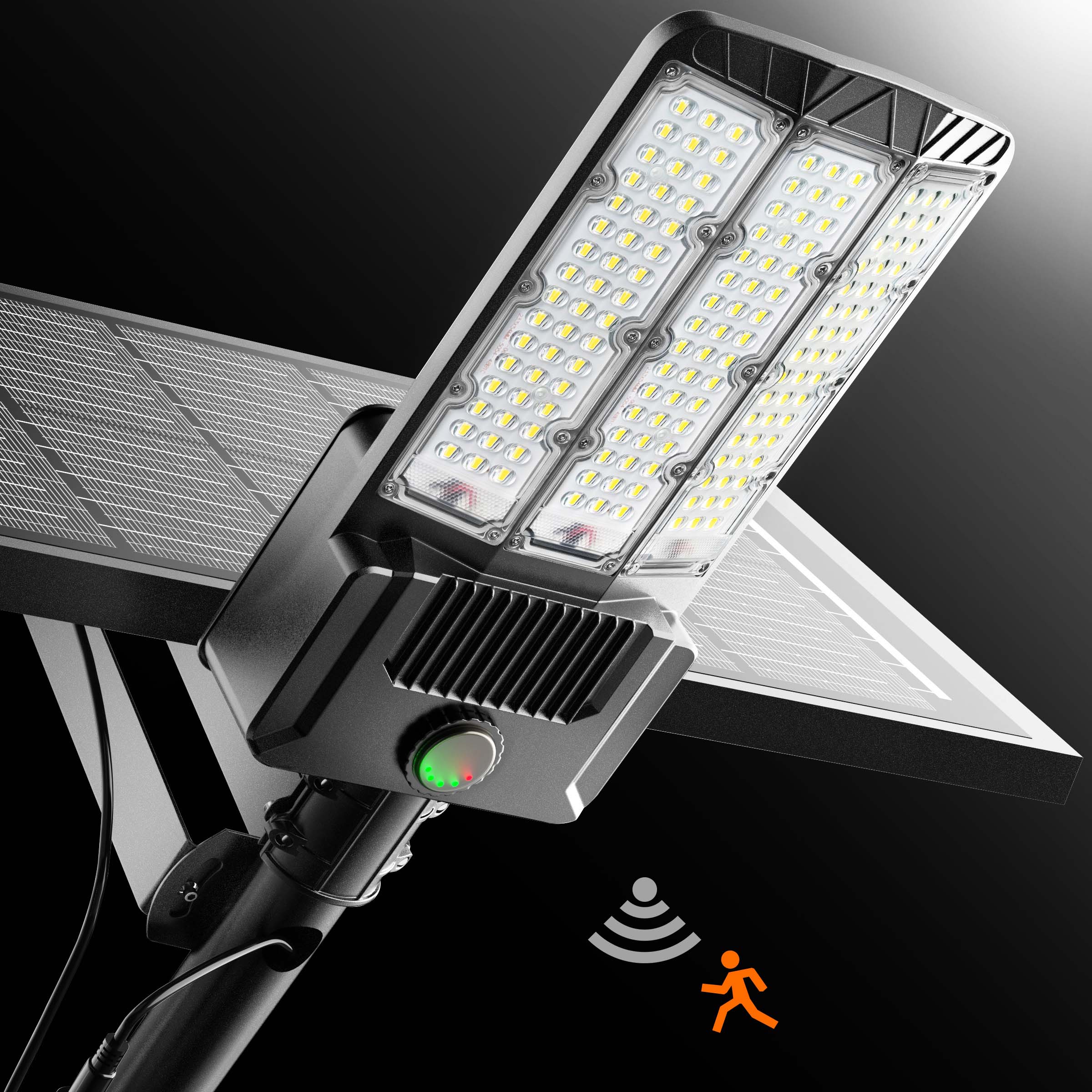
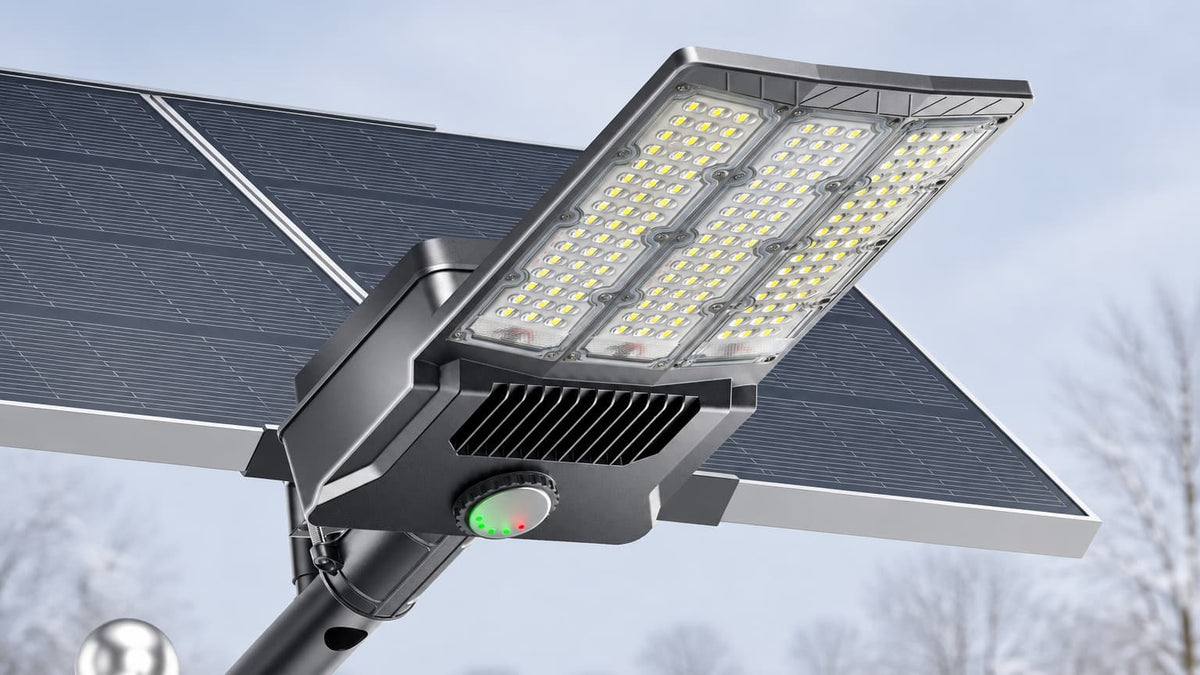
Dual panels can increase the solar collection area available to a fixture. On a constrained winter day, that additional collection capacity may help replace energy before dusk. HYKOONT describes its SZ400 dual-panel solar street light as having a 6 V, 50 W dual-panel setup and a 3.2 V, 42,000 mAh LiFePO4 battery. Its listed one-pack price is $270 USD. The product listing also describes motion-sensing and timer options, which matter because a stronger charger cannot compensate indefinitely for an overnight load that is too high.
But two panels are not magic. If both are buried under snow or both face the same deep shade, their combined rating is not the answer. Nor is “dual” automatically better than every single-panel system: a large, properly aimed single panel paired with a larger battery and an efficient charge controller may be the better design for a particular road or lot.
Think of a second panel as more opportunity to collect sunlight, not an exemption from solar geometry. If your installation allows panel orientation adjustments, use them to reduce avoidable shading and capture the best winter exposure. Follow the mounting instructions for the actual product; do not assume the two panels can be independently aimed unless its hardware specifically supports that.

Shop the SZ400 dual-panel light, from $270 USD for one pack.
The comparison that matters: energy in, energy out
For a rough planning exercise, write down three numbers: panel wattage, battery capacity in watt-hours, and expected nightly consumption in watt-hours. If battery capacity is listed in amp-hours instead, multiply nominal voltage by amp-hours to get an approximate watt-hour figure. The SZ400 listing's 3.2 V × 42 Ah works out to about 134 Wh nominal. That is not a promise that every watt-hour is available to the LEDs: controller losses, battery protection, temperature, and operating mode reduce usable energy.
Here is an intentionally simplified example. If a system harvests 100 Wh on a winter day but uses 130 Wh overnight, it enters the next day about 30 Wh behind. Repeat that pattern and the battery eventually runs low. Increase the daily harvest, reduce the nightly load, or do both. That is how you solve early shutoff, not by assuming a larger-looking lamp will somehow charge itself faster.
A second panel may raise the harvest side. Motion detection, scheduled dimming, or a lower continuous output reduces the spending side. A larger battery adds a reserve for uneven weather, but it does not produce energy. An efficient controller can make more of changing light conditions, yet it cannot manufacture sunlight. These are complementary tools, not interchangeable marketing badges.
Single panels are not the budget option by definition
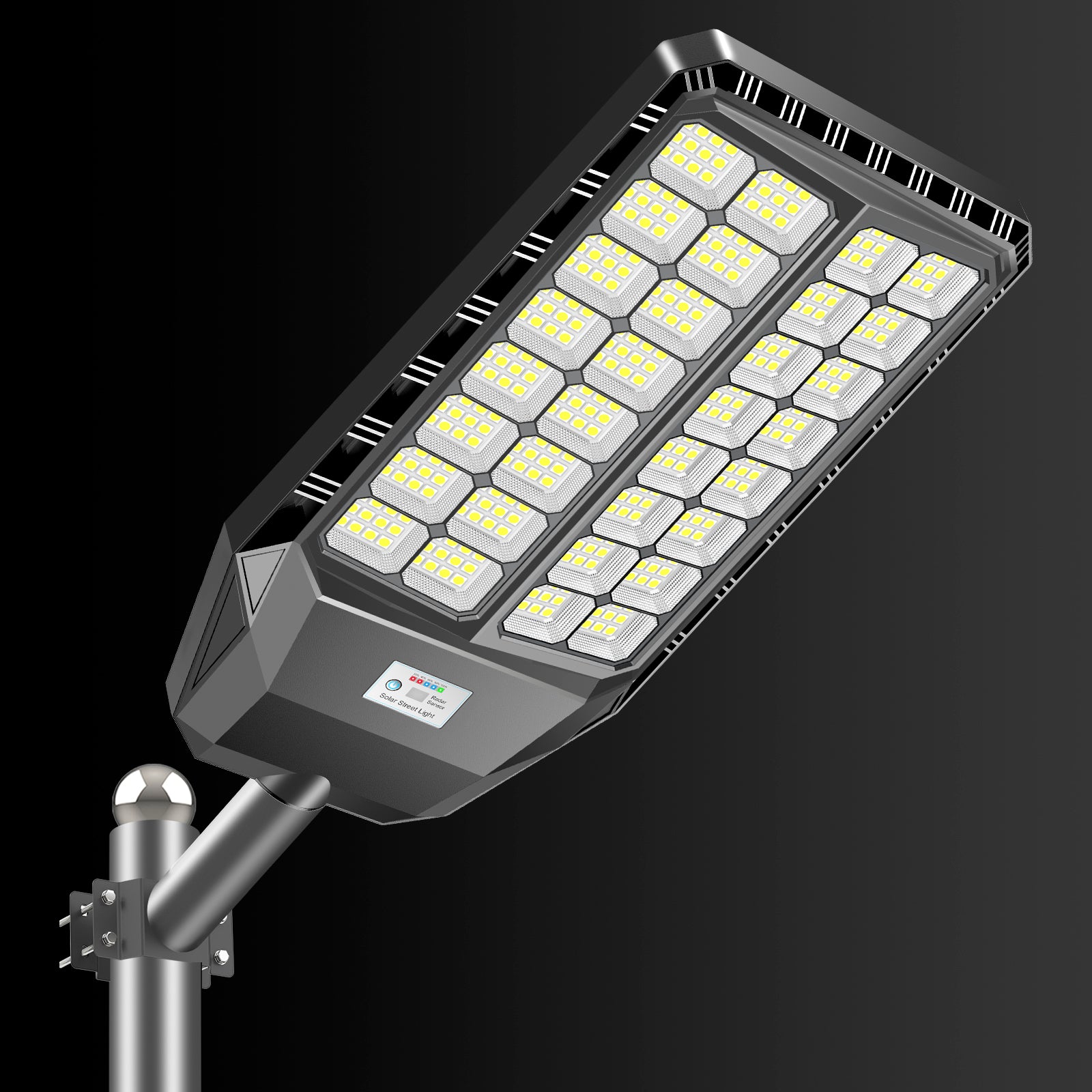
Consider the NT100A solar street light. Its listing specifies an 18 V, 80 W monocrystalline panel, 320 Wh LiFePO4 battery, and MPPT controller. Its listed price is $762 USD. It has one panel, yet that panel's stated wattage exceeds the SZ400's stated 50 W dual-panel total. Comparing panel count alone would completely miss that distinction. The battery capacity also changes how the system can ride through uneven charging days.

For a smaller installation, the NT60A solar street light lists an 18 V, 60 W monocrystalline panel, 230 Wh LiFePO4 battery and MPPT charging. Its listed price is $582 USD. Again, it is not reasonable to rank this light below a dual-panel product merely because sixty watts are supplied by one panel rather than two. Beam pattern, required coverage, mounting height and controls also need to match the site.

See NT60A pricing and specifications, $582 USD at review.
When the job gets larger
A facility entrance and a backyard path should not share a shopping checklist. For a larger commercial area, the HY100C commercial solar light lists a separate 5 V, 150 W monocrystalline panel, a 3.2 V, 300 Ah battery (approximately 960 Wh nominal), and MPPT charging. Its listed price is $1,890 USD. This is a very different scale of installation and budget from a compact all-in-one fixture. Importantly, the HY100C does have a separate solar panel; plan space and mounting for it.

Those watt-hour figures make the comparison clearer than the words “single” and “dual.” They still are not a substitute for an installation plan. You need to know where the panel will go, what the light must illuminate, the mounting height, the likely winter shade, and whether the site can tolerate dimming when nobody is present.
Explore the HY100C commercial system, $1,890 USD at review.
A winter site walk beats a spec-sheet argument
Before ordering, visit the intended mounting point in the middle of the day, preferably in the season when performance matters most. Look south if you are in the Northern Hemisphere and note what blocks the low winter sun. A tree that casts no useful shadow on the panel in June can cover it for hours in December. An adjacent building can create the same problem. If the site is not built yet, map the likely shadows rather than guessing from a summer photograph.
Next, decide what “working” means. Does a driveway need a low background level all night with a bright motion response? Does a parking area need steady illumination during business hours and reduced output afterward? Is a farm entrance used only at dawn and dusk? The schedule changes the nightly energy requirement. Ask what lighting level is needed at the ground, not just what lumen figure sounds impressive on a product page.
Then look at the panel surface and access. Will snow slide off, or will it sit? Can someone safely clear accumulated snow and debris? Is the mounting location reachable for periodic cleaning? If the site sees salt spray, dust, or falling leaves, maintenance is part of the charging plan. A supposedly ideal panel that stays dirty will not deliver its advertised advantage.
Why a cold battery needs a little humility
Cold conditions can limit battery charging and usable capacity, depending on battery chemistry and the protection electronics in the light. A product being described as suitable for cold environments is not a guarantee of identical winter and summer runtime. The panel may actually perform efficiently in cool sunshine, but that does not erase short days, low sun, snow coverage, and longer nights.
That is why we would not promise that dual panels “solve winter” in every zip code. In a clear but cold location with good exposure, extra panel capacity may be genuinely useful. In a heavily shaded corridor, moving the panel to a better position may be worth more than buying another panel. In a site that needs full brightness from dusk to dawn, sizing the battery and daily harvest conservatively is more important than choosing a catchy panel configuration.
How to diagnose a light that fades before morning
Start with timing. If the light is strong at dusk but fades progressively earlier after several cloudy days, the system may be accumulating a charging deficit. If it fails suddenly only on very cold nights, inspect battery behavior and the manufacturer's temperature limits. If it never seems to charge fully despite clear weather, examine shading, dirt, snow, panel connection, and the charging setup. A light stuck in a high-output mode may simply use more energy than the site can replace.
Check the obvious things before swapping hardware: wipe the panel safely according to the product instructions; confirm that leaves or new landscaping have not blocked the sun; inspect accessible connections for damage; and verify the selected lighting mode. Do not open or modify electrical components unless the product instructions and your qualifications permit it. For mounted commercial systems, safe access matters more than a quick DIY fix.
If the site consistently gets poor winter sun, change the site plan. A bigger battery alone postpones the outage. A bigger panel placed in the same shadow does little. Better exposure, appropriate generation capacity, an efficient controller, and a realistic lighting schedule work together.

Four choices, four different briefs
SZ400, $270 USD for one pack: a dual-panel option worth considering when you want a compact solar street light with selectable lighting behavior and a modest listed entry price. Evaluate the actual mounting exposure, because a second panel does not overcome persistent shade. Its listing contains differing charging-duration claims, so do not treat one claimed time as guaranteed winter performance.
NT60A, $582 USD: a single 60 W panel and 230 Wh battery for a site where the required illumination and installation height suit its specifications. The MPPT controller is a useful part of its energy-management picture, not a substitute for sunshine.
NT100A, $762 USD: a single 80 W panel and 320 Wh battery for a larger lighting brief than the NT60A. If someone says “dual always collects more than single,” this is the counterexample to ask them to measure rather than assume.
HY100C, $1,890 USD: a commercial-scale option with a separate 150 W panel and approximately 960 Wh nominal battery storage. It needs the installation space and planning of a larger system. The right choice for one site may be wildly oversized for another.
What to ask before you buy
Ask for the panel's rated wattage, not merely its count. Ask for battery capacity in watt-hours, or obtain voltage and amp-hours so you can estimate it. Ask which modes are available and what the light does after a stretch of cloud. Ask whether the panel is separate from the fixture and where it can be mounted. Ask whether the pole, bracket, and installation accessories needed for your particular site are included. Check mounting height and beam shape against the area you actually need to illuminate.
Then think through the worst ordinary week, not the best sunny afternoon. A week of cloud, a low January sun, and a long operating window are the conditions that expose undersized systems. If lighting is safety-critical, do not rely on an unverified runtime claim alone; have the site professionally assessed and consider backup or redundant lighting appropriate to the risk.
The practical verdict
Dual-panel charging can help a solar street light collect more energy when the design adds meaningful generation capacity and both panels have useful exposure. That can reduce winter power drop in a well-matched setup. But a panel count cannot tell you the whole story. The NT60A, NT100A, and HY100C show why: their single-panel systems have different panel ratings, battery reserves, controllers, and installation demands. The winning design is the one whose winter energy harvest reliably supports the light schedule your site needs.
For a smaller entry or drive, begin with the coverage and mounting plan, then compare the SZ400 dual-panel option against the NT60A single-panel system. For a bigger road or commercial site, compare NT100A and HY100C with the real mounting plan in hand. The best winter upgrade might be another panel, or it might be a better place for the panel you already have.
Frequently asked questions
Do dual solar panels always charge faster than one panel?
No. Compare total rated wattage, exposure, controller and actual conditions. A well-positioned high-wattage single panel can outperform a smaller dual-panel array in some settings.
Why does my solar street light turn off early in winter?
Shorter days, lower sun, shade, cloud and snow can reduce charging while longer nights increase demand. Dirty panels, an aggressive full-brightness schedule, or battery issues can add to the deficit.
Will an MPPT controller fix a shaded panel?
MPPT can optimize charging under changing conditions, but it cannot replace sunlight blocked by a building or dense tree. Improve exposure first where possible.
Is a bigger battery enough for several cloudy days?
It provides more reserve, but it must eventually be recharged. Match battery capacity with realistic winter panel harvest and nightly energy consumption.
Can snow stop a solar street light from charging?
Snow covering the panel blocks incoming light. Follow the manufacturer's safe maintenance guidance; never climb an unsafe mounting position just to clear it.
How should I compare battery sizes listed in Ah?
Multiply nominal voltage by amp-hours to estimate nominal watt-hours. Compare that alongside panel wattage and light schedule; usable energy will be lower than the nominal figure in practice.
Does a higher lumen claim mean longer runtime?
No. Brightness and endurance are different questions. Check the lighting modes, consumption and battery reserve rather than assuming the brighter-sounding light lasts longer.
Which is better for a US parking lot, dual or single panels?
It depends on area, mounting height, required light levels, operating hours and winter exposure. Start with a site plan and compare complete systems, not panel count alone.


Leave a comment
This site is protected by hCaptcha and the hCaptcha Privacy Policy and Terms of Service apply.