






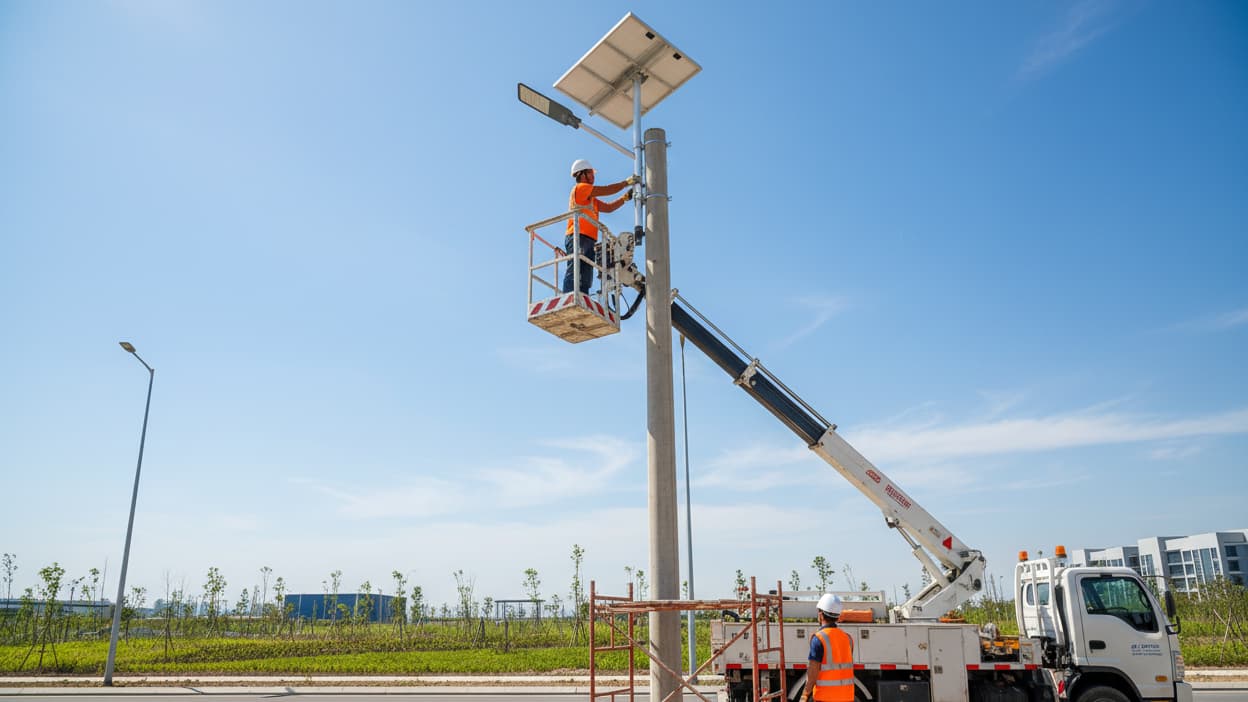
It's 6 AM after a three-day nor'easter. Your facility manager is calling because half the parking lot lights are out. The solar units that were supposed to be "maintenance-free" have gone dark, and now you've got a liability issue before the morning shift even starts.
If this sounds familiar, you're not alone. It's one of the most common complaints we hear from property managers who switched to solar lighting and got burned — not by the technology itself, but by underpowered batteries that couldn't handle a real American winter.
Here's the thing: solar street lights can handle harsh weather. The ones that fail almost always have the same problem — a battery that was sized for sunny-day marketing specs, not for three consecutive overcast days in January in Ohio. This guide is about understanding why that happens, what to look for instead, and which commercial solar lights are actually built to stay on when the weather turns ugly.
The Dirty Secret Behind Most Solar Light Failures
Walk into any big-box store or browse a generic solar lighting site and you'll see lights advertised with impressive wattage numbers — 60W, 100W, 200W. What those listings bury in the fine print (or skip entirely) is the battery capacity in watt-hours (Wh).
Watt-hours are what actually keep your lights on. Wattage tells you how bright the light is; watt-hours tell you how long it can stay bright without solar input. A 100W light with a 100Wh battery will run for about one hour at full brightness with no sun. That's not a commercial lighting solution — that's a flashlight on a pole.
The math isn't complicated. If your light draws 50W and you need it to run for 12 hours, you need 600Wh of battery capacity just for one night. Add a 20% buffer for battery efficiency losses, and you're looking at 720Wh minimum for a single night of operation. Now imagine three cloudy days in a row with minimal solar charging. You need 2,000Wh+ to get through that without dimming — or you need a smart dimming system that stretches your battery by reducing output during low-traffic hours.
Most cheap solar lights ship with 100–200Wh batteries. They look fine in the product photos. They work fine in July in Phoenix. They fail in February in Minneapolis, and they fail in November in Seattle, and they fail after any multi-day storm system anywhere in the continental US.

What "All-Weather" Actually Means for Commercial Solar Lighting
Every solar light manufacturer claims their product is "all-weather" or "weatherproof." That claim usually refers to the IP (Ingress Protection) rating — how well the housing keeps out water and dust. IP65 means the unit is protected against water jets from any direction. IP66 means it can handle powerful water jets. IP67 means it can be submerged briefly.
IP rating matters, but it's not the whole story. True all-weather performance for commercial solar lighting means four things:
- Battery capacity sufficient for multi-day backup — enough stored energy to run through 3–5 consecutive days of minimal solar input
- Battery chemistry that performs in cold — LiFePO4 retains ~80% capacity at 14°F; standard lithium-ion drops to 50–60%
- Wind-rated mounting — commercial poles and mounting hardware rated for 100+ mph wind loads
- Thermal management — the battery and electronics need to handle both extreme heat (Arizona summers hit 115°F+) and extreme cold without degrading prematurely
When you're evaluating commercial solar lights for a US property, ask for specs on all four. If a manufacturer can't answer questions about battery backup days or cold-weather performance, that's your answer.
The Battery Chemistry Question: Why LiFePO4 Is the Standard
There are several lithium battery chemistries used in solar lighting. The two you'll encounter most often are standard lithium-ion (Li-ion) and lithium iron phosphate (LiFePO4). Here's why the distinction matters for commercial applications:
Standard Li-ion: Higher energy density (more Wh per kilogram), lower cost, but degrades faster with temperature cycling, loses significant capacity in cold weather, and has a higher thermal runaway risk. Cycle life is typically 500–1,000 full charge/discharge cycles before significant capacity loss.
LiFePO4: Slightly lower energy density, higher upfront cost, but dramatically better thermal stability, much better cold-weather performance, and a cycle life of 2,000–3,000+ cycles. At 1 cycle per day, that's 5–8 years of daily cycling before meaningful degradation. With smart charging that avoids full discharge, real-world lifespan often exceeds 10 years.
For a commercial installation that you expect to run reliably for a decade, LiFePO4 isn't a premium upgrade — it's the baseline requirement. The cost difference between a Li-ion and LiFePO4 unit is typically $50–$200. The cost of replacing a failed battery pack (parts + labor + downtime) is typically $300–$800. The math is straightforward.
Solid-state battery technology — which replaces the liquid electrolyte in both chemistries with a solid material — is the next step beyond LiFePO4. It promises even higher energy density, better thermal stability, and longer cycle life. Commercial-scale solid-state solar lighting is still emerging, but LiFePO4 delivers most of the practical benefits today and is what you'll find in the best commercial units currently available.

Five Commercial Solar Lights That Actually Hold Up
Let's get specific. Here are five products that are worth your attention for commercial applications — each with honest notes on where they fit and where they don't.
YK030 — The Reliable Workhorse for Smaller Footprints

The YK030 is a 30W unit with 4,800 lumens and 96Wh of LiFePO4 battery capacity. It's rated for 16-grade wind resistance — that's approximately 89 mph sustained wind, which covers most storm scenarios outside of direct hurricane paths.
At 96Wh, the YK030 isn't designed for multi-day backup at full brightness. What it is designed for is reliable, consistent performance for pathway lighting, perimeter marking, and low-traffic areas where you need dependable illumination without the cost of a high-capacity unit. The LiFePO4 battery and 5-year rated lifespan mean you're not replacing this every two years like you would a cheap Li-ion unit.
The SMD5050 LED array is worth noting — it's a commercial-grade LED specification that delivers better color rendering and longer rated life than the generic LED chips used in budget solar lights. For a pathway or perimeter application where you want consistent, quality light rather than maximum brightness, the YK030 hits the mark.
Best for: Walkways, perimeter lighting, campground paths, low-traffic parking areas, residential community roads
Price: $235.00
SZ300 — High-Output Value for Large Coverage Areas

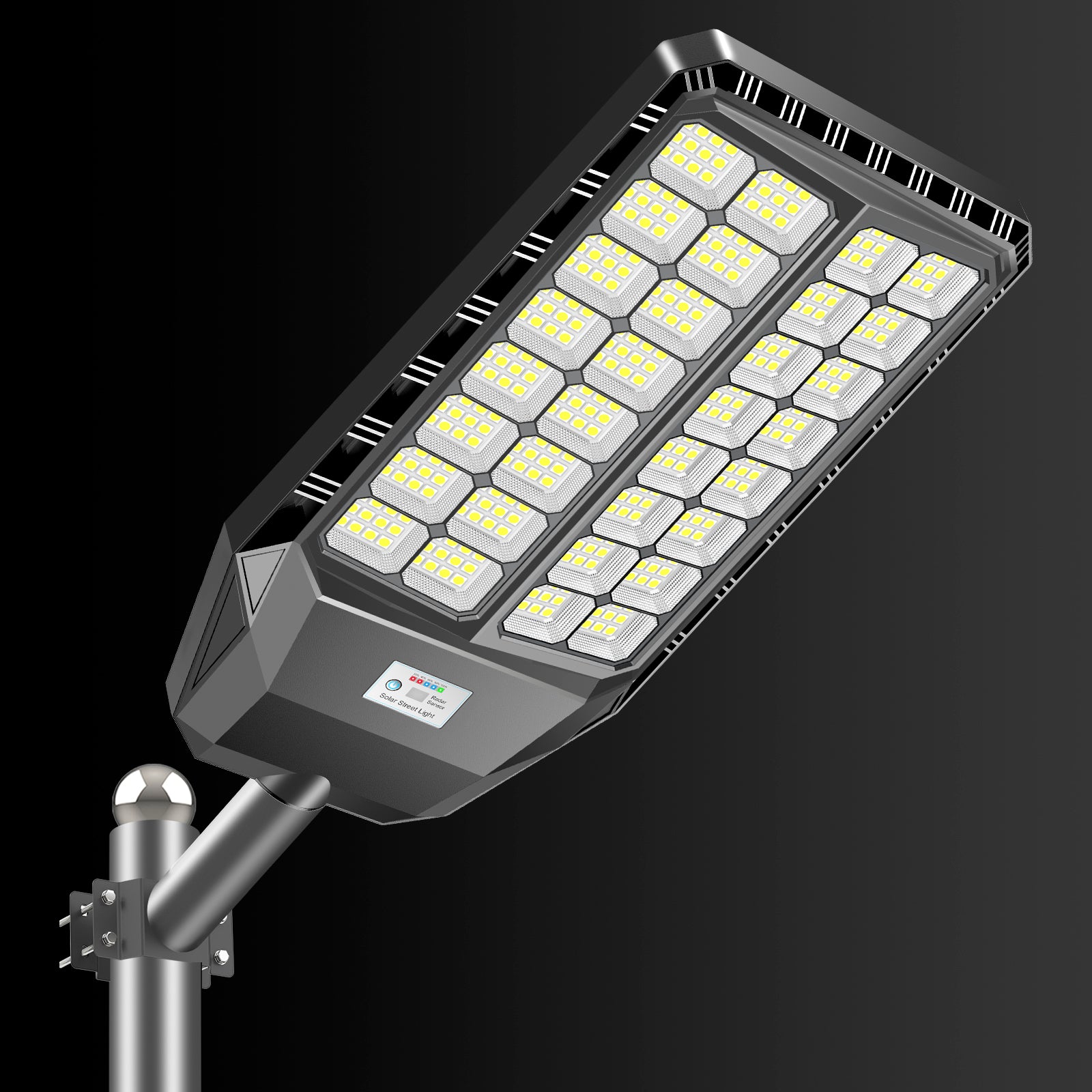
The SZ300 is a different kind of product — it's rated at 400W equivalent output with 60,000 lumens, built on a monocrystalline solar panel with die-cast aluminum housing. At $145, it's the most accessible entry point in the commercial lineup, which makes it worth understanding carefully.
The SZ300 is designed for applications where coverage area is the priority — large open spaces, wide road sections, or industrial yards where you need broad illumination rather than concentrated high-intensity light. The die-cast aluminum housing is a genuine commercial-grade spec: it dissipates heat better than plastic housings, which extends LED life and maintains consistent lumen output over time.
For buyers comparing this to more expensive units: the SZ300 trades battery capacity for coverage breadth. It's the right choice for sunny-climate installations (Southwest, Southeast) or supplemental lighting where you have other light sources providing baseline illumination. For northern climates or standalone critical lighting, step up to a higher-capacity unit.
Best for: Large open areas, industrial yards, supplemental lighting, sunny-climate commercial properties, cost-sensitive projects
Price: $145.00
OK50C — When You Need Flood Coverage, Not Just Street Lighting

Most commercial solar lighting discussions focus on street lights — pole-mounted units designed to illuminate roads and parking lots from above. But a lot of commercial properties need flood lighting: wide-angle illumination for building facades, loading docks, signage, sports areas, or security perimeters where you need to wash a large vertical or horizontal surface with light.
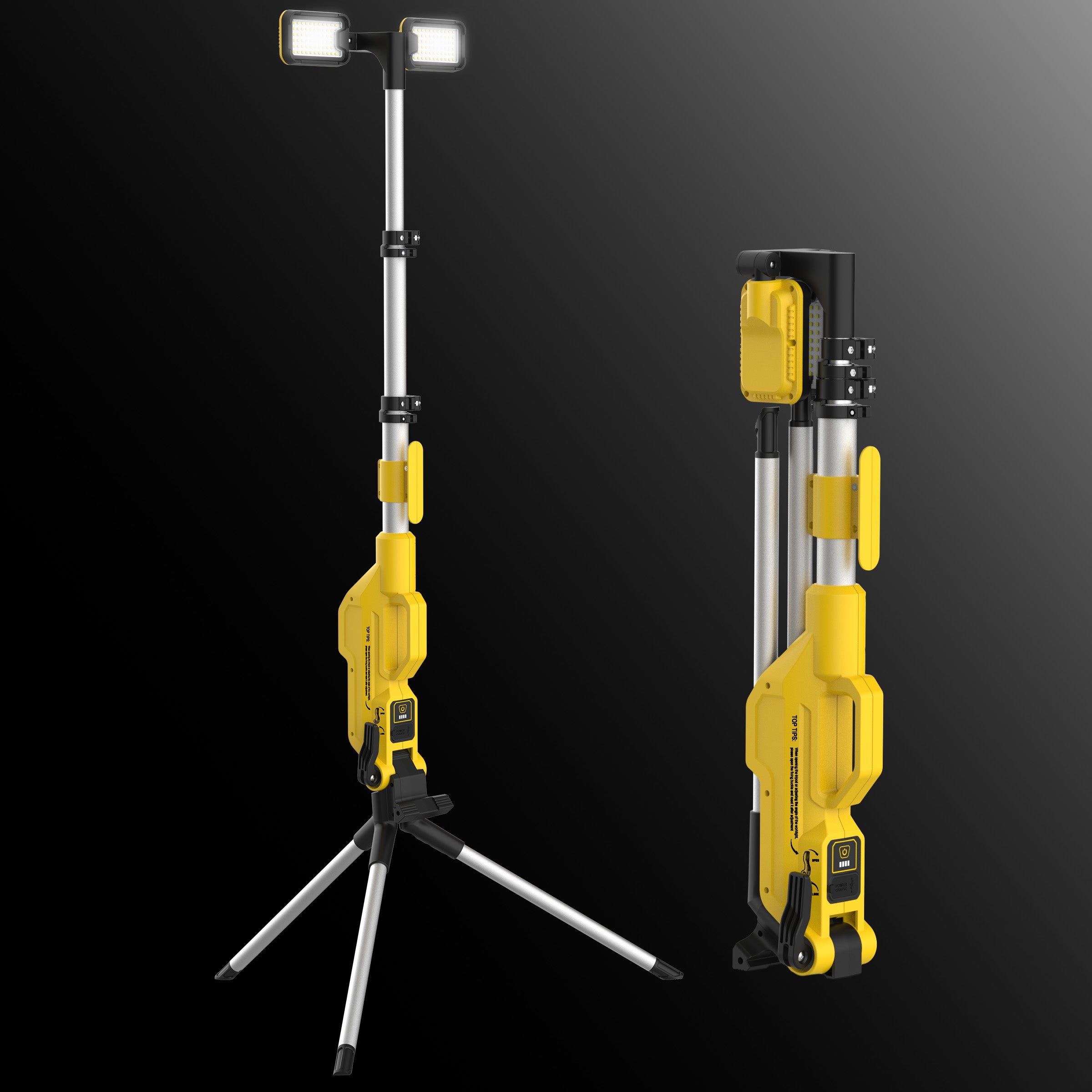
The OK50C fills that gap. It's a 50W solar flood light with 288Wh of battery capacity and customizable lighting modes — you can adjust the beam angle and brightness to match your specific application. The 288Wh battery is meaningful for a flood light: it provides enough backup capacity to handle 2–3 cloudy days at moderate brightness settings.
The customizable lighting feature is genuinely useful for commercial applications. A loading dock needs different light distribution than a building facade, which needs different distribution than a sports court. Rather than buying three different products, the OK50C lets you dial in the beam pattern at installation.
Best for: Building facades, loading docks, security perimeters, signage illumination, sports courts, construction sites
Price: $364.00
→ Shop OK50C Solar Flood Light — $364.00
ZD490 — Wind-Resistant Engineering for Exposed Locations

The ZD490 is the product you want when your installation site is genuinely exposed — coastal properties, open highway shoulders, hilltop facilities, or anywhere that sees sustained high winds regularly. It's built around monocrystalline panels (higher efficiency in low-light conditions) with a wind-resistant design that goes beyond standard IP ratings.
Wind resistance in solar street lights is an underappreciated spec. The solar panel is essentially a sail — a large flat surface mounted at the top of a pole. In high-wind environments, the forces on that panel and its mounting hardware are significant. Cheap mounting systems fail; the ZD490's wind-resistant engineering is designed to handle the kind of sustained wind loads that coastal and exposed-site installations actually experience.
The monocrystalline panel is the other key spec here. Mono panels convert sunlight to electricity more efficiently than polycrystalline alternatives, which matters most in two scenarios: low-light conditions (overcast days, early morning, late afternoon) and installations at higher latitudes where the sun angle is lower. If your property is north of the 40th parallel or regularly sees overcast conditions, mono panels charge meaningfully faster than poly panels.
Best for: Coastal properties, highway shoulders, exposed hilltop sites, wind-prone regions, northern US installations
Price: $853.00
HY100C — The One You Buy When Failure Isn't an Option

We covered the HY100C in our previous guide, but it belongs in this conversation too — because when the topic is weather reliability, the HY100C is the benchmark.
960Wh of LiFePO4 battery capacity. 10-year rated battery lifespan. 100W output with 18,000 lumens. MPPT charge controller. This is the unit you specify when you're lighting a facility where dark parking lots create real liability exposure, when your maintenance team can't easily access the site, or when you're making a 10-year infrastructure commitment and need to know the lights will still be working in 2035.
The 960Wh battery is what makes the HY100C genuinely weather-resilient. Running at full brightness (100W), it has approximately 9–10 hours of stored energy. With a smart dimming schedule — say, 100% from dusk to midnight, 30% from midnight to dawn — that 960Wh stretches to cover 4–5 nights of operation without any solar input. In practical terms, that means the HY100C can handle a full week of heavy overcast without dimming, which covers virtually any weather event in the continental US.
Best for: Critical infrastructure, northern US climates, remote or hard-to-access sites, long-term commercial contracts, any application where reliability is non-negotiable
Price: $1,890.00
Climate-by-Climate Buying Guide for US Properties
The US has wildly different climate zones, and the right commercial solar light for a property in Miami is not the same as the right one for a property in Chicago. Here's a practical breakdown:
Southwest (Arizona, Nevada, Southern California, New Mexico)
You have the best solar resource in the country — 300+ sunny days per year, high solar irradiance, mild winters. Almost any quality commercial solar light will perform well here. Battery backup requirements are lower because you're rarely going more than 1–2 days without meaningful solar charging. The SZ300 ($145) is a strong value play for this region. Heat management matters more than cold-weather performance — look for units with good thermal dissipation in the housing.
Southeast (Florida, Georgia, Carolinas, Gulf Coast)
High humidity and occasional hurricane-force winds are the main challenges. IP65+ rating is essential. Wind-rated mounting hardware is critical for coastal properties. Battery backup matters during hurricane season when you can have 3–5 days of heavy cloud cover. The ZD490 ($853) is worth considering for coastal sites; the OK50C ($364) works well for flood lighting applications common in this region.
Midwest (Ohio, Michigan, Illinois, Minnesota, Wisconsin)
This is the hardest climate for solar lighting in the US. Long winters, frequent multi-day overcast periods, significant snowfall, and temperatures that regularly drop below 0°F. Battery capacity is the critical spec here — you need 480Wh minimum, and 768Wh+ is strongly recommended. LiFePO4 chemistry is non-negotiable for cold-weather performance. The HY100C ($1,890) is the right call for critical applications; the HY100 ($1,399) for standard commercial use.
Pacific Northwest (Washington, Oregon, Northern California)
High annual rainfall, extended overcast periods (Seattle averages 226 cloudy days per year), and mild temperatures. The challenge here is sustained low solar input rather than extreme cold. Battery capacity is the priority — you need enough stored energy to bridge multi-day overcast stretches. The HY100C's 960Wh battery is particularly well-suited to this region. The ZD490's monocrystalline panels also help by maximizing charging efficiency on partially cloudy days.
Northeast (New York, New England, Mid-Atlantic)
Four distinct seasons, significant winter snowfall, nor'easters that can bring 3–5 days of heavy overcast, and cold temperatures that stress standard lithium batteries. Similar requirements to the Midwest — LiFePO4 chemistry and 480Wh+ battery capacity are the baseline. For critical applications, the HY100C is the right specification.
The Maintenance Conversation Nobody Has Before They Buy
Here's a question most buyers don't ask until it's too late: what happens when something goes wrong?
Commercial solar lights have three main failure points: the LED array, the battery, and the charge controller. LED arrays in quality commercial units are rated for 50,000+ hours — at 12 hours per night, that's 11+ years before the LEDs themselves are the problem. Charge controllers are generally reliable if the unit is from a reputable manufacturer.
The battery is where most failures happen, and it's the most important thing to understand before you buy. Questions to ask:
- Is the battery field-replaceable? If not, a battery failure means replacing the entire unit.
- Are replacement batteries available? A manufacturer that's been in business for 5+ years and maintains parts inventory is meaningfully different from one that might not exist in 3 years.
- What does the warranty actually cover? Parts only? Labor? Replacement units? Shipping costs?
- What's the battery's rated cycle life? 2,000 cycles at 1 cycle/day = 5.5 years. 3,000 cycles = 8+ years. This is the number that tells you when you'll need a replacement.
Hykoont's commercial line uses field-replaceable LiFePO4 batteries with rated cycle lives of 2,000–3,000+ cycles. The HY100C's 10-year battery warranty is the strongest in the lineup and reflects genuine confidence in the battery's longevity.
Spec Sheet Red Flags: What to Watch Out For
After looking at hundreds of commercial solar light spec sheets, here are the red flags that consistently predict poor real-world performance:
- No battery capacity listed in Wh — If they only list battery voltage and amp-hours (e.g., "12V 20Ah"), calculate Wh yourself (12 × 20 = 240Wh). If they don't list battery specs at all, walk away.
- "Equivalent" wattage claims — "400W equivalent" means nothing without actual lumen output. Always look for lumens, not equivalent wattage.
- No battery chemistry specified — If the spec sheet doesn't say LiFePO4 or Li-FePO4, assume it's standard lithium-ion and factor in shorter lifespan and worse cold-weather performance.
- Suspiciously low prices for high specs — A 100W solar street light with 1,000Wh of LiFePO4 battery for $89 is not a deal. The battery alone would cost more than that wholesale. Something is wrong with the specs.
- No IP rating or unverified IP claims — IP65 is the minimum for outdoor commercial use. If the listing doesn't specify, assume it's not rated.
- No wind resistance specification — For commercial pole-mounted lights, this is a structural safety issue, not just a performance issue.

Frequently Asked Questions
Q: My solar lights work fine in summer but dim or go out in winter. What's happening?
A: Almost certainly a battery capacity issue combined with cold-weather battery performance loss. In winter, you have shorter days (less solar charging time), lower sun angles (less efficient charging), and colder temperatures (reduced battery capacity). If your lights have standard lithium-ion batteries, they may be losing 30–40% of their rated capacity in cold weather. Upgrading to LiFePO4 chemistry and higher battery capacity (480Wh+) will solve this in most cases.
Q: How do I calculate how much battery capacity I actually need?
A: Start with your light's wattage and your required operating hours. Multiply them: a 50W light running 12 hours needs 600Wh per night. Add 20–25% for battery efficiency losses: 600 × 1.25 = 750Wh for one night. For 3-day backup, multiply by 3: 2,250Wh. In practice, smart dimming (running at 30–50% brightness during low-traffic hours) can cut your effective consumption by 40–60%, which is why MPPT controllers with programmable dimming are worth the investment.
Q: What's the difference between MPPT and PWM charge controllers?
A: PWM (Pulse Width Modulation) controllers are simpler and cheaper. They work by connecting the solar panel directly to the battery and reducing current as the battery fills. MPPT (Maximum Power Point Tracking) controllers are more sophisticated — they continuously adjust the electrical operating point of the solar panel to extract maximum power under varying conditions. In real-world testing, MPPT controllers deliver 15–30% more usable energy than PWM controllers, especially in low-light conditions. For commercial applications, MPPT is worth the cost difference.
Q: Can I install commercial solar street lights myself, or do I need a contractor?
A: The electrical work is straightforward — there's no grid connection, so you're not dealing with high-voltage wiring. However, commercial installations typically require permits, and pole foundation work (digging, concrete, anchor bolts) requires equipment and expertise. Most commercial buyers use a general contractor for the civil work and handle the light mounting themselves or with their maintenance team. Budget for permits, foundation work, and pole installation separately from the light cost.
Q: How do solar street lights perform during a power outage?
A: This is one of solar's genuine advantages over grid-tied lighting — solar street lights are completely independent of the grid, so they keep working during power outages. As long as the battery has charge, the lights stay on. This is particularly valuable for properties where lighting is a safety or security requirement during emergencies.
Q: What maintenance do commercial solar lights actually require?
A: Significantly less than grid-tied lighting, but not zero. The main maintenance tasks are: cleaning the solar panel (dust, bird droppings, and snow accumulation reduce charging efficiency — quarterly cleaning is typical), inspecting mounting hardware annually for corrosion or loosening, and monitoring light output over time to catch early signs of battery degradation. Most commercial LiFePO4 units need no battery service for 5–8 years.
Q: Are there tax incentives for commercial solar lighting in the US?
A: Yes, potentially significant ones. Commercial solar installations may qualify for the federal Investment Tax Credit (ITC), which currently allows businesses to deduct a percentage of solar installation costs from federal taxes. Some states have additional incentives. Solar lighting systems may also qualify for accelerated depreciation under MACRS (Modified Accelerated Cost Recovery System). Consult a tax professional for your specific situation — the savings can meaningfully change the ROI calculation.
Q: How do I handle snow accumulation on the solar panels?
A: Most commercial solar street lights are mounted at angles that allow snow to slide off naturally. For heavy snowfall regions, look for panels with a steeper tilt angle (45°+) and smooth glass surfaces that don't grip snow. In extreme cases, a soft brush on an extension pole can clear panels without scratching the glass. Avoid metal scrapers or pressure washers, which can damage the panel surface.
Q: What's the lead time for commercial solar light orders?
A: For standard in-stock units, expect 3–7 business days for shipping within the continental US. For large commercial orders (20+ units), contact the supplier directly — bulk orders may have different lead times and pricing. Factor in 4–8 weeks for permitting and site preparation when planning your project timeline.
Q: Can I mix different models across a single property?
A: Yes, and it often makes sense. A large commercial property might use high-capacity HY100C units for main parking areas and access roads, YK030 units for pedestrian pathways, and OK50C flood lights for building facades and loading docks. Mixing models lets you right-size the lighting solution for each area rather than over-specifying everywhere.
The Bottom Line on Weather-Resilient Commercial Solar Lighting
The solar lights that fail in storms aren't failing because solar technology doesn't work. They're failing because someone bought a product with a 150Wh battery and expected it to perform like a product with a 960Wh battery. The technology is sound. The spec selection is where most buyers go wrong.
For US commercial properties, the minimum viable spec for reliable year-round performance is: LiFePO4 battery chemistry, 480Wh+ capacity, MPPT charge controller, IP65 rating, and wind-rated mounting hardware. Everything above that is about how much reliability margin you want to build in.
If you're in the Sunbelt and your application isn't critical, the SZ300 at $145 or YK030 at $235 are solid starting points. If you're in the northern US or need lights that stay on no matter what, the HY100C at $1,890 is the specification that delivers that confidence.
Questions about your specific site? Reach out with your location, application, and pole count — we can help you put together a spec that actually works for your climate and your budget.
Shop HY100C — Maximum Reliability Shop ZD490 — Wind-Resistant Build Shop OK50C — Flood Light Option

Leave a comment
This site is protected by hCaptcha and the hCaptcha Privacy Policy and Terms of Service apply.