









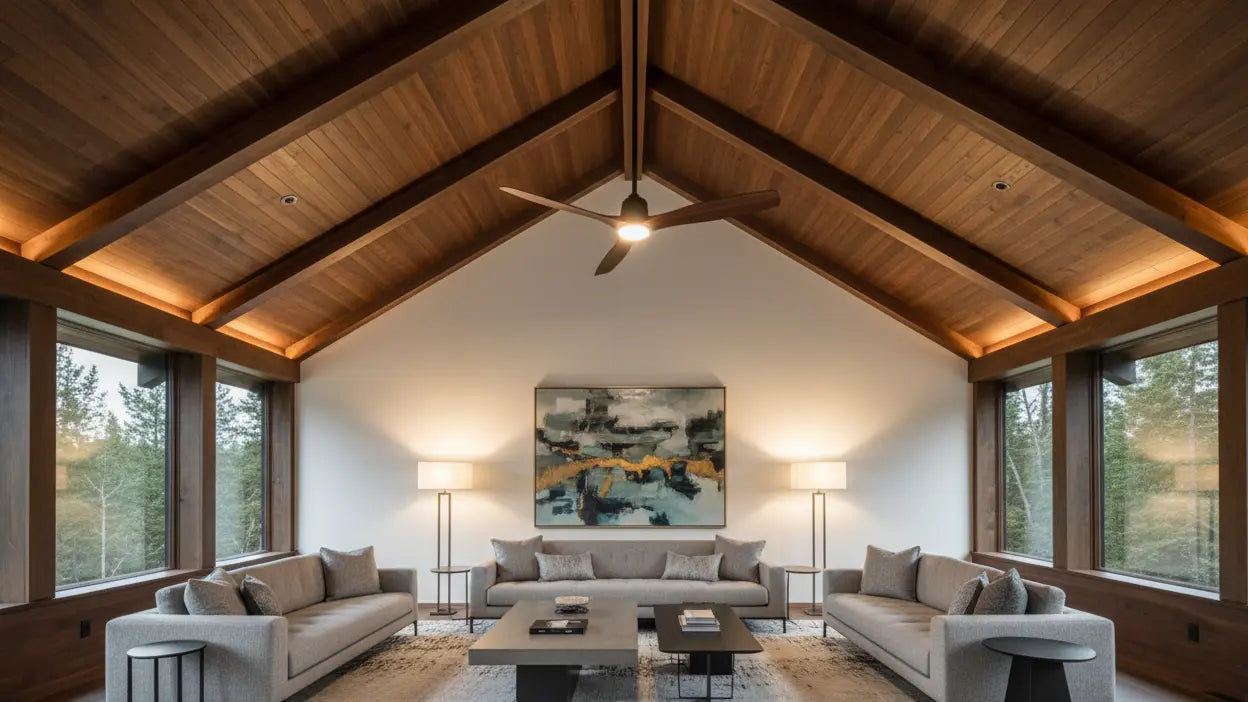
Vaulted ceilings, cathedral ceilings, A-frame rooflines—slanted ceilings are one of the most dramatic architectural features a home can have. They create a sense of openness, volume, and visual interest that flat ceilings simply can't match. But when it comes time to install a ceiling fan, that beautiful slope suddenly becomes a significant engineering challenge.
The question we hear most often: will a flush mount ceiling fan with light work on a slanted ceiling? The short answer is: it depends—on the degree of slope, the specific fan model, and whether you're willing to use the right mounting hardware. The long answer is what this guide is all about.
We'll cover the physics of airflow on angled ceilings, the specific challenges flush mount fans face, every available mounting solution, how to choose the right fan for your space, and what to look for in a modern ceiling fan with light that will perform beautifully on a sloped ceiling for years to come.
Understanding Flush Mount Ceiling Fans: Design Intent and Limitations
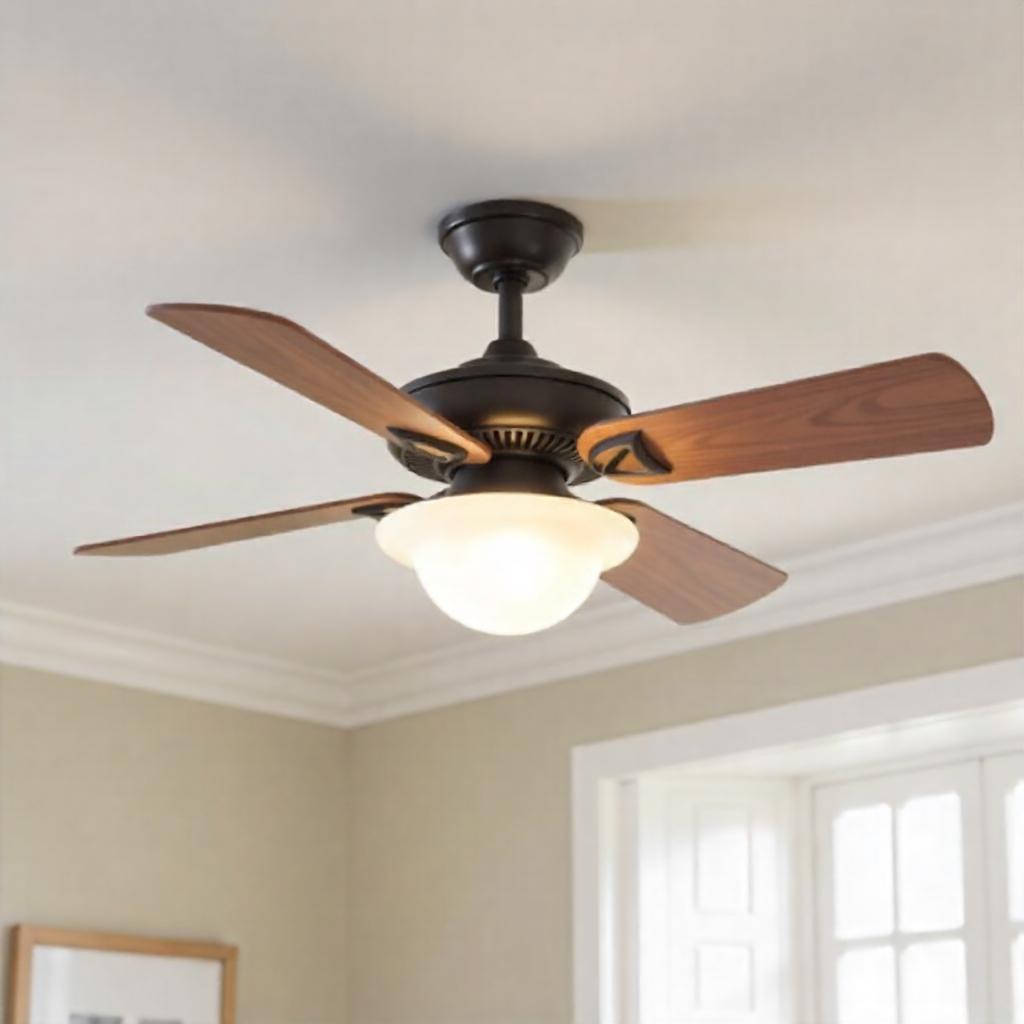
A flush mount ceiling fan (also called a hugger fan) is specifically engineered to mount directly against the ceiling surface with no downrod—or a very short one (typically under 3 inches). This design was created to solve a specific problem: rooms with low ceilings where a standard downrod fan would hang too close to head height.
The flush mount design offers real advantages in the right setting:
- Maximizes headroom in rooms with 7–8 foot ceilings
- Sleek, integrated appearance that sits close to the ceiling plane
- Reduced visual weight in smaller rooms
- Lower center of gravity that can feel more proportionate in compact spaces
However, these same design characteristics create challenges on slanted ceilings. Flush mount fans are engineered with the assumption that the mounting surface is perfectly horizontal. When that assumption is violated—as it is on any sloped ceiling—the fan's performance, safety, and aesthetics can all be compromised.

The Physics of Ceiling Fan Airflow: Why Blade Angle Matters
To understand why slanted ceilings create problems for flush mount fans, it helps to understand how ceiling fans actually move air.
A ceiling fan creates airflow through the pitch (angle) of its blades relative to the horizontal plane. As the blades rotate, their pitch causes them to push air either downward (summer mode, counterclockwise rotation) or upward (winter mode, clockwise rotation). The efficiency of this airflow depends critically on the blades being level—parallel to the floor, not the ceiling.
When a flush mount fan is installed on a slanted ceiling without any angle compensation, the entire fan—motor, blades, and all—tilts at the same angle as the ceiling. This means:
- One side of the blade sweep is closer to the floor than the other
- The airflow is directed at an angle rather than straight down
- The fan creates uneven air circulation, with some areas of the room receiving more airflow than others
- The motor may experience uneven load distribution, potentially shortening its lifespan
- Vibration and noise can increase as the unbalanced load stresses the motor bearings
The severity of these effects depends on the degree of slope. A ceiling with a 1:12 pitch (about 5°) will cause minimal issues; a ceiling with a 6:12 pitch (about 27°) or steeper will create significant airflow and mechanical problems if the fan isn't properly compensated.

How Steep Is Your Ceiling? Understanding Roof Pitch
Before choosing a mounting solution, you need to know your ceiling's slope. Roof pitch is typically expressed as a ratio of rise to run (e.g., 4:12 means the ceiling rises 4 inches for every 12 inches of horizontal distance) or as an angle in degrees.
Here's a practical reference:
- 1:12 to 2:12 (5°–9°): Slight slope—some flush mount fans with angle tolerance can handle this without additional hardware
- 3:12 to 5:12 (14°–23°): Moderate slope—requires an angled mounting kit or sloped ceiling adapter
- 6:12 to 9:12 (27°–37°): Steep slope—requires a downrod fan with a ball-and-socket mount; flush mount is not recommended
- 10:12 and above (40°+): Very steep—requires specialized mounting hardware and professional installation; consult the fan manufacturer before proceeding
To measure your ceiling pitch, use a digital angle finder or a standard level and tape measure. Place the level against the ceiling surface and measure the rise over a 12-inch horizontal run. This gives you your pitch ratio.
The 3 Core Challenges of Installing a Flush Mount Fan on a Slanted Ceiling
Challenge 1: Airflow Efficiency and Direction
As explained above, a tilted fan creates angled airflow rather than the vertical circulation a ceiling fan is designed to produce. In a room with a vaulted ceiling, this is particularly problematic because the ceiling geometry already creates natural air stratification—warm air rises and collects at the peak, while cooler air settles near the floor. A properly installed ceiling fan counteracts this stratification by actively mixing the air column. A tilted flush mount fan may actually worsen stratification by directing airflow toward one wall rather than down through the room.
The practical result: you'll feel less airflow where you're sitting, the fan will work harder to achieve the same effect, and your energy bills will be higher than they should be.
Challenge 2: Mechanical Stress and Longevity
Ceiling fan motors are designed to operate with their shaft perfectly vertical. When the motor is tilted, the rotor and stator experience uneven magnetic forces, and the bearings carry asymmetric loads they weren't designed for. Over time, this accelerates bearing wear, increases vibration, and can lead to premature motor failure—often within 2–3 years rather than the 10–15+ years a properly installed fan should last.
Additionally, the fan's mounting hardware—the canopy, mounting bracket, and ceiling box—experiences shear forces when the fan is tilted. These forces can loosen connections over time, creating a safety hazard. This is why most manufacturers explicitly void the warranty if a flush mount fan is installed on a slope beyond their specified tolerance.
Challenge 3: Aesthetics and Lighting Distribution
A flush mount ceiling fan with light installed at an angle looks visually off-balance. The canopy won't sit flush against the ceiling, gaps may appear on one side, and the integrated light will direct illumination at an angle rather than downward. In a room where the ceiling is a design feature—as vaulted ceilings typically are—a poorly installed fan can undermine the entire aesthetic.
Uneven lighting distribution is a practical problem too: one side of the room will be brighter than the other, creating uncomfortable contrast and potentially requiring supplemental lighting to compensate.

5 Solutions for Installing a Ceiling Fan on a Slanted Ceiling
Solution 1: Angled Mounting Kit (Sloped Ceiling Adapter)
An angled mounting kit—also called a sloped ceiling adapter or vaulted ceiling adapter—is a specialized canopy that allows the fan's downrod to hang vertically even when the ceiling is sloped. The adapter's canopy is designed to sit flush against the angled ceiling surface while the internal ball-and-socket joint allows the downrod to pivot to vertical.
Most angled mounting kits are rated for ceilings up to 45° or 52° of slope. They're available from fan manufacturers as accessories or from third-party suppliers. Key considerations:
- The kit must be compatible with your specific fan model—check the manufacturer's compatibility list
- You'll need a downrod of appropriate length to maintain safe blade-to-floor clearance (minimum 7 feet recommended)
- The ceiling electrical box must be rated for fan use (not just light fixtures) and properly anchored to ceiling framing
This solution works for fans that support downrod installation—which brings us to an important point: if you're committed to a flush mount fan specifically, this solution requires switching to a downrod configuration, which changes the fan's profile significantly.
Solution 2: Downrod Installation with Ball-and-Socket Mount
The most reliable and widely recommended solution for slanted ceilings is a downrod ceiling fan with a ball-and-socket mounting system. This is the standard mounting method for most modern ceiling fans with light, and it's specifically designed to accommodate sloped ceilings.
In a ball-and-socket mount, the top of the downrod has a ball that sits in a socket in the ceiling canopy. This allows the downrod—and therefore the fan—to hang perfectly vertical regardless of the ceiling angle. The canopy is designed to accommodate a range of slopes, typically up to 45–52°.
The advantages of this approach:
- The fan hangs level, ensuring optimal airflow efficiency
- The motor operates in its designed orientation, maximizing longevity
- The aesthetic is clean and intentional—the fan clearly hangs from the ceiling rather than sitting awkwardly against it
- Downrod length can be adjusted to achieve the ideal blade height for your room
The one trade-off: in rooms with lower slanted ceilings (common in A-frame homes or rooms under a staircase), the downrod may bring the fan too close to head height at the lower end of the ceiling. In these cases, use the shortest possible downrod and position the fan toward the higher end of the ceiling slope.
Solution 3: Flush Mount Fan with Built-In Angle Tolerance
Some flush mount ceiling fans are designed with a small degree of angle tolerance built into their mounting system. These fans can typically accommodate slopes of up to 15–20° without additional hardware. Check the manufacturer's specifications carefully—this information is usually listed as "maximum slope angle" or "sloped ceiling compatible up to X degrees."
If your ceiling slope falls within the fan's rated tolerance, this is the simplest solution—no additional hardware required. However, be conservative: if your ceiling is at the upper limit of the fan's tolerance, the mechanical stress and airflow issues described above will still be present, just within acceptable limits.
Solution 4: Ceiling Fan Medallion or Mounting Block
For very slight slopes (under 5°), a ceiling fan medallion or mounting block can create a level mounting surface. A mounting block is a wedge-shaped piece of wood or composite material that is attached to the ceiling at the fan location, creating a flat, horizontal surface for the fan canopy to mount against.
This solution is primarily cosmetic and structural—it doesn't address the fundamental issue of the fan motor being tilted. It's only appropriate for very slight slopes where the tilt is minimal enough not to cause significant airflow or mechanical issues. For anything steeper than about 5°, use one of the solutions above.
Solution 5: Professional Custom Installation
For very steep slopes (above 45°) or unusual ceiling geometries, a professional electrician or carpenter can create a custom mounting solution. This might involve building a level mounting platform into the ceiling structure, installing a specialized junction box at a specific angle, or using extended custom downrods. This is the most expensive option but may be the only viable one for extreme architectural situations.

Choosing the Right Ceiling Fan for a Slanted Ceiling: Key Specifications
Whether you're using a downrod fan with a ball-and-socket mount or a flush mount fan with angle tolerance, certain specifications matter more for slanted ceiling installations than for standard flat-ceiling applications.
Motor Type: DC vs. AC
DC motors are strongly preferred for slanted ceiling installations. Here's why:
- DC motors are significantly more efficient—typically 70–75% more energy-efficient than AC motors—which matters more when the fan is working harder due to a non-ideal installation angle
- DC motors run cooler, which reduces heat-related stress on bearings that may already be under asymmetric load
- DC motors are quieter—under 25dB in many models—which is important because any vibration from an imperfect installation is amplified by a noisy motor
- DC motors offer more speed settings (typically 6 speeds vs. 3 for AC), giving you finer control over airflow
Blade Span: Matching Fan Size to Room Volume
Rooms with vaulted or slanted ceilings typically have more volume than their floor area suggests. A room that's 12 feet wide might have a ceiling that peaks at 16 feet—significantly more air volume than a standard 8-foot ceiling room of the same footprint. This means you generally need a larger blade span than you would for a flat-ceiling room of the same floor area:
- Rooms up to 150 sq ft: 42–48 inch blade span
- Rooms 150–300 sq ft: 52–60 inch blade span
- Rooms 300–500 sq ft: 60–72 inch blade span
- Large open-plan spaces with vaulted ceilings: 72 inch or larger, or multiple fans
Downrod Length: Achieving Optimal Blade Height
For downrod installations on slanted ceilings, blade height is measured at the lowest point of the blade sweep (the low end of the ceiling slope). The minimum recommended blade-to-floor clearance is 7 feet for safety. Calculate your required downrod length as follows:
Downrod Length = Ceiling Height at Fan Location – Motor Housing Height – Blade Thickness – 7 feet (minimum clearance)
Most fans include multiple downrod lengths (commonly 5" and 10") and are compatible with extended downrods available separately. For high vaulted ceilings, you may need a 24", 36", or even 48" downrod.
Reversible Motor: Essential for Vaulted Ceilings
A reversible motor is particularly valuable in rooms with vaulted ceilings. In summer, counterclockwise rotation pushes cool air down. In winter, clockwise rotation at low speed pulls cool air up and pushes warm air (which collects at the ceiling peak) down along the walls—dramatically improving heating efficiency in high-ceiling rooms. Look for fans with a remote-controlled reversible motor so you can switch modes without climbing a ladder.
Integrated Lighting: CCT and Brightness
For rooms with slanted ceilings, integrated lighting with adjustable color temperature (CCT) is particularly valuable. Vaulted ceiling rooms often serve multiple functions—living areas, dining spaces, home offices—and the ability to switch between warm (3000K), neutral (4000K), and cool (6000K) light allows the fan to serve all these functions without supplemental fixtures.

Recommended Ceiling Fans for Slanted and Vaulted Ceilings
Based on the specifications above, here are three Hykoont ceiling fans that are particularly well-suited for slanted ceiling installations, all featuring downrod designs with ball-and-socket compatible mounting systems:
Hykoont 48"/60"/72" Black Walnut Ceiling Fan with Light, 3 CCT — Best for Living Rooms and Open-Plan Spaces
This is one of the most versatile ceiling fans in Hykoont's lineup, and its combination of features makes it an excellent choice for vaulted ceiling rooms. The 35W reversible DC motor delivers powerful, whisper-quiet airflow at 6 adjustable speeds, while the 3 CCT lighting system (3000K warm / 4000K natural / 6000K cool) with memory function means the fan remembers your preferred light setting between uses.
Key specifications for slanted ceiling suitability:
- Blade sizes: 48", 60", and 72"—covering everything from medium bedrooms to large open-plan living areas with vaulted ceilings
- Downrod design with included 5" and 10" downrods, compatible with extended downrods for high ceilings
- 5 dual-sided blades (dark walnut / light walnut) for design flexibility
- Reversible motor with remote control—switch between summer and winter modes without a ladder
- 1/4/8 hour intelligent timer for automated operation
- 15W LED light disk with 3 CCT settings and memory function
- Ultra-quiet operation at as low as 35dB
The 72" blade span option is particularly well-suited for large rooms with cathedral ceilings, where a smaller fan would be overwhelmed by the room volume. The dual-sided blade design also gives you flexibility to match either a darker or lighter interior aesthetic without purchasing a different fan.
Hykoont Black Wood Ceiling Fan with Light | Downrod Design, Quiet Operation 62"/72" — Best for Large Rooms and High Vaulted Ceilings
When you need serious airflow coverage in a large room with a high vaulted ceiling, the 62" and 72" blade options of this fan deliver. The 32W ETL-certified DC motor is 75% more energy-efficient than traditional AC motors—a meaningful advantage in a large room where the fan may run for extended periods to overcome the thermal stratification common in high-ceiling spaces.
Key specifications for slanted ceiling suitability:
- Blade sizes: 62" and 72"—ideal for large living rooms, great rooms, and open-plan spaces with vaulted ceilings
- Downrod design with 5" and 10" downrods included; compatible with extended downrods for very high ceilings
- 3 premium black walnut wood blades for a natural, warm aesthetic that complements exposed beam ceilings common in vaulted ceiling homes
- Whisper-quiet operation under 25dB—critical in open-plan spaces where fan noise carries throughout the room
- Reversible motor with remote control for year-round efficiency
- ETL and FCC certified for safety and electromagnetic compliance
- Lifetime motor warranty
The natural wood blade aesthetic is particularly well-suited to homes with exposed timber framing, wooden beams, or rustic-modern interior styles—all of which are common in homes with dramatic vaulted ceilings. The under-25dB noise level ensures the fan remains unobtrusive even in quiet, open spaces.
Hykoont Ceiling Fan with Light | Solid Wood Blades, Downrod Design, 6 Speeds 52"/60"/72" — Best for Versatility Across Room Sizes
This fan's combination of three blade size options (52", 60", 72"), a choice between 3-blade and 5-blade configurations, and a lifetime motor warranty makes it the most versatile option in Hykoont's lineup for slanted ceiling applications. Whether you're fitting a bedroom with a modest slope or a great room with a dramatic cathedral ceiling, there's a configuration here that works.
Key specifications for slanted ceiling suitability:
- Blade sizes: 52", 60", and 72" with 3-blade or 5-blade options—choose based on room size and aesthetic preference
- Downrod design with included downrods; compatible with extended downrods
- 32W energy-saving DC motor—75% more efficient than AC motors, ETL-certified
- High-quality solid walnut wood blades for premium aesthetics and durability
- 6 adjustable speeds with remote control for precise airflow management
- Reversible motor for year-round use
- Whisper-quiet under 25dB
- Lifetime motor warranty—the strongest warranty commitment in Hykoont's lineup
The 3-blade option moves air more efficiently at higher speeds (ideal for cooling in summer), while the 5-blade option provides smoother, quieter airflow at lower speeds (ideal for gentle circulation in winter or in bedrooms). Having both options available in the same model is a genuine advantage for buyers who want to optimize for their specific use case.

Step-by-Step Installation Guide for Ceiling Fans on Slanted Ceilings
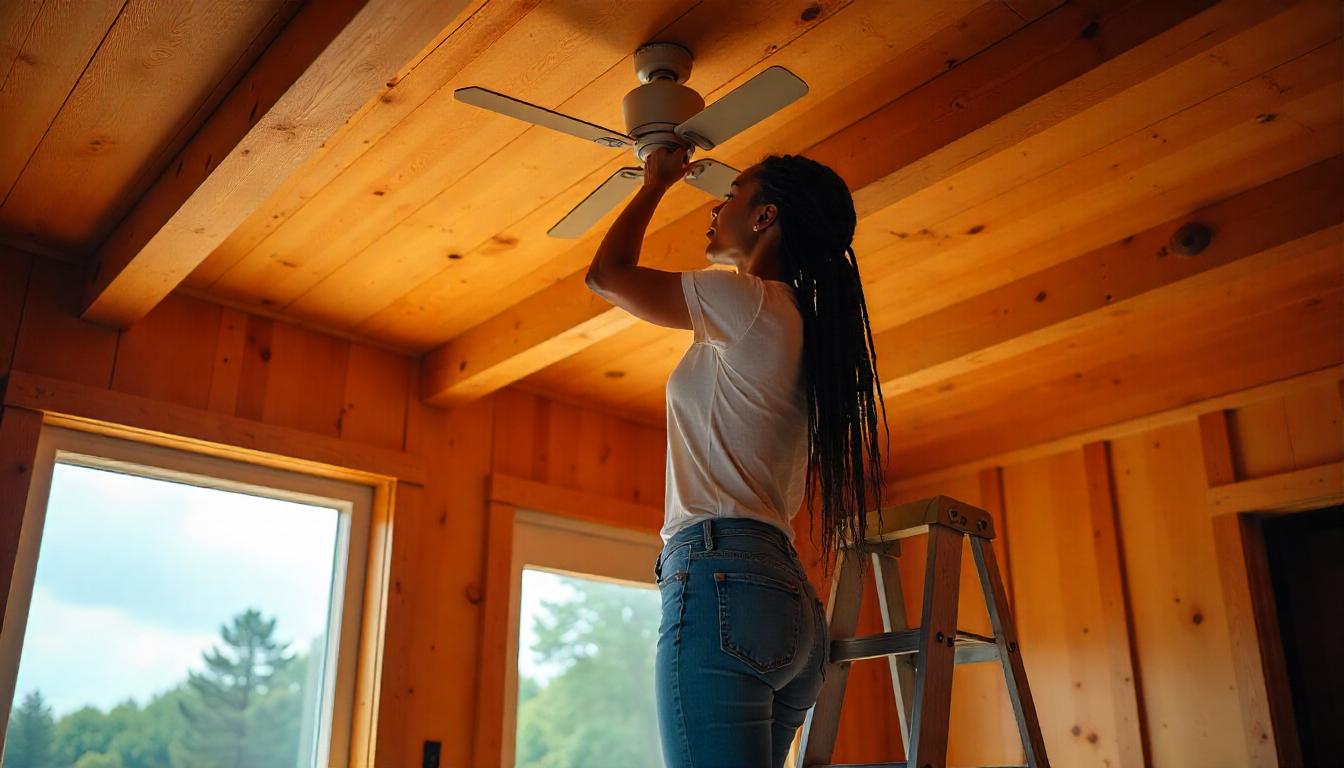
Once you've selected the right fan and mounting solution, here's a practical installation overview. Note: always consult a licensed electrician for any work involving your home's electrical system.
Step 1: Assess and Prepare the Ceiling Box
The ceiling electrical box must be rated for fan support (minimum 35 lbs, ideally 50 lbs). Standard light fixture boxes are NOT rated for fan use—the vibration and dynamic load of a spinning fan will eventually loosen or break a standard box. Replace with a fan-rated box anchored directly to ceiling framing or a fan brace bar rated for your fan's weight.
Step 2: Install the Mounting Bracket
For sloped ceiling installations with a ball-and-socket mount, the mounting bracket attaches to the ceiling box. Ensure the bracket is level (use a bubble level) and securely fastened. For angled mounting kits, follow the kit manufacturer's specific instructions for bracket orientation.
Step 3: Assemble the Downrod
Thread the wiring through the downrod and attach the downrod to the motor housing according to the fan manufacturer's instructions. Select the appropriate downrod length for your ceiling height, ensuring a minimum 7-foot blade-to-floor clearance at the lowest point of the blade sweep.
Step 4: Hang the Fan
With a helper, lift the fan and seat the downrod ball into the mounting bracket socket. The ball-and-socket joint will allow the fan to hang vertically even as the canopy sits against the angled ceiling. Verify the fan hangs level before proceeding.
Step 5: Make Electrical Connections
Connect the fan wiring to the house wiring according to the wiring diagram in the fan's manual. Typically: black to black (hot), white to white (neutral), green or bare copper to green or bare copper (ground). If your fan has a separate light kit, there may be an additional blue wire for the light circuit. Cap all connections with wire nuts and tuck neatly into the canopy.
Step 6: Attach the Canopy and Blades
Slide the canopy up to cover the ceiling box and secure it. Attach the blade brackets to the motor housing and then attach the blades to the brackets. Ensure all screws are tight—loose blades are a common cause of wobble and noise.
Step 7: Balance and Test
Power on the fan and test all speeds. Check for wobble—a small amount is normal, but significant wobble indicates a blade is out of balance. Use the balancing clip included with most fans to identify and correct the imbalance. Test the light at all CCT settings and brightness levels.

Common Mistakes to Avoid
- Using a standard light fixture box: This is a safety hazard. Always use a fan-rated ceiling box.
- Ignoring the manufacturer's slope rating: Installing a fan beyond its rated slope angle voids the warranty and creates safety risks.
- Choosing too small a blade span: Vaulted ceiling rooms have more air volume than their floor area suggests. Size up.
- Skipping the downrod length calculation: Too short a downrod on a high ceiling reduces airflow effectiveness; too long creates a safety hazard at the low end of the slope.
- Installing without a helper: Ceiling fan installation on a slanted ceiling requires at least two people—one to hold the fan, one to make connections.
- Neglecting the reversible motor feature: In rooms with vaulted ceilings, winter mode (clockwise rotation) can reduce heating costs by 10–15% by redistributing warm air that collects at the ceiling peak.
Frequently Asked Questions
What is the maximum slope angle for a flush mount ceiling fan?
Most flush mount ceiling fans are designed for flat ceilings and have a maximum slope tolerance of 0–15°. Some models specify up to 20°. Always check the manufacturer's specifications. For slopes above 15–20°, a downrod fan with a ball-and-socket mount is strongly recommended.
Do I need a special ceiling box for a slanted ceiling fan installation?
Yes—you need a fan-rated ceiling box (not a standard light fixture box) regardless of ceiling angle. For slanted ceilings, you may also need an angled ceiling box or a fan brace bar that can be positioned to create a level mounting surface. Consult a licensed electrician if you're unsure about your existing ceiling box.
How long a downrod do I need for a vaulted ceiling?
Calculate: Ceiling height at fan location minus motor housing height minus blade thickness minus 7 feet (minimum clearance) equals required downrod length. For a 12-foot ceiling with a standard motor housing, you'd typically need a 36–48" downrod. Most fans include short downrods (5–10") and are compatible with extended downrods available separately.
Will a ceiling fan on a slanted ceiling wobble?
A properly installed fan with a ball-and-socket mount hanging vertically should not wobble more than a fan on a flat ceiling. Wobble is caused by blade imbalance, loose blade brackets, or an improperly seated ball-and-socket joint—not by the ceiling angle itself. Use the balancing clip included with your fan to correct any imbalance after installation.
Can I install a ceiling fan on a very steep ceiling myself?
For slopes above 30°, professional installation is strongly recommended. The physical challenges of working on a steep slope, combined with the electrical work and the weight of the fan, create significant safety risks for DIY installation. The cost of professional installation is modest compared to the cost of a fan damaged by a fall or an electrical fault.
Does a ceiling fan on a vaulted ceiling actually help with heating costs?
Yes—significantly. Warm air rises and collects at the peak of a vaulted ceiling, where it does nothing to heat the occupied space. Running the fan in clockwise (winter) mode at low speed pulls cool air up and pushes warm air down along the walls, redistributing it to the occupied zone. Studies have shown this can reduce heating costs by 10–15% in rooms with high ceilings.
Conclusion: The Right Fan, Properly Installed, Makes All the Difference
A flush mount ceiling fan can work on a slanted ceiling—but only within a limited slope range and with the right mounting hardware. For most slanted ceiling applications, a downrod ceiling fan with a ball-and-socket mount is the superior solution: it hangs level regardless of ceiling angle, operates in its designed orientation for maximum efficiency and longevity, and looks intentional rather than awkward.
The key decisions are: measure your ceiling slope accurately, choose a fan with the right blade span for your room's volume, select the correct downrod length for safe blade clearance, and prioritize a DC motor for efficiency and quiet operation. A reversible motor is essential for year-round benefit in vaulted ceiling rooms, and adjustable CCT lighting adds versatility that single-temperature fixtures can't match.
Hykoont's downrod ceiling fan lineup—including the 48"/60"/72" Black Walnut 3 CCT fan, the 62"/72" Black Wood Quiet Operation fan, and the 52"/60"/72" Solid Wood Blades fan with lifetime motor warranty—offers the blade sizes, motor efficiency, and mounting flexibility needed for successful slanted ceiling installations. With the right fan and proper installation, your vaulted ceiling room can enjoy powerful, efficient, whisper-quiet airflow and beautiful integrated lighting for years to come.


Leave a comment
This site is protected by hCaptcha and the hCaptcha Privacy Policy and Terms of Service apply.