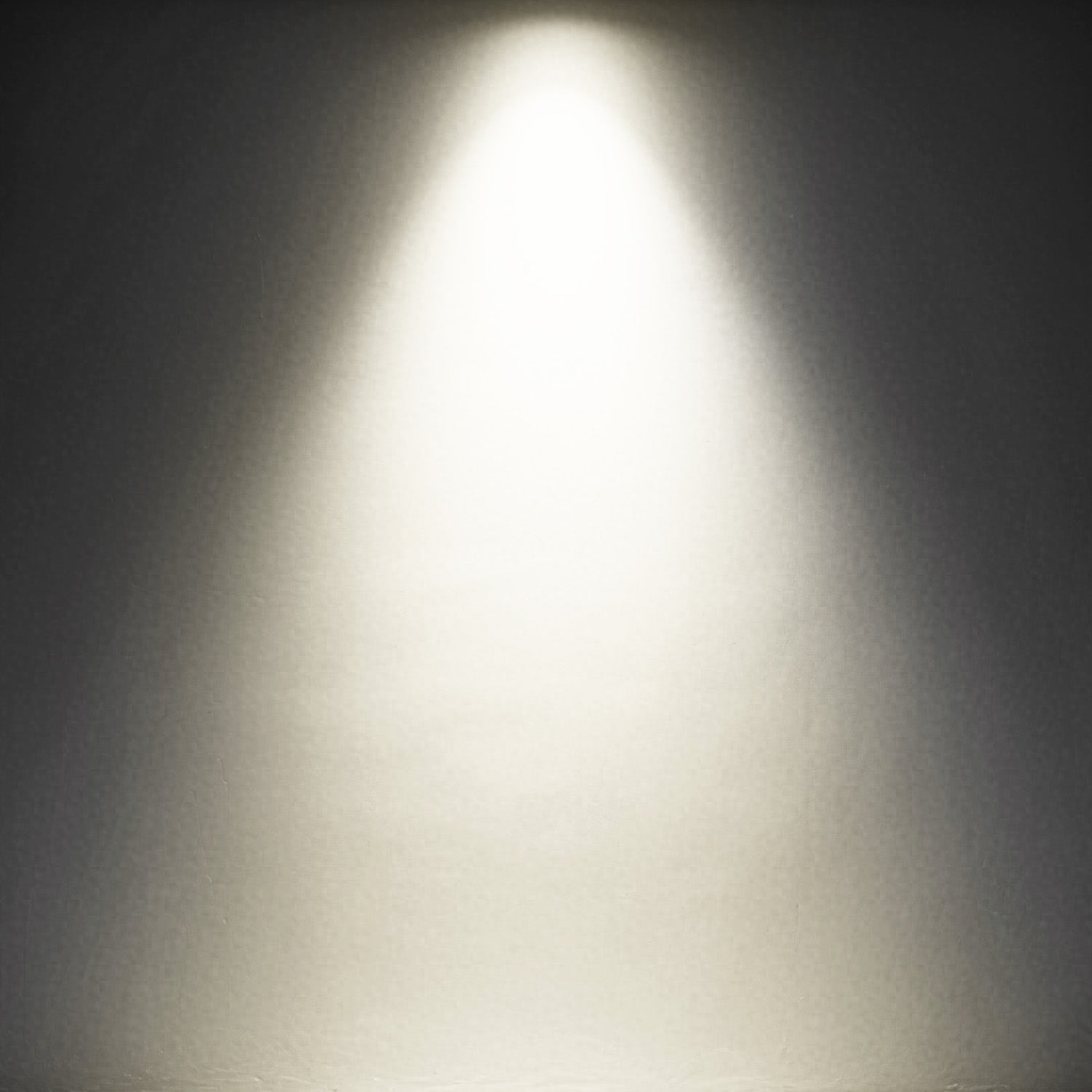
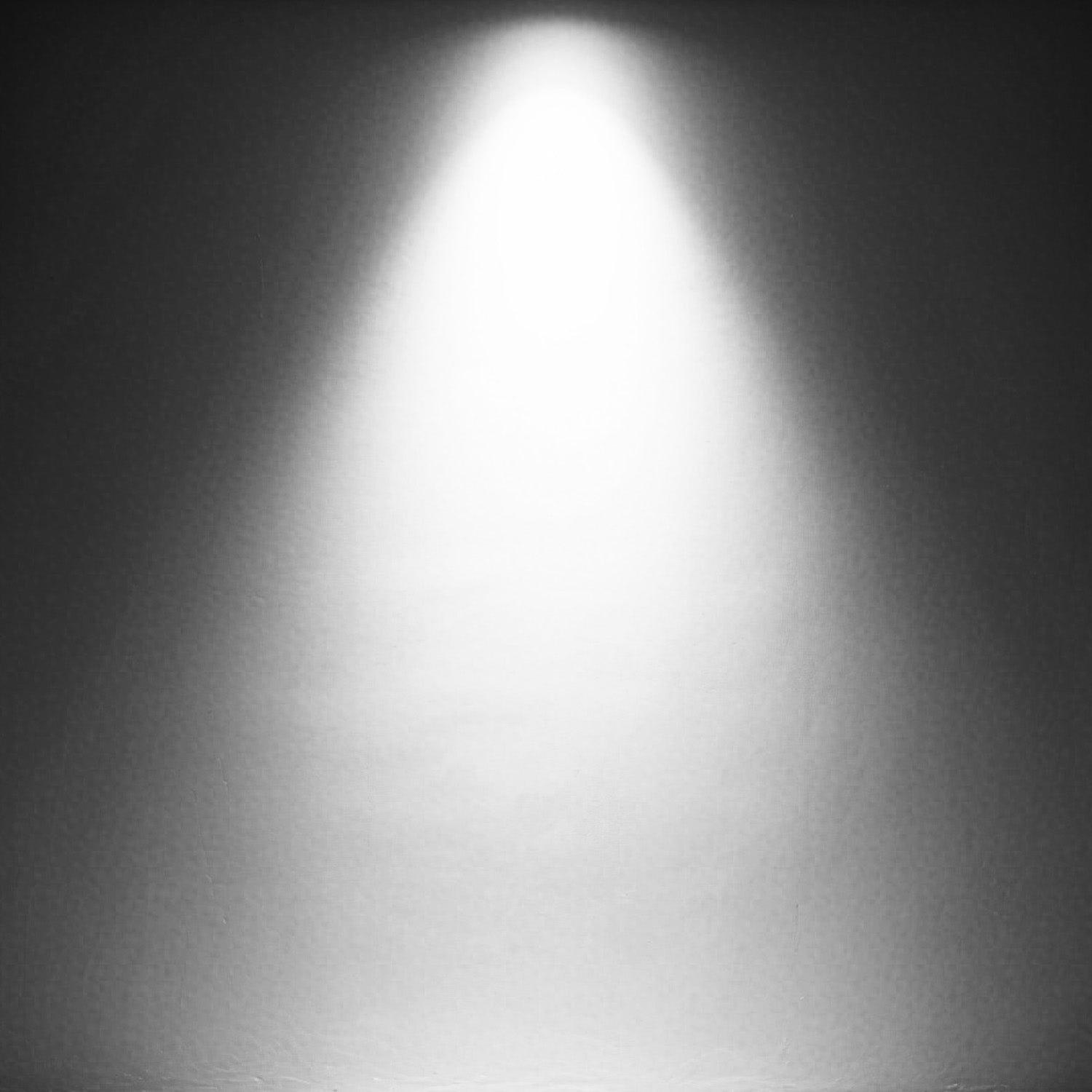
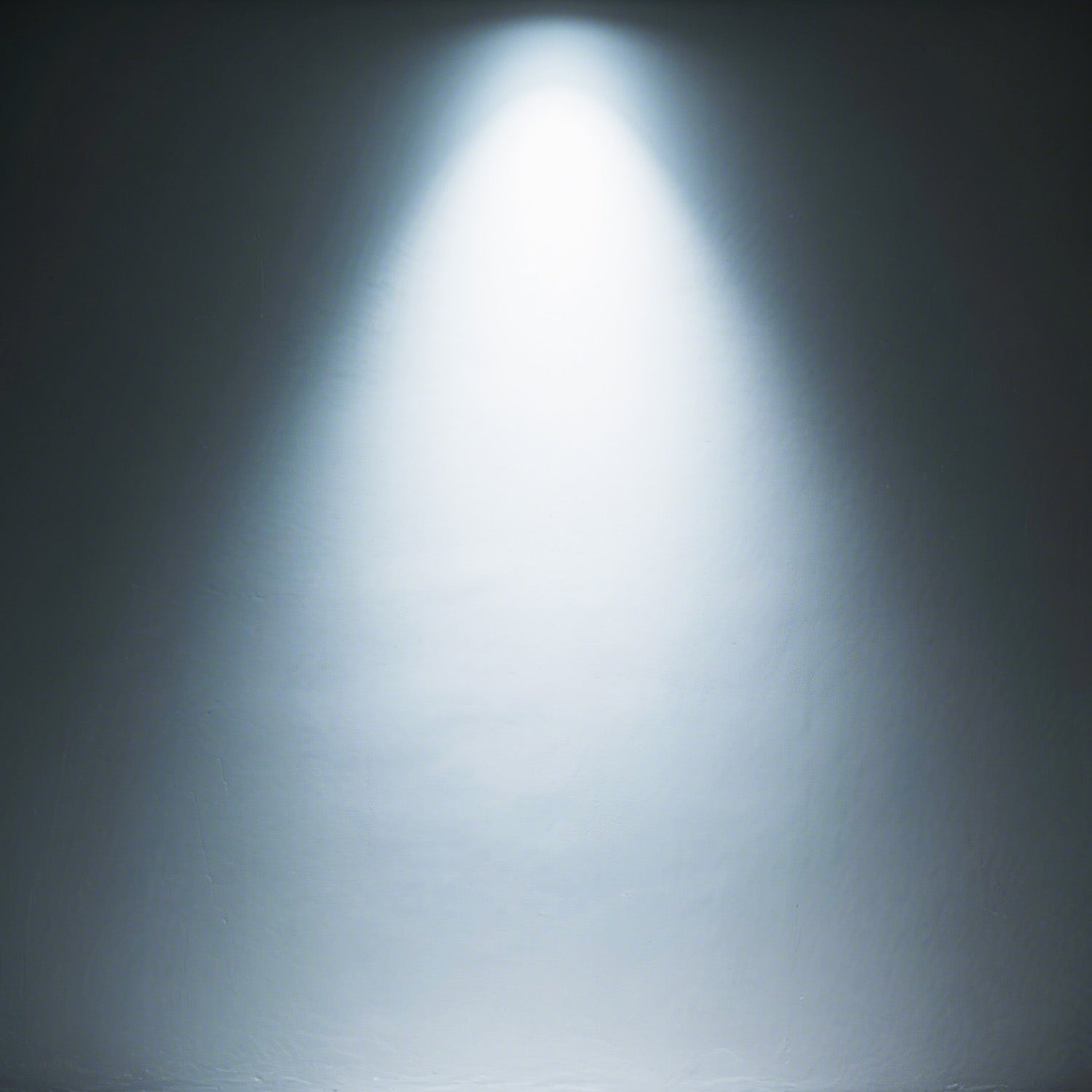








The driveway looks bright. So why are you still squinting?
It is a familiar problem: you pull in after dinner, a motion light wakes up, and the first thing you notice is the fixture itself. Not the edge of the pavement. Not the package beside the gate. Just a hard white rectangle staring back at you through the windshield.
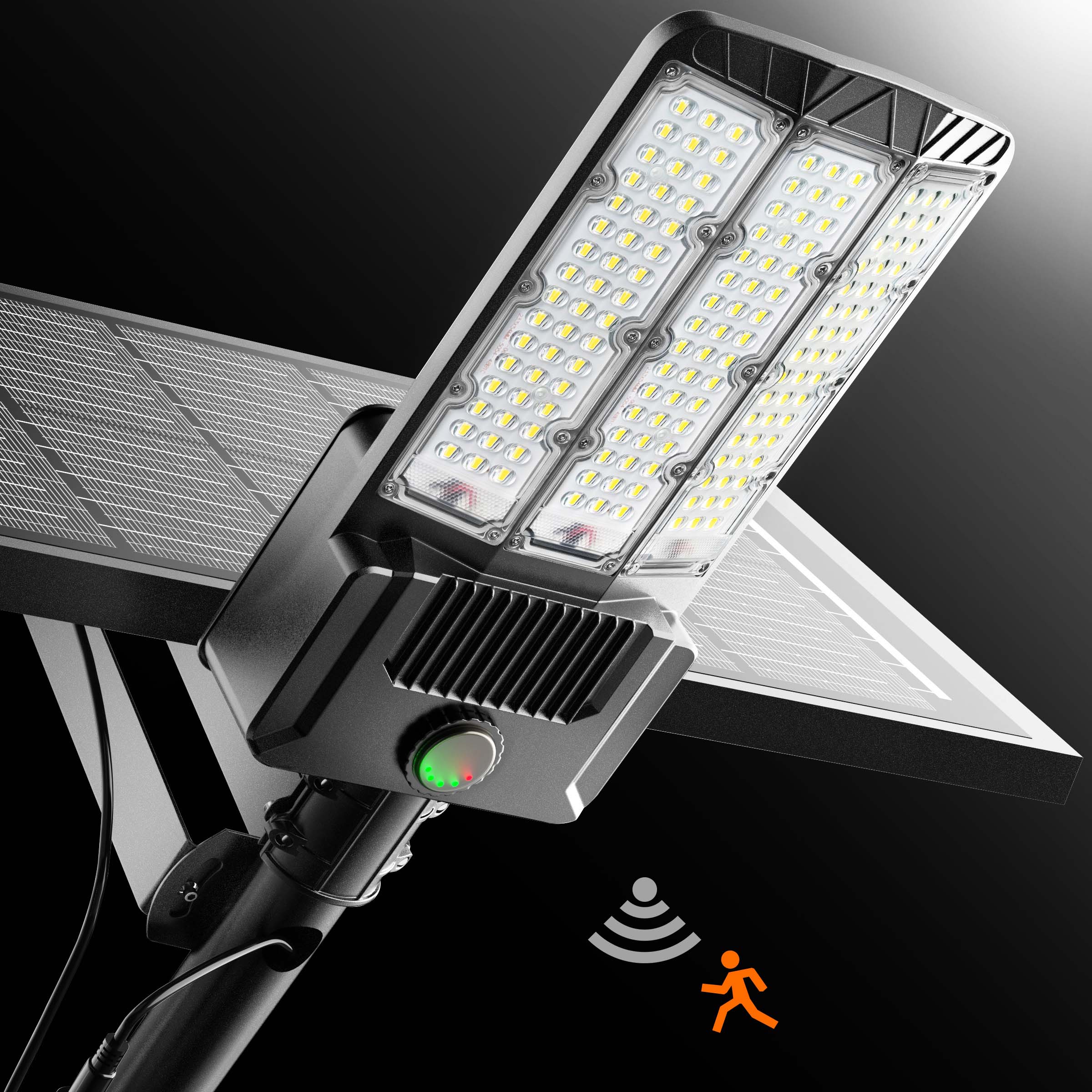
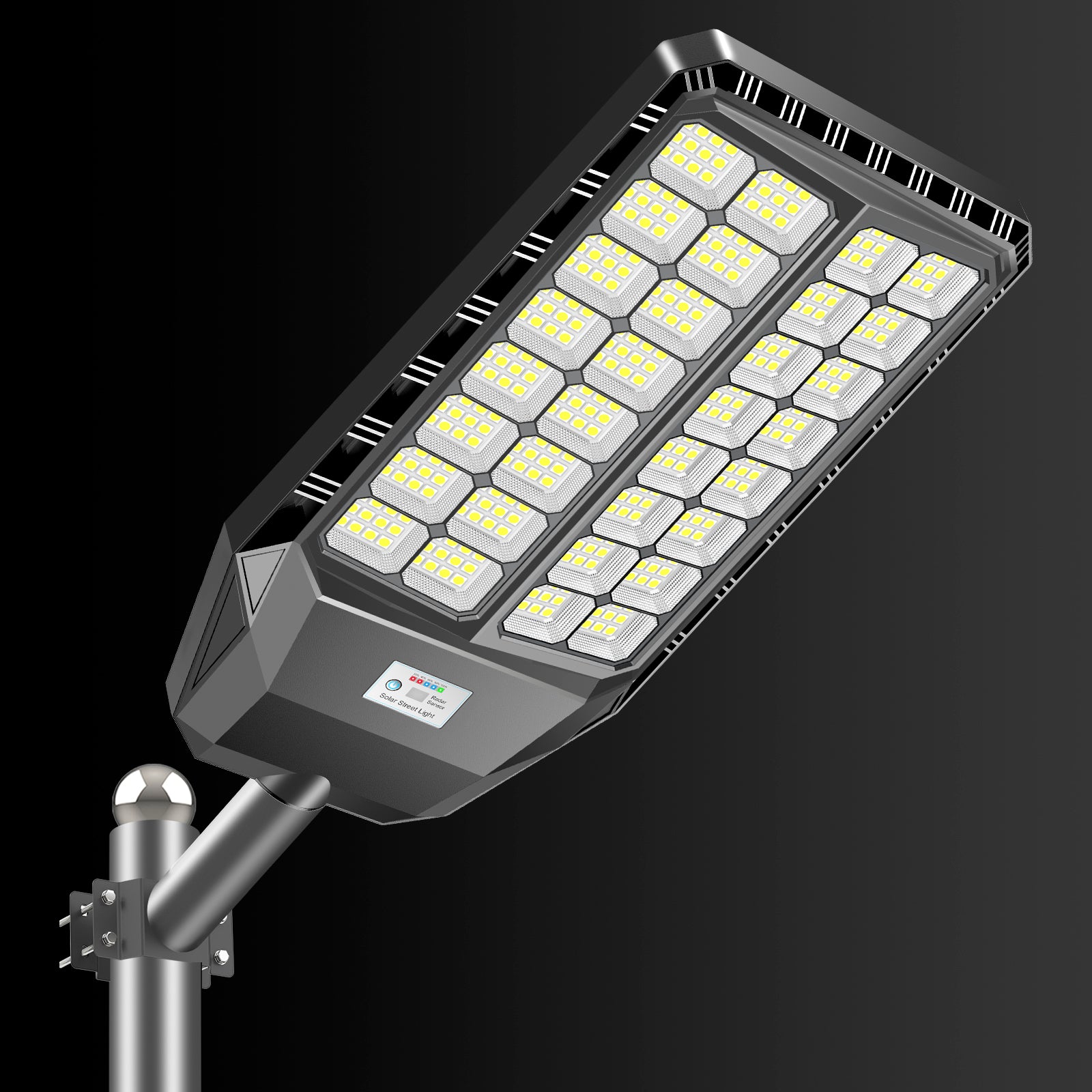
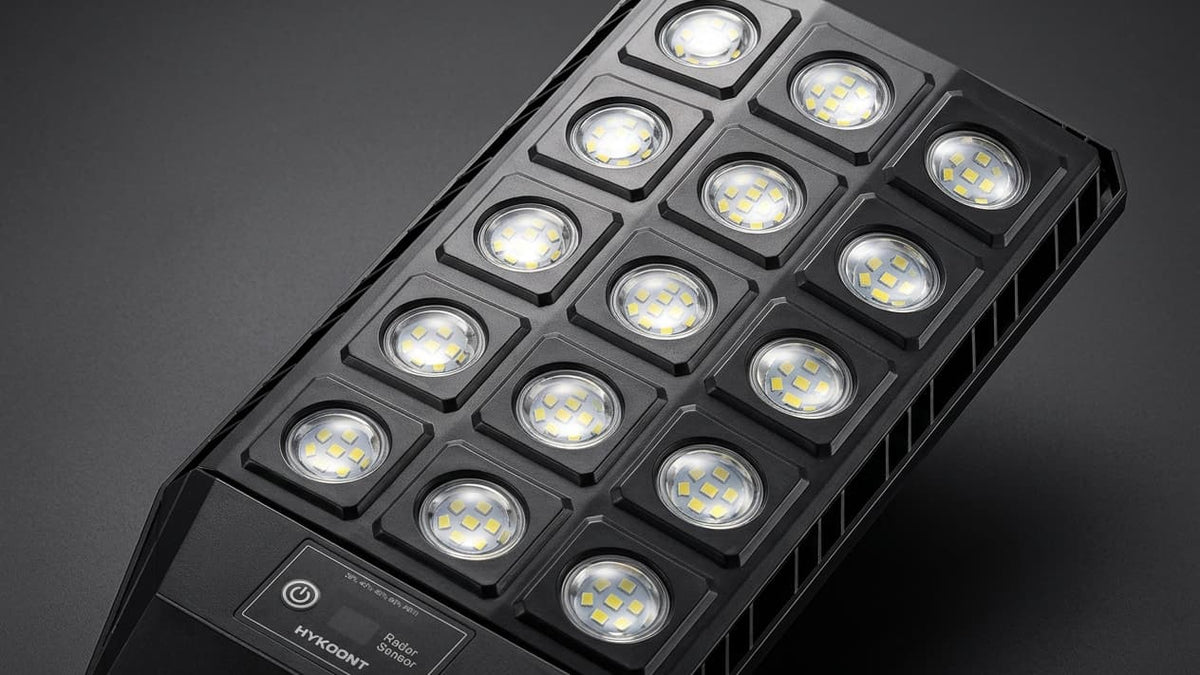
That is the difference between producing light and putting it somewhere useful. The HYKOONT HY015 is built around that second job. Its defining feature is a face of 15 large optical lenses paired with deep reflector cups, designed to concentrate and direct the output of 255 LEDs rather than simply present a broad sheet of exposed light.
For anyone comparing solar street lights for driveway lighting, that is a more useful starting point than a lumen number alone. The current HY015 listing advertises 15,000 lumens and a price of $85.00 USD. It also identifies the product as a pre-order with shipping in approximately one month. Check the live product page for the latest fulfillment estimate before planning an installation.
One important distinction before we get into the optics: “without glare” describes the design goal in this title, not a promise that no one can ever find the light uncomfortable. Lenses and reflectors help manage a beam. Mounting position, viewing angle, nearby surfaces, and brightness settings still determine how that beam feels on your property. No independent glare rating or measured beam-distribution report is provided in the product information used for this article.

The problem is not darkness everywhere. It is darkness where your feet go.
Walk outside tonight and try a small experiment. Ignore the light fixture for a moment. Look at the places where something actually happens: the step beside the garage, the latch on the garden gate, the edge of the gravel shoulder, the turn where a delivery driver backs out.
Most properties do not need every square foot illuminated equally. They need a handful of useful zones connected by a readable route. A light that washes a large wall while leaving the turn dark can feel powerful and still miss its assignment. A more carefully directed beam may serve that route better, even when its advertised lumen number is lower than another fixture’s.
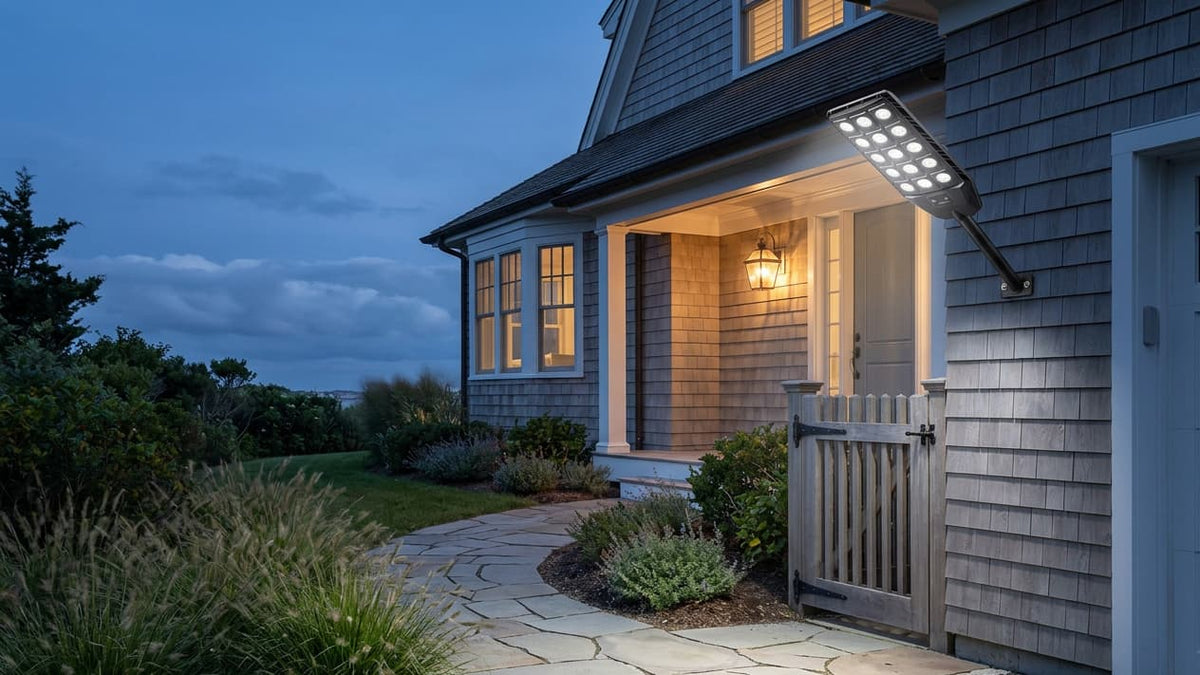
This is where HY015’s lens-focused approach becomes interesting. Its product description emphasizes targeted lighting for pathways, driveways, garden gates, and yard perimeters. Those are places where direction matters. You want enough illumination to see what you are doing, but you do not necessarily want the whole neighborhood participating.
Imagine a driveway with a parked pickup on one side and a narrow walking strip on the other. Point the strongest light into the truck’s windshield and the scene can become harder to read. Put the useful part of the beam on the walking strip and gate approach, and the installation starts solving the right problem. The fixture has not changed. Its job has become clearer.
What the 15 lenses actually do
An LED emits light across a range of directions. An optical lens changes the paths of some of those rays, shaping how the light leaves the fixture. A reflector works differently: its surfaces redirect light by reflection. Combining the two gives a fixture designer more ways to manage where the output goes.
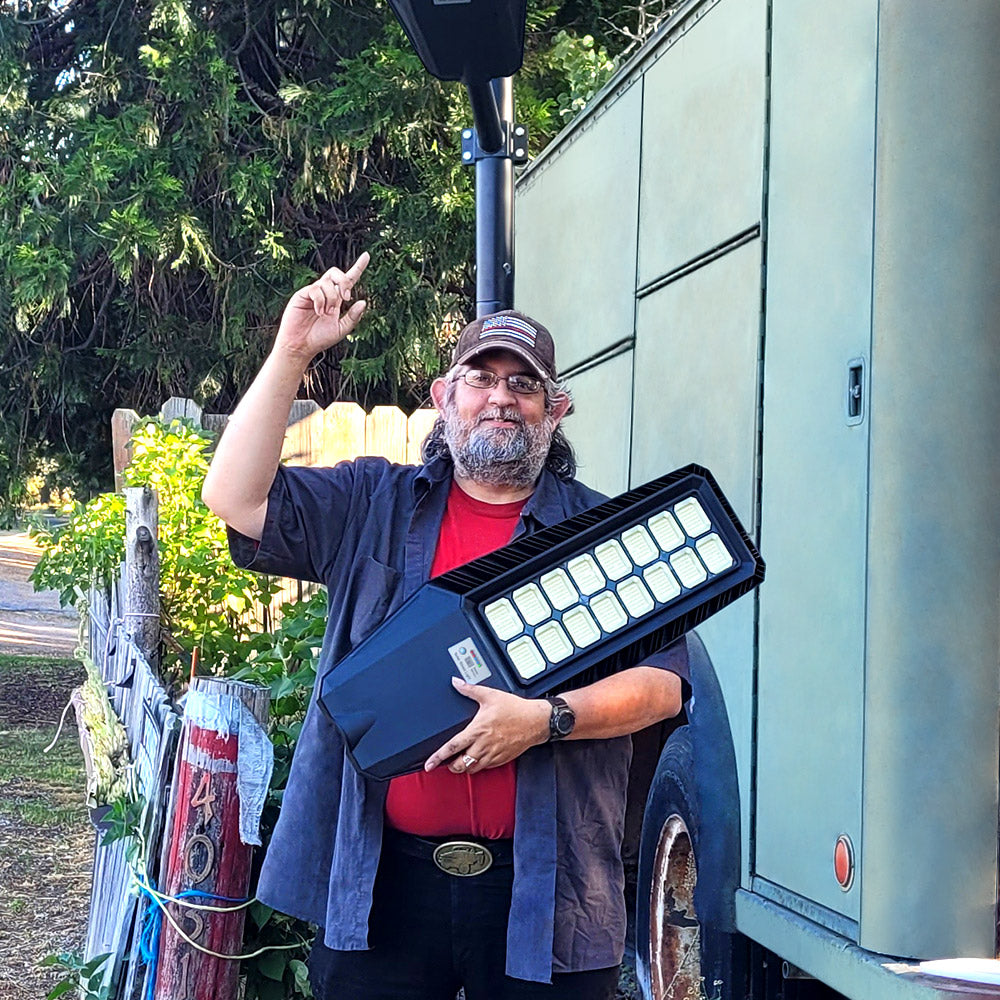
HY015 uses 15 large optical lenses with deep reflector cups. You can see the individual round optical elements arranged across the front in the product image. The listing describes this as a dual-focus system intended to increase center-point brightness and throw distance. That tells us the design priority is concentration, not simply spreading light as widely as possible.
Think of the difference between pouring water across an entire countertop and guiding it into a basin. The quantity is not the only issue; the destination matters. The analogy is imperfect, but it captures the practical point. The optics do not create extra lumens. They change the distribution of the light the LEDs produce.
Nor does a count of 15 lenses establish a specific beam angle, a fixed reach, or a guaranteed number of lux on your driveway. Those require measured distribution data and a defined installation geometry. HY015’s listing does not provide those measurements, so it would be misleading to turn the lens count into an exact performance promise.
What it does provide is a useful reason to look more closely. If your current light scatters illumination into places you do not use, a fixture designed around beam concentration is worth considering. If your goal is a very broad, softly lit entertaining area, concentrated output may not be the first feature you need.

Lumens are the supply. The ground tells you the result.
The advertised 15,000-lumen figure describes light output, not how bright every point below the fixture will be. Ground-level illumination depends on how that output is distributed, how far it travels, and the angle at which it meets a surface. Move the fixture and those relationships change.
That is why two products with similar lumen claims can create different-looking scenes. One may have a strong center with a quicker drop-off at the edges. Another may spread its output more broadly. Without comparable photometric files, neither the larger number nor the larger face proves which product will suit your driveway.
HY015’s listing also advertises coverage of 2,000 square feet. Treat that as a product claim rather than a guarantee of uniform brightness over any shape you choose. A long narrow driveway, a square courtyard, and a sloped gravel approach are very different lighting tasks, even if their total areas are identical.
Before choosing a light, write down the part of the property that must remain readable. Include the far end, not just the area directly under the proposed fixture. If consistent brightness across a large space is essential, request a lighting layout or photometric information instead of relying on a coverage headline. That extra step is especially valuable for shared parking and commercial sites.
For a residential gate or a focused driveway zone, the decision can be simpler. Start with the actual route, make sure the mounting location gets adequate sunlight, and plan an after-dark adjustment. The goal is not to win a lumen contest. It is to walk from the car to the door without wondering where the pavement ends.
Can focusing light really reduce glare?
It can help, but focus and comfort are not the same thing. A controlled beam can reduce unwanted spill when it is aimed appropriately. Yet a concentrated beam aimed straight at someone can be distinctly uncomfortable. “More focused” should never be interpreted as “safe to point anywhere.”
The deep reflector cups in HY015 are part of its glare-control design. Their actual effect at a particular viewing position depends on the optical geometry. Without angular brightness measurements, we cannot quantify how much they reduce glare or claim a particular cutoff performance. The honest benefit is directional control as a design intention, not a universal zero-glare result.
There are two everyday problems worth separating. One is direct glare: seeing the bright source itself. The other is reflected glare: light bouncing off a surface toward your eyes. A wet driveway, a glossy garage door, or a vehicle window can change the experience even if the lamp never moves.
Good placement addresses both. Keep the strongest useful light on the task area, avoid pointing it toward normal approach directions, and evaluate reflective surfaces after dark. If someone routinely faces the fixture while walking toward the house, that approach deserves special attention. A layout that feels fine beneath the light may feel very different from the gate.
For the specific question “how do I reduce solar driveway light glare without leaving the entrance dark?”, the practical answer is a combination: choose controllable optics, put the fixture in a sensible location, and adjust the installed result. Swapping to a brighter product without changing the geometry often misses the cause of the problem.

The $85 HY015, without the showroom shorthand
Here is the core specification picture from the current product listing. HY015 uses 255 high-output 2535 LEDs behind its 15-lens array. Its advertised color temperature is 6500K–7000K, a cool daylight-white appearance. The housing is ABS and PC, and the listed light-body dimensions are 400 by 220 millimeters, approximately 15.7 by 8.6 inches.
The solar panel is specified as a 5V, 10W monocrystalline panel measuring 171 by 322 millimeters. Battery capacity is listed as 3.2V, 9,200mAh, or 9.2Ah. The controls combine automatic light sensing, radar motion detection, and a wireless remote. The description says motion triggers full brightness before the fixture returns to an energy-saving dim mode when the path is clear.
Those details describe a light intended to manage its energy rather than behave like a continuously powered utility fixture. Dusk-to-dawn activation and full-output-all-night operation are not interchangeable claims. The available sunlight, selected operating mode, weather, battery condition, and number of motion events all affect what happens overnight.
At $85.00 USD, HY015 is a relatively small purchase compared with a major hardwired lighting project, but purchase price is only one part of the decision. Check mounting compatibility, safe access for installation, and whether the chosen location can actually harvest sunlight. A bargain mounted in permanent shade is still the wrong light in the wrong place.
Shop the HY015 for $85.00 and check the current pre-order shipping estimate.
Three places the lens-focused idea makes sense
The driveway that stops short of the front door
Some driveways have plenty of light near the garage but very little where people step out of a vehicle. Adding another bright source beside the existing one may simply make the garage brighter. The better question is where the walking route loses definition.
HY015 is worth considering when that missing zone is a defined part of the driveway rather than an entire sprawling property. Plan the beam around the route from the parked car to the entrance. Watch for vehicles creating shadows, and do not assume the driveway will always be empty when you evaluate placement.
For a household with different arrival patterns, test more than one parking position. The person getting out of the passenger seat may have a completely different view of the fixture. A successful layout works for the people using the space, not just for a photograph taken from the curb.

The garden gate everyone uses after sunset
A gate is a small task area with several things to see: a latch, the ground beneath it, and whichever direction you walk next. Lighting only the gate panel can leave the footing in shadow. Lighting from an awkward angle can put the bright fixture directly in the visitor’s line of sight.
This is a good example of why beam placement deserves more attention than headline coverage. Direct useful light toward the approach and latch area, then check both sides of the gate. Remember that the person leaving the yard will face a different direction from the person entering it.
Also consider the gate’s movement. A swinging panel can temporarily block illumination or reflect it. Work through the actual action of arriving, opening, passing through, and closing the gate. That small rehearsal often reveals a better fixture location than a quick daytime glance.

The side yard that feels like an afterthought
A side yard may be a narrow passage between a house and fence, a route to trash bins, or access to a workshop. It rarely needs the visual intensity of a large open lot. It does need enough useful illumination to identify obstacles without shining through the nearest bedroom window.
Before choosing solar for this location, study the sun exposure carefully. Narrow passages can be bright at noon yet shaded for much of the day. The best nighttime mounting point may be a poor charging location. If the equipment cannot be installed in a way that satisfies both needs, choose a different arrangement rather than forcing the purchase.
Where sunlight and placement work together, motion-responsive lighting can be convenient for occasional trips. Still, test activation from the normal approach instead of assuming a sensor will respond exactly where you want. Detection distance and timing should be confirmed from the current instructions, not guessed from the presence of radar control.
Start your installation plan from the driver’s seat
The easiest mistake is evaluating a driveway light only while standing underneath it. That is usually not where the most uncomfortable view occurs. Sit in the vehicle where you normally pause to open the gate or garage. Look toward the proposed fixture position at a normal driving eye height.
Then walk the approach from the street, the mailbox, and the house. Ask where you will see the front of the light directly. A fixture that looks neatly positioned from the porch can be visually intrusive from the road. If nearby windows face the installation, include those viewpoints in the plan.
Do not improvise a mounting height from a generic internet diagram. Use the product’s installation instructions and confirm the suitability of the supporting surface and supplied hardware. Different walls, poles, wind exposure, and mounting arrangements require different decisions. If safe access or structural support is uncertain, bring in a qualified installer.
Once the light is installed according to its instructions, do the final optical assessment after sunset. Aim for a readable route rather than the largest possible bright patch. If the fixture looks harsh from the approach, change the geometry or setting where the hardware and instructions allow. Buying a second light should not be the first fix for an aiming problem.
A five-minute nighttime acceptance test
Give the installation a real-world test before calling the job finished. Begin at your usual arrival point, not directly below the lamp. Walk toward the property at a normal pace and notice when the motion response occurs. Does useful light arrive before you reach the area where you need it?
Next, look at ordinary objects rather than the fixture. Can you distinguish the edge of the walking surface, the gate hardware, and an item placed where a package might arrive? Do not stare into the LEDs to decide whether the light is bright enough. That tells you little about the task area and makes the evaluation less comfortable.
Repeat the route with a vehicle parked in its usual position. Check for a shadow where a person steps down. Then view the installation from neighboring-facing boundaries without entering anyone else’s property. Light spilling beyond your useful area is a reason to reconsider placement or settings, not evidence of extra value.
Finally, check again on a different night. A freshly charged light after a sunny day is one condition, not the whole year. Notice how weather and usage affect the operating pattern. If winter performance matters to your purchase decision, ask about expected behavior under your local charging conditions before committing to a larger installation.
That crisp white color is a choice, not a quality score
HY015’s listed 6500K–7000K color temperature gives it a cool daylight-white appearance. Some people prefer that look around a functional driveway or gate because it feels clear and businesslike. Others find it too stark beside a warm porch or a seating area.
Color temperature does not tell you whether a fixture has good beam control. It also does not establish color-rendering quality or prove that the scene will be comfortable. A warm light aimed poorly can cause problems; a cool light positioned thoughtfully can be useful. These are separate decisions, and it helps to keep them separate while shopping.
If your main goal is a relaxed patio atmosphere, do not choose HY015 solely because it has a large lumen claim. Consider whether its cool appearance suits the space. For a workmanlike arrival route, that same appearance may be exactly what you want. The right choice depends on what people do there after dark.
Try to avoid abrupt visual clashes with existing lighting. You need not make every fixture identical, but the transition from driveway to porch should feel intentional. A practical arrangement might use a brighter functional zone for arriving and a gentler entrance light closer to the door, provided the overall layout remains comfortable.

Solar power changes the overnight conversation
A solar light has a daily energy budget. The panel collects energy, the battery stores it, and the controls decide how it is spent. That is a different operating model from a fixture connected to a reliable continuous electrical supply.
HY015’s motion-responsive dimming is important in that context. The listing describes a lower-output state between motion events and full brightness when motion is detected. A quiet garden gate and a busy driveway may therefore put different demands on the same model. More frequent activation can change overnight energy use.
Panel wattage should not be read as guaranteed energy collection every hour the sun is up. Shade, dirt, seasonal sun position, and weather affect charging. Similarly, battery capacity by itself does not establish hours at maximum light output. Without a verified power draw and operating profile, an exact full-brightness runtime calculation would be speculation.
If your requirement is uninterrupted, specified illumination throughout every night, say that clearly before buying. Ask for documented runtime conditions and an appropriate system design. HY015’s advertised dusk-to-dawn automation should not be stretched into a promise that a particular brightness level will be maintained through any sequence of cloudy days.
Two other active HYKOONT options, and why you might choose them instead
The point of comparing products is not to make HY015 win every category. It is to avoid choosing a compact, targeted solution for a problem that calls for a different scale of equipment. The following products were active in the catalog when this article was prepared. Prices are in USD and can change.
TW040: a different starting point for a larger area

The HYKOONT TW040 Solar Street Light is currently listed at $152.00 for one pack and $306.00 for two packs. Its product page advertises 56,000 lumens, a 6500K color temperature, a 6V 48Ah battery, IP66 protection, and light, time, remote, and radar control.
Those are catalog specifications, not a measured head-to-head test against HY015. We would not translate the lumen difference into a claim that TW040 lights a driveway a particular number of times better. Its relevance is that it gives shoppers a broader-area candidate to investigate when the job extends beyond a focused gate or arrival zone.
For a larger yard or open parking area, compare the desired layout and mounting requirements before deciding. Ask how the illumination will be distributed across the actual space, not just what the brightest part might look like. Several poorly placed bright fixtures can still leave difficult shadows.
Shop TW040 and compare the one-pack and two-pack options.
HY100: when the project deserves a system-level discussion

The HY100 Commercial Solar Street Light is currently listed at $1,399.00 USD. Its listing describes a separate 150W monocrystalline solar panel, a 25.6V 30Ah battery, and MPPT charging control. This is a substantially different equipment and budget discussion from an $85 HY015.
One detail deserves care: the current HY100 title and description contain inconsistent output and wattage figures. Rather than repeat conflicting numbers as settled specifications, confirm the current configuration with HYKOONT before purchase. For project work, get the exact model documentation and the performance information relevant to your site.
That makes HY100 a useful comparison for buyers evaluating a more substantial commercial installation, not an automatic upgrade for a small gate. A larger system can bring different structural, mounting, and layout requirements. The right answer may involve professional planning instead of simply ordering the largest fixture in the catalog.
Explore the HY100 commercial system and confirm its current specifications.
What $85 does not tell you about total value
The sticker price is easy to compare. The cost of choosing the wrong location is less obvious. Moving a fixture, replacing unsuitable hardware, or hiring someone twice can outweigh a small difference between products. Spend a little time on the site plan before spending money on the light.
Solar can avoid the need to supply household electricity to the fixture itself, but that does not make every installation free or maintenance-free. Mounting work, access equipment, cleaning, and eventual component wear still matter. Compare the actual work required at your property rather than assuming the same savings for every home.
There is also a timing cost. HY015’s current pre-order note matters if you need the light for an upcoming move, an event, or a contractor visit. Do not schedule labor around a vague expectation that an active product must ship immediately. Confirm the current estimate and leave room for the realities of delivery.
A sensible purchase is one that fits the task, the charging conditions, and the schedule. For a defined driveway or gate zone, HY015’s lens-focused design and $85 price make it worth a close look. For a larger site, the extra planning is not a nuisance. It is part of buying the right equipment.
Keep the optics clean, and keep the original aim
Outdoor lighting changes slowly enough that you may not notice a decline until something becomes inconvenient. Dust on the panel affects the charging side of the system. Dirt on the optical face affects the light leaving the fixture. Seasonal vegetation can shade a panel that was clear when you installed it.
Follow the product’s cleaning and care instructions, use safe access methods, and avoid abrasive treatment of optical surfaces. Do not climb onto an unstable chair to reach a light simply because the task seems small. If the fixture cannot be maintained safely from the available access, arrange appropriate help.
After severe weather or work near the mounting point, check whether the fixture still points where it originally did. A small shift may put more light toward an approaching driver or a window. Mechanical security and optical aim belong in the same inspection because one can change the other.
Finally, keep a simple note of the operating mode you chose. If someone changes settings with the remote, you will have a reference when performance seems different. Before blaming the battery or buying a replacement light, check the panel exposure, cleanliness, mode, and recent weather. Those basics often tell a more useful story than the lumen number.
Frequently asked questions
1. Is HY015 completely glare-free?
No universal glare-free result is established by the available product information. Its 15 large lenses and deep reflector cups are designed to focus the beam and manage unwanted light, but direct viewing angle, placement, reflections, and output settings still matter. Treat glare reduction as an installation goal, not a reason to ignore aiming.
2. How much does HY015 cost, and is it ready to ship?
The current listed price is $85.00 USD. The product title identifies it as a pre-order shipping in approximately one month. Verify the live product page before checkout, particularly if installation is tied to a specific date. An active catalog listing does not by itself mean immediate dispatch.
3. Do 15 focusing lenses make more lumens?
No. Optical lenses shape the distribution of light; they do not create additional LED output. HY015’s advertised output is 15,000 lumens. The purpose of its lens-and-reflector arrangement is to direct that output, with the listing emphasizing center-point brightness and throw distance rather than an undirected flood of light.
4. Will one HY015 evenly light 2,000 square feet?
The listing advertises coverage of 2,000 square feet, but that is not a guarantee of uniform illumination across every property shape and mounting arrangement. Slopes, obstructions, mounting geometry, and the beam pattern affect the result. For a project requiring a defined minimum illumination level, request photometric data and a site-specific layout.
5. Does dusk-to-dawn mean maximum brightness all night?
Not necessarily. HY015’s description includes motion-triggered full brightness and an energy-saving dim mode between events. Dusk-to-dawn describes automatic operation in response to ambient light. Actual overnight behavior depends on charging, mode, motion activity, and battery condition. Confirm documented operating conditions if uninterrupted output is important.
6. What is the best way to reduce glare on a driveway?
Start by checking the view from the driver’s seat and normal walking approaches. Keep useful light on the route instead of directing the beam toward those viewpoints. Evaluate reflections from vehicles and wet pavement, and adjust placement or settings within the installation instructions. More lumens alone do not solve an aiming problem.
7. Is HY015 a warm-white light for patios?
No. Its listed color temperature is 6500K–7000K, which is a cool daylight-white appearance. That may suit a functional gate or driveway, but it is a different look from warm ambient patio lighting. Choose according to the activity and visual atmosphere you want, not just the output claim.
8. Should I choose HY015, TW040, or HY100?
Consider HY015 for a defined driveway, pathway, or gate task where focused optics are a priority. Investigate TW040 when comparing a larger-area option. For a more substantial commercial solar system, review HY100 with current documentation and a project plan. Confirm site fit and mounting requirements rather than ranking these products by price alone.
The best result is a driveway you stop thinking about
Good lighting does not need to announce itself every time you come home. You notice the step. You find the latch. You carry the groceries inside without squinting toward a white rectangle or guessing where the pavement ends.
That is the worthwhile idea behind HY015’s 15 large focusing lenses: make the light more intentional. Its advertised 15,000-lumen output is only the beginning of that story. The useful result comes from pairing its optical design with the right task, reliable solar exposure, and an installation that respects the people looking toward it.
If your problem is a defined arrival route rather than an entire commercial lot, start there. Map the route, check the sunlight, and compare the fixture against that specific need. A carefully placed $85 light is a better purchase than a much brighter one asked to do the wrong job.
Product prices, active status, and listing details checked October 16, 2026. Prices and fulfillment estimates may change. Output, coverage, and other performance figures above are product-listing claims, not results from an independent field test.

Leave a comment
This site is protected by hCaptcha and the hCaptcha Privacy Policy and Terms of Service apply.