






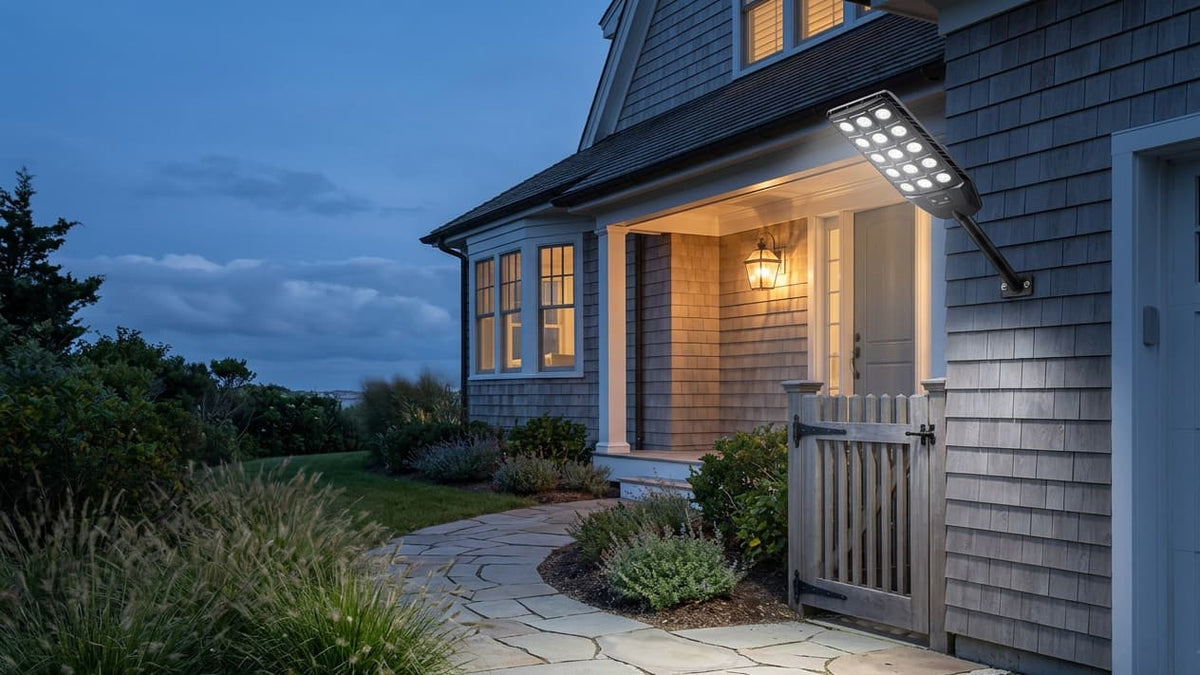
The first thing you notice is the view. The second, a few months later, might be the rusty screw on the porch light.
Living near the coast changes how you look at outdoor hardware. A fixture that seems perfectly ordinary inland suddenly has a harder assignment: damp mornings, wind-driven rain, strong sun, and, at some locations, salt carried through the air. Meanwhile, it still has to do the everyday job you bought it for. Help you back into the driveway. Show the turn in the path. Make the walk from the car to the front door feel straightforward.
That is where ABS+PC lighting enters the conversation. A polymer housing can be a useful alternative to exposed metal surfaces, but a material label is not the whole weather-protection story. The seams, mounting hardware, optics, and installation matter too. So does the difference between a damp coastal neighborhood and a fixture directly exposed to ocean spray.
The Hykoont TW015 is the central product in this guide because its current listing explicitly specifies an ABS+PC housing and identifies driveways, pathways, garden gates, and yard perimeters as intended applications. We will also compare three related active products, with their real catalog images and current prices. They are alternatives for different lighting jobs, not four identical materials wearing different names.
The aim is simple: choose outdoor lighting around the route you actually use, then check the construction against the exposure it will actually face. A beautiful coast does not need a backyard that looks like a loading dock, and a waterproof claim should not be mistaken for a salt-corrosion guarantee.
Buying context: USD catalog prices checked October 12, 2026. Primary keyword: solar outdoor lighting for coastal driveways and pathways. Long-tail focus: how to choose ABS+PC solar lights for damp coastal driveways without overlooking salt exposure, charging, and glare. Product specifications below are listing information, not independent test results. “Built for coastal moisture” describes the design questions explored here; it does not establish marine certification or verified salt-spray resistance.
The coast is not one weather condition
A sheltered driveway several blocks from the water and an exposed oceanfront gate do not give a light the same job. Both may be called coastal. Their hardware can experience very different conditions.
Humidity is moisture in the air. Rain is liquid water reaching the fixture. Salt-bearing spray adds another exposure, one that a generic rain-resistance statement does not fully describe. A purchase that makes sense for a protected suburban wall may need additional documentation before it makes sense on a seafront property.
Start with what you can observe. Does the proposed mounting wall receive wind-driven rain? Does salty residue regularly collect on the windows or nearby railings? Is the location sheltered, or does it face the prevailing weather with nothing in front of it? Are sprinklers aimed at the mounting point?
You do not need to become a materials engineer to ask useful questions. You need to give the supplier an accurate picture of the installation. “For a coastal house” is less informative than “on an exposed wall that receives frequent wind-driven rain and visible salt deposits.”
That description helps separate a reasonable candidate from an unverified promise. It also keeps you from overbuying for a sheltered location or underbuying for a severe one. Distance from the shoreline is a starting clue, not a complete exposure assessment.

What ABS+PC tells you, and what it leaves out
ABS is short for acrylonitrile butadiene styrene. PC means polycarbonate. When a product page says ABS+PC, it identifies polymer materials used in the construction. It does not, by itself, tell you whether the fixture uses a blended resin, separate components, a particular UV-stabilized formulation, or a tested marine assembly.
A polymer housing does not rust in the same way a ferrous metal housing can. That can make it appealing when comparing exposed outdoor surfaces. But the complete fixture may still include metal screws, brackets, contacts, and other components. Choosing a polymer body does not remove those components from the weather.
There is also more than one way for an outdoor product to age. A buyer should ask about sunlight exposure, temperature limits, lens condition, seal integrity, and mounting strength, not only corrosion. A housing can remain visually tidy while a loose bracket or compromised joint creates a separate problem.
For the TW015, the listing describes a weather-resistant ABS+PC build intended to handle heat, rain, and winter cold. It does not provide a salt-spray test report in the information reviewed for this article. Nor does that information establish the resin grade or the precise allocation of ABS and PC among the parts.
The practical takeaway is encouraging but measured: ABS+PC is a relevant construction detail to compare, especially for a damp outdoor setting. It is not enough to declare a fixture rust-proof, salt-proof, or maintenance-free as a complete system.
Your driveway and your pathway should not share one vague lighting goal
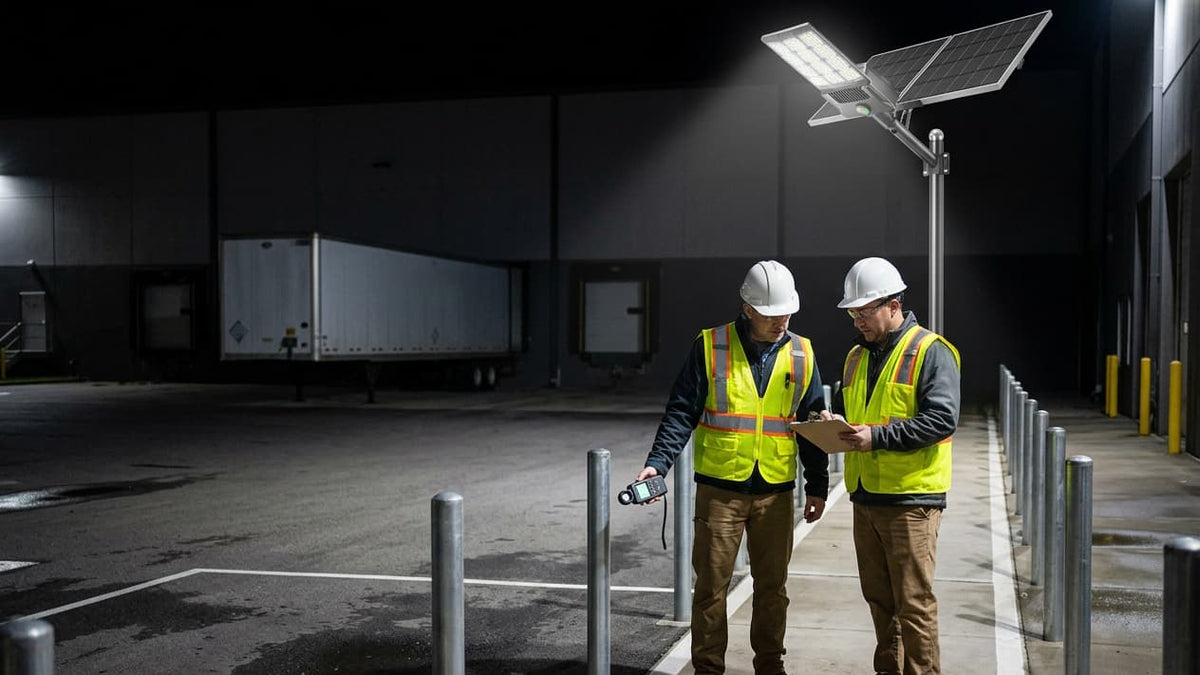
The driveway is a vehicle space. You want to identify the entrance, see the edges, notice an obstacle, and move toward a parking position without looking directly into a bright fixture. The pathway is a walking space. You want to follow a route, understand a turn, and recognize changes in level.
Those tasks overlap, but they are not identical. A powerful wall light that helps with the driveway may leave a curved path behind a hedge in shadow. A row of subtle pathway lights may make the garden pleasant while doing little for the far end of the parking area.
Think in connected zones. The driveway entrance is one zone. The parking position is another. The route to the porch is a third. A side gate may be a fourth. A useful plan follows the journey through those zones rather than trying to wash the entire property in one broad pool of light.
Take a slow walk after dark before deciding what to buy. Where do you look down? Where does your eye struggle when moving from a bright area to a darker one? Where does a parked SUV interrupt the view? Those are the places that deserve attention.
You may find that one well-aimed fixture solves most of the problem. You may find that two modestly lit positions work better. Either answer is preferable to buying the highest advertised output and hoping the layout will take care of itself.
Meet the TW015: the ABS+PC candidate at the center of this guide
The Hykoont TW015 15000LM Large Lens Solar Street Light currently lists at $85. Its active product title identifies it as a pre-order and says it ships in one month. Confirm the current dispatch estimate before buying for a project with a firm installation date.
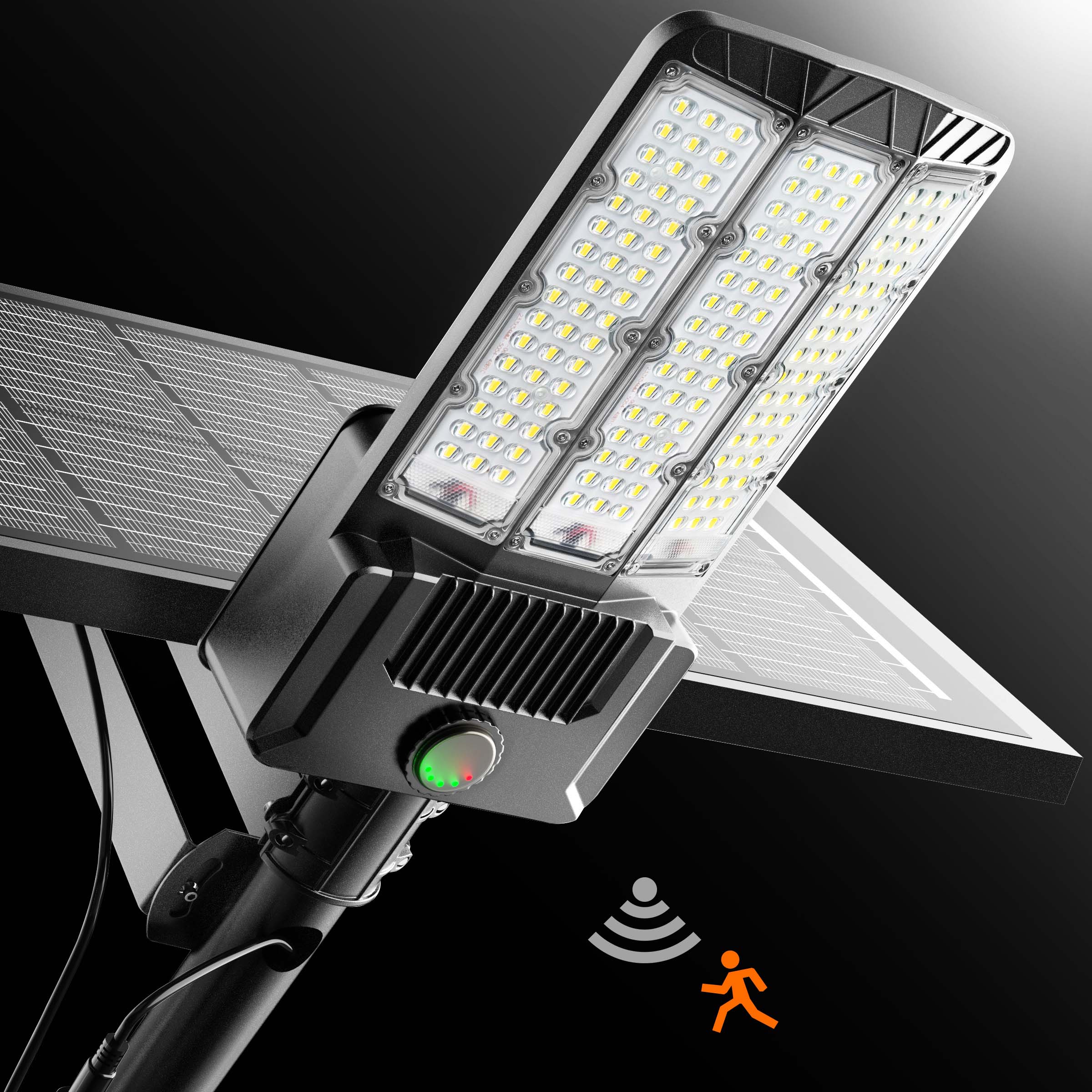
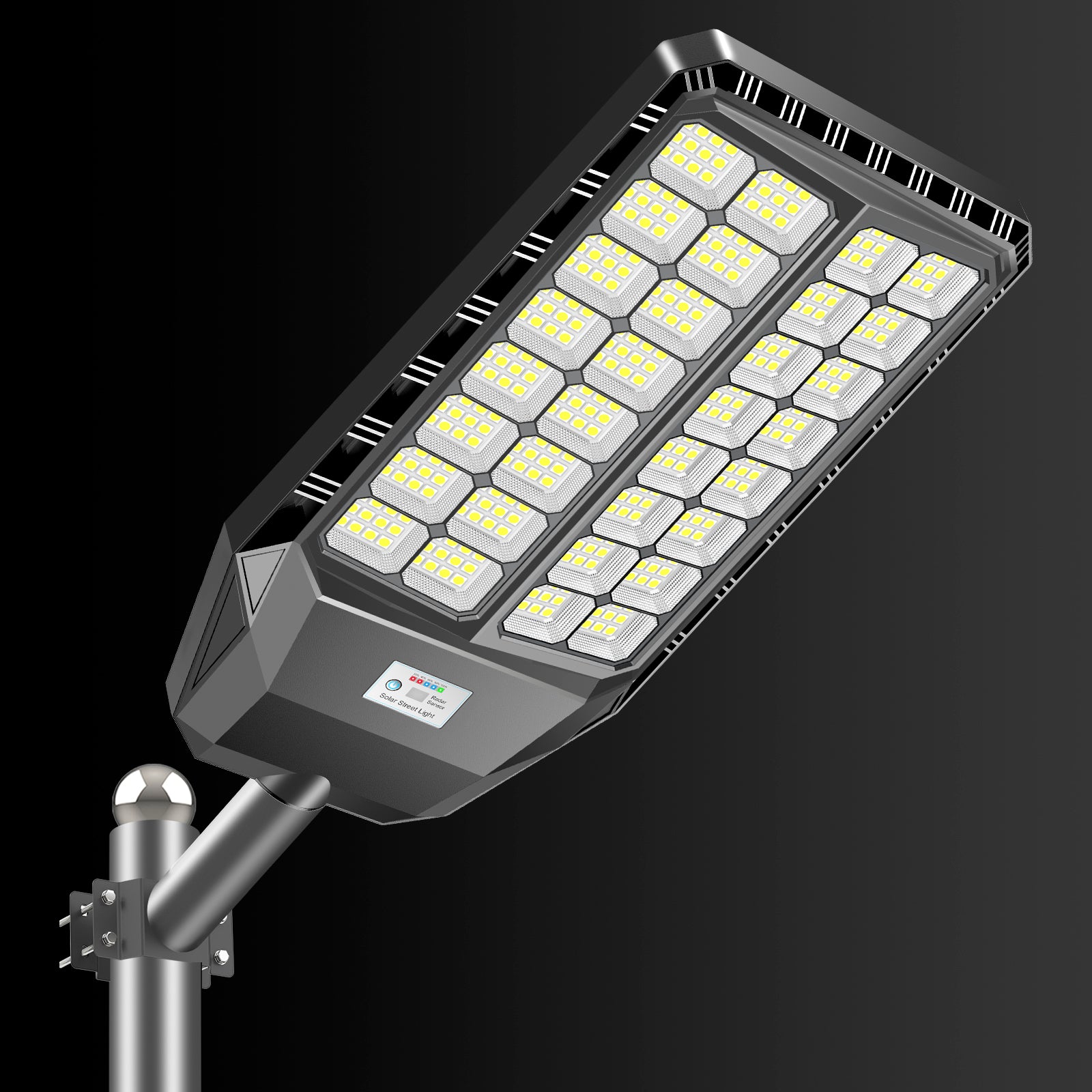
The product page lists fifteen large optical lenses with deep reflector cups, 255 LED chips, and an advertised 15,000-lumen output. It describes the optical arrangement as a way to concentrate light for targeted applications such as pathways, driveways, and garden gates.
The listed solar panel is a 5V 10W monocrystalline panel, with a 3.2V 9,200mAh battery. The panel is integrated into the fixture rather than a separate remote panel. That all-in-one arrangement simplifies the number of separate components you need to position, but it also means the light's installation location has to work for daytime charging.
Its body dimensions are listed as approximately 15.7 by 8.6 inches. The current page specifies light-sensing activation, radar motion detection, and remote control. It describes a motion response that increases brightness and returns to a dim setting after activity clears.
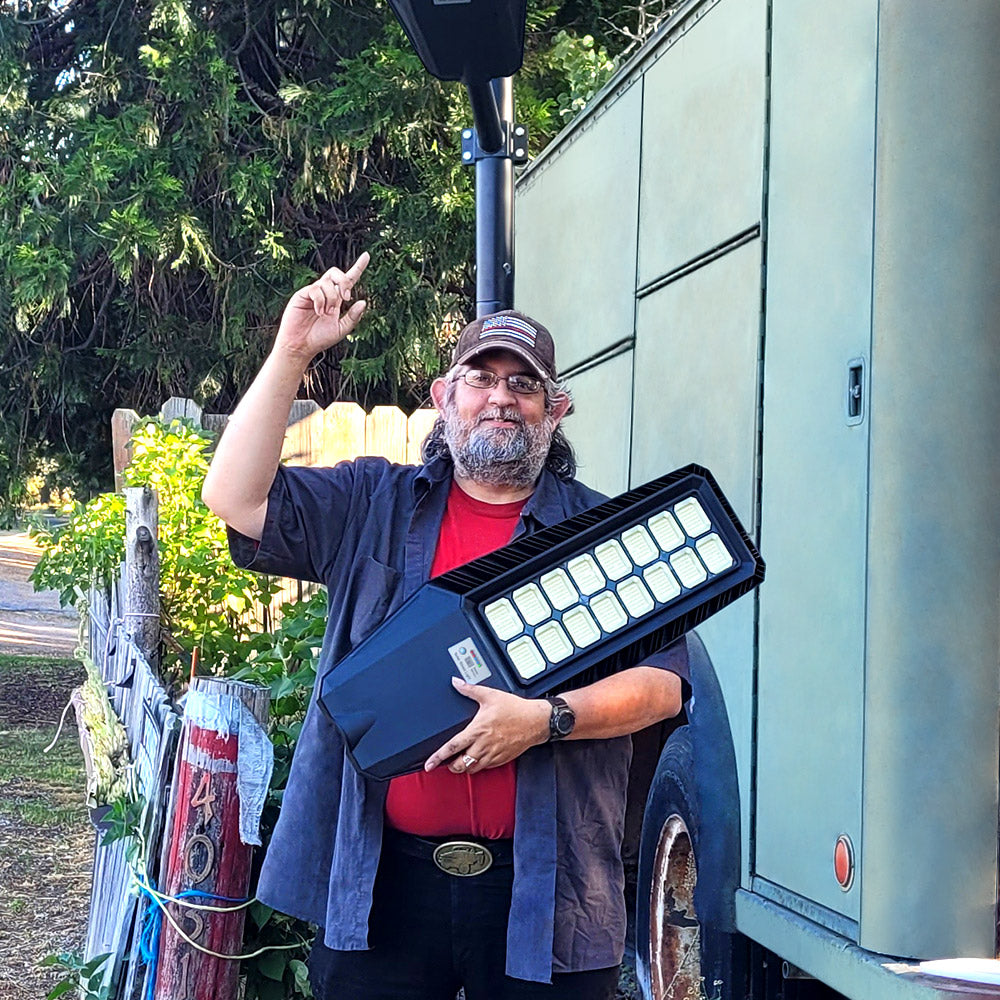
For a buyer, the strongest starting case is a wall-mounted targeted-lighting application with a suitable supporting surface and useful sunlight exposure. Use a rigid, securely fixed mounting arrangement. Do not treat a product image as evidence that any improvised pole, decorative fence, or thin wall surface is appropriate.

Actual TW015 catalog image. The smaller rear view shows the panel integrated into the same fixture.
Shop the TW015 at the current $85 pre-order price and check the latest shipping estimate.
Optical efficiency means putting light where the route needs it
“High efficiency” can mean several different things in a lighting conversation. Electrical efficacy concerns light output relative to power. Solar conversion concerns turning sunlight into electrical energy. Optical efficiency concerns how the fixture directs its output.
The TW015 listing discusses a focusing-lens arrangement. That makes light placement a more useful topic than treating its advertised lumen count as the entire story. A directed beam may help reach a particular route, but it still has to be aimed and assessed in the actual space.
This article does not calculate a verified lumens-per-watt figure for the TW015. The reviewed data does not provide the independently verified operating-power and output measurements needed for that claim. The solar panel's wattage is not a substitute for measured LED operating power.
What you can judge practically is whether the light lands on the driveway edge, the gate latch, and the route to the door rather than on the neighbor's window. That is useful light. It is also a more homeowner-friendly definition of efficiency than maximum brightness everywhere.
A focused arrangement can create a bright center and less light elsewhere. Do not assume that a large advertised coverage area means every point receives the same illumination. Inspect the edges, the near area below the fixture, and the places where landscaping interrupts the beam.
Water protection is a question about the whole assembly
Water can reach a light through its seams, connections, lens interfaces, and installation details. Material choice is only part of the answer. A housing label does not establish how the assembled fixture behaves under every exposure.
The current TW015 description reviewed here does not specify a numerical IP rating. Rather than borrowing a rating from another model, ask for documentation for the TW015 itself. Also ask which mounting orientation and installation conditions that documentation assumes.
Related products in this guide do list IP ratings. Those ratings describe ingress protection, not a complete promise about salt corrosion, ultraviolet aging, wind resistance, or immersion. They should be compared alongside the other design and installation details.
Do not interpret “waterproof” as permission to submerge a fixture, pressure-wash it, or place it where drainage water repeatedly floods it. Follow the product's installation and cleaning instructions. A normal outdoor rain exposure and a concentrated high-pressure water jet are different situations.
For a coastal purchase, ask separately about moisture protection and salt-exposure suitability. Two clear answers are more useful than one sweeping phrase such as “all-weather.” If the seller cannot document the severe exposure your site receives, choose a better-documented product for that location.

Sunlight at the wall matters more than sunlight somewhere in the yard
A garden can feel wonderfully sunny while the proposed light position spends most of the day under an eave. The panel collects energy where it is installed, not where the lawn receives the best sunlight.
Because the TW015 has an integrated panel, examine the precise mounting position during different daylight hours. Consider roof overhangs, trees, neighboring structures, and the changing seasonal sun path. A clear view at noon does not prove a useful charging window across the day.
There is a familiar temptation to put the fixture under the most protective part of the roof. That may reduce direct weather exposure while also reducing charging. The location needs to balance both requirements without violating the installation instructions.
If the best place to illuminate the route is persistently shaded, do not force the all-in-one solar format into that spot. A different system architecture, including an appropriately specified wired solution, may be more practical. The right answer is not always another battery setting.
The TW015 page does not establish a guaranteed runtime for your site's conditions. Ask for runtime assumptions, charging requirements, and low-energy behavior. A solar light should be selected around the hours you need it, especially when shorter charging days coincide with longer evenings.
Motion control is convenient when it notices you early enough
A motion light should help before you need to guess where the step is. That means detection needs to be evaluated from the direction you approach, not only while standing beneath the fixture.
For a driveway, test the normal arrival route and the walk from the parked car. For a pathway, approach from both ends and include any turn behind vegetation. The sensing behavior may look different when an object is partly obscured or moving along another angle.
Consider the baseline setting too. If the fixture is dim or off before activation, is there enough visibility to begin the approach comfortably? A constant low-output mode may suit some spaces, while a triggered brighter setting may suit intermittent activity elsewhere.
There is also the energy side. A quiet path with occasional activity is not the same operating load as a driveway triggered repeatedly through the evening. Any long runtime statement should be interpreted in the context of the mode and activity assumptions behind it.
Choose the mode after deciding what the route needs. Then observe it over several evenings. If you find yourself hesitating before detection occurs, adjust the layout or choose a different arrangement rather than accepting the behavior because the light eventually turns on.

Three related products, three different roles
TW016: an ABS-listed alternative for a different driveway layout
The Hykoont TW016 Solar Street Lights currently costs $79.99. Its listing describes an ABS construction and also mentions a die-cast aluminum frame. It should not be relabeled ABS+PC simply because it is another Hykoont solar light.
The page advertises 19,200 lumens and identifies motion, timing, remote, and light controls. It lists an IP66 rating and positions the product for outdoor areas including driveways, gardens, and courtyards. Those details make it a relevant comparison candidate, not a verified equivalent to the TW015's focusing-lens design.
Think of the TW016 as another layout to investigate when the shape of the driveway or desired distribution differs. Compare actual mounting instructions, light distribution, and panel exposure. Do not decide between these products solely because one advertised lumen figure is higher.
The page includes runtime and charging claims, but their applicability depends on conditions and settings. Verify the current battery configuration and operating documentation before using those claims to plan a required lighting schedule. Its IP66 listing also does not establish marine or salt-spray certification.

Shop the TW016 at the current $79.99 price and compare its layout with your driveway.
AMS193: adjustable wall lighting for smaller activity zones
The Hykoont AMS193 three-head solar wall light currently lists a one-pack at $25, a two-pack at $39.99, and a four-pack at $69.99. The title includes two-pack wording, but the selectable variants offer multiple quantities. Check the selected pack rather than assuming the title determines the cart quantity.
This is an ABS-listed product, not a verified ABS+PC model. Its page specifies IP65 protection and describes three adjustable lighting heads, a solar panel, motion detection, and remote-selectable operating modes. The advertised output is 3,000 lumens.
The adjustable heads make it worth considering for a localized wall-mounted job: the area beside a gate, the transition near a garage door, or a small side entrance. It is not a substitute for a complete long-path lighting design just because multiple heads can point in different directions.
Its operating modes also differ from the TW015's description. The listing describes triggered operation, a triggered mode with low standby, and constant low brightness without motion sensing. Match that behavior to your arrival pattern and confirm daytime charging before buying several units.

Shop AMS193 wall lights, currently $25 for one or $39.99 for two.
BD02: a wired pathway comparison, not another solar plastic fixture
The Hykoont BD02 LED Bollard Light currently costs $315. It belongs in this guide because a pathway sometimes benefits from purpose-positioned bollard lighting rather than a wall-mounted solar fixture trying to reach around a corner.
Its construction is listed as die-cast aluminum with a UV-resistant powder coating and polycarbonate lens options. It is not an ABS+PC housing. The listing identifies wired AC power, tunable wattage, 3,000K/4,000K/5,000K color-temperature options, and dimming capability.
The page lists a wet protection level and a five-year limited warranty. Those details deserve review with the current installation documents and warranty terms. The reviewed description does not establish that the complete fixture has been certified for direct marine exposure.
A wired bollard changes the project cost and installation requirements. It may be a candidate where dependable scheduling, a particular visual appearance, or a shaded path makes solar less practical. Plan electrical installation with a qualified professional rather than treating it like a screw-on solar wall light.

Shop the BD02 at the current $315 price and review its wired installation requirements.
Three property layouts that change the answer
Consider a sheltered coastal driveway with a straight route to the door. The mounting wall receives useful sun, and the car does not block the entire path. A TW015 could be a targeted-lighting candidate here, subject to documentation and a nighttime check. A separate gate light might be unnecessary if the actual route remains visible.
Now consider a narrow side path beneath a deep roof overhang. The most obvious wall position gets little direct sunlight. Even if a solar fixture looks convenient, charging becomes the weak link. A wired pathway approach may deserve a closer look rather than repeatedly adjusting a solar light in permanent shade.
Finally, consider an exposed oceanfront entrance where salt deposits collect on nearby surfaces. That is not the location to rely on generic weather-resistant language. Request documentation for the assembly, hardware, and intended exposure, and be willing to select a product with explicit evidence for the job.
These are planning examples, not tested performance scenarios for the products pictured. Their purpose is to show why the same material and price can lead to different decisions on different properties.
In every case, start with the route, the charging location, and the exposure. The product choice comes afterward. That order is less exciting than shopping by a giant brightness number, but it is far more likely to produce a useful installation.
Glare is the problem you might accidentally buy
A driveway fixture can be bright and still make it harder to look toward the house. If the source faces an approaching driver or sits directly in the walking sightline, the first impression may be discomfort rather than clarity.
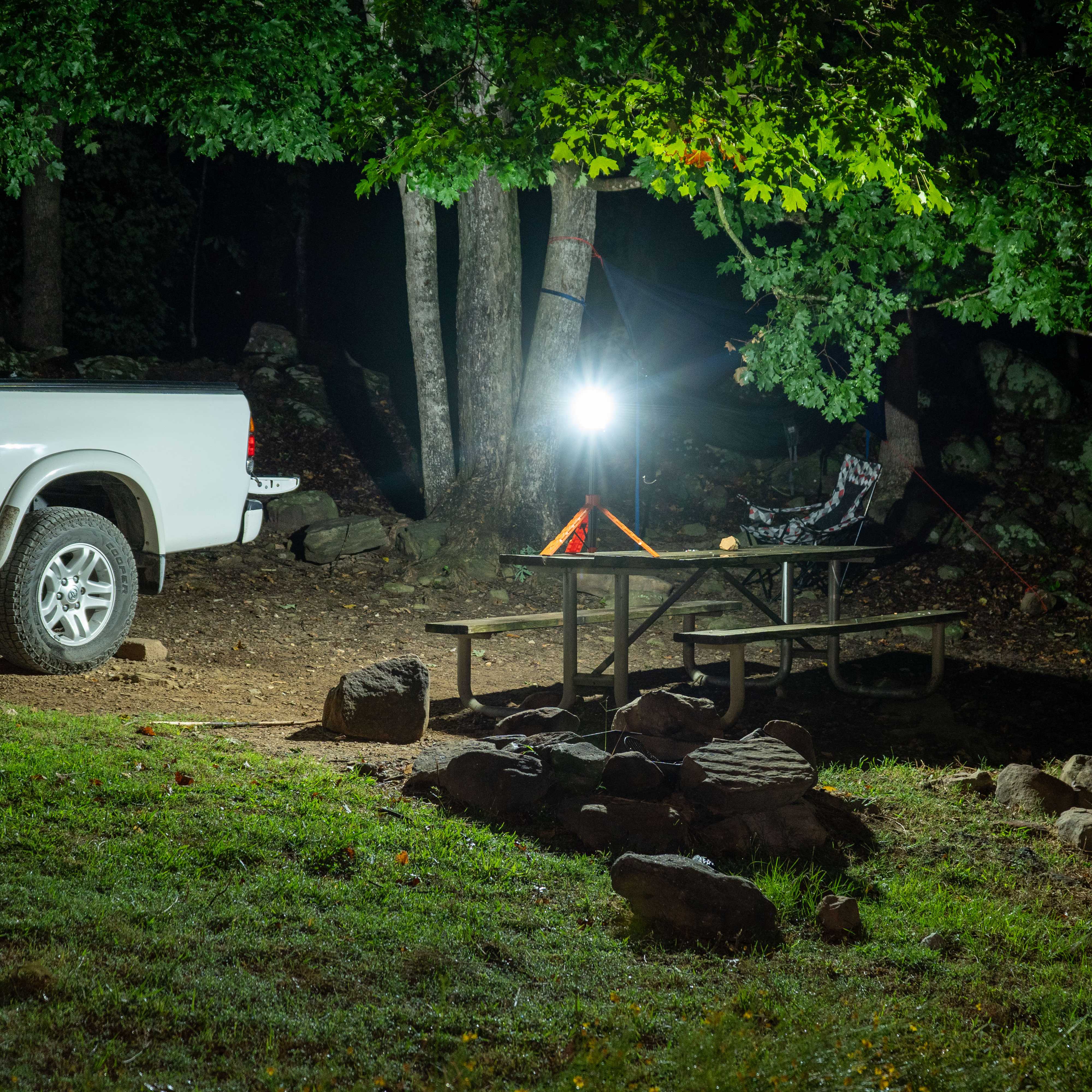
Aim for useful visibility on the route. Look from the driver's position and from a person's normal walking height. Check the direction of light toward neighboring windows, the street, and the garden boundary. A fixture should solve your problem without exporting it next door.
The TW015 listing positions its lenses as a focusing system and makes glare-related claims. Treat those as product descriptions to verify in the installation. No optical design eliminates the need for thoughtful placement and aiming.
Color temperature affects the appearance of the space as well. The TW015 and several solar products here list cool daylight-white output. The BD02 offers selectable warmer and cooler options. A cool light may fit one functional driveway while a warmer appearance suits another landscaped path.
Choose deliberately rather than assuming a coastal setting requires a particular color. Consider how the light looks from inside the house, what neighboring lighting already exists, and whether the route remains comfortable to use. Where site-specific restrictions apply, confirm those before installation.
The screws deserve as much attention as the shell
An ABS+PC body can become the headline while the supporting hardware receives no thought at all. That is backwards when a fixture is exposed to wind, wet surfaces, and salt-bearing air.
Ask what hardware is supplied, which supporting surfaces are permitted, and whether a different installation kit is required for your location. Use the specified attachment method. Do not improvise with a loose bracket simply because the fixture is solar and does not need a nearby power connection.
A wall-mounted TW015 should have a sound base, a straight rigid support, and a visibly secure attachment. The installation should not depend on a decorative trim board or a surface that cannot support the specified loads. If you are uncertain about the structure, get qualified help.
Wind exposure should be evaluated separately from moisture protection. A numerical IP rating does not establish a wind-load rating. Likewise, a heavy-looking bracket in a product photo does not prove suitability for every exposed coastal wall.
Plan for maintenance access without making the installation reachable only through unsafe climbing. Solar simplifies the electrical supply question, but it does not remove the physical installation question. A reliable fixture needs a reliable place to stay.
A coastal maintenance plan should be modest, not imaginary
The useful promise is not “never touch it again.” It is a system you can inspect and maintain without turning every season into a project.
Follow the manufacturer's cleaning instructions for the panel, lenses, and housing. Avoid abrasive materials, aggressive chemicals, or high-pressure water unless explicitly allowed. The aim is to remove deposits without creating a new problem at a seal or optical surface.
Watch for changes rather than waiting for complete failure. A fixture that starts staying dim, activating unpredictably, or running for a shorter period may need a settings check, a charging assessment, or service. Those symptoms do not automatically prove that the housing material was wrong.
Inspect mounting points after significant weather when it is safe to do so. Look for looseness, damaged components, unusual discoloration, and deposits on exposed surfaces. Follow the service guidance rather than opening a sealed fixture or attempting repairs that are not intended for the user.
For a rental property, make the plan explicit. Who checks the lights? Who notices that a tree has started shading the panel? Who handles a fault between guest stays? A small amount of organized attention can be more valuable than a long list of features no one ever checks.
What the current prices mean for a real shopping basket
A TW015 at $85 plus an AMS193 two-pack at $39.99 gives a fixture-hardware subtotal of $124.99. That could be a comparison basket for a main targeted position and two smaller wall zones. It is not a verified three-light design for your property, and the TW015's pre-order timing must be considered.
A TW016 at $79.99 plus the same AMS193 two-pack gives a $119.98 hardware subtotal. The difference from the previous basket is only $5.01. That is not a good reason to ignore distribution, mounting, availability, or exposure documentation.
Two BD02 bollards would be $630 in fixture hardware at the current unit price. Their installed project cost would also involve the appropriate electrical and physical installation. Compare them for the pathway role they serve, not as though they were a more expensive version of an $85 solar wall fixture.
These prices exclude any applicable checkout charges, discounts, additional hardware, and installation. Pack prices are not always simple multiples of the one-pack figure. Read the selected variant and quantity before making your final comparison.
The most economical plan is the smallest properly supported arrangement that does the job. Saving a few dollars on a light that cannot charge where you need it is not a saving. Neither is buying a larger fixture to compensate for a corner it cannot see around.
Before buying, ask questions that lead to usable answers
For the TW015, ask for the current moisture-protection documentation, supported mounting orientation, operating-temperature limits, and solar charging guidance. The reviewed description does not establish a numerical IP rating or marine certification.
For any product placed in salt-bearing air, describe the exposure and ask about the complete assembly, not only the housing. Ask whether salt-spray testing exists and whether the warranty addresses your intended environment. Read the actual terms rather than treating a warranty duration as blanket coverage.
For any solar choice, ask how runtime is measured and which brightness setting is assumed. Confirm what happens when stored energy is low. If a particular path must remain illuminated throughout a required period, make that requirement explicit before ordering.
For the BD02, confirm the selected power configuration, electrical installation requirements, dimming compatibility, and wet-location installation details with the current documentation and a qualified installer.
Finally, confirm fulfillment. An active product that can be ordered is not necessarily ready for immediate dispatch. The TW015 is a clear example: the current title describes a pre-order. Your lighting plan and your installation date need to match the actual supply timeline.
Frequently asked questions
1. Is ABS+PC a good material choice for coastal outdoor lighting?
It is a useful construction detail to consider because the polymer body does not rust like a ferrous metal housing. However, the complete light still depends on its seals, lenses, hardware, resin formulation, and installation. ABS+PC alone does not establish salt-spray resistance, marine suitability, or a guaranteed service life.
2. Is the Hykoont TW015 certified for saltwater or oceanfront exposure?
The current product information reviewed for this guide describes weather-resistant ABS+PC construction but does not establish marine certification or a salt-spray test result. Ask for documentation before using it in an exposed oceanfront location. Do not interpret the article title as a claim of verified resistance to direct saltwater spray.
3. How much does the TW015 cost, and is it ready to ship?
The checked catalog price is $85. The active product title currently identifies it as a pre-order and says it ships in one month. Confirm the latest dispatch estimate before purchasing, especially if you are coordinating an installer or preparing a vacation property for a specific date.
4. Does the TW015 have a separate solar panel?
No. The TW015 is an all-in-one design with the panel integrated into the same fixture. Its catalog image includes a rear view of that panel. This means the wall-mounted location must suit both the direction of illumination and the panel's need for sunlight.
5. Can I install a solar light under a covered porch?
Only if the permitted installation arrangement also provides the panel with adequate exposure for the required operation. A deeply shaded porch may be a poor match for an integrated-panel fixture. Evaluate the actual location across daylight hours, and consider a different system if the light needs to be placed where charging is consistently limited.
6. Does an IP65 or IP66 rating prove coastal corrosion resistance?
No. Ingress protection and salt-corrosion resistance address different concerns. The AMS193 listing states IP65 and the TW016 listing states IP66, but those statements do not establish marine certification. Ask separately about salt exposure, hardware, installation conditions, and the documentation for the exact model.
7. Which products in this guide are actually ABS+PC?
The TW015 listing explicitly specifies ABS+PC. The TW016 lists ABS and also mentions an aluminum frame. The AMS193 lists ABS. The BD02 uses a die-cast aluminum construction with polycarbonate lens options. They are related application choices, not four verified ABS+PC models.
8. Should I use motion lighting or a constant baseline on a pathway?
Choose according to how the route is approached and when it is used. A baseline can make the start of the path easier to see, while motion-triggered brightness may suit intermittent activity. Test detection from both ends and around obstructions. For solar products, also confirm runtime at the mode you intend to use.
9. Is a wired bollard worth considering when solar is cheaper?
Yes, when it solves a different problem. A shaded path, a desired color temperature, or a particular operating schedule may justify evaluating a wired bollard such as the BD02. Include professional installation costs in the comparison. A cheaper solar fixture is not the better option if its installation position cannot support the needed charging.
10. What should I check after installing a light?
Walk the real route after dark, including the driveway approach and the path from the parked car. Check glare, dark edges, activation timing, neighboring windows, and late-evening behavior. Then follow the manufacturer's maintenance guidance and review performance after less favorable charging weather. A bright first-night photograph is not a complete evaluation.
A good coastal lighting plan feels ordinary when you use it
You arrive home, see the driveway edge, park, and follow the path to the door. The light does not make you squint. The side gate is visible. Nothing about the journey asks for a flashlight or a guess.
That is the result to aim for. ABS+PC can be part of the construction decision, and the TW015 is a relevant product to evaluate for targeted wall-mounted lighting. But the route, sunlight, exposure, and mounting details decide whether the choice makes sense.
For damp coastal settings, ask the right questions before buying. For severe salt exposure, require the right documentation. Keep related products in their correct roles, and spend for useful visibility rather than the biggest number on the page.
Review the TW015 ABS+PC light and its current pre-order details, compare AMS193 options for smaller wall zones, or explore the BD02 for a wired pathway plan. Buy for the walk you actually take, not the property photograph you hope to create.

Leave a comment
This site is protected by hCaptcha and the hCaptcha Privacy Policy and Terms of Service apply.