









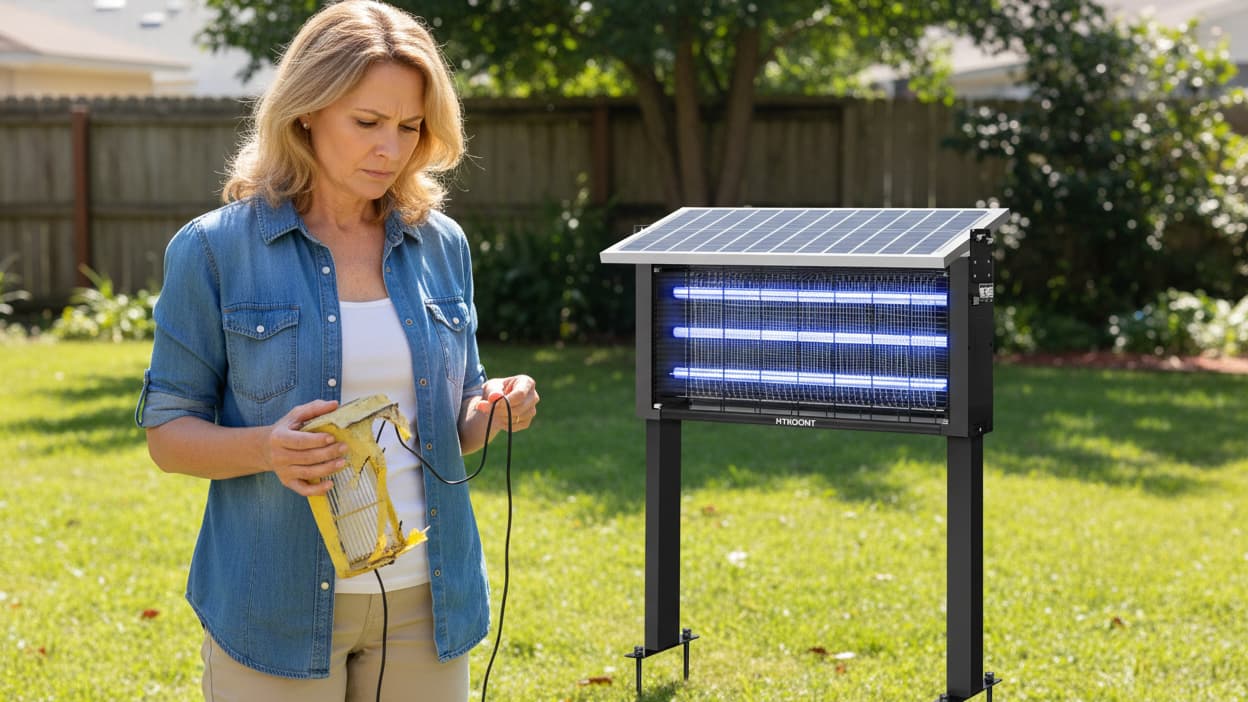
So your bug zapper finally died.
Maybe it made a sad little pop and went dark. Maybe the UV tube flickered for a week before giving up entirely. Maybe you plugged it in this spring and nothing happened at all. Whatever the cause, you're now standing in your backyard with a dead bug zapper and a mosquito problem that hasn't taken a day off.
Here's the thing: replacing a bug zapper is actually a decision worth thinking about for five minutes. Because the way most people replace them — grab the same cheap plug-in unit from the hardware store, repeat the cycle — is exactly how you end up doing this again in two years.
This guide covers how to properly replace a broken bug zapper, what actually causes them to fail, what to look for in a replacement, and why a growing number of US homeowners are skipping the plug-in models entirely and going solar instead. We'll also break down the real cost difference so you can make the call yourself.
First: Why Did Your Bug Zapper Break?

Before you replace it, it's worth knowing what killed it. Bug zappers fail for a handful of predictable reasons, and knowing which one applies to yours tells you what to avoid in the next one.
UV Tube Burnout
This is the most common failure. The UV fluorescent or LED tube that attracts insects has a finite lifespan — typically 8,000 to 15,000 hours for fluorescent tubes, longer for LED. If your zapper ran every night for two or three summers, the tube may simply be at end of life. The fix on a cheap unit is often more expensive than the unit itself, which is why most people just replace the whole thing.
LED-based zappers (like both HYKOONT models) have significantly longer tube lifespans than fluorescent units. This is one of the less-discussed reasons to upgrade.
Water Damage
Most budget bug zappers have minimal weatherproofing. A few seasons of rain, humidity, and morning dew work their way into the housing and corrode the internal components. If your unit died after a wet spring or a heavy rain event, water intrusion is likely the culprit.
What to look for in a replacement: an IPX4 rating or higher. IPX4 means the unit can handle rain and splashing water from any direction — which is the minimum you want for anything living outside year-round.
Electrical Grid Failure
The high-voltage grid that electrocutes insects can fail from insect buildup, corrosion, or physical damage. On cheap units, this is essentially unrepairable. On better-built units with metal housings, the grid is more durable and easier to clean.
Power Supply Issues
Plug-in zappers depend on a continuous power connection. Extension cords degrade, outlets get tripped, and GFCIs reset. If your zapper "died" but the tube looks fine, check the power supply first — it may just be a tripped outlet or a failed extension cord.
This is also one of the practical arguments for solar: no cord, no outlet dependency, no extension cord to fail.
Plastic Housing Degradation
UV exposure from the sun (not the zapper — actual sunlight) breaks down plastic housings over time. They yellow, crack, and warp. Once the housing is compromised, water gets in and the unit fails fast. Metal-housed units don't have this problem.
The Real Cost of "Just Replacing It" With the Same Thing

Let's run the numbers on what most people actually spend on bug control over a few years.
A typical plug-in bug zapper from a hardware store runs $25–$50. Add a replacement UV tube every season or two ($8–$15), an outdoor extension cord if you don't have a convenient outlet ($15–$25), and the electricity to run it (a 40W zapper running 8 hours a night for 5 months costs roughly $5–$8/year at average US electricity rates). Over three years, you're looking at $80–$130 in total cost — and that's assuming the unit itself lasts three years, which many don't.
Now compare that to a solar bug zapper:
- HYKOONT 19W Solar Bug Zapper Standard — $95: One-time purchase. No electricity cost. No replacement tubes. No extension cord. LED tubes rated for significantly longer lifespan than fluorescent. Metal housing that doesn't degrade in sunlight.
- HYKOONT 30W Solar Bug Zapper Pro — $159: Same zero-ongoing-cost profile, larger coverage area, more powerful solar panel for faster charging.
Over three years, the solar unit is either cost-competitive or cheaper — and it keeps going after that with no additional spend. The plug-in unit needs to be replaced again.
That's the math. It's not complicated, but it's easy to miss when you're standing in the hardware store aisle looking at a $30 price tag.
👉 See the 19W Solar Zapper — $95, Free Shipping
What to Actually Look for When Replacing a Bug Zapper

Whether you go solar or stick with plug-in, here's what separates a bug zapper that lasts from one that ends up in the trash in 18 months.
1. LED Tubes, Not Fluorescent
Fluorescent UV tubes are the weak link in most budget zappers. They burn out faster, they're fragile, and replacements add ongoing cost. LED UV tubes last significantly longer, use less power, and maintain consistent output over their lifespan. Both HYKOONT models use triple LED UV tubes — three tubes instead of one, which also means wider coverage and more insect attraction.
2. Metal Housing
Plastic housings are fine indoors. Outside, they degrade. Metal housings — particularly die-cast aluminum or powder-coated steel — hold up to sun, rain, and temperature swings without cracking or warping. Both HYKOONT models use metal housing, which is part of why they're built to last multiple seasons.
3. IPX4 Waterproof Rating or Better
This is the minimum for anything living outside. IPX4 means protection against water splashing from any direction. If a product doesn't list a waterproof rating, assume it has none and plan accordingly.
4. Automatic Operation
A bug zapper you have to remember to turn on is a bug zapper that doesn't get turned on. Both HYKOONT models include a built-in light sensor that automatically activates at dusk and shuts off at dawn. You set it up once and it runs every night without any input from you.
5. Coverage Area That Matches Your Space
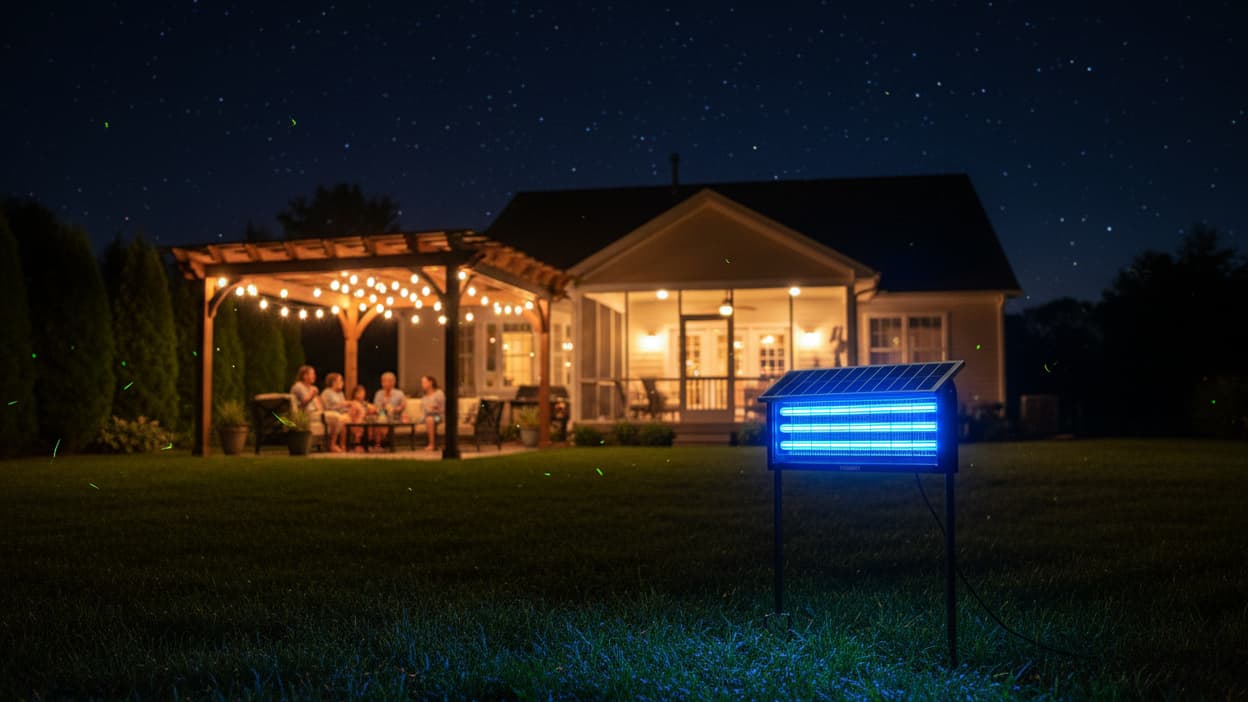
A single-tube zapper covering 500 square feet isn't going to do much for a 2,000 square foot backyard. Know your space before you buy. The HYKOONT 19W Standard covers approximately 4,000 square feet — enough for most suburban backyards. The 30W Pro extends that further for larger properties.
6. Installation Flexibility
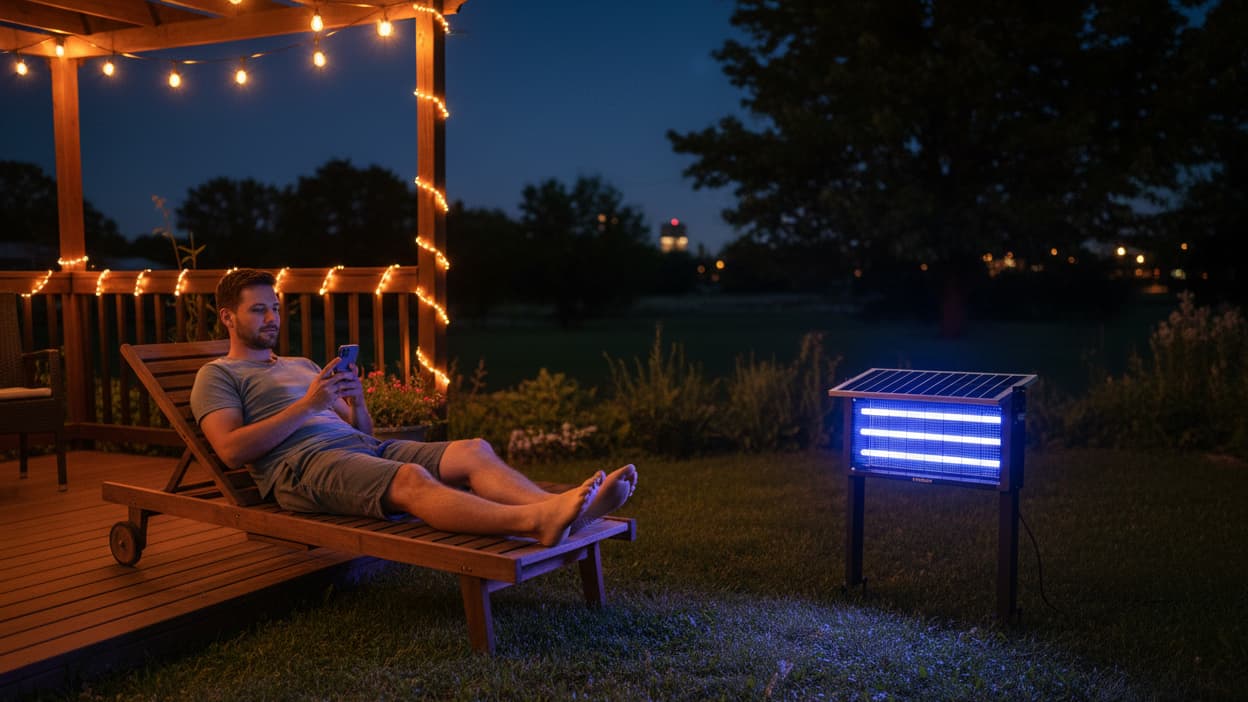
Plug-in zappers go where the outlet is, which is often not where you need them. Solar zappers go where you need them — period. The HYKOONT 19W Standard includes both a ground stake and a hanging hook, so you can position it in the garden, hang it from a pergola, or mount it on a fence post depending on your setup.
Solar vs. Plug-In: The Honest Comparison

We're not going to pretend solar is perfect for every situation. Here's the straight comparison:
| Factor | Plug-In Electric Zapper | HYKOONT Solar Zapper |
|---|---|---|
| Upfront Cost | $25–$50 | $95–$159 |
| Ongoing Cost | Electricity + replacement tubes | $0 |
| Placement Flexibility | Limited by outlet/cord | Anywhere with sun |
| UV Tube Type | Usually fluorescent (1 tube) | LED (3 tubes) |
| Housing | Usually plastic | Metal |
| Waterproofing | Varies (often minimal) | IPX4 rated |
| Auto On/Off | Rarely | Yes (light sensor) |
| Coverage | 500–1,500 sq ft typical | ~4,000 sq ft (19W) / larger (30W) |
| Lifespan | 1–3 years typical | Multi-season with metal housing |
| Works During Power Outage | No | Yes |
| 3-Year Total Cost (est.) | $80–$130+ | $95–$159 (one-time) |
The one area where plug-in wins is upfront cost. If you genuinely can't spend more than $30 right now, a plug-in unit gets the job done for the season. But if you're thinking beyond this summer, the solar math works in your favor pretty quickly.
👉 Shop the 30W Pro — $159, Built to Last
How to Dispose of Your Old Bug Zapper Properly
Quick note before you toss it: bug zappers contain electrical components and, in older fluorescent models, small amounts of mercury in the UV tubes. Don't throw them in the regular trash if you can avoid it.
- Check your local e-waste program. Most US counties have electronics recycling drop-off locations. Earth911.com lets you search by zip code.
- Home Depot and Best Buy both accept small electronics for recycling at most locations.
- If it's LED-based (no fluorescent tubes), it's generally safer for landfill disposal, but e-waste recycling is still the better option.
Step-by-Step: Setting Up Your HYKOONT Solar Bug Zapper as a Replacement

If you've ordered a HYKOONT solar bug zapper to replace your old unit, here's how to get it running correctly from day one.
Step 1: Choose Your Location
Pick a spot that gets at least 6 hours of direct sunlight during the day. This is the most important factor for solar performance. The unit doesn't need to be in full sun all day — but 6 hours gives you a reliable full charge for 8 hours of nighttime operation.
Position the zapper 10–15 feet from where people will be sitting or gathering. You want the UV light to attract insects away from your seating area, not directly overhead. Avoid placing it right next to bright porch lights or other competing light sources.
Step 2: Install the Ground Stake or Hanging Hook
The 19W Standard comes with both options. For most backyards, the ground stake is the easiest — push it into the soil in your chosen spot and the unit sits on top. No tools required. If you're hanging it from a pergola, fence, or tree branch, use the included hook.
The 30W Pro has multiple mounting options — check the included instructions for your specific configuration.
Step 3: Angle the Solar Panel
The solar panel should face south (in the US) and be angled to maximize sun exposure during peak hours. Most units come with the panel pre-angled, but if yours is adjustable, tilt it toward the sun.
Step 4: Initial Charge
Before first use, let the unit charge for a full day in direct sunlight. This gives the 6,000mAh battery a complete initial charge and ensures maximum runtime on the first night.
Step 5: Flip the Power Switch and Walk Away
Turn the unit on. The light sensor will handle everything from here — it detects dusk, activates the UV tubes, runs through the night, and shuts off at dawn. You don't need to do anything else.
"Replaced my old plug-in zapper with the HYKOONT 19W. Setup took maybe 8 minutes. It's been running every night since without me touching it once."
— Verified HYKOONT customer, Georgia
Which HYKOONT Model Should You Get?

Two models, two price points. Here's how to pick:
HYKOONT 19W Solar Bug Zapper Standard — $95

- 19W monocrystalline solar panel
- Triple UV LED tubes
- 6,000mAh battery, up to 8 hours runtime
- ~4,000 sq ft coverage
- Two working modes (constant + dusk-to-dawn)
- IPX4 waterproof, metal housing
- Ground stake + hanging hook included
- Best for: Typical suburban backyards, patios, decks, gardens
HYKOONT 30W Solar Bug Zapper Pro — $159

- 30W monocrystalline solar panel (faster charging, more power)
- Triple UV LED tubes
- 6,000mAh battery, up to 8 hours runtime
- Extended coverage for large properties
- Two working modes (constant + dusk-to-dawn)
- IPX4 waterproof, metal housing
- Multiple mounting options
- Best for: Large yards, HOA common areas, commercial outdoor spaces, pool areas
If you're replacing a single backyard zapper, start with the 19W Standard. If you're covering a larger space or want the most powerful option available, go with the 30W Pro.
Shop 19W Standard — $95 Shop 30W Pro — $159
Frequently Asked Questions
1. Can I repair my broken bug zapper instead of replacing it?
Sometimes, yes. If the UV tube is the only thing that failed, you can often find replacement tubes online for $8–$15. Search your model number plus "replacement UV tube." However, if the electrical grid, housing, or internal wiring has failed, repair usually isn't cost-effective on budget units — the parts cost more than a new unit. If your zapper is more than 2–3 years old and has failed, replacement is almost always the better call.
2. How do I know if my bug zapper's UV tube is burned out vs. another problem?
Plug it in (or charge it) and look at the tube directly. If the tube doesn't light up at all, it's either the tube or the power supply. If the tube glows but dimly or with a different color than usual, the tube is degrading. If the tube lights up fine but you're not hearing the zap when insects hit the grid, the electrical grid may have failed. A tube that flickers before going dark is usually at end of life.
3. Do solar bug zappers work as well as plug-in electric ones?
In most cases, yes — and often better. The HYKOONT models use triple UV LED tubes, which produce more total UV output than the single fluorescent tube in most plug-in budget zappers. The main variable is solar charging: if your yard gets good sun, the solar unit will run all night at full power. In heavily shaded yards, runtime may be shorter. For most US locations with average sun exposure, solar performance is comparable or superior to plug-in.
4. What's the lifespan of a solar bug zapper battery?
The 6,000mAh lithium battery in both HYKOONT models is rated for hundreds of charge cycles. In practical terms, you should expect 3–5 years of reliable battery performance with normal seasonal use. Battery capacity gradually decreases over time (as with all lithium batteries), so runtime may shorten slightly after several years. The battery is the component most likely to need eventual replacement, but it's not a near-term concern for most users.
5. Can I use a solar bug zapper in a covered patio or under a pergola?
The zapper unit itself can be placed in a covered area — it just needs to be positioned where the UV light can attract insects. The solar panel, however, needs direct sun exposure to charge. Since both HYKOONT models have the solar panel integrated into the unit, you'll need to position them where the panel gets sun during the day. For covered patios, consider placing the unit at the edge of the covered area where the panel can catch sun, or use the hanging hook to position it just outside the covered zone.
6. How often do I need to clean a solar bug zapper?
Every 2–4 weeks during peak season is a reasonable cadence. The main thing to clean is the collection tray at the bottom of the unit, where dead insects accumulate. Slide it out, empty it, and wipe it down. Occasionally wipe the solar panel with a damp cloth to remove dust and debris that can reduce charging efficiency. The UV tubes themselves don't need cleaning under normal use.
7. Will a solar bug zapper work during a power outage?
Yes — this is one of the underappreciated advantages of solar. Since the unit runs entirely on its own battery charged by the sun, it operates completely independently of the grid. During summer storms and power outages (when mosquitoes are often at their worst), your solar zapper keeps running.
8. Is the HYKOONT solar bug zapper safe around children and pets?
Yes. The electrical grid is enclosed within the metal housing, making accidental contact unlikely during normal use. The UV light is not harmful at normal viewing distances. Keep the unit out of reach of very young children and don't allow pets to chew on it, but for general outdoor use around families, both models are safe. The IPX4 rating also means rain and splashing water won't create electrical hazards.
9. How many bug zappers do I need for my yard?
The HYKOONT 19W Standard covers approximately 4,000 square feet — roughly a 63x63 foot area. For a typical suburban backyard, one unit is usually sufficient. For larger properties, consider the 30W Pro for extended coverage, or add a second 19W Standard unit on the opposite side of the yard. For HOA common areas or commercial spaces, multiple units positioned strategically will give you the best coverage.
10. What if the solar bug zapper doesn't work well in my yard?
The most common performance issues come down to placement rather than product defects. If runtime is shorter than expected, check that the solar panel is getting adequate direct sun (not just bright shade). If insect attraction seems low, make sure the unit isn't competing with a bright nearby light source. Repositioning the unit 10–15 feet from seating areas and away from competing lights resolves most performance concerns. Check the product page for current warranty and return information if you have a unit defect.
The Bottom Line

Your broken bug zapper is an opportunity, not just an inconvenience. The replacement decision you make right now determines whether you're doing this again in two years or whether you're done with the cycle entirely.
If you want the same thing you had — a plug-in unit that works for a season or two and then needs replacing — that option is available at any hardware store. No judgment.
But if you want to actually solve the problem: a solar bug zapper with metal housing, LED UV tubes, automatic operation, and zero ongoing cost is the upgrade that makes the most sense for most US homeowners. The HYKOONT 19W Standard at $95 is the right call for most backyards. The 30W Pro at $159 is the right call for larger spaces and anyone who wants the most durable, powerful option available.
Either way, you're done replacing bug zappers for a long time.

Leave a comment
This site is protected by hCaptcha and the hCaptcha Privacy Policy and Terms of Service apply.