







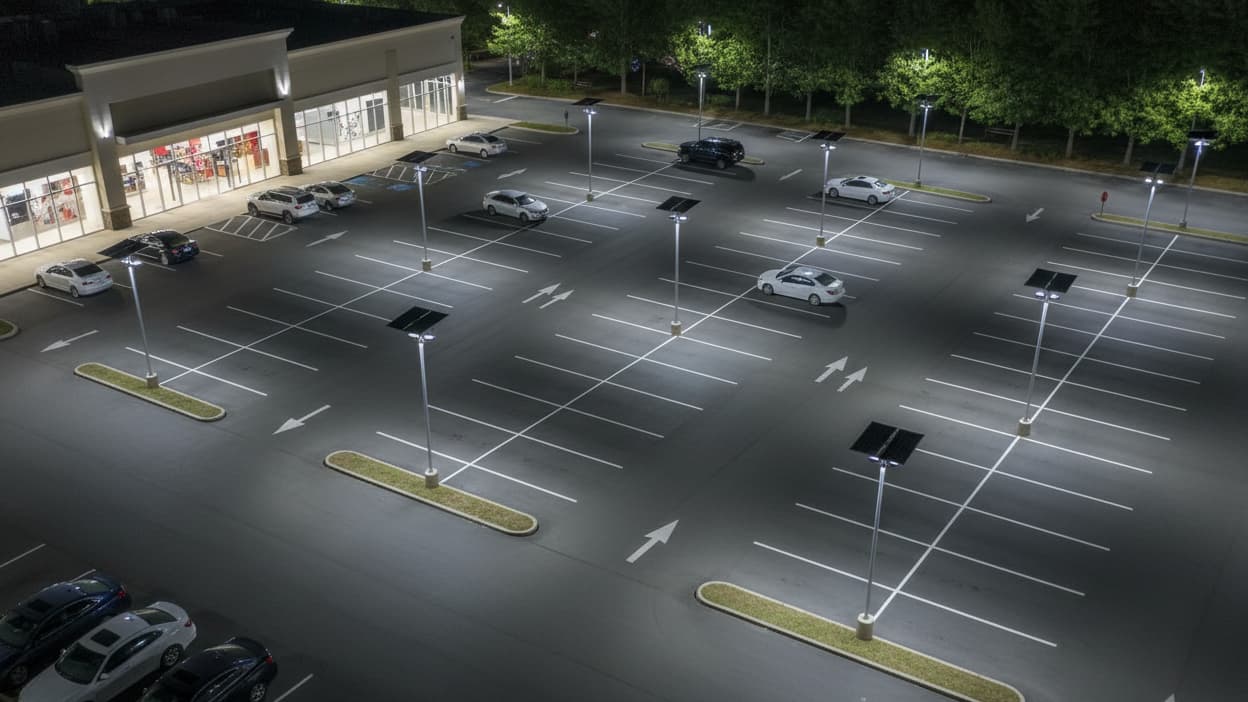
Let's be honest — nobody gets excited about their electricity bill. But if you're managing a parking lot, warehouse, distribution center, or any commercial outdoor space, that bill is probably one of the most frustrating line items you deal with every month. Lighting alone can account for 30–40% of a commercial property's total energy spend. That's not a rounding error. That's real money walking out the door, month after month.
So when people ask, "How much can businesses actually save with solar LED lights?" — the answer isn't a vague "a lot." It's specific, it's measurable, and for most US businesses, it's genuinely surprising.
This guide breaks it all down: the real numbers, the realistic timelines, the hidden savings most people overlook, and the products that are actually worth your investment.
The Real Cost of Traditional Outdoor Lighting (And Why It Hurts)
Before we talk savings, let's talk about what you're currently spending. A standard 250W metal halide street light — the kind you'll find in most older parking lots and roadways — runs about 250 watts per hour. Run it 12 hours a night, 365 days a year, and you're looking at roughly 1,095 kWh per fixture annually.
At the US commercial average electricity rate of $0.12–$0.16 per kWh (and climbing in states like California, New York, and Massachusetts), that's $131–$175 per fixture per year — just in electricity. Add in:
- Lamp replacements every 2–3 years (~$40–$80 per lamp)
- Ballast replacements (~$60–$120 every 5–7 years)
- Bucket truck rentals for maintenance (~$150–$300 per visit)
- Labor costs for a licensed electrician
- Trenching and grid connection fees for new installations
A parking lot with 20 traditional fixtures can easily cost $3,000–$5,000 per year just to keep the lights on. And that's before any rate increases from your utility provider.

What Solar LED Lights Actually Cost — And What They Save
Here's where it gets interesting. Solar LED street lights and flood lights have a higher upfront cost than traditional fixtures, but they eliminate the two biggest ongoing expenses: electricity and grid-tied maintenance.
No Electricity Bill. Ever.
Solar lights generate their own power from sunlight and store it in onboard batteries. Once installed, your electricity cost for that fixture is $0.00 per month. Not reduced. Zero.
For a 20-fixture parking lot, that's potentially $2,600–$3,500 in annual electricity savings alone.
No Trenching. No Grid Connection Fees.
Installing traditional wired lighting in a new parking lot or along a roadway requires trenching — digging up the ground to run electrical conduit. Depending on the project size, trenching alone can cost $5,000–$50,000+. Solar lights are self-contained. You mount the pole, aim the panel, and you're done. No trenching, no permits for electrical work, no utility hookup fees.
For new construction or expansion projects, this single factor can make solar the dramatically cheaper option from day one.
Dramatically Lower Maintenance Costs
Quality solar LED lights — like the ones we'll cover below — are rated for 50,000+ hours of LED life. That's roughly 11+ years of nightly operation before you'd even think about replacing the light source. Compare that to metal halide lamps that need replacement every 2–3 years, and the maintenance math becomes very clear.

Real-World ROI: Let's Run the Numbers
Let's use a concrete example: a mid-size distribution center in Texas with a 50-space parking lot that currently uses 20 traditional 250W metal halide fixtures.
Current Annual Costs (Traditional Lighting)
- Electricity: 20 fixtures × $150/year = $3,000/year
- Lamp replacements (every 2 years, prorated): $600/year
- Maintenance visits (2×/year): $500/year
- Total: ~$4,100/year
Switching to Solar LED Street Lights
Let's say you upgrade to the Hykoont NT040 40W Solar LED Street Light at $465 per unit.
- 20 units × $465 = $9,300 upfront
- Annual electricity cost: $0
- Annual maintenance: minimal (LED lifespan 50,000+ hrs, 10-year rated lifespan)
- Estimated annual savings vs. traditional: $3,500–$4,100
- Payback period: approximately 2.3–2.7 years
After payback, you're essentially running your parking lot lighting for free. Over a 10-year period, the net savings on a 20-fixture installation can exceed $30,000.
Featured Products: What We Actually Recommend for Commercial Use
Not all solar lights are built for commercial applications. Here are the Hykoont products that consistently perform for businesses, warehouses, parking lots, and large outdoor spaces across the US.
1. NT040 40W Solar LED Street Light — Best for Mid-Size Parking Lots

Price: $465.00
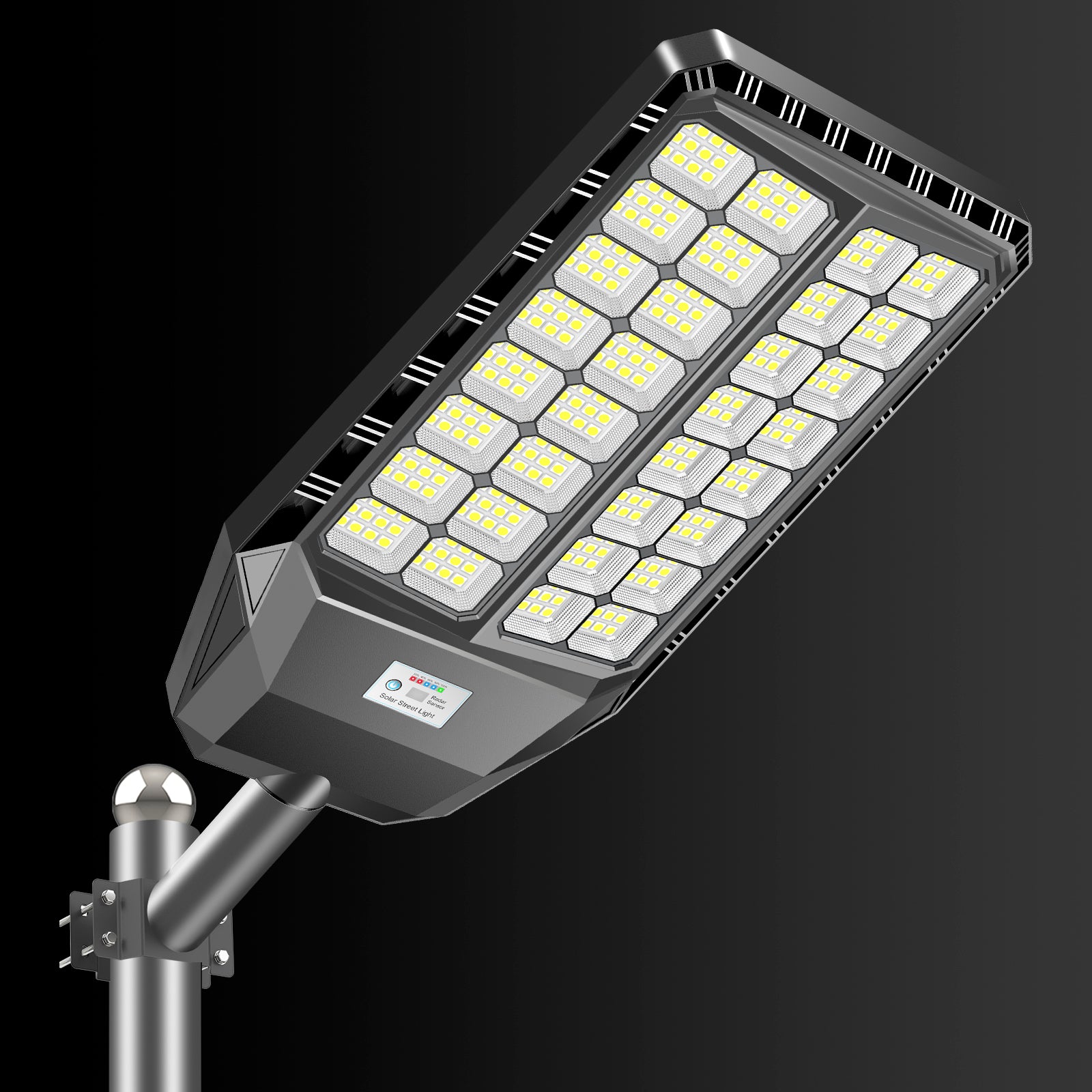
The NT040 is built for the long haul — literally. With a 240Wh LiFePO4 battery and a rated lifespan of 10 years, this is the kind of fixture you install once and forget about. The 40W LED output delivers bright, consistent illumination for standard parking lots, walkways, and access roads. Durable aluminum construction handles everything from Texas heat to Minnesota winters without complaint.
What makes it stand out for businesses: the dusk-to-dawn automation means zero manual operation, and the IP66 waterproof rating means weather isn't a maintenance concern.
2. NT100 100W Solar LED Street Light — Best for Large Lots & Roadways

Price: $762.00
When you need serious output — think large distribution center yards, highway-adjacent properties, or sprawling commercial campuses — the NT100 is the answer. At 100W with a 480Wh battery bank, it's engineered for maximum brightness across vast spaces. This is the fixture that replaces 250W–400W metal halide installations without compromise.
The 480Wh battery capacity means it can handle multiple consecutive cloudy days without dimming — a real concern for businesses in the Pacific Northwest or Great Lakes region.
3. Hykoont TW020 200W Solar Street Light — Best Value for High-Output Needs

Price: $89.00
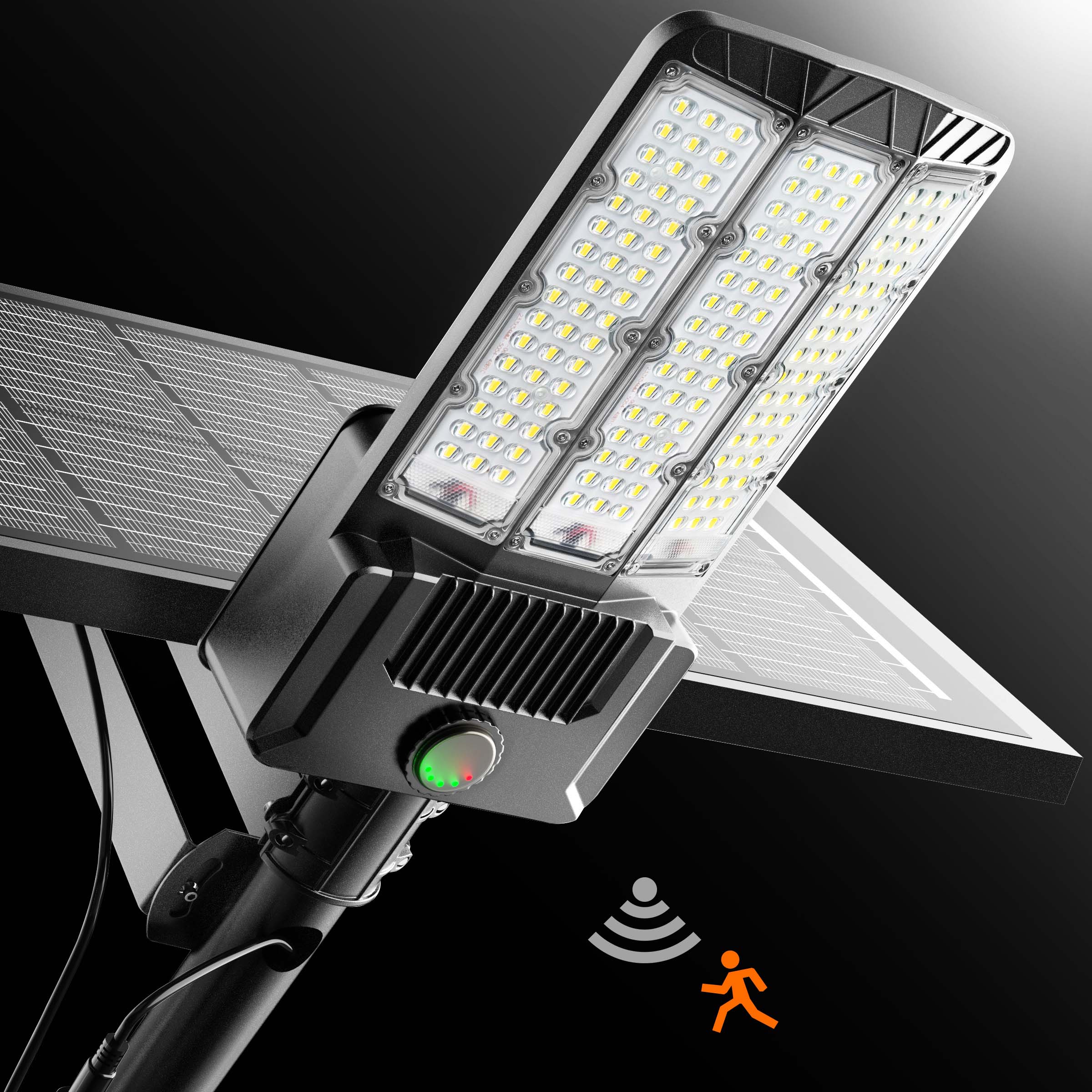
The TW020 punches well above its price point. At 200W output and $89, it's one of the most cost-effective high-lumen solar street lights available for commercial use. If you're outfitting a large perimeter or need to cover significant ground on a tighter budget, the TW020 series is worth a serious look. Motion sensor capability adds an extra layer of energy efficiency — lights dim when no one's around and brighten when motion is detected.
4. Hykoont ZZ077 300W Solar Flood Lights (2-Pack) — Best for Wide-Area Coverage

Price: $238.00 (2-Pack)
Flood lights serve a different purpose than street lights — they're about wide-area coverage, security illumination, and lighting large vertical or horizontal surfaces. The ZZ077 2-pack at $238 gives you two 300W-equivalent solar flood lights for less than the cost of a single traditional wired flood fixture installation. Ideal for loading docks, building perimeters, signage illumination, and outdoor storage areas.
→ Shop the ZZ077 2-Pack — $238.00
5. Hykoont XH300 Solar Flood Lights Outdoor 42000LM — Best for Maximum Flood Coverage

Price: $79.00
42,000 lumens. Let that sink in. The XH300 delivers stadium-level brightness from a solar-powered fixture at a price point that makes it accessible for almost any commercial project. Whether you're lighting a construction site, a large outdoor event space, or a sprawling warehouse yard, the XH300 covers ground that most solar flood lights simply can't match.
The Hidden Savings Most Businesses Don't Think About
The electricity savings are obvious. But there are several other financial benefits that don't show up in the initial ROI calculation — and they add up fast.
Tax Incentives and Depreciation
The federal Investment Tax Credit (ITC) currently allows businesses to deduct a significant percentage of solar equipment costs from their federal taxes. Combined with MACRS accelerated depreciation (solar equipment qualifies for 5-year depreciation), the effective cost of your solar lighting installation can be reduced by 30–50% in the first year alone. Talk to your accountant — this is real money.
Utility Rebates
Many US utilities offer rebates for commercial customers who reduce grid demand. Installing solar lighting can qualify your business for these programs. Check the DSIRE database (dsireusa.org) for incentives in your state — some programs offer $50–$200 per fixture in rebates.
Insurance Premium Reductions
Better outdoor lighting reduces slip-and-fall liability and deters theft and vandalism. Some commercial property insurers offer premium discounts for properties with improved security lighting. It's worth asking your broker.
Increased Property Value
Commercial properties with modern, energy-efficient infrastructure command higher valuations and are more attractive to tenants. If you lease your space, solar lighting is a legitimate selling point that can justify higher rents.
Business Continuity During Outages
Grid-tied lighting goes dark during power outages. Solar lighting doesn't. For businesses where outdoor lighting is a safety or security requirement — warehouses, logistics hubs, healthcare facilities — this resilience has real dollar value.
How to Calculate Your Specific Savings
Every business situation is different, but here's a simple framework you can use to estimate your own ROI:
Step 1: Count Your Current Fixtures
How many outdoor lights do you currently operate? Include parking lot lights, perimeter lights, signage lights, and security lights.
Step 2: Calculate Annual Electricity Cost
Wattage per fixture × hours per night × 365 days × your electricity rate ($/kWh) = annual cost per fixture. Multiply by number of fixtures.
Step 3: Add Maintenance Costs
Estimate your annual lamp replacement, ballast replacement, and service call costs. For most commercial properties, this adds 20–40% on top of electricity costs.
Step 4: Get Solar Quotes
Use the product pages above to price out equivalent solar fixtures. Remember to factor in installation savings (no trenching, no electrician for grid connection).
Step 5: Calculate Payback Period
Solar upfront cost ÷ annual savings = payback period in years. Most commercial solar lighting installations pay back in 2–4 years.
Common Objections — And Honest Answers
"What about cloudy days?"
Modern solar LED lights with quality LiFePO4 batteries — like the NT040 and NT100 — are designed to store enough energy for 3–5 consecutive cloudy nights. For most US locations, this is more than sufficient. If you're in a consistently low-sun region (Seattle, for example), look for fixtures with larger battery capacity and consider supplemental charging options.
"Are solar lights bright enough for commercial use?"
Yes — if you choose the right fixtures. The products featured in this article are specifically selected for commercial-grade output. The NT100 at 100W and the XH300 at 42,000 lumens are not residential garden lights. They're engineered for parking lots, roadways, and large outdoor spaces.
"What's the actual lifespan?"
The NT040 is rated for 10 years. The LED components in most quality fixtures are rated for 50,000+ hours. The LiFePO4 batteries used in premium solar lights typically last 2,000–3,000 charge cycles — that's 5–8 years of daily cycling before capacity degrades meaningfully. Plan for a battery replacement around year 6–8; the fixture itself will likely outlast it.
"Is installation complicated?"
For most solar street lights, installation is straightforward: set the pole, mount the fixture, aim the solar panel south (in the US), and you're done. No licensed electrician required for the lighting itself (though you may need a permit for the pole foundation depending on your municipality). Most commercial installations can be completed by a general contractor or even a capable facilities team.
Who Benefits Most from Solar LED Lighting?
While virtually any business with outdoor lighting can benefit, some sectors see the most dramatic ROI:
- Logistics and distribution centers — Large yards, 24/7 operations, high electricity consumption
- Retail strip malls and shopping centers — Extensive parking lots, high visibility requirements
- Manufacturing facilities — Perimeter security, loading dock illumination
- Municipal and government properties — Parks, roadways, public parking — often eligible for additional grant funding
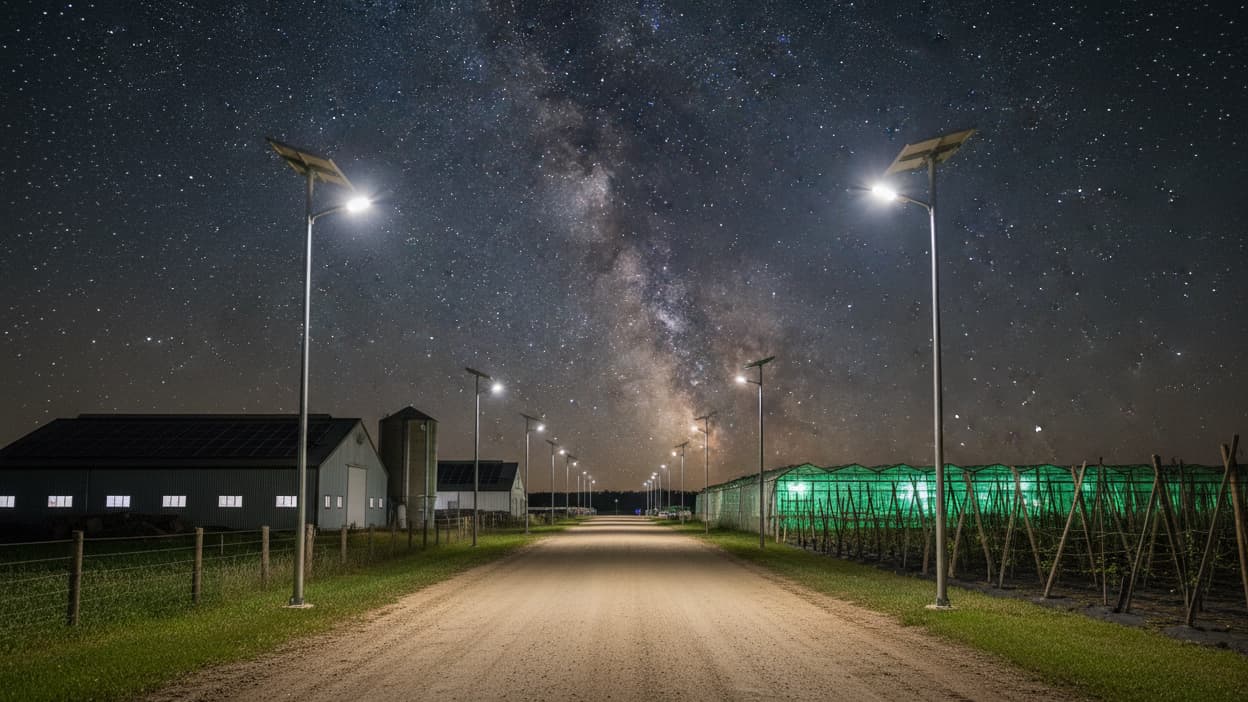
- Agricultural operations — Remote locations where grid connection is expensive or impractical
- Construction companies — Temporary site lighting that moves with the project
- Property management companies — Multiple properties, scalable savings
Making the Switch: A Practical Roadmap
If you're convinced the numbers work (and for most US businesses, they do), here's how to approach the transition without headaches:
Start with a pilot. Don't replace every fixture at once. Pick your highest-cost area — usually the main parking lot or primary access road — and install 5–10 solar fixtures. Measure the results over 60–90 days. The data will make the case for full rollout better than any sales pitch.
Audit your current lighting first. Know exactly what you have before you buy replacements. Wattage, fixture count, operating hours, and current electricity rate are the four numbers you need.
Check incentives before you buy. Federal tax credits, state rebates, and utility programs can significantly reduce your net cost. A quick call to your accountant and a search on dsireusa.org takes 30 minutes and could save you thousands.
Buy commercial-grade, not residential. The price difference between a $30 Amazon solar light and a $465 commercial fixture is real — and so is the performance difference. For business applications, buy fixtures rated for commercial use with documented battery capacity, IP ratings, and warranty terms.
Plan for battery replacement. Budget for a battery replacement around year 6–8. It's a fraction of the original fixture cost and extends the life of your installation by another decade.
FAQ: Solar LED Lights for Businesses
Q: How much does it cost to install solar LED street lights for a commercial parking lot?
A: It depends on the number of fixtures and the products you choose. Using the Hykoont NT040 at $465 per unit, a 20-fixture parking lot would cost approximately $9,300 in product costs. Installation (pole setting, no electrical trenching required) typically adds $50–$150 per fixture depending on your contractor. Total installed cost: roughly $10,300–$12,300 for 20 fixtures.
Q: How long does it take for solar LED lights to pay for themselves?
A: For most US commercial applications, the payback period is 2–4 years. Businesses in high-electricity-cost states (California, New York, Massachusetts) often see payback in under 2 years. After payback, the savings are essentially pure profit.
Q: Do solar LED lights work in northern states with less sunlight?
A: Yes, with the right fixtures. Look for products with larger battery capacity (like the NT100 with its 480Wh battery) and high-efficiency solar panels. Most quality commercial solar lights are designed to operate through 3–5 consecutive cloudy days. For locations with very short winter days, consult with a solar lighting specialist about panel sizing.
Q: Are there federal tax incentives for commercial solar lighting?
A: Yes. Solar lighting equipment typically qualifies for the federal Investment Tax Credit (ITC) and MACRS 5-year accelerated depreciation. The combined effect can reduce your net equipment cost by 30–50% in year one. Consult your tax advisor for specifics applicable to your business.
Q: What's the difference between solar flood lights and solar street lights for commercial use?
A: Street lights are designed for downward illumination of roadways and parking areas — they're mounted on poles and optimized for uniform ground-level coverage. Flood lights project a wide beam and are better for illuminating building facades, loading docks, signage, and large open areas. Most commercial properties need both types for complete coverage.
Q: How do I know if a solar light is powerful enough for my parking lot?
A: The key metric is lumens per square foot. Commercial parking lots typically require 1–3 foot-candles of illumination (roughly 10–30 lux). Calculate your lot's square footage, determine the required lumen output, and choose fixtures accordingly. The NT040 and NT100 both include photometric data to help with this calculation.
Q: Can solar lights handle extreme weather — heat, cold, snow?
A: Quality commercial solar lights are rated for wide temperature ranges and carry IP65–IP68 waterproof ratings. The Hykoont fixtures featured here are IP66 rated, meaning they're fully protected against dust and powerful water jets. They're designed for outdoor commercial use in all US climate zones.
Q: What maintenance do solar LED lights require?
A: Minimal. The main maintenance tasks are: occasional panel cleaning (dust and debris reduce charging efficiency), checking mounting hardware annually, and planning for battery replacement around year 6–8. There are no lamp replacements, no ballast failures, and no electrician callouts for routine maintenance.
Q: Can I get a volume discount for outfitting a large facility?
A: Yes — contact Hykoont directly for volume pricing on orders of 10+ units. Large commercial and municipal projects often qualify for project pricing that significantly reduces per-unit cost.
Q: How do solar lights perform during a power outage?
A: Solar lights are completely independent of the grid, so they continue operating normally during power outages. For businesses where outdoor lighting is a safety or security requirement, this grid independence is a significant operational advantage over traditional wired lighting.
The Bottom Line
The question isn't really "Can businesses save money with solar LED lights?" — the answer to that is clearly yes. The real question is how much, and how fast.
For most US commercial properties, the math is compelling: payback in 2–4 years, 10+ years of essentially free lighting after that, zero electricity costs, dramatically lower maintenance, and a stack of tax incentives that reduce the upfront investment. Over a 10-year horizon, a properly sized solar lighting installation can save a mid-size business $20,000–$50,000 compared to continuing with traditional grid-tied lighting.
The technology is mature, the products are proven, and the financial case is solid. The only question left is which fixtures are right for your specific application.
Browse the full Hykoont commercial solar lighting lineup below — and if you have questions about which products are right for your facility, reach out. We're happy to help you run the numbers.
→ Shop NT040 40W Solar Street Light — $465.00
→ Shop NT100 100W Solar Street Light — $762.00
→ Shop ZZ077 300W Solar Flood Lights 2-Pack — $238.00

Leave a comment
This site is protected by hCaptcha and the hCaptcha Privacy Policy and Terms of Service apply.