







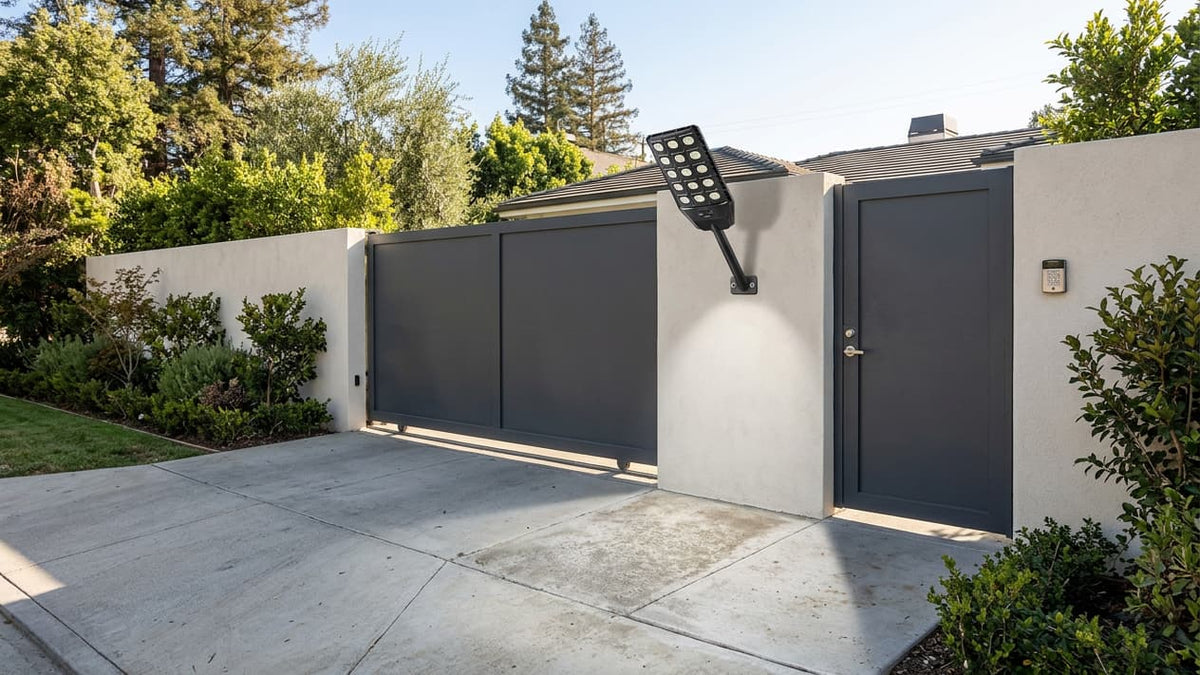
At 7:30 p.m., the driveway looks terrific. You can see the gate latch, the gravel edge, and the delivery truck turning around. At 12:15 a.m., you look outside again and wonder whether someone swapped the light while you were watching TV.
Same fixture. Same location. Very different night.
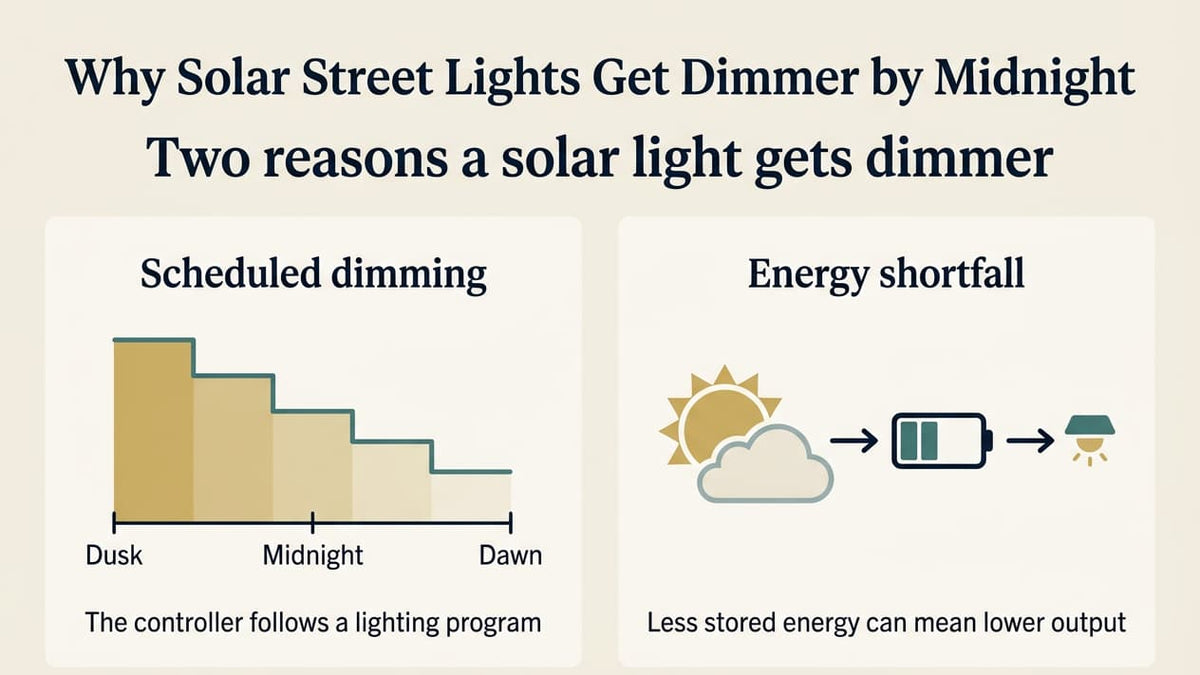
That change is not automatically a defect. Some solar street lights deliberately reduce their output after the busiest evening hours. Others are running short of stored energy. And sometimes the light is doing exactly what its selected mode tells it to do, just not what you thought you bought.
The useful question is not simply, “Why did it get dimmer?” It is, “Did it dim on schedule, or did it run out of room in its energy budget?” Those are different problems, and they need different fixes.
This guide looks at solar street lights for parking lots, private driveways, and access roads from the perspective that matters: what you can actually see after the first few impressive hours have passed.
The short answer: your light may be budgeting, struggling, or both
A solar street light is a small off-grid power system. The panel collects energy during the day. The battery stores it. The controller decides how to spend it. The LED fixture turns that energy into light.
If the controller is programmed to prioritize the early evening, brightness can step down later even when the equipment is functioning normally. If the battery started the night partly charged, the controller may reduce output to stretch the remaining energy. A worn battery, shaded panel, unusually long night, or inappropriate mode can make that reduction arrive sooner.
There is also a third possibility: the property is not getting much darker overall, but the particular place you need to see becomes underlit when the light drops to its overnight level. That is a lighting-design problem as much as an electrical one.
Think of a rural entrance. A low overnight setting might still show where the driveway begins. It might not provide enough detail to read a keypad, spot an obstacle, or reverse a trailer. “Still on” and “still useful” are not interchangeable.

Midnight is a clue, not a diagnosis
Before replacing anything, notice the timing. A light that drops sharply to a stable lower level behaves differently from one that slowly fades, flickers, or shuts down. The pattern gives you a better starting point than the word “dim.”
A clean step down often points toward a programmed mode
Imagine the light is bright at 8:59 p.m., then distinctly lower at 9:00 p.m., and holds that level. That is consistent with a timed brightness stage. It is not proof, because battery-protection behavior can also produce a step change, but the control settings are the first place to investigate.
Some systems count hours from dusk rather than using an actual clock. A reduction that seems to happen around midnight in summer could happen much earlier on the clock in winter. Write down when the fixture turns on, not just when it gets dim.
An earlier drop after cloudy days suggests an energy shortage
If the same light lasts comfortably after sunshine but drops early after several gray days, charging deserves attention. The panel may be operating normally while collecting less energy than the nightly program consumes.
That does not mean every cloudy-day change requires a new panel. First check for temporary shading, dirt, snow, an accidentally selected high-output setting, or a lighting schedule that no longer matches the season.
One weak fixture among several needs its own investigation
If a row of similar lights behaves normally and just one fades early, a shared weather explanation becomes less persuasive. Compare that unit’s panel exposure, selected mode, installation history, and visible condition with its neighbors.
A tree branch casting shade on one panel can create a surprisingly local problem. So can a connector issue or a battery that has aged differently. Avoid resetting every light on the property before you know whether the problem is actually shared.
“Dusk to dawn” does not tell you the brightness at 2 a.m.
This is where a lot of reasonable expectations go sideways. A dusk-to-dawn description tells you about operating behavior, but it does not by itself specify a constant light output throughout the night.
A fixture can turn on automatically at dusk, run through several brightness stages, and switch off at dawn. Another may stay at a lower baseline and increase output when its supported sensor detects activity. Both can be described in everyday shopping language as all-night lighting.
Neither arrangement is necessarily wrong. The problem starts when a buyer interprets “all night” as “the maximum advertised output, continuously, until sunrise.” That requires a much more demanding energy balance.
For a storage-yard entrance that sees occasional overnight traffic, a reduced baseline may be perfectly sensible. For an employee exit used at 1 a.m., the overnight level matters as much as the opening level. For a public road, suitability also depends on an appropriate professional lighting design, not just a product description.
Ask what the light does during each part of the night. How long does the initial level last? What comes next? Is the later output fixed, adjustable, motion-responsive, or dependent on battery condition? What assumptions sit behind the runtime claim?
Those questions are more valuable than asking only how many hours the light stays on. You are buying visibility during particular hours, not simply an illuminated object on a pole.

The battery math that the biggest number on the box cannot replace
You do not need an engineering degree to spot an unrealistic expectation. You just need to keep power and energy separate.
Watts describe the rate at which energy is used. Watt-hours describe an amount of energy. A battery rated in watt-hours is closer to the size of the fuel tank; the actual electrical load is closer to how quickly you are emptying it.
Here is a deliberately simplified example, not a runtime promise for any product in this article. A hypothetical light drawing a steady 20 watts for 12 hours would need 240 watt-hours at the load. Real battery sizing must also account for usable capacity, conversion losses, temperature, protection settings, aging, and reserve.
If the same hypothetical light uses 20 watts for four hours and 8 watts for eight hours, the load-side total is 144 watt-hours. That is why staged dimming can make such a substantial difference. It changes the nightly energy requirement rather than creating extra battery capacity.
The catch is that a product’s headline wattage may not be its measured continuous nighttime battery draw. You cannot responsibly calculate an exact runtime from the headline alone. You need the actual operating load and the relevant brightness schedule.
Compare watt-hours, not bare amp-hours
Amp-hours without voltage are an incomplete comparison. Two batteries can carry similar amp-hour labels and store very different amounts of energy because their voltages differ.
The basic nominal-energy relationship is volts multiplied by amp-hours equals watt-hours. It is useful for comparing listed capacity, but nominal energy still is not a guarantee that every watt-hour reaches the LEDs under every condition.
When asking a seller for help, request battery watt-hours, the output schedule, and the assumptions behind any runtime figure together. A single large number rarely explains overnight performance.
A bigger battery does not fix an energy deficit forever
More storage can give you more reserve. It does not solve a permanent mismatch between daily collection and nightly consumption. If a system uses more energy each night than it collects each day, eventually even a larger battery will run low.
This is why a good solar lighting purchase is a matched-system decision. The panel, battery, controller, lighting program, and site all need to work together. Shopping for just the largest battery can be as misleading as shopping for just the brightest LED claim.
The panel may be in daylight without getting a useful charging day
Look at the panel at 10 a.m., noon, and midafternoon. Not from the driveway entrance. Look at the actual surface and the shadows crossing it.
A panel can sit outside all day and still lose important charging opportunities to a roof edge, utility pole, nearby tree, or seasonal shadow. The location that gives the lamp a useful view of the driveway may not give the panel the best view of the sky.
For sites in the United States, a generally south-facing orientation is often a starting point for fixed solar collection, but shade, roof geometry, latitude, and the equipment’s mounting limits can change the best practical arrangement. Use the manufacturer’s installation instructions and a site-specific assessment rather than treating one compass direction as a guarantee.
Winter makes the mismatch easier to notice. The sun’s path changes, useful collection can shrink, and the light may have more nighttime hours to cover. A setup that coasts through July can reveal its limits in December without any component having suddenly failed.
Dust, pollen, leaves, bird droppings, and snow can add to the problem. Inspect from a safe position. Follow the manufacturer’s cleaning instructions and do not scrape the panel, spray electrical joints, or climb an unsuitable ladder to save a few minutes.
If the panel is inaccessible, schedule qualified help. The purpose of troubleshooting is to improve the lighting, not turn a maintenance task into a fall.
Cold weather and battery age can move the dimming point
A light that used to last well into the morning but now fades around midnight deserves a different conversation from a new light that has always followed the same schedule.
Batteries age. Their usable performance can change with temperature and service history. A system that once had enough margin may become sensitive to a few cloudy days, a longer winter night, or a higher-output setting.
Cold-weather behavior also depends on the specific battery chemistry, charging protection, and system design. An advertised operating-temperature range does not automatically describe every charging condition. Check the manual for charging limits separately.
Do not warm a battery with improvised heaters, bypass a protection circuit, or substitute a pack because its connector happens to fit. Battery replacements need to match the manufacturer’s requirements for voltage, chemistry, protection, enclosure, and connections.
For an older installation, keep the comparison fair. Was it tested in the same season? Is the panel equally clean? Has the landscaping grown? Has the mode changed? An aging battery is a plausible explanation, not permission to skip the easier checks.

Sometimes the light is bright, but the wrong patch of ground is bright
Stand where a person actually needs to see. Not directly below the fixture, and not at the window where you first noticed the problem.
For a driveway, that might be the keypad, turning area, or uneven shoulder. For a small parking lot, it might be the walk from the last parking space to the door. For an access road, it might be the bend where a bright pool of light ends.
High output at the fixture does not guarantee useful illumination at those points. Mounting height, beam distribution, tilt, obstructions, and spacing affect where the light lands.
At the initial brightness setting, a weak layout can look acceptable because there is enough spill to hide its gaps. Once the controller reduces output, those gaps become obvious. Increasing the opening brightness may make the contrast worse without solving the overnight problem.
That is why “buy the brightest one” is not always the best answer. Sometimes the better fix is a revised layout, a different mounting position within the manufacturer’s limits, or an additional correctly placed fixture. For commercial sites, ask for a photometric assessment instead of guessing from a broad coverage claim.
Also watch glare. Looking at a bright LED source can make the surrounding scene harder to judge. Evaluate the ground and the task, not how dazzling the fixture looks when you stare up at it.
A three-night check that beats random button pressing
You do not need to watch the fixture continuously. You do need a consistent record. The goal is to learn whether the dimming follows elapsed time, available charge, activity, or an individual unit.
Night one: record what it does before changing it
Write down the selected mode if you can identify it, the day’s weather, approximate panel shading, turn-on time, and when the change becomes noticeable. Check from the same observation points at dusk, later in the evening, and around the time the light usually disappoints you.
If you take photos, keep the camera position and exposure settings consistent where possible. Automatic phone exposure can make a dim scene look bright or a bright scene look unexpectedly dark. Photos are useful for a record, but they are not calibrated illuminance measurements.
For a more useful comparison, a suitable light meter can track the same ground locations over time. Measure consistently and keep nearby vehicle headlights or other temporary light sources out of the comparison.
Night two: test one explanation
Read the mode instructions and change only one relevant setting, if the equipment allows it and the change is suitable for the site. Alternatively, address an obvious charging obstruction or have the panel cleaned safely.
Do not clean the panel, change the mode, move the fixture, and reset the controller all at once. If the outcome improves, you will not know which action mattered. If it worsens, you will have four things to undo.
Allow the charging period recommended by the manufacturer before judging a previously depleted system. One partial day may not restore the battery enough to make a fair comparison.
Night three: compare, then decide
Compare the timing and useful visibility, not just whether the fixture remained on. A later dimming point after improved sun exposure supports a charging explanation. An identical step-down after the same elapsed time supports a schedule explanation. Neither observation replaces the manual or a technical inspection when the evidence is mixed.
If you have neighboring identical lights, compare them under similar conditions. Give support the model, installation age, mode, weather history, charging exposure, and recorded behavior. That is much more actionable than “it gets weak at night.”
Stop ordinary troubleshooting if you see damaged wiring, swelling, scorching, water inside an electrical compartment, or repeated abnormal flickering. Keep clear of unsafe equipment and contact qualified service support.
Three Hykoont options, compared by the questions that matter after dark
The following products were listed as active and available to purchase when this article was prepared. Prices are in USD and are a snapshot, not a promise of future pricing. Check each product page for the current price, selected configuration, included equipment, shipping, and any applicable tax.
These are buying starting points, not a claim that any one fixture will satisfy every parking lot, road, or overnight lighting requirement. None should be chosen solely from its opening brightness.
YK080 Pro: $365, with staged output explicitly described

The Hykoont YK080 Pro Solar Street Light is listed at $365. Its product information specifies a 160Wh battery, a 40W monocrystalline solar panel, MPPT charging, and segmented brightness levels of 100%, 70%, 45%, and 30%.
That makes it particularly relevant to this discussion. A lower late-night setting can be part of the intended program, not evidence that the LEDs have become weak. The important next question is which stages the selected mode uses, how long each lasts, and whether the resulting overnight visibility fits your property.
The listing also advertises up to three days of lighting after a full charge. Treat that as a conditional runtime statement tied to operating behavior, not three days at the headline maximum output. Ask for the applicable schedule and conditions before planning a site around it.
At this price, the YK080 Pro is worth comparing when your priority is a managed overnight lighting pattern rather than an assumption of continuous peak output. Match the mounting arrangement and light distribution to the actual task before ordering.
Shop the YK080 Pro and review its current specifications.
HY050: $696, with a larger listed battery and separate solar panel

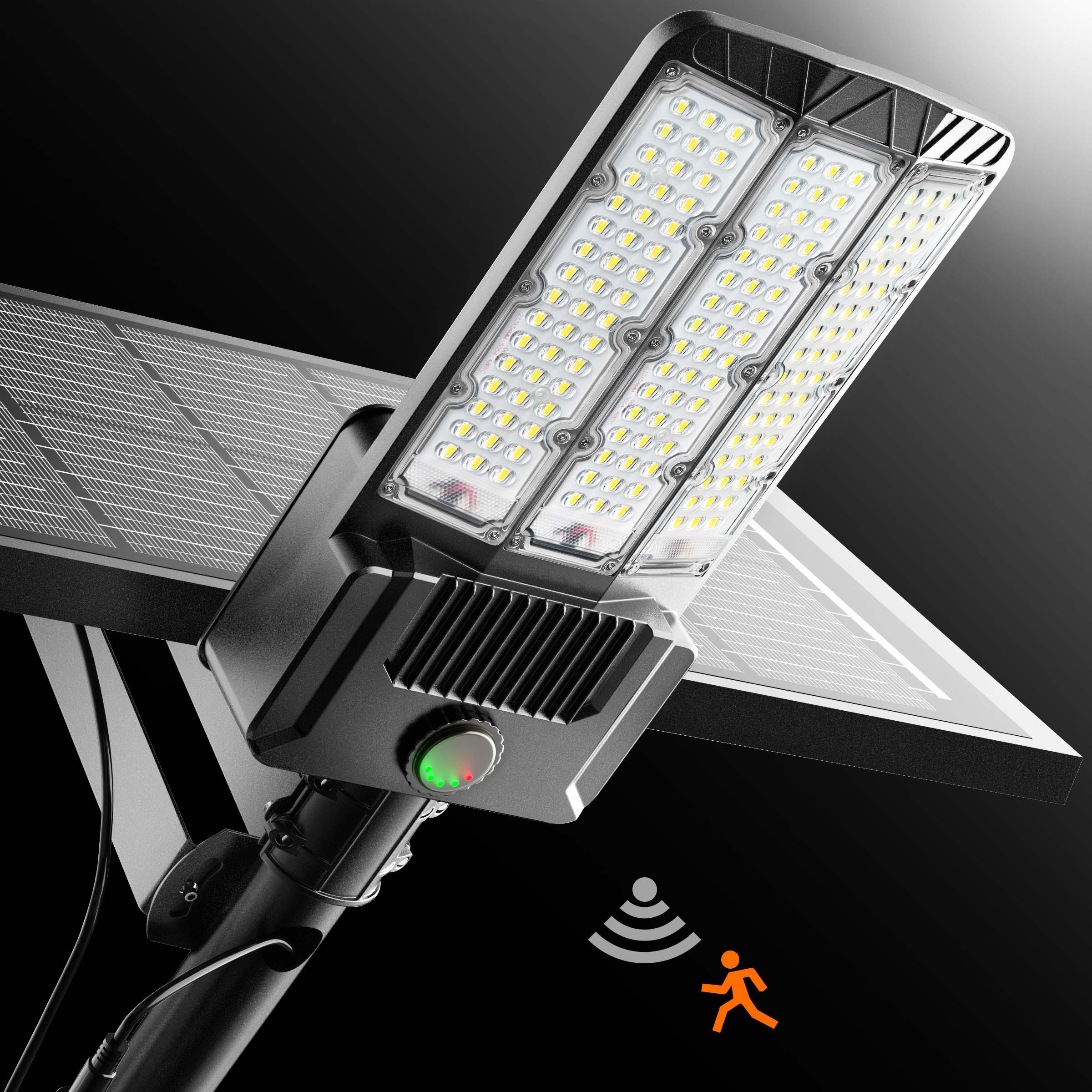
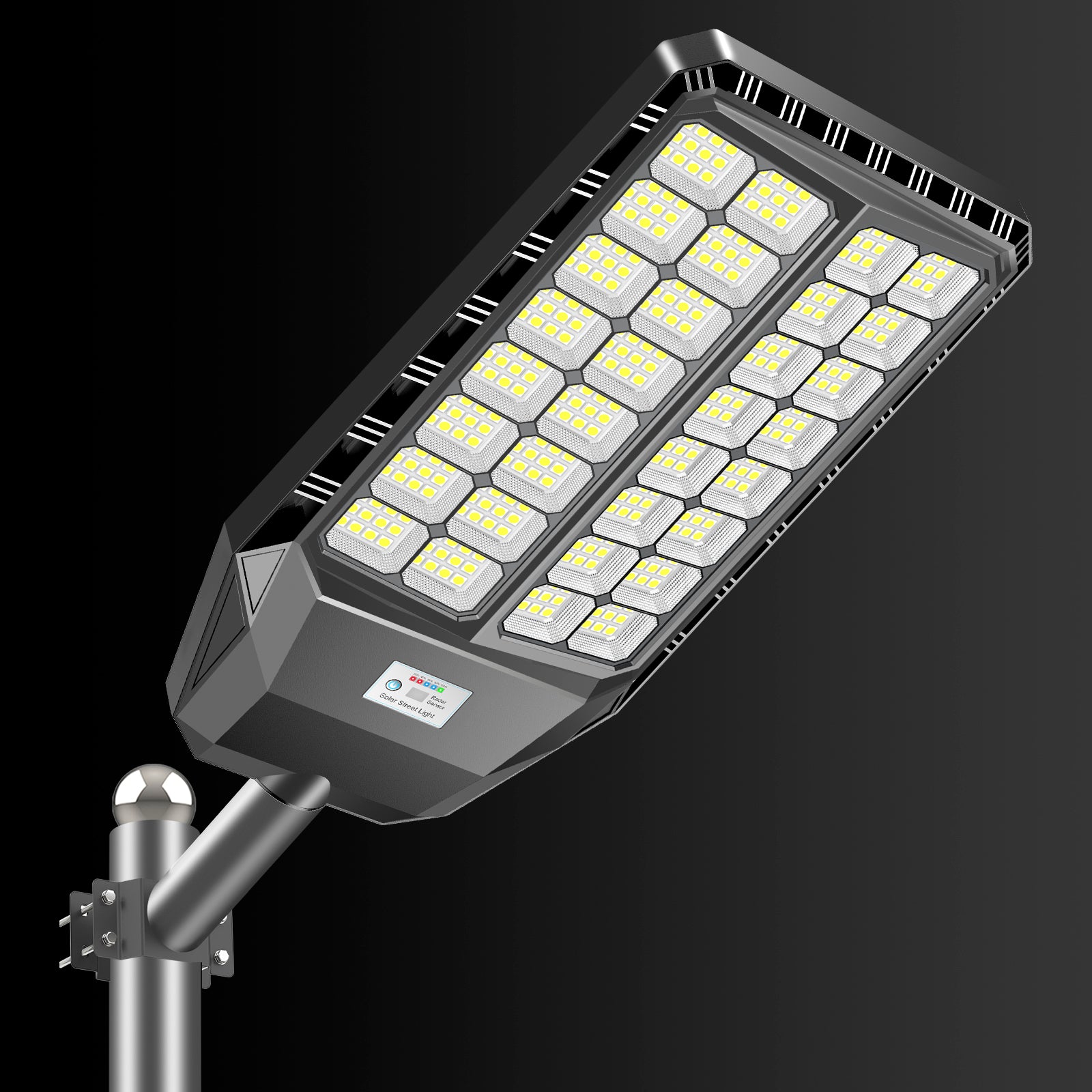
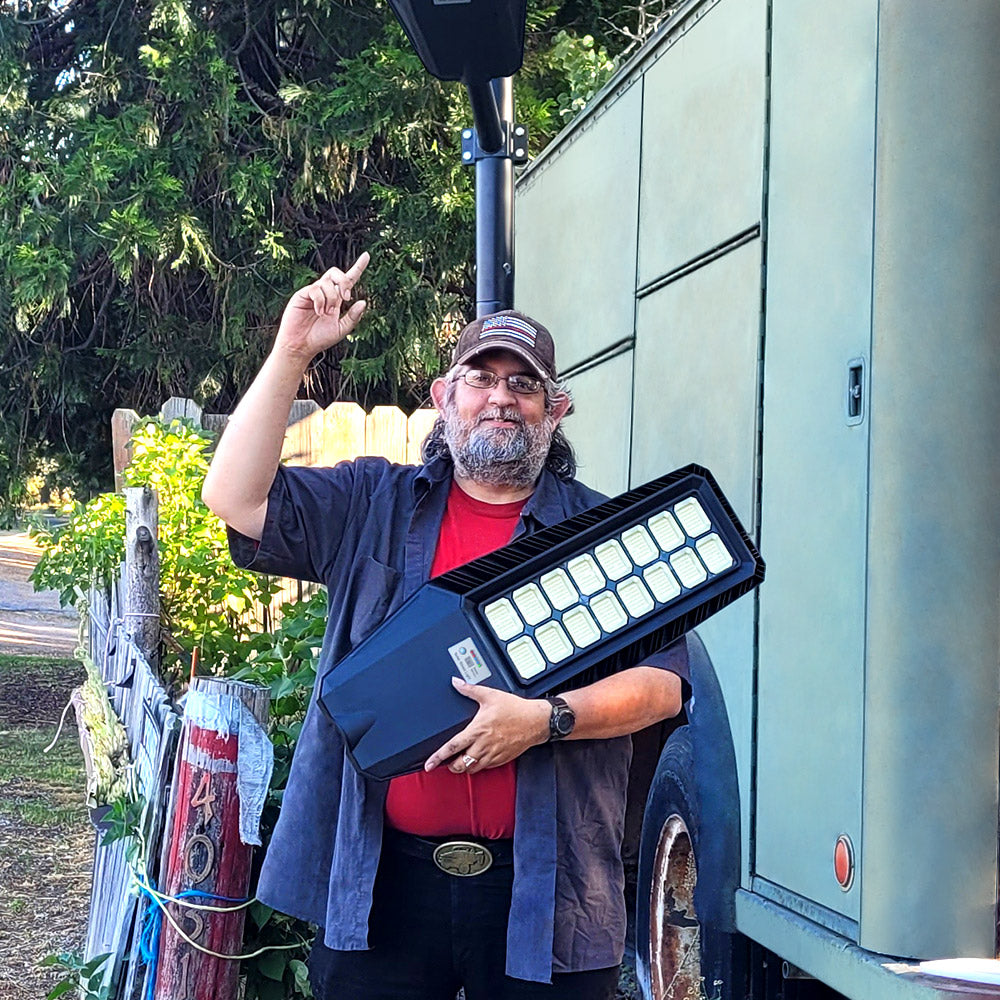
The Hykoont HY050 Commercial Solar Street Light is listed at $696. Its product information specifies a 480Wh battery, an 80W monocrystalline panel, a listed 9,000-lumen output, and MPPT charging. The HY design uses a separate solar panel; the photo above shows the light head, not the complete installed assembly.
The listing describes both full-power operation and time-controlled dimming. That distinction matters: a larger listed battery gives you more capacity to evaluate, but it does not remove the need to confirm the operating schedule and actual load.
A separate-panel layout can be useful when the best location for illumination and the best available solar exposure are not identical, provided the approved hardware and cable arrangement allow the proposed installation. Do not assume unlimited separation or modify the wiring to reach a sunnier roof.
For a private access lane, business entrance, or parking area, compare this system when battery reserve and panel placement are important parts of the conversation. Have the layout assessed for the lowest scheduled output, not just the advertised maximum.
Shop the HY050 and check its panel, battery, and control details.
HY100: $1,399, for a larger-system comparison

The Hykoont HY100 Commercial Solar Street Light is listed at $1,399. Its product information specifies a 768Wh battery, a separate 150W monocrystalline solar panel, and MPPT charging with intelligent brightness management.
It belongs in the comparison when a larger commercial installation needs a closer look at stored energy and daily collection. That does not mean it automatically delivers a particular illuminance across your whole lot or stays at maximum output all night.
The listing contains differing brightness references, so confirm the current rated output and configuration before making a photometric or purchasing decision. A useful supplier conversation should resolve those details rather than selecting whichever number looks most impressive.
The pictured component is the light head. Plan for the separate panel and its approved mounting, including the structural and wind-loading considerations of the complete assembly. For a commercial project, installation planning should happen before the purchase, not after the boxes arrive.
Shop the HY100 and confirm the configuration for your project.
Which price makes sense for your property?
There is a $1,034 difference between the listed YK080 Pro and HY100 prices. That is a meaningful gap, but treating it as a simple “good, better, best” ladder misses the point. The systems have different battery, panel, control, and installation considerations.
A quiet driveway with occasional late arrivals has a different job from a business parking lot used after midnight. A site with open sun has a different charging problem from an entrance tucked under mature trees. A larger battery cannot make the second location behave like the first indefinitely.
Start with the required task and hours. Then compare the lowest acceptable output, the energy needed to support it, the charging conditions, and the installed cost. The least expensive useful solution may not be the cheapest fixture, but the most expensive fixture is not automatically the correct solution either.
Include the pole or mounting structure, footing where needed, access equipment, labor, and future maintenance access in the budget. Confirm what the selected product actually includes. A product photo is not an itemized packing list.
If constant output through long winter nights is essential, say that explicitly before purchasing. Ask whether a solar-only configuration is suitable for the site at all. An honest answer may involve a different system design rather than a bigger promise.
Ask for a midnight specification, not just a sunset demonstration
A sunset demonstration answers one narrow question: how bright can the fixture look at that moment? A useful purchasing conversation answers what happens later, after the battery has been working for hours.
Describe the property in practical terms. “Cars leave this lot until 1 a.m.” is more informative than “I need something bright.” “People use this gate keypad before sunrise” is more useful than “I want dusk to dawn.”
Then ask for the brightness schedule, actual operating load where available, battery capacity, panel specification, charging assumptions, and expected behavior after poor weather. Ask which figures are nominal ratings and which come from testing under a stated setup.
For a commercial layout, request the relevant photometric information and evaluate the critical ground locations at the proposed overnight setting. Do not multiply an advertised coverage area by the number of fixtures and assume the result is a lighting design.
Keep a record of the agreed mode and configuration. Months later, that record will help distinguish a changed setting from a changed battery or a new shading problem. It also makes support conversations faster and less speculative.
Frequently asked questions
1. Why does my solar street light get dimmer after a few hours?
The most useful first checks are the brightness program and the day’s charging conditions. A repeatable drop after a consistent interval can indicate timed dimming. Earlier dimming after poor sunlight can indicate limited available energy. Inspect the pattern before assuming the battery or LEDs have failed.
2. Is it normal for solar street lights to dim at midnight?
It can be normal if the selected mode includes a lower overnight output. Midnight itself may be incidental, especially when the controller counts time from dusk. Normal operation is not automatically suitable operation, though. The lower setting still needs to provide the visibility your property requires.
3. How can I stop a solar street light from dimming too early?
Identify the mode, check panel exposure and cleanliness, and follow the recommended charging procedure. If the schedule is adjustable, choose a supported setting that fits the site. If the energy balance is inadequate, forcing maximum output can shorten runtime rather than solve the problem. Investigate sizing instead.
4. Will replacing the battery make it bright all night?
Only if reduced battery performance is the relevant cause and the replacement is correctly specified. A new battery will not remove a timed dimming stage or fix chronic shading. Check the system first, and use a manufacturer-approved replacement rather than improvising around voltage, chemistry, or protection requirements.
5. Does a larger solar panel prevent late-night dimming?
A properly matched panel can improve energy collection where the existing charging system is inadequate. It cannot change a fixed brightness schedule by itself, and it may not solve heavy shade. Any upgrade needs to be compatible with the controller, battery, wiring, mounting structure, and manufacturer’s requirements.
6. Why is my light worse in winter even when it still turns on?
Winter can combine less available solar energy, longer operating nights, different shading, and temperature-related battery limitations. The fixture may still start normally while having less reserve for later hours. Compare charging exposure and runtime across similar conditions, and check the model’s charging-temperature guidance separately from its operating range.
7. Can I leave the light at 100% brightness all night?
Only expect that where the supported configuration and site energy budget can sustain it. A selectable full-power mode is not, by itself, a guarantee of full-night runtime in every season. Ask for continuous-output performance under stated conditions before making that requirement part of your purchase.
8. Which Hykoont model should I compare for better overnight reserve?
The YK080 Pro lists 160Wh, the HY050 lists 480Wh, and the HY100 lists 768Wh of battery capacity. Those figures are useful starting points, not a runtime ranking by themselves. Compare actual load, output schedule, panel collection, and the required illumination at your site alongside the current prices.
9. How do I know whether the light is actually getting dimmer?
Observe the same ground locations at consistent times and under similar surrounding conditions. A suitable light meter is more useful than automatic phone photos for comparing illumination. Record mode, turn-on time, weather, and the timing of changes so that a technician can interpret the result in context.
The best solar street light is the one that still does its job when you need it
A bright first impression is easy to notice. A well-matched lighting system earns its place later, when someone arrives home, an employee walks to a car, or a delivery driver needs to find the entrance before sunrise.
If your light gets dimmer by midnight, start by separating a planned brightness reduction from an energy shortfall. Check the mode before replacing the battery. Check the sunlight before blaming the panel. Check the actual walking and driving areas before buying more headline lumens.
Then choose around the hours that matter. A sensible dimming schedule can be a strength when it fits the property. When it does not, the answer is a better-matched configuration, not pretending that “on until dawn” means the same thing as “bright enough until dawn.”
Before you buy, picture your property at its least convenient hour. That is the lighting test worth passing.

Leave a comment
This site is protected by hCaptcha and the hCaptcha Privacy Policy and Terms of Service apply.