











Most conversations about solar lighting ROI stay frustratingly vague. You get phrases like "significant energy savings" and "rapid payback" without anyone actually showing their work. So let's do something different: let's run the actual numbers for an industrial parking lot, with real fixture prices, real utility rates, and real installation costs.
If you manage a warehouse, manufacturing plant, distribution center, or industrial campus, this is the calculation you've probably been meaning to do. By the end of this article, you'll have a clear framework for running it against your own facility's numbers — and a realistic sense of whether the investment makes sense right now or in a future budget cycle.
Why Industrial Parking Lots Are a Different Animal
Industrial facilities have lighting requirements that differ meaningfully from retail or office parking lots. A few things that change the calculation:
Operating hours. Many industrial facilities run 24/7 or extended shifts. Parking lots at manufacturing plants and distribution centers may need lighting from 4am to 10pm — or all night — rather than the standard dusk-to-dawn residential schedule. This affects battery sizing requirements and changes the ROI math.
Lot size. Industrial parking lots tend to be large. A mid-size distribution center might have 200–400 employee parking spaces plus truck staging areas. That's 25–50 light poles, sometimes more. At that scale, the monthly electricity cost is substantial — and so is the solar savings opportunity.
Security requirements. Industrial facilities often have higher security lighting standards than commercial retail. Perimeter lighting, loading dock illumination, and camera coverage areas all have specific lumen requirements that affect fixture selection.
Utility rate structures. Industrial facilities typically pay commercial or industrial utility rates, which often include demand charges on top of consumption charges. Demand charges — billed based on your peak 15-minute power draw during the month — can add 30–50% to your effective electricity cost. Eliminating parking lot load entirely via off-grid solar removes those fixtures from your demand calculation entirely.

The Baseline: What Industrial Parking Lot Lighting Actually Costs
Scenario 1: Mid-Size Distribution Center
Let's use a realistic mid-size scenario: a 150,000 sq ft distribution center with 250 employee parking spaces, 30 light poles, currently running 400W metal halide fixtures on a dusk-to-dawn schedule (12 hours/night).
- 30 fixtures × 400W = 12kW
- 12kW × 12 hrs/night × 30 nights = 4,320 kWh/month
- At US industrial average $0.10/kWh: $432/month consumption
- Demand charges (~30% adder): ~$130/month
- Total: ~$560/month, or $6,720/year — just for parking lot lights
Scenario 2: Large Manufacturing Campus
- 50 fixtures × 400W = 20kW
- 20kW × 14 hrs × 30 nights = 8,400 kWh/month
- At $0.10/kWh: $840/month + demand charges ~$250/month
- Total: ~$1,090/month, or $13,080/year
At this scale, the ROI conversation gets very interesting very quickly.

The Solar Upgrade Cost: Off-Grid vs Grid-Tied for Industrial Lots
Off-Grid Solar: The Industrial Case
For industrial parking lots, off-grid solar street lighting has a compelling argument that goes beyond just installation cost savings. Industrial facilities are exactly the type of property where grid independence has real operational value — a power outage that darkens the parking lot during a shift change is a safety incident, not just an inconvenience.
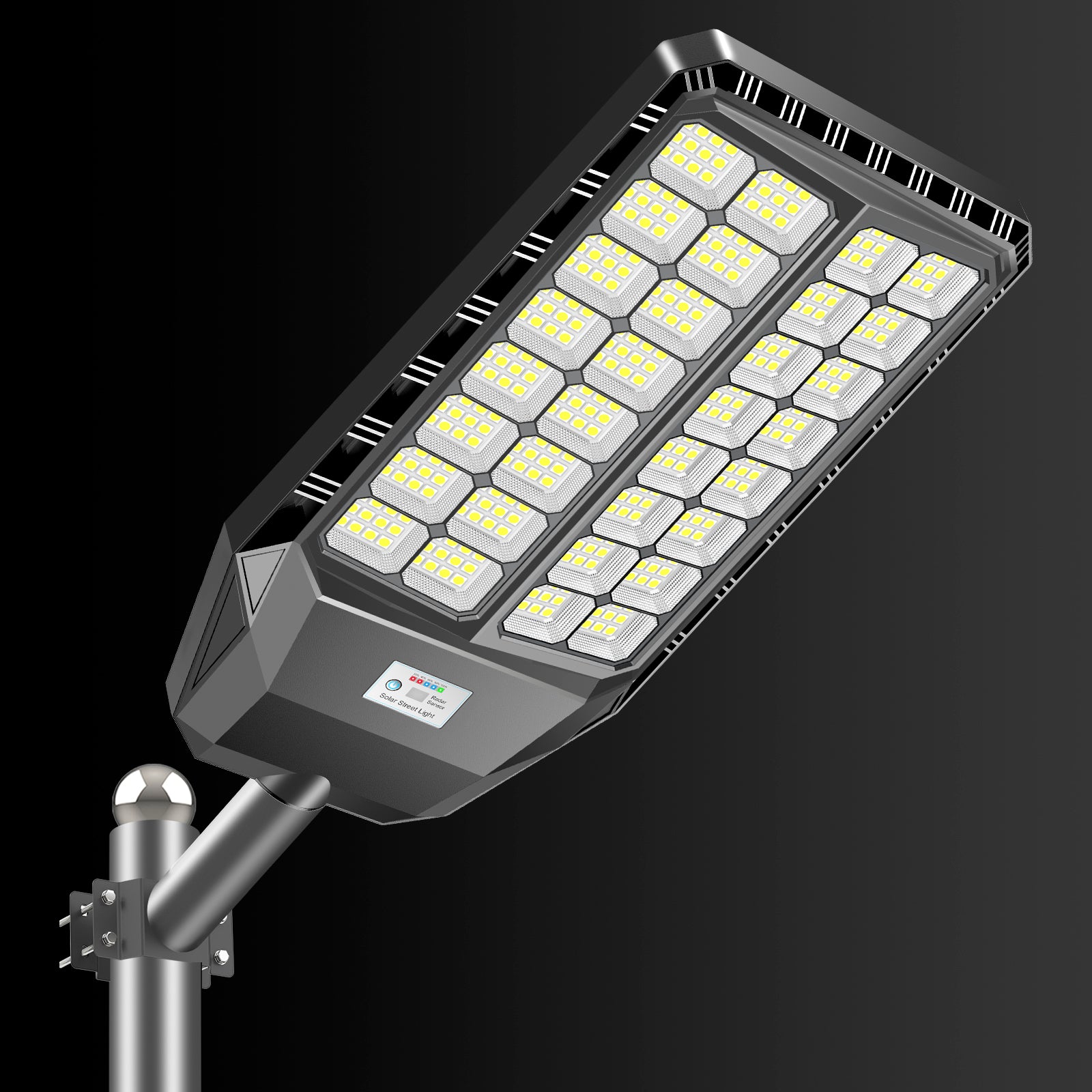
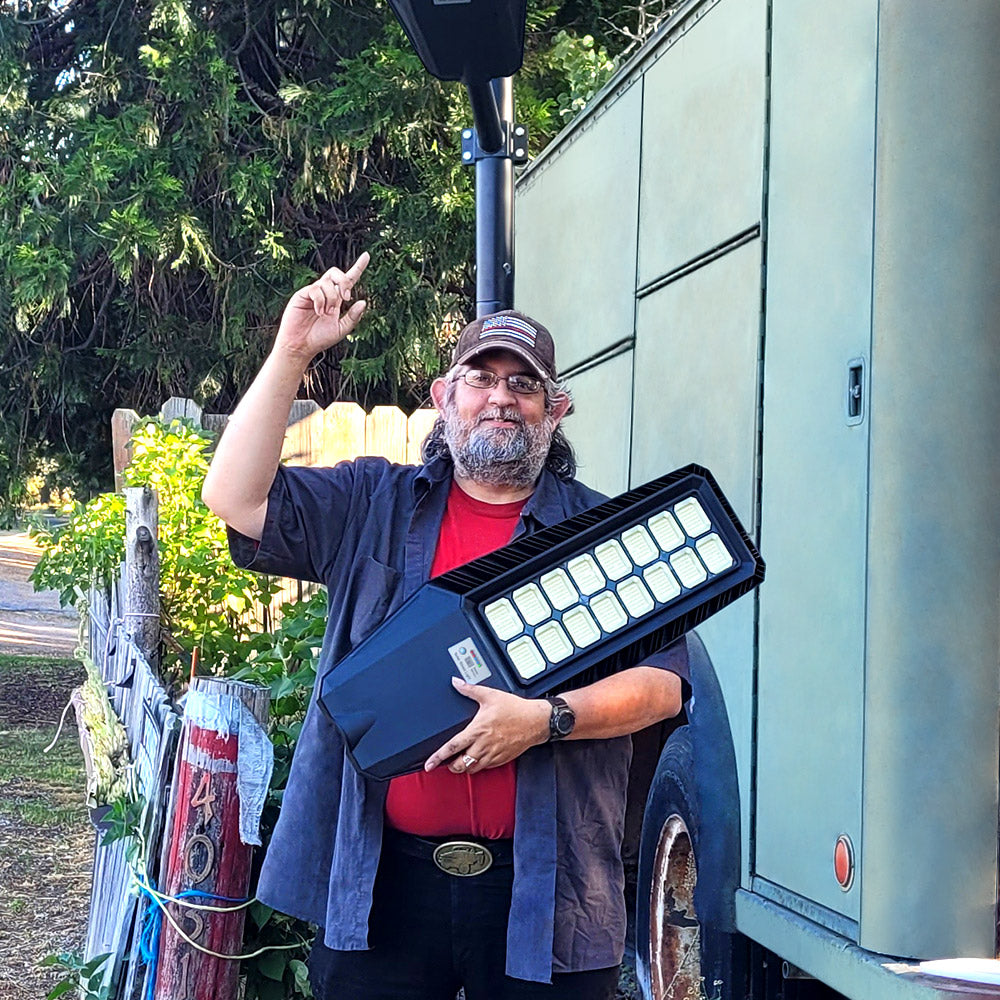
Let's price out the Scenario 1 upgrade (30 poles) using the Hykoont SZ300 400W Commercial Solar Street Light at $145.00/unit — a purpose-built commercial fixture with 60,000LM output and die-cast aluminum housing:
- 30 × SZ300 fixtures: $4,350
- Pole replacement (30 poles): ~$6,000–$9,000
- Installation labor (no trenching): ~$6,000–$9,000
- Contingency: ~$1,000–$1,500
- Total: $17,350–$23,850
- Less 30% federal ITC: Net: $12,145–$16,695
Monthly savings: $560 | Simple payback: 22–30 months
After payback, you're saving $6,720/year with zero ongoing electricity cost for parking lot lighting. Over a 15-year fixture lifespan, that's over $100,000 in avoided electricity costs from a net investment of roughly $14,000. That's a 7x return.
For Larger Lots: The HY Series Math
For the Scenario 2 campus (50 poles) requiring true commercial-grade infrastructure, the HY100 100W Commercial Solar Street Light at $1,399/unit delivers 18,000LM with a 768WH LiFePO4 battery — engineered for facilities that cannot afford a dark fixture under any weather condition:
- 50 × HY100 units: $69,950
- Pole replacement + installation: ~$20,000–$30,000
- Total: ~$89,950–$99,950
- Less 30% ITC: Net: ~$62,965–$69,965
Monthly savings: $1,090 | Payback: ~54–64 months (4.5–5.3 years)
For mission-critical industrial infrastructure, a 5-year payback on a system rated for 15+ years is a strong capital investment — particularly when you factor in demand charge elimination and zero maintenance costs on the LED arrays.
Shop SZ300 Commercial Solar Street Light — $145.00 →
The Demand Charge Factor: Why Industrial ROI Is Better Than It Looks
Most solar lighting ROI discussions focus only on kWh consumption savings. But for industrial customers, demand charges are often the bigger number — and off-grid solar eliminates them entirely.
Demand charges for industrial customers typically run $10–$20 per kW of peak demand. For a 30-pole lot drawing 12kW: that's $120–$240/month in demand charges attributable to parking lot lighting alone. When you go fully off-grid, those fixtures disappear from your utility meter. They don't contribute to your demand calculation at all.
Grid-tied systems that draw from the utility during low-solar periods still show up on your demand meter. Off-grid doesn't. For industrial facilities with significant demand charges, factor this in and payback periods often drop by 3–6 months versus the simple consumption-cost calculation.
Recommended Commercial Solar Street Lights for Industrial Facilities
1. Hykoont SZ300 400W — Best Entry Commercial Grade

$145.00 per fixture | 60,000LM | 400W | Die-cast aluminum | IP66 | Motion sensor | Remote control
The SZ300 is where commercial-grade starts. At $145, it's the most accessible true commercial solar street light in the lineup — die-cast aluminum housing (not stamped sheet metal), 60,000 lumens of output, and IP66 waterproofing rated for industrial environments. The motion sensor and remote control allow you to configure lighting modes for your facility's specific shift schedule without climbing the pole.
For mid-size industrial lots (20–40 poles) where budget is a primary constraint, the SZ300 delivers commercial performance at a price point that makes the ROI math work on a 2–3 year payback timeline.
2. HY050 50W Commercial Solar Street Light — Best for Perimeter & Pathway

$696.00 per fixture | 50W | 9,000LM | MPPT charging system | Separate solar panel | Commercial-grade construction
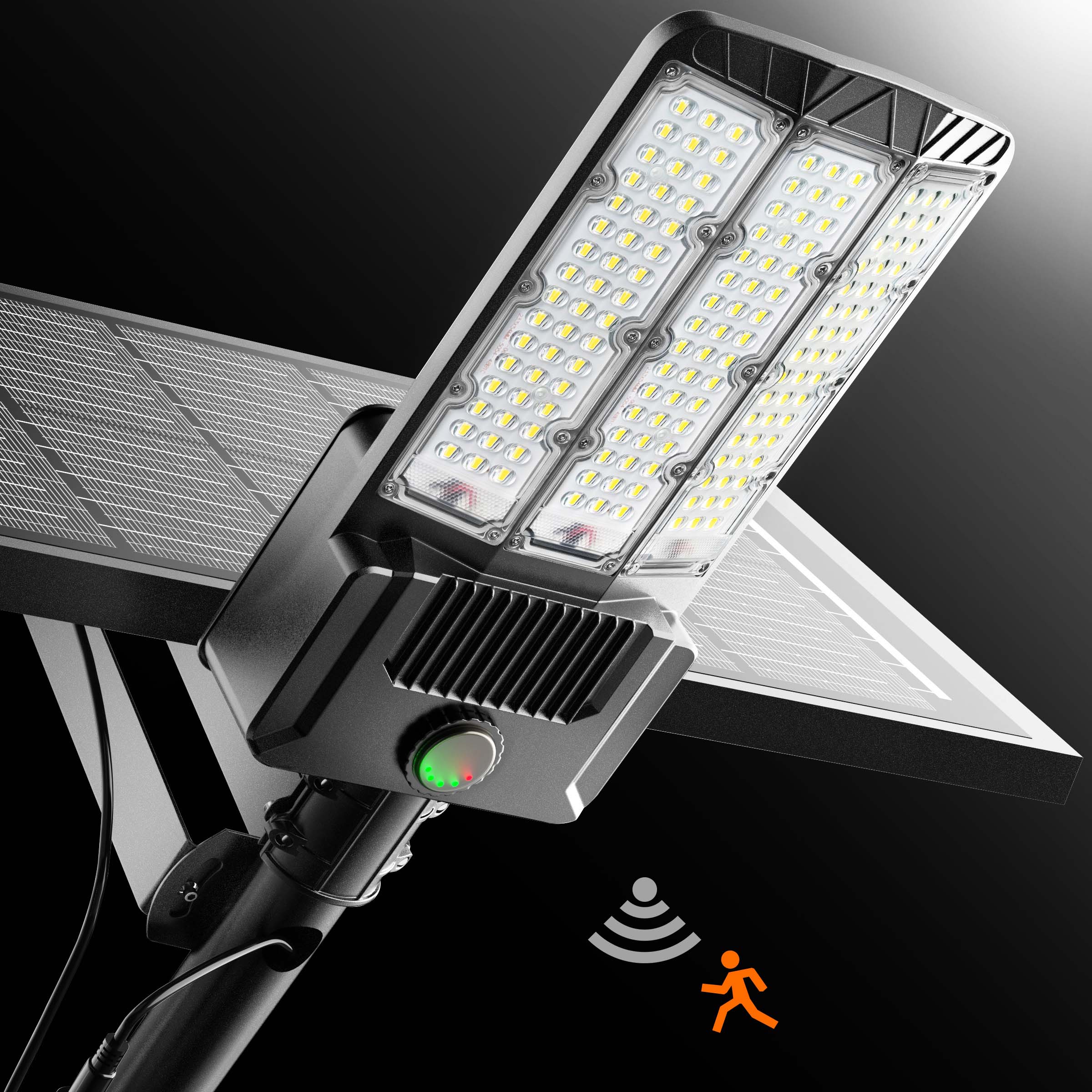
The HY050 is a different category of product from the all-in-one fixtures — it uses a separate high-efficiency solar panel with an MPPT (Maximum Power Point Tracking) charge controller, which extracts significantly more energy from the panel than standard PWM controllers. This matters in locations with suboptimal sun angles or partial shading.
At 9,000LM, the HY050 is optimized for perimeter security lighting, pedestrian pathways, and access roads where you need reliable, consistent illumination rather than maximum area coverage. The MPPT system ensures the battery stays charged even during marginal solar days — critical for security applications where a dark fixture is not acceptable.
For industrial facilities with perimeter fencing, camera coverage zones, or pedestrian safety paths, the HY050 is the right specification. The $696 price point reflects the commercial-grade construction and MPPT technology — this is infrastructure, not a commodity fixture.
3. HY080 80W Solar Street Light — Best for Extended-Hours Operations

$999.00 per fixture | 80W | 538WH LiFePO4 battery | Adjustable CCT | MPPT | Commercial-grade
The HY080's defining feature is its 538WH LiFePO4 battery — one of the largest battery reserves in this product category. For industrial facilities running extended shifts (4am–midnight or 24/7 operations), this battery capacity provides the reserve needed to maintain full illumination through long operating cycles and consecutive overcast days.
The adjustable color temperature (CCT) is a practical feature for industrial applications: cooler color temperatures (5000K–6500K) improve color rendering for security camera footage and create a perception of brightness that enhances safety. The ability to tune CCT means you can optimize for your specific camera system's requirements.
For manufacturing plants and distribution centers with 24/7 operations, the HY080's battery reserve and MPPT charging make it the reliable choice when downtime is not an option.
4. HY100 100W Commercial Solar Street Light — Best for Mission-Critical Applications

$1,399.00 per fixture | 100W | 18,000LM | 768WH LiFePO4 battery | 150W monocrystalline panel | MPPT
The HY100 is the specification for industrial facilities where lighting failure has real operational or safety consequences. The 768WH battery — nearly 1.5× the HY080's capacity — provides multiple nights of reserve power. The 150W monocrystalline solar panel charges the battery faster and more efficiently than standard panels, reducing recovery time after extended overcast periods.
At 18,000LM with commercial optics, the HY100 delivers the illumination levels required for loading dock areas, truck staging zones, and high-security perimeter lighting where IES standards for commercial/industrial applications must be met.
The $1,399 price point positions this as infrastructure investment, not a commodity purchase. For a 10-pole critical area (loading docks, main entrance, security perimeter), 10 × HY100 = $13,990 — after 30% ITC, $9,793 net. At $560/month savings on a 30-pole lot, the critical zones pay back within the overall project timeline.
5. HY120 200W Commercial Solar Street Light — Largest Industrial Deployment

$1,914.00 per fixture | 200W | 1,152WH LiFePO4 battery | 36V 200W monocrystalline panel | MPPT control
The HY120 is the top of the commercial solar street light lineup — 200W output, 1,152WH battery storage, and a 200W monocrystalline solar panel. This is the specification for large industrial campuses, ports, airports, and facilities where lighting infrastructure is expected to perform reliably for 10+ years with minimal intervention.
The 1,152WH battery provides approximately 4–6 nights of full-output operation without any solar charging — the kind of reserve that handles a week of Pacific Northwest winter weather without a service call. For remote industrial facilities where maintenance visits are expensive and infrequent, this reserve capacity has real operational value.
At $1,914 per fixture, the HY120 is a capital infrastructure purchase. For large campuses where the alternative is a $50,000+ grid-tied installation with ongoing utility costs, the math still works — particularly when demand charge elimination and 15+ year fixture lifespan are factored into the NPV calculation.
How to Match the Right Fixture to Your Application
Here's a practical decision framework for industrial facility managers:
Budget-constrained mid-size lots (20–40 poles): SZ300 at $145/fixture. Commercial-grade construction, 60,000LM, fast ROI. Best for facilities where payback period is the primary decision criterion.
Perimeter security and pedestrian paths: HY050 at $696/fixture. MPPT charging, consistent illumination, optimized for security camera coverage. Best for applications where reliability matters more than area coverage.
Extended-hours manufacturing and distribution: HY080 at $999/fixture. 538WH battery reserve, adjustable CCT, built for 24/7 operational environments. Best for facilities that run multiple shifts and need lighting through long operating cycles.
Mission-critical loading docks and high-security zones: HY100 at $1,399/fixture. 768WH battery, 150W monocrystalline panel, 18,000LM commercial optics. Best for areas where lighting failure has direct operational or safety consequences.
Large campus infrastructure and remote facilities: HY120 at $1,914/fixture. 1,152WH battery, 200W panel, 4–6 night reserve. Best for large deployments where long-term reliability and minimal maintenance are the primary requirements.

Building the ROI Case for Your Capital Committee
If you need to present a solar lighting upgrade to ownership, a capital committee, or a CFO, here's how to structure the financial case:
Step 1 — Document current costs: Pull 12 months of utility bills and calculate parking lot lighting load (fixtures × wattage × operating hours × days × utility rate). Add your demand charge allocation.
Step 2 — Build project cost estimate: Use fixture prices above. Add pole costs ($100–$300 each if replacing), installation labor ($200–$400 per pole for off-grid, no trenching), and 10–15% contingency. Apply 30% federal ITC for net cost.
Step 3 — Calculate simple payback: Net project cost ÷ annual electricity savings = payback years. For most industrial lots, this lands between 2 and 5 years depending on fixture tier selected.
Step 4 — Calculate 15-year NPV: Discount 15 years of electricity savings at your cost of capital (typically 8–12%). Factor in one battery replacement at year 6–8. The NPV is almost always strongly positive.
Step 5 — Add non-financial benefits: Reduced maintenance (no bulb replacements, no ballast failures), improved lighting quality (LED color rendering vs. aging HPS), grid independence value, and sustainability reporting metrics if relevant to your organization.

Tax Incentives: The 30% That Changes the Math
The federal Investment Tax Credit (ITC) at 30% applies to commercial solar installations including solar street lighting. For a $50,000 industrial campus project, that's $15,000 back in federal taxes — reducing your net investment to $35,000.
Key requirements: solar must be the primary power source (satisfied by all HY-series fixtures), system must be placed in service during the tax year you claim the credit, and the facility must be a US taxpaying entity. Many states add incentives on top — check dsireusa.org for your state's current programs.

Frequently Asked Questions
Q: What's a realistic payback period for commercial solar street lighting at an industrial facility?
It depends on fixture tier and lot size. Using the SZ300 ($145/fixture) for a 30-pole mid-size lot: 22–30 months after ITC. Using HY-series fixtures for mission-critical applications: 4–6 years. Larger lots with higher electricity costs pay back faster regardless of fixture tier — the savings scale with pole count while installation cost per pole decreases with volume.
Q: What's the difference between the SZ300 and the HY-series commercial fixtures?
The SZ300 is an all-in-one integrated fixture — solar panel, battery, and LED head in a single unit. It's cost-effective, fast to install, and well-suited for standard commercial parking lot applications. The HY-series (HY050 through HY120) use separate high-efficiency solar panels with MPPT charge controllers, larger LiFePO4 battery banks, and commercial-grade optics. They cost more per fixture but deliver higher reliability, longer battery reserve, and better performance in challenging conditions. For mission-critical industrial applications, the HY-series is the appropriate specification.
Q: Does the 30% federal ITC apply to commercial solar street lights?
Yes. The Investment Tax Credit applies to commercial solar installations where solar is the primary power source. All Hykoont commercial solar street lights qualify. The credit applies to both equipment and installation costs. Consult a tax professional — the ITC is a dollar-for-dollar tax credit, so your ability to utilize it fully depends on your tax position.
Q: How do commercial solar street lights perform during extended power outages?
Off-grid commercial solar street lights are completely unaffected by grid outages — they have no utility connection. During a grid outage, your solar-powered parking lot keeps running while grid-connected lights go dark. The HY080 (538WH battery) and HY100 (768WH battery) provide multiple nights of reserve power even without any solar charging — critical for facilities where shift changes happen regardless of grid status.
Q: What's the difference between MPPT and PWM charge controllers?
PWM (Pulse Width Modulation) controllers are simpler and less expensive — they're standard in most all-in-one solar street lights. MPPT (Maximum Power Point Tracking) controllers continuously optimize the operating point of the solar panel to extract maximum power under varying conditions. In real-world conditions (partial shading, non-optimal panel angles, temperature variations), MPPT controllers typically deliver 15–30% more energy from the same panel compared to PWM. The HY-series fixtures use MPPT — this is a meaningful performance difference for industrial applications where reliability is paramount.
Q: Can we phase the installation to spread capital cost across multiple budget years?
Yes — each fixture is independent, so you can install in phases without any system-level constraints. A common approach: install SZ300 fixtures in standard parking areas in year one (fast payback, immediate savings), then upgrade critical zones with HY-series fixtures in year two using year-one savings to partially fund the investment. Each phase claims the 30% ITC in the tax year placed in service.
Q: How do commercial solar street lights handle extreme cold in northern industrial facilities?
LiFePO4 batteries — used in all HY-series fixtures — perform significantly better in cold temperatures than standard lithium-ion batteries. They maintain usable capacity down to -4°F (-20°C) and don't suffer the same cold-weather capacity loss as lithium-ion. For facilities in Minnesota, Wisconsin, Michigan, or other northern states, LiFePO4 chemistry is the appropriate specification. The HY080 and HY100's large battery reserves also provide buffer for the shorter charging days of northern winters.
Q: What maintenance is required for commercial solar street lights?
Minimal. Panel cleaning 2–4 times per year in dusty industrial environments. Annual inspection of mounting hardware and connections. Battery replacement at year 6–10 depending on cycle count and depth of discharge. Compare this to metal halide: bulb replacement every 3–5 years, ballast replacement every 8–12 years, plus labor for each service call. Commercial solar LED maintenance costs are a fraction of conventional fixture maintenance over a 15-year period.
Q: Do we need permits to install commercial solar street lights?
For off-grid fixtures on private industrial property, most US jurisdictions require a building permit for pole installation but not an electrical permit (no utility connection). This is significantly simpler than grid-tied installations. For installations near property lines or on public rights-of-way, additional permits may apply. Always verify with your local building department — the permitting process for off-grid solar is generally much faster than grid-tied.
Q: Can commercial solar street lights integrate with our existing security and facility management systems?
Standalone off-grid fixtures like the SZ300 operate independently and don't integrate with BMS platforms. The HY-series fixtures offer more sophisticated control options — check individual product specifications for current connectivity features. For facilities requiring full BMS integration with centralized monitoring and control, discuss your specific requirements with us before ordering to ensure the right specification.
The Bottom Line
The ROI on commercial solar street lighting for industrial parking lots is real, it's calculable, and for most facilities it competes favorably with other capital investments in the same budget cycle.
The right fixture depends on your application: SZ300 for budget-conscious mid-size lots with fast payback requirements; HY050 for perimeter security paths; HY080 for extended-hours operations; HY100 for mission-critical loading docks and high-security zones; HY120 for large campus infrastructure where long-term reliability is the primary specification.
The 30% federal ITC, demand charge elimination, and near-zero maintenance costs make the financial case stronger than the simple electricity savings calculation suggests. Run your own numbers with the framework above — for most industrial facilities, the math speaks for itself.
Ready to Spec Your Industrial Solar Lighting Project?
Browse the full commercial solar street light lineup — from entry commercial to mission-critical infrastructure:
SZ300 — Entry Commercial, $145 → HY050 — Perimeter Security, $696 → HY100 — Mission Critical, $1,399 → HY120 — Large Campus, $1,914 →


Leave a comment
This site is protected by hCaptcha and the hCaptcha Privacy Policy and Terms of Service apply.