








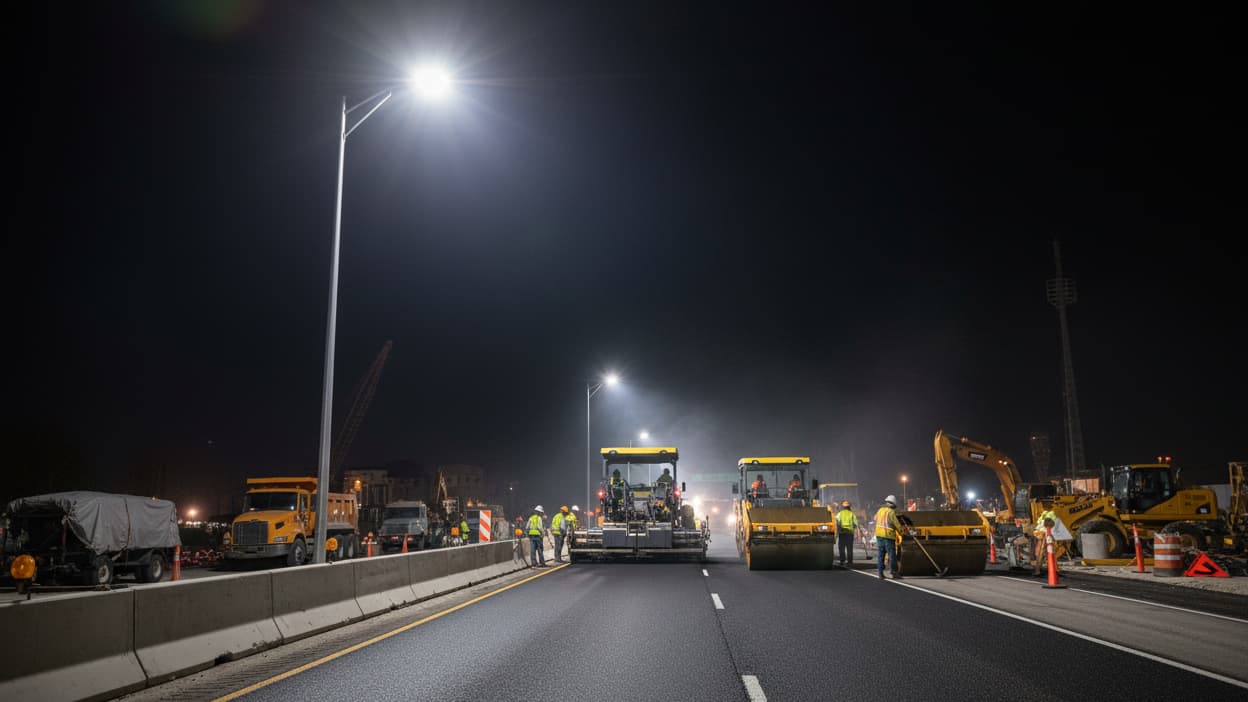
Picture this: it's 7 PM on a highway widening project outside Houston. The crew has a concrete pour scheduled for 9 PM, the temperature finally dropped below 95°F, and the site super is on the phone with the generator rental company because the 25kW unit they've been running for three weeks just threw a fault code. Again.
The generator gets fixed — two hours later, $380 service call. The pour happens. But the super is already doing the math: three weeks of generator rental, diesel, and two service calls have burned through more than the entire lighting budget for the project. And there are four more weeks to go.
That's the conversation driving a real shift in how construction crews think about temporary site lighting. Not because solar is fashionable, but because the numbers have finally crossed over. Solar street lights that run a full 10-hour night shift without sun during the day, set up in under 30 minutes, and move to the next location without a fuel truck following them around.
This guide is written for site superintendents, project managers, and contractors who want to know what solar temporary street lighting actually looks like in practice — what works, what the real trade-offs are, and which specific products are worth putting on a job site.
The Generator Math Nobody Does Until It's Too Late
When contractors budget for temporary lighting, they usually start and stop at the generator rental rate. That's the visible number. The invisible numbers are where the real cost lives.
Fuel: A 20–25kW generator running 10 hours a night burns 10–15 gallons of diesel. At current prices, that's $45–$65 per night, per generator. On a 60-day project, that's $2,700–$3,900 in fuel alone — before you've paid for the generator itself.
Maintenance and service calls: Generators on job sites get abused. Filters clog, fuel lines get contaminated, voltage regulators fail. Service calls run $200–$400 each, and they always happen at the worst possible time — mid-pour, mid-shift, mid-deadline.
Noise complaints and permit requirements: In urban and suburban job sites, generator noise is a real liability. Many municipalities require noise permits for nighttime generator operation, and violations can shut down a shift entirely. In residential-adjacent projects, this isn't a hypothetical — it's a recurring problem.
Setup and teardown labor: Running extension cords, positioning light towers, managing fuel — it's not glamorous work, but it takes time. On a large site, that's 30–60 minutes per shift that isn't going toward the actual project.
Fuel delivery logistics: Someone has to arrange fuel delivery, be on site to receive it, and manage storage. On remote sites — pipeline work, rural road projects, utility infrastructure — that's a genuine operational burden that adds cost and complexity.
Add it up across a typical 60-day project with two generators running, and you're looking at $10,000–$18,000 in total lighting-related costs. That's not a rounding error. That's a line item that deserves a second look.

What Solar Street Lights Actually Deliver on a Construction Site
Let's be direct about what solar street lighting can and can't do on a job site, because the honest answer is more useful than the marketing version.
Where solar street lights genuinely excel:
- Access road and perimeter lighting: This is the strongest use case. Solar street lights mounted on temporary poles along access roads and site perimeters provide consistent, all-night lighting with zero operating cost after installation. No fuel, no noise, no maintenance calls.
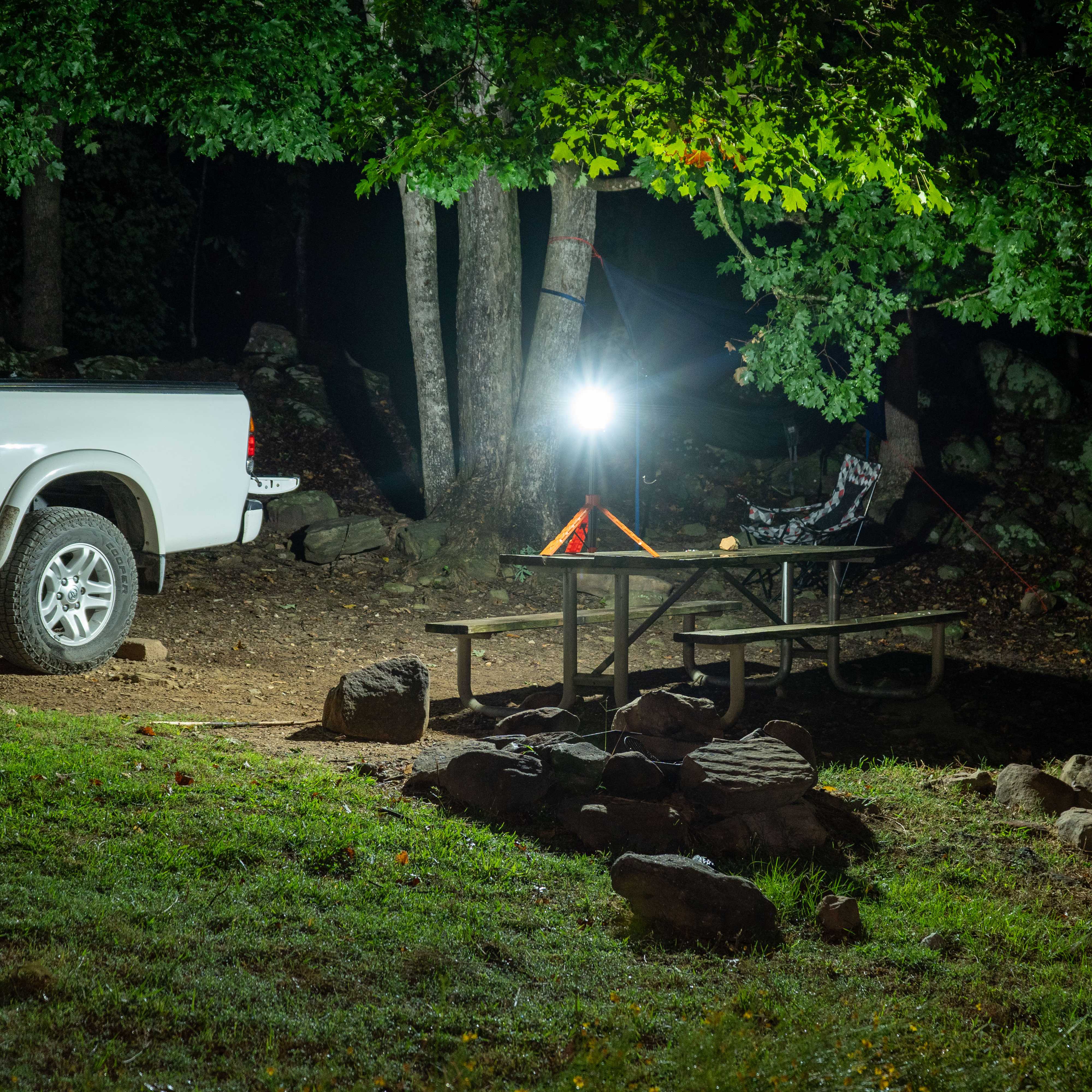
- Remote and off-grid sites: Pipeline work, rural road projects, utility infrastructure — anywhere that getting fuel to a generator is a logistical challenge, solar removes the problem entirely. No fuel truck, no delivery coordination, no storage.
- Long-duration projects: The longer the project, the better the economics. A 90-day highway project where solar street lights replace generator-powered light towers can save $15,000–$25,000 in operating costs on lighting alone.
- Fast-moving projects: Solar street lights on temporary poles can be repositioned in under 30 minutes without disconnecting power infrastructure. On projects where the active work zone moves daily — road paving, pipeline laying — that mobility is a genuine operational advantage.
- Multi-zone coverage: A single solar street light on a 15–20 foot pole covers a much larger area than a ground-mounted flood light. For access roads and open site areas, pole-mounted solar street lights provide better coverage per fixture than any ground-level alternative.
Where you need to plan carefully:
- Extended overcast periods: Most quality solar street lights are rated for 2–3 days of operation without sun. In regions with extended overcast weather, plan for supplemental charging or reduced operating modes during long cloudy stretches.
- Very high-intensity task lighting: Welding, precision electrical work, and detailed inspection tasks may require supplemental task lighting beyond what a street light provides. Solar street lights are area lights — they're not designed for point-source task illumination.
- Extremely short-duration projects: If you're on a 3-day emergency repair, the setup time and cost of solar street lights may not pencil out versus a quick generator rental. The economics favor solar on projects of 2 weeks or longer.

How to Set Up Temporary Solar Street Lights on a Construction Site
The setup process is genuinely simpler than most contractors expect. Here's a practical workflow that works on most job sites:
Step 1: Map Your Light Zones
Walk the site and identify three categories: primary access roads (highest priority — crew safety depends on these), active work zone perimeters (medium priority — defines the lit boundary of the work area), and equipment storage and staging areas (lower priority — needs ambient lighting, not work-level illumination).
Step 2: Determine Pole Placement
Solar street lights on 15–20 foot poles cover roughly 30–40 feet of road width and 50–80 feet of length per fixture, depending on the mounting height and beam angle. For a 500-foot access road, you're looking at 6–10 fixtures spaced at 50–80 foot intervals. Sketch this out before ordering — it determines how many fixtures you need.
Step 3: Choose Your Temporary Pole Solution
For temporary installations, you have three practical options: driven T-posts (fast, cheap, works for lighter fixtures), temporary concrete base forms (more stable, better for heavier commercial fixtures, takes a day to set), or rented temporary light pole bases (weighted bases that don't require ground penetration — ideal for paved surfaces or sites where you can't drive posts).
Step 4: Orient Panels for Maximum Charging
Solar panels need unobstructed southern exposure during daylight hours. On a construction site, this means thinking about where cranes, equipment, and structures will cast shadows during the day — not just where you need light at night. Most commercial solar street lights have adjustable panel angles; set them at 15–30° tilt for optimal summer charging in most US latitudes.
Step 5: Set Operating Modes for Your Shift Schedule
Commercial solar street lights offer multiple operating modes. For a 10-hour night shift, a mode that provides full brightness during active work hours and dims to 30–50% after the crew leaves is the right balance — it conserves battery while maintaining security lighting through the night. Check the specific mode settings for your fixture before the first shift.
Step 6: Plan for Repositioning
On projects where the active work zone moves, designate one person per shift to reposition lights at the start of each shift. With solar, this means pulling the temporary pole, moving it, re-driving or repositioning it, and re-angling the panel. No disconnecting power, no fuel management — just move and go.

Recommended Solar Street Lights for Construction Site Use
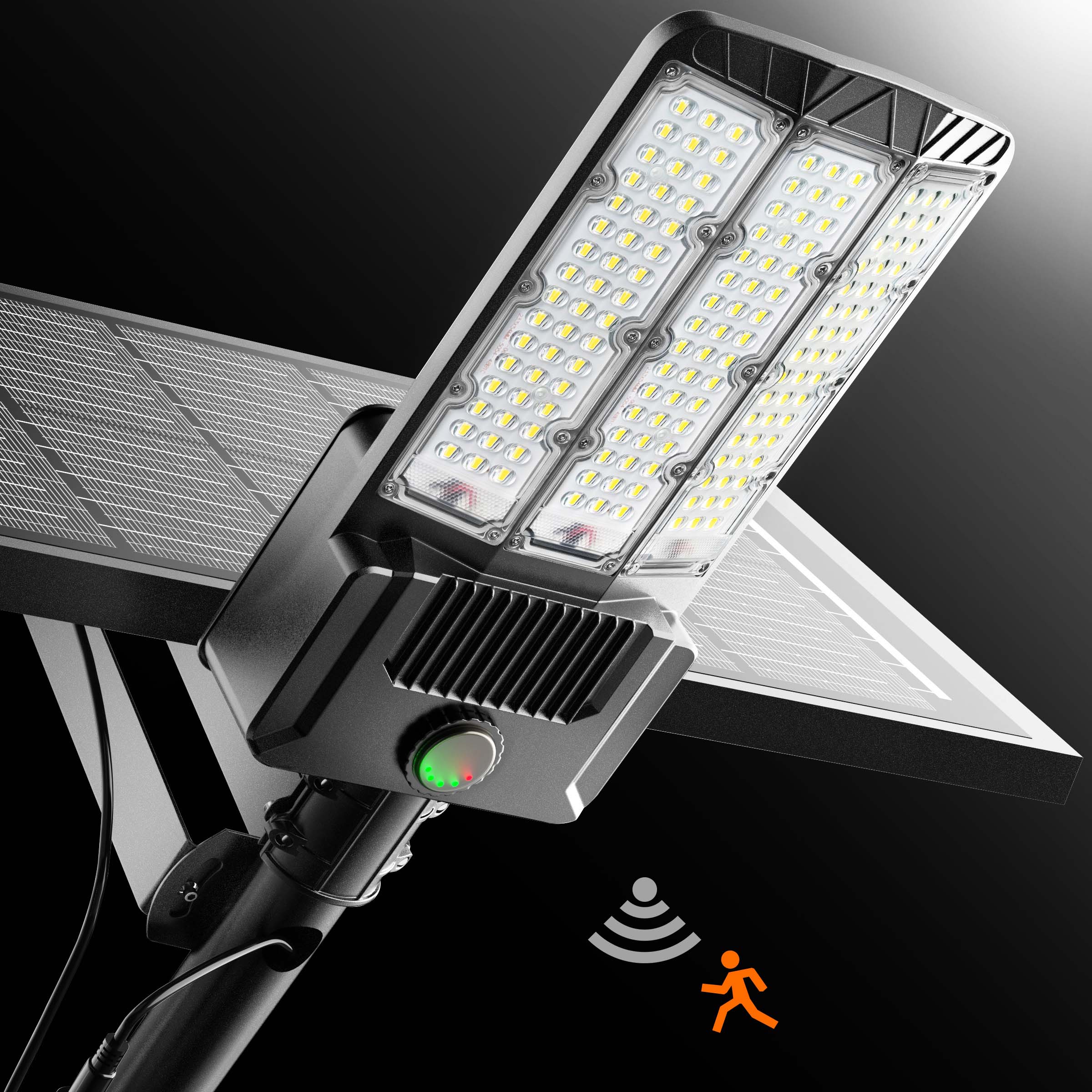
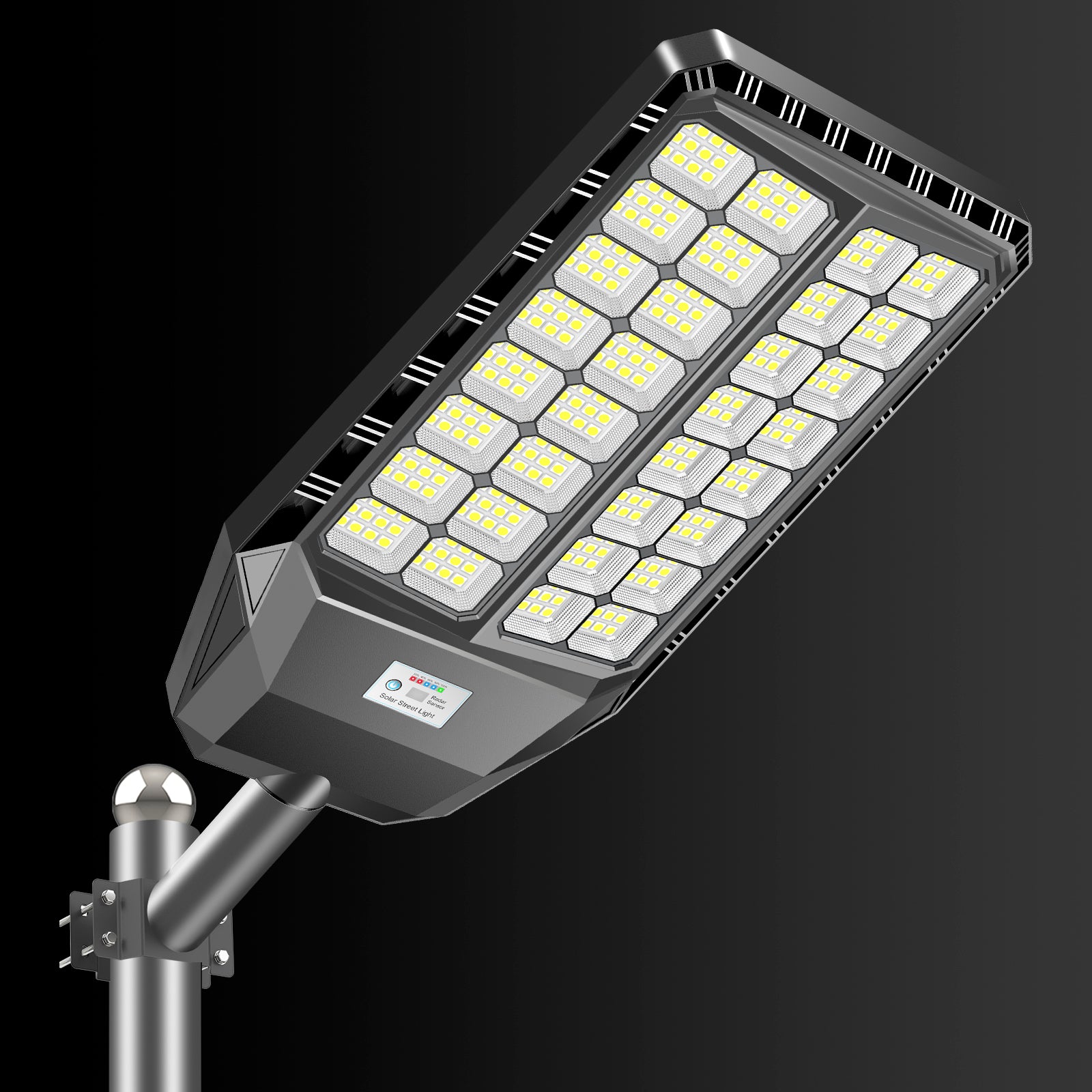
Here are the Hykoont solar street lights that make the most practical sense for job site applications, based on output, battery autonomy, durability, and ease of temporary installation.
1. Hykoont BD006 Solar Street Light — Best Entry-Level Option for Access Roads and Smaller Sites

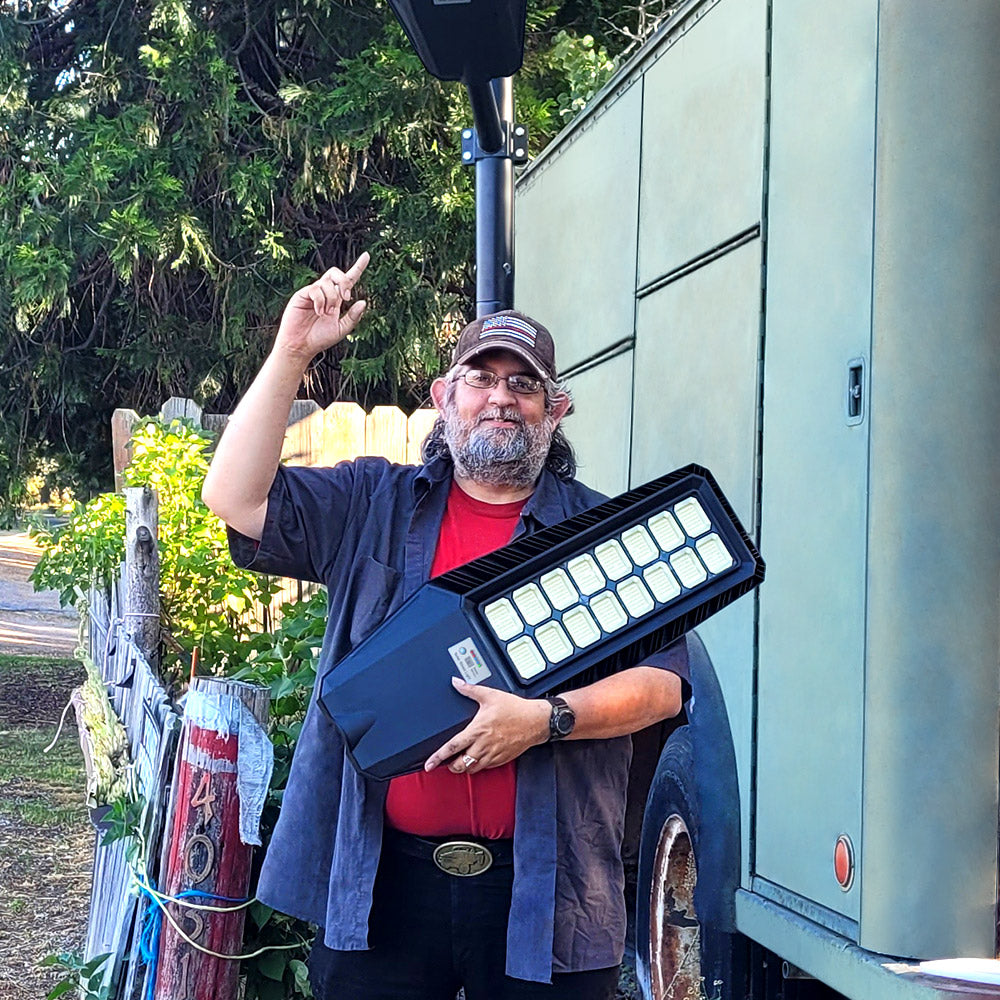
The BD006 is the right starting point for contractors who want to test solar street lighting on a job site without a large upfront commitment. At $179, it's the most accessible price point in the commercial solar street light lineup, and it delivers the monocrystalline panel efficiency and aluminum alloy construction that job site conditions demand. For access roads on smaller projects — residential subdivisions, utility work, smaller commercial builds — the BD006 covers the lighting need without overbuilding the solution.
Key specs for job site use:
- Monocrystalline solar panel — higher efficiency in partial shade and overcast conditions
- Aluminum alloy housing — corrosion-resistant, handles job site abuse
- High lumen output for access road and perimeter coverage
- IP65 waterproof — handles rain, mud splash, and job site conditions
- Intelligent lighting control — adjusts brightness based on conditions
- Black finish — low-visibility profile that doesn't attract attention on site
Best for: Smaller job sites, residential construction access roads, utility work perimeters, projects where budget is the primary constraint.
Price: $179.00
→ Shop BD006 Solar Street Light — $179
2. HY050 50W Commercial Solar Street Light — Best Mid-Range Option for Multi-Zone Site Coverage

The HY050 is where the specs start to get serious for commercial job site use. At 9,000 lumens with a 480WH battery capacity, it has enough stored energy to run through a full 10-hour night shift and still have reserve for the next day if charging conditions are less than ideal. The 50W output and high-efficiency solar panel combination means faster recovery on partially cloudy days — which matters on job sites where you can't always guarantee full sun during the charging window.
Key specs for job site use:
- 9,000 lumens — adequate for access roads and active perimeter lighting
- 480WH battery capacity — extended autonomy for multi-day cloudy periods
- 50W high-efficiency solar panel — faster recovery after overcast days
- MPPT charging system — optimizes energy capture in variable conditions
- IP65 waterproof, aluminum alloy housing
- Operating temperature: -20°C to 60°C — handles US climate extremes
- 3-year warranty — covers the duration of most long-term projects
Best for: Mid-size commercial construction sites, highway projects, multi-zone coverage where you need reliable autonomy across variable weather conditions.
Price: $696.00
→ Shop HY050 Solar Street Light — $696
3. HY100 100W Commercial Solar Street Light — Best High-Output Option for Large Site Access Roads

The HY100 is the workhorse for large commercial construction sites where access road lighting needs to match the output of a conventional grid-tied street light. At 18,000 lumens with a 768WH battery bank and 150W monocrystalline panel, it's built for the kind of sustained, high-output operation that a major highway project or large commercial build demands. The 25.6V 30AH LiFePO4 battery handles temperature extremes better than standard lithium-ion — which matters on job sites in Texas summers and Minnesota winters alike.
Key specs for job site use:
- 18,000 lumens — matches conventional street light output for major access roads
- 768WH (25.6V 30AH LiFePO4) battery — 3-day autonomy in cloudy conditions
- 150W monocrystalline panel (36V) — fastest charging in the lineup
- MPPT charging with intelligent brightness control
- Wide beam: 70°+140° — covers road width and shoulders effectively
- Adjustable CCT: 3000K–6500K — set to 6000K+ for maximum visibility on active sites
- Suitable for 10–12 meter installation heights
- Operating temperature: -20°C to 60°C
- CE, RoHS, ISO-9001 certified | 3-year warranty
Best for: Large commercial construction sites, highway and road projects, industrial facility builds, any application where access road lighting needs to match conventional street light standards.
Price: $1,399.00
→ Shop HY100 Solar Street Light — $1,399
4. HY120 200W Commercial Solar Street Light — Best for Major Infrastructure Projects and Long-Duration Deployments

When you're running a 6-month highway project or a large industrial facility build and you need lighting that performs like permanent infrastructure, the HY120 is the answer. The 25.6V 45AH battery bank — the largest in the lineup — combined with a 200W monocrystalline panel means this fixture recovers charge faster and runs longer than anything else in its class. For project managers who need to set up lighting once and not think about it again for months, the HY120 is the fixture that earns that confidence.
Key specs for job site use:
- 21,600 lumens — maximum output for major road and infrastructure lighting
- 1,152WH (25.6V 45AH LiFePO4) battery — longest autonomy in the lineup
- 200W monocrystalline panel (36V) — fastest post-overcast recovery
- MPPT charging with intelligent lighting control
- Wide beam: 70°+140° for maximum road coverage
- Adjustable CCT: 3000K–6500K
- Suitable for 12–14 meter installation heights
- Operating temperature: -20°C to 60°C
- CE, RoHS, ISO-9001 certified | 3-year warranty
Best for: Major highway projects, large industrial facility construction, long-duration deployments (90+ days), any project where lighting reliability is non-negotiable and downtime is not an option.
Price: $1,914.00
→ Shop HY120 Solar Street Light — $1,914
Building a Complete Solar Street Light Plan for a Mid-Size Job Site
Let's put this into a concrete example. A mid-size commercial construction site — a 500-foot main access road with two secondary roads and a perimeter of roughly 1,200 linear feet — might look like this:
Main access road (500 ft, 2-lane):
7× HY100 at $1,399 each = $9,793. Spaced at 70-foot intervals, mounted at 10–12 meters. Provides consistent 18,000-lumen coverage across the full road length with overlapping light fields.
Secondary access roads (2× 200 ft roads):
6× HY050 at $696 each = $4,176. Spaced at 65-foot intervals. 9,000 lumens per fixture is adequate for secondary roads with lower traffic volume.
Perimeter and equipment storage areas:
8× BD006 at $179 each = $1,432. Positioned at corners and key perimeter points. Provides ambient security lighting across the site boundary.
Total equipment cost: ~$15,401
Compare that to 90 days of generator-based lighting at $15,000–$25,000 in total operating costs. The solar setup pays for itself within the first project — and then you own the equipment for the next project, and the one after that. Over a 5-year equipment life across multiple projects, the cost-per-project drops to near zero.
→ Start with BD006 — $179 → Scale Up with HY050 — $696 → Go Full Commercial with HY100 — $1,399
OSHA Lighting Requirements for Construction Night Work
Before the FAQ, a quick note on compliance — because it matters and it's often misunderstood on job sites.
OSHA 29 CFR 1926.56 sets minimum illumination levels for construction work areas. The key thresholds relevant to street lighting applications:
- General construction areas and excavation: 3–5 foot-candles minimum
- Access ways and active storage areas: 3 foot-candles minimum
- Loading platforms and refueling areas: 3 foot-candles minimum
A commercial solar street light like the HY100 (18,000 lumens) mounted at 10 meters delivers well above the 5 foot-candle minimum across a 30–40 foot road width. For OSHA compliance documentation, a light meter reading at project start is worth the 10 minutes it takes — it protects you if there's ever a question about site lighting adequacy during an inspection.
Some states and municipalities have stricter requirements than federal OSHA minimums. Check with your local building department or safety officer before finalizing your lighting plan, particularly on public road projects where DOT standards may also apply.
Frequently Asked Questions
Can solar street lights really run a full 10-hour night shift without sun during the day?
Yes — with the right fixtures and adequate daytime charging. The HY050, HY100, and HY120 are all rated for 2–3 days of operation without sun, which means a single full day of charging provides more than enough capacity for a 10-hour night shift with reserve. The key variable is battery capacity relative to power draw. The HY120's 1,152WH battery bank is the most conservative choice for sites where charging conditions are unpredictable.
How do I mount solar street lights temporarily on a construction site without permanent foundations?
Three practical options work well on most job sites. Driven T-posts (6–8 foot steel posts driven 2–3 feet into the ground) work for lighter fixtures like the BD006 on shorter temporary poles. Weighted temporary base plates — the kind used for temporary traffic signs — work on paved surfaces where you can't drive posts. For heavier commercial fixtures like the HY100 and HY120, a temporary concrete base form (a tube form filled with concrete, set a day before installation) provides the stability these fixtures need at 10–12 meter mounting heights.
How many solar street lights do I need to replace a diesel light tower?
A standard 4-head diesel light tower outputs 120,000–160,000 lumens concentrated in one location. Solar street lights distributed along an access road provide better coverage quality — less shadowing, more even distribution — but you're comparing different lighting geometries. For access road replacement specifically, one HY100 (18,000 lumens) per 60–70 feet of road replaces the functional lighting provided by a light tower positioned at the same interval. For open-area work zone lighting, solar street lights are less effective than flood-style lighting and you'd need to supplement with other fixtures.
What happens if it's cloudy for several days in a row on the job site?
The HY100 and HY120 are rated for 3 days of operation without sun. For extended overcast periods beyond that, switch to a lower-power operating mode (50% brightness extends runtime significantly) or use a small portable charger to top up the battery during the day. In practice, most US regions outside the Pacific Northwest in winter don't experience more than 2–3 consecutive fully overcast days. For projects in high-overcast regions, the HY120's larger battery bank provides the most buffer.
Do I need an electrician or permit to install temporary solar street lights on a job site?
No electrician is required — solar street lights are self-contained systems with no grid connection. For the lighting system itself, no electrical permit is needed. However, if you're installing temporary poles on public right-of-way (a highway project, for example), you may need a traffic control permit that covers the pole placement. Check with your project's traffic control plan — the lighting installation typically falls under the same permit as other temporary infrastructure on public roads.
Can I use the same solar street lights across multiple projects?
Absolutely — and this is where the economics really work in your favor. Unlike generator rentals (which you pay for every project) or disposable temporary lighting, solar street lights are owned equipment that moves from project to project. A set of HY100 units that pays for itself on the first 90-day project then provides essentially free lighting on every subsequent project. Over a 5-year equipment life, the cost-per-project drops to near zero.
How do I handle solar street lights in winter construction in northern states?
All Hykoont commercial solar street lights are rated to operate at -20°C (-4°F), which covers virtually all US winter conditions. The practical challenge in northern winters is reduced daylight hours and lower sun angles, which reduce daily charging capacity. In December in Minnesota, you might get 5–6 hours of effective charging versus 8–9 hours in summer. Plan for this by using lower-power operating modes during long winter nights, or by deploying more fixtures than you'd need in summer to distribute the load across the site.
What's the maintenance requirement for solar street lights on a job site?
Minimal. The main maintenance task is keeping the solar panel clean — mud and debris on the panel surface reduce charging efficiency by 20–40%. A quick wipe-down every few days keeps performance consistent. Beyond that, check mounting hardware weekly (job site vibration from heavy equipment can loosen bolts over time) and inspect cable connections monthly. There's no fuel to manage, no oil to change, and no filters to replace.
Are solar street lights bright enough to meet OSHA requirements for construction site access roads?
Yes. OSHA 29 CFR 1926.56 requires 3–5 foot-candles for construction access ways and general areas. The HY100 at 18,000 lumens mounted at 10 meters delivers well above that threshold across a standard 2-lane access road. For documentation purposes, a light meter reading at project start is recommended — it takes 10 minutes and protects you during any OSHA inspection.
What's the warranty situation if a solar street light is damaged on a job site?
Hykoont's 3-year warranty covers defects in materials and workmanship. Physical damage from job site incidents (equipment strikes, falling debris) is typically covered under your commercial general liability or equipment insurance, not the product warranty. Document your installation with photos and keep purchase records — both are useful for insurance claims. The aluminum alloy housings on the HY-series lights are genuinely durable, but no fixture is immune to a direct hit from a piece of heavy equipment.
The Bottom Line
The generator isn't going away entirely — there are applications where it's still the right tool. But for temporary access road and perimeter lighting on most construction projects, the math has shifted decisively toward solar. Lower operating cost, faster setup, no fuel logistics, no noise complaints, and equipment you own rather than rent.
The BD006 at $179 is the entry point for smaller sites and contractors who want to test the approach. The HY050 at $696 covers mid-size commercial projects with reliable autonomy. The HY100 at $1,399 matches conventional street light output for major access roads. And the HY120 at $1,914 is the choice for long-duration infrastructure projects where lighting reliability is non-negotiable.
The generator company will still be there if you need them. But after one project running solar street lights, most crews don't go back.

Leave a comment
This site is protected by hCaptcha and the hCaptcha Privacy Policy and Terms of Service apply.