







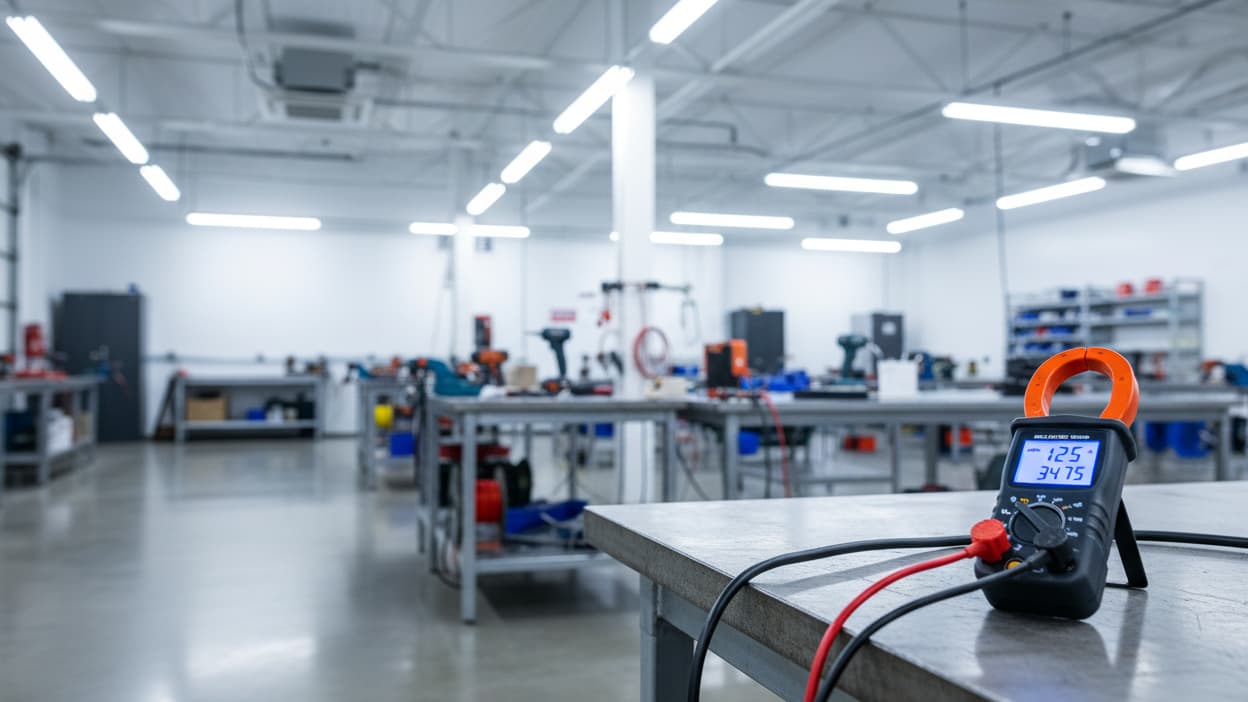
Understanding the amperage draw of 8ft LED shop lights is fundamental for electrical system design, safety compliance, and energy optimization. Modern 8ft LED shop lights typically draw between 0.6 to 1.0 amps on standard 120V circuits, representing a 60-75% reduction compared to legacy fluorescent systems. This comprehensive technical guide examines electrical characteristics, load calculations, circuit design considerations, and advanced optimization strategies for commercial and industrial lighting installations.
Whether you're retrofitting an existing facility, designing a new workshop, or optimizing energy consumption, mastering the electrical requirements of 8ft LED shop lights ensures safe, efficient, and code-compliant installations that maximize return on investment.
Fundamental Electrical Principles: Understanding Amperage in LED Lighting
The Relationship Between Watts, Volts, and Amps
Amperage (current) represents the flow rate of electrical charge through a conductor, measured in amperes (amps). The relationship between electrical power (watts), voltage (volts), and current (amps) is governed by Ohm's Law and the power equation:
Basic Power Formula:
Amps = Watts ÷ Volts
For AC circuits with reactive loads (like LED drivers), the calculation becomes more complex:
True Power Formula:
Amps = Watts ÷ (Volts × Power Factor)
The power factor (PF) represents the efficiency of power utilization. Quality LED shop lights maintain power factors of 0.90-0.98, meaning 90-98% of supplied current performs useful work. Lower-quality fixtures may have power factors as low as 0.70, requiring 30% more current for the same light output.

Why Amperage Matters in Commercial Lighting
Circuit Capacity Planning: Standard 15-amp and 20-amp circuits have defined load limits. The National Electrical Code (NEC) requires continuous loads (operating 3+ hours) to not exceed 80% of circuit capacity—12 amps for 15-amp circuits, 16 amps for 20-amp circuits.
Wire Sizing Requirements: Higher amperage demands larger conductor sizes. Undersized wiring causes voltage drop, reduced light output, overheating, and fire hazards. Proper amperage calculation ensures appropriate wire gauge selection (14 AWG for 15A, 12 AWG for 20A circuits).
Energy Cost Calculation: Amperage directly correlates to energy consumption. Lower amperage at constant voltage means reduced wattage and lower operating costs. Understanding amp draw enables accurate ROI calculations for LED retrofits.
Safety and Code Compliance: Overloaded circuits cause breaker trips, equipment damage, and fire risks. Accurate amperage assessment ensures NEC compliance and insurance requirements are met.
Detailed Amperage Analysis: 8ft LED Shop Light Specifications
Typical Amperage Draw by Wattage Class
8ft LED shop lights are available in multiple wattage configurations, each serving different application requirements:
Economy Class (65-80 Watts):
- Wattage: 65-80W
- Amperage at 120V: 0.54-0.67 amps
- Amperage at 277V: 0.23-0.29 amps
- Light Output: 8,000-10,000 lumens
- Applications: Storage areas, low-ceiling workshops, residential garages
- Power Factor: 0.85-0.90
Standard Class (90-110 Watts):
- Wattage: 90-110W
- Amperage at 120V: 0.75-0.92 amps
- Amperage at 277V: 0.32-0.40 amps
- Light Output: 11,000-14,000 lumens
- Applications: General workshops, retail spaces, light manufacturing
- Power Factor: 0.90-0.95
High-Output Class (120-150 Watts):
- Wattage: 120-150W
- Amperage at 120V: 1.00-1.25 amps
- Amperage at 277V: 0.43-0.54 amps
- Light Output: 15,000-19,000 lumens
- Applications: High-bay warehouses, precision work areas, automotive shops
- Power Factor: 0.92-0.98
Premium High-Lumen Class (160-200 Watts):
- Wattage: 160-200W
- Amperage at 120V: 1.33-1.67 amps
- Amperage at 277V: 0.58-0.72 amps
- Light Output: 20,000-26,000 lumens
- Applications: Industrial facilities, sports facilities, large commercial spaces
- Power Factor: 0.95-0.98
Comparative Analysis: LED vs. Traditional Lighting Technologies

8ft Fluorescent T12 Systems (Legacy Technology)
Electrical Characteristics:
- Typical Wattage: 150-200W per fixture (two 75-100W lamps plus ballast loss)
- Amperage at 120V: 1.25-1.67 amps
- Power Factor: 0.85-0.90 (magnetic ballast) or 0.95+ (electronic ballast)
- Ballast Loss: 10-15% additional power consumption
Comparison: A 100W LED fixture replacing a 175W T12 system reduces amperage by 52% (from 1.46A to 0.83A), enabling circuit capacity for additional fixtures or reducing electrical infrastructure requirements.
Total Cost of Ownership Analysis
Beyond initial amperage draw, consider lifecycle electrical costs:
10-Year Operating Cost Comparison (8-hour daily operation):
8ft T12 Fluorescent (175W, 1.46A @ 120V):
- Annual Energy: 511 kWh
- 10-Year Energy Cost: $613 (at $0.12/kWh)
- Lamp Replacements: 8-10 sets @ $25 each = $200-250
- Total 10-Year Cost: $813-863
8ft LED (100W, 0.83A @ 120V):
- Annual Energy: 292 kWh
- 10-Year Energy Cost: $350
- No lamp replacements (50,000+ hour lifespan)
- Total 10-Year Cost: $350
- Savings: $463-513 per fixture (57-59% reduction)
Advanced Circuit Design and Load Calculation
NEC-Compliant Circuit Planning

The National Electrical Code (NEC Article 220) establishes requirements for lighting load calculations:
Continuous Load Derating:
Lighting operating 3+ hours continuously must not exceed 80% of circuit rating:
- 15-amp circuit: 12-amp maximum continuous load
- 20-amp circuit: 16-amp maximum continuous load
- 30-amp circuit: 24-amp maximum continuous load
Practical Circuit Capacity (120V Systems):
15-Amp Circuit:
- Available continuous capacity: 12 amps
- 100W LED fixtures (0.83A each): Maximum 14 fixtures
- 150W LED fixtures (1.25A each): Maximum 9 fixtures
- Safety margin recommendation: Use 80% of calculated maximum (11 and 7 fixtures respectively)
20-Amp Circuit:
- Available continuous capacity: 16 amps
- 100W LED fixtures: Maximum 19 fixtures
- 150W LED fixtures: Maximum 12 fixtures
- Safety margin recommendation: 15 and 10 fixtures respectively
Energy Optimization and Smart Control Integration
Dimming and Amperage Reduction

Dimmable LED shop lights offer proportional amperage reduction:
Dimming Performance:
- 100% output: 100W, 0.83A
- 75% output: 75W, 0.63A (24% amperage reduction)
- 50% output: 50W, 0.42A (49% amperage reduction)
- 25% output: 25W, 0.21A (75% amperage reduction)
Unlike fluorescent systems that maintain full ballast power consumption when dimmed, LEDs provide true energy savings proportional to light output reduction.
Installation Best Practices and Safety Protocols
Pre-Installation Electrical Assessment
Circuit Capacity Audit: Document existing circuit loads, available capacity, and voltage characteristics. Identify circuits suitable for LED retrofit without modification.
Voltage Testing: Measure actual voltage at fixture locations under load. Voltages below 115V or above 125V (for 120V nominal systems) indicate electrical issues requiring correction.
Professional Installation Procedures
Power Isolation: De-energize circuits at breaker panel and verify with non-contact voltage tester. Lock out/tag out procedures prevent accidental energization during installation.
Proper Grounding: Ensure continuous equipment grounding conductor connection. LED fixtures require proper grounding for safety and electromagnetic compatibility.
Secure Mounting: 8ft fixtures weigh 8-15 pounds and require robust mounting. Use appropriate fasteners for ceiling material (wood joists, steel beams, concrete) with minimum two-point suspension.

Conclusion: Strategic Amperage Management for Optimal Performance
Understanding the amperage draw of 8ft LED shop lights is essential for designing safe, efficient, and cost-effective lighting systems. With typical amperage ranging from 0.6 to 1.25 amps on 120V circuits (0.26 to 0.54 amps on 277V), modern LED technology offers dramatic improvements over legacy fluorescent and HID systems.
Key takeaways for successful implementation:
Electrical Planning: Calculate total amperage requirements accounting for power factor, voltage drop, and NEC continuous load derating. Design circuits with 20% safety margin beyond calculated loads.
Technology Selection: Specify fixtures with power factor above 0.90, THD below 20%, and appropriate wattage for application requirements. Higher initial investment in quality fixtures pays dividends through reduced amperage, longer lifespan, and superior performance.
System Integration: Incorporate dimming, occupancy sensing, and daylight harvesting to reduce effective amperage by 40-60%, maximizing energy savings and ROI.
For a typical commercial facility replacing 100 fluorescent fixtures (146 amps total) with LED shop lights (83 amps total), the 43% amperage reduction translates to $4,500-6,000 annual energy savings, 2-3 year payback period, and 60-75% reduction in lighting-related carbon emissions.
Whether retrofitting a small workshop or designing a large industrial facility, mastering the electrical characteristics of 8ft LED shop lights ensures optimal performance, safety, and value throughout the system lifecycle.

Leave a comment
This site is protected by hCaptcha and the hCaptcha Privacy Policy and Terms of Service apply.