







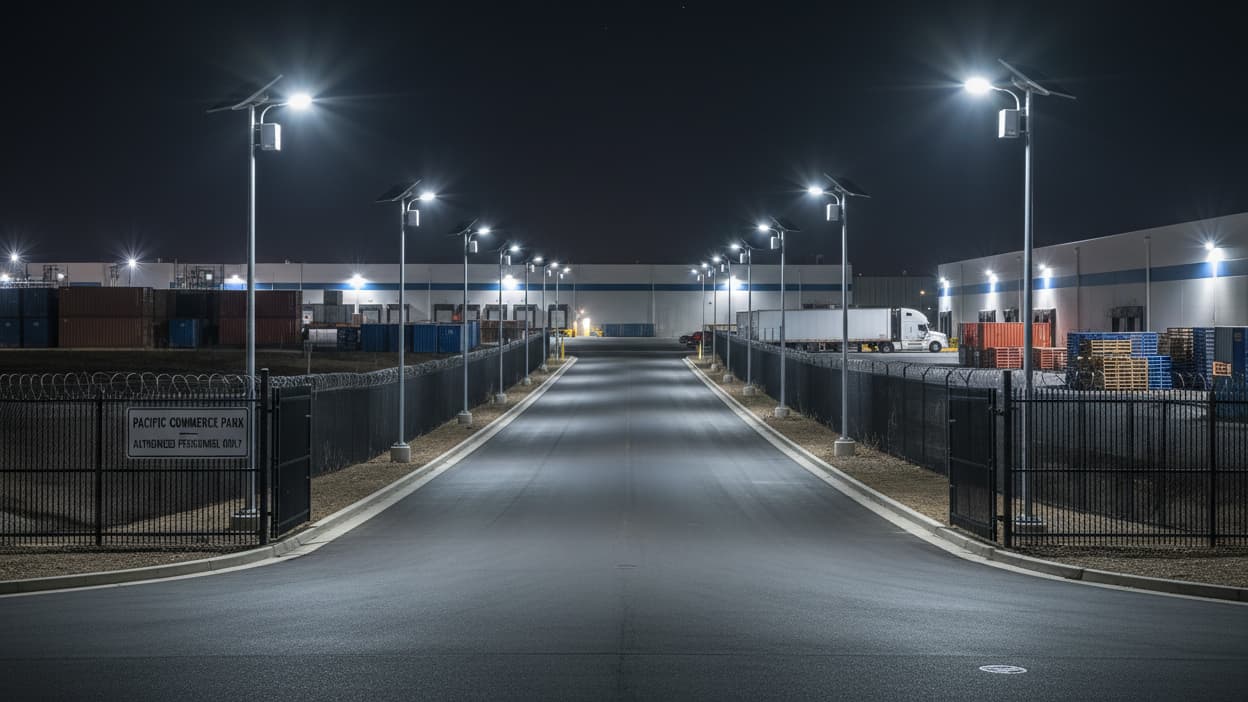
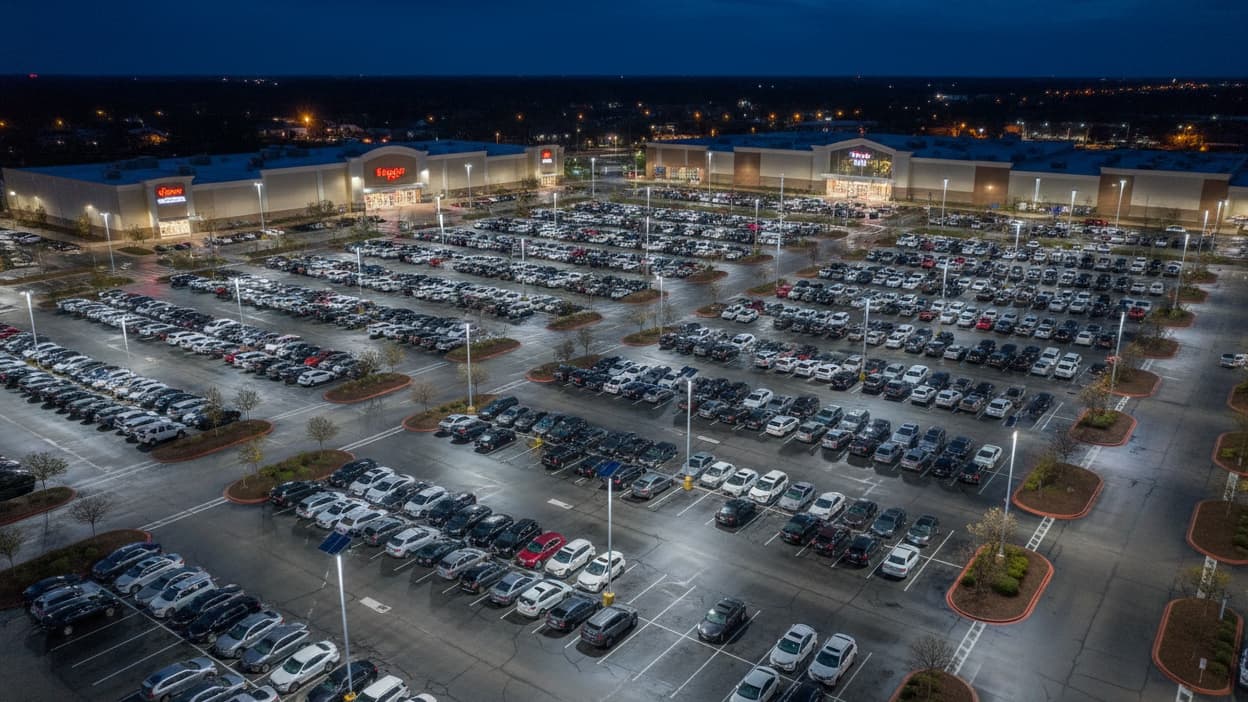
Here's something most lighting vendors won't tell you upfront: the number on the box — whether it's watts or lumens — doesn't always match what you actually get on the ground. And when you're lighting a commercial parking lot, that gap between spec-sheet performance and real-world output can mean the difference between a safe, well-lit property and a liability waiting to happen.
If you've been searching for solar parking lot lights and feeling overwhelmed by the options, you're not alone. The market is flooded with fixtures that all claim to be "commercial grade" and "ultra-bright," but the specs vary wildly and the marketing language is often designed to confuse rather than clarify.
This guide cuts through that noise. We'll walk through exactly what to look for when choosing high-lumen solar parking lot lights for a commercial property — with real numbers, honest trade-offs, and specific product recommendations with actual prices. No fluff, no vague promises.
First, Let's Talk About Why Lumens Matter More Than Watts
If you've been shopping for lighting for more than five minutes, you've probably noticed that some fixtures are marketed by wattage ("300W Solar Street Light") while others lead with lumens ("42,000 Lumen Solar Light"). These are measuring completely different things, and confusing them is one of the most common — and expensive — mistakes buyers make.
Watts = power consumption. It tells you how much energy the fixture uses, not how much light it produces.
Lumens = light output. This is the number you actually care about. More lumens means more light on the ground.
The relationship between watts and lumens depends on the efficiency of the LED chips inside the fixture. A high-quality LED might produce 150–180 lumens per watt. A cheap one might produce 80–100 lumens per watt. So a "300W" fixture from one brand might produce 42,000 lumens, while a "300W" fixture from another brand produces only 24,000 lumens — and they're both technically accurate in their wattage claims.
For commercial parking lots, always lead with lumens when comparing fixtures. Wattage is secondary.
How Many Lumens Does a Commercial Parking Lot Actually Need?
This is the question most buyers ask first, and the honest answer is: it depends on your specific lot. But here are the benchmarks that matter.
The Illuminating Engineering Society (IES) publishes lighting standards for commercial parking facilities. Their RP-20 standard recommends:
- General parking areas: 1.0 foot-candle (fc) minimum at ground level
- Entrance/exit areas: 5.0 fc minimum (these need to be significantly brighter)
- Covered parking structures: 5.0 fc minimum during daytime, 1.0 fc at night
- High-security or high-crime areas: 2.0–3.0 fc recommended
To translate foot-candles into fixture selection, you need to know your mounting height and spacing. Here's a practical rule of thumb for open-air commercial parking lots:
- Mounting height 15–20 feet, spacing 25–30 feet: you need approximately 15,000–25,000 lumens per fixture
- Mounting height 20–25 feet, spacing 30–40 feet: you need approximately 25,000–42,000 lumens per fixture
- Large lots with wide spacing (40+ feet): 42,000+ lumens per fixture
Most commercial parking lots fall into the middle range — 20,000–42,000 lumens per fixture is the sweet spot for the majority of U.S. commercial properties.

The 6 Specs That Actually Determine Whether a Solar Parking Lot Light Is Worth Buying
Beyond lumens, here are the specs that separate fixtures that perform from fixtures that disappoint.
1. Battery Capacity and Type
The battery is the most critical component in any solar light — and the one most likely to fail first. For commercial parking lot applications, you need a battery that can power the fixture through a full night (10–12 hours) and still have reserve capacity for 2–3 consecutive cloudy days.
Battery type matters enormously. Lithium iron phosphate (LiFePO4) batteries are the standard for quality commercial solar fixtures. They handle temperature extremes better than standard lithium-ion, have a longer cycle life (2,000+ cycles vs. 500–800 for standard lithium-ion), and are significantly safer. If a fixture doesn't specify LiFePO4, ask — or assume it's using a lower-grade battery.
Battery capacity is measured in watt-hours (Wh) or amp-hours (Ah). For a fixture drawing 20–30W at full brightness, you need at least 200–300Wh of battery capacity to run through a 10-hour night with reserve.
2. Solar Panel Efficiency and Size
The solar panel charges the battery during the day. Panel efficiency determines how much energy you capture per hour of sunlight — which directly affects how well the fixture performs on short winter days or in partially cloudy conditions.
Monocrystalline panels are more efficient than polycrystalline (typically 20–22% vs. 15–17% efficiency). For commercial applications in northern states or areas with frequent cloud cover, monocrystalline is worth the premium.
Panel size matters too. A larger panel captures more energy, which means better battery charging on suboptimal days. Be skeptical of fixtures with very small panels relative to their claimed lumen output — the math often doesn't add up.
3. IP Rating
IP (Ingress Protection) rating tells you how well the fixture is sealed against dust and water. For outdoor commercial use, the minimum you should accept is IP65. IP66 is better for areas with heavy rain or pressure washing. IP67 means the fixture can handle temporary submersion.
Don't skip this spec. A fixture with an inadequate IP rating will fail prematurely in outdoor conditions, and warranty claims on water damage are often contested.
4. Color Temperature (CCT)
Color temperature is measured in Kelvin (K) and affects how the light looks and how well people can see under it. For commercial parking lots, 5000K–6500K (cool white to daylight) is the standard. This range provides the best visibility and color rendering for security cameras, which is important for any property with surveillance.
Warmer color temperatures (3000K–4000K) look more pleasant but reduce visibility and camera performance. Save those for decorative or hospitality applications.
5. Motion Sensing and Dimming Modes
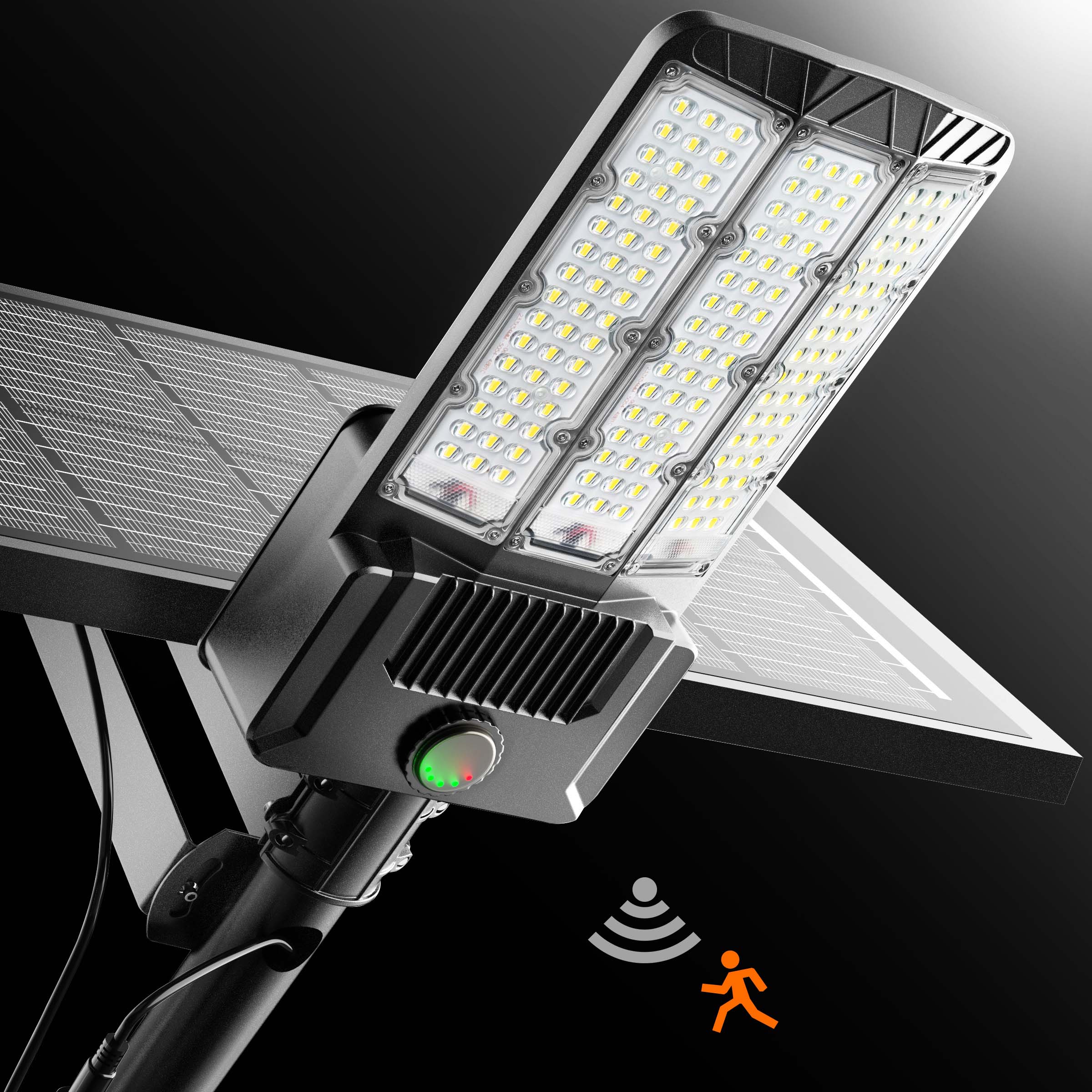
Most quality commercial solar lights include motion sensing with adjustable dimming modes. A typical setup runs the fixture at 30–50% brightness when no motion is detected, then ramps to 100% when motion is sensed. This dramatically extends battery life, which means the fixture can run longer on a single charge and handle cloudy periods better.
Look for fixtures with adjustable sensitivity and timing settings. A parking lot that closes at 10pm has different needs than a 24-hour facility.
6. Construction and Mounting
Die-cast aluminum housing is the standard for commercial-grade solar fixtures. It dissipates heat effectively (which extends LED life), handles physical impacts, and resists corrosion. Avoid fixtures with plastic housings for any commercial application.
Check the mounting hardware as well. Commercial fixtures should include robust pole mounting brackets rated for the fixture's wind load. In areas with high wind exposure, verify the fixture's wind resistance rating.

Product Breakdown: The Best High-Lumen Solar Parking Lot Lights for Commercial Use
Here's an honest look at the fixtures that make sense for commercial parking lot applications, with real specs and real prices.
Best for Large Lots: Hykoont TW030 300W — 42,000 Lumens

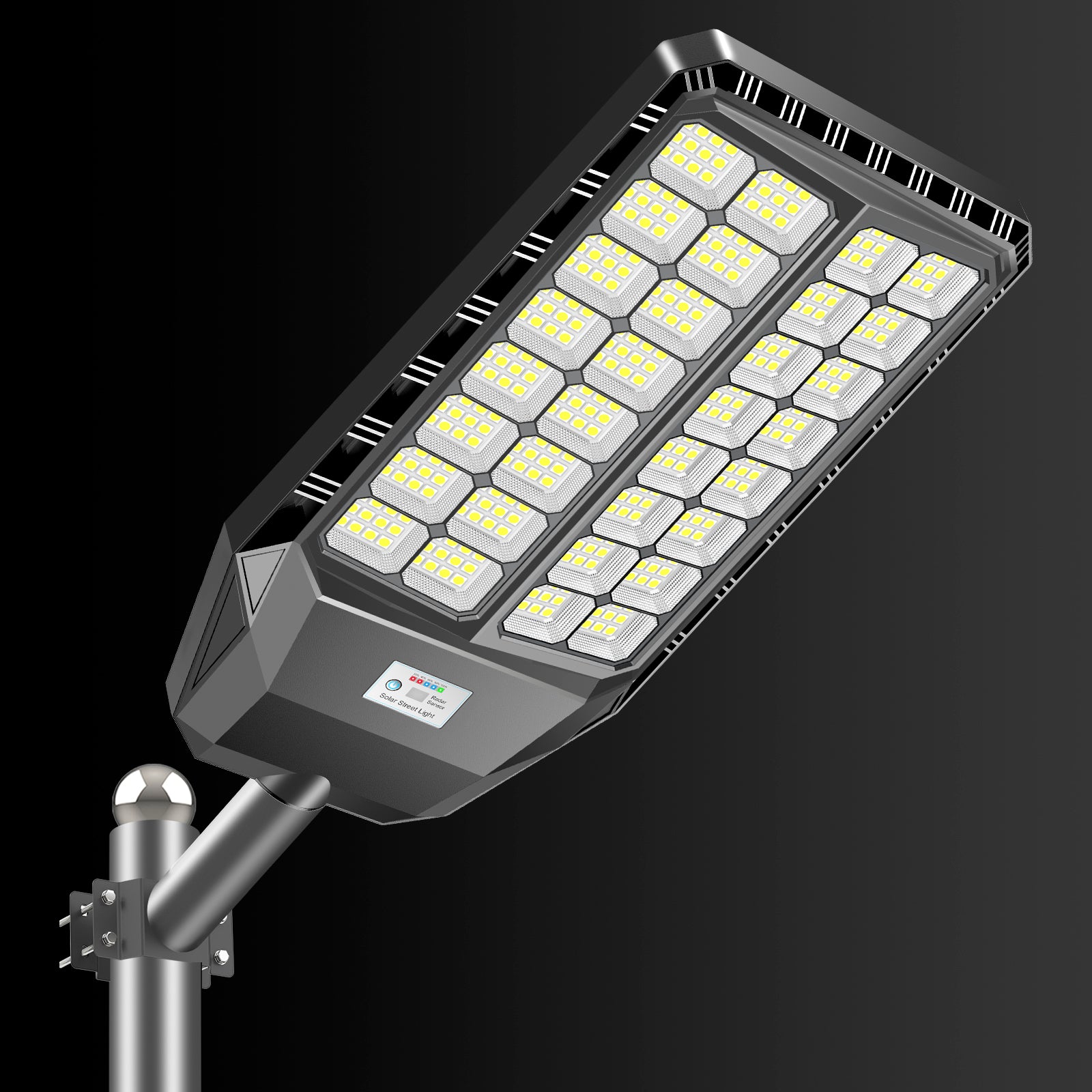
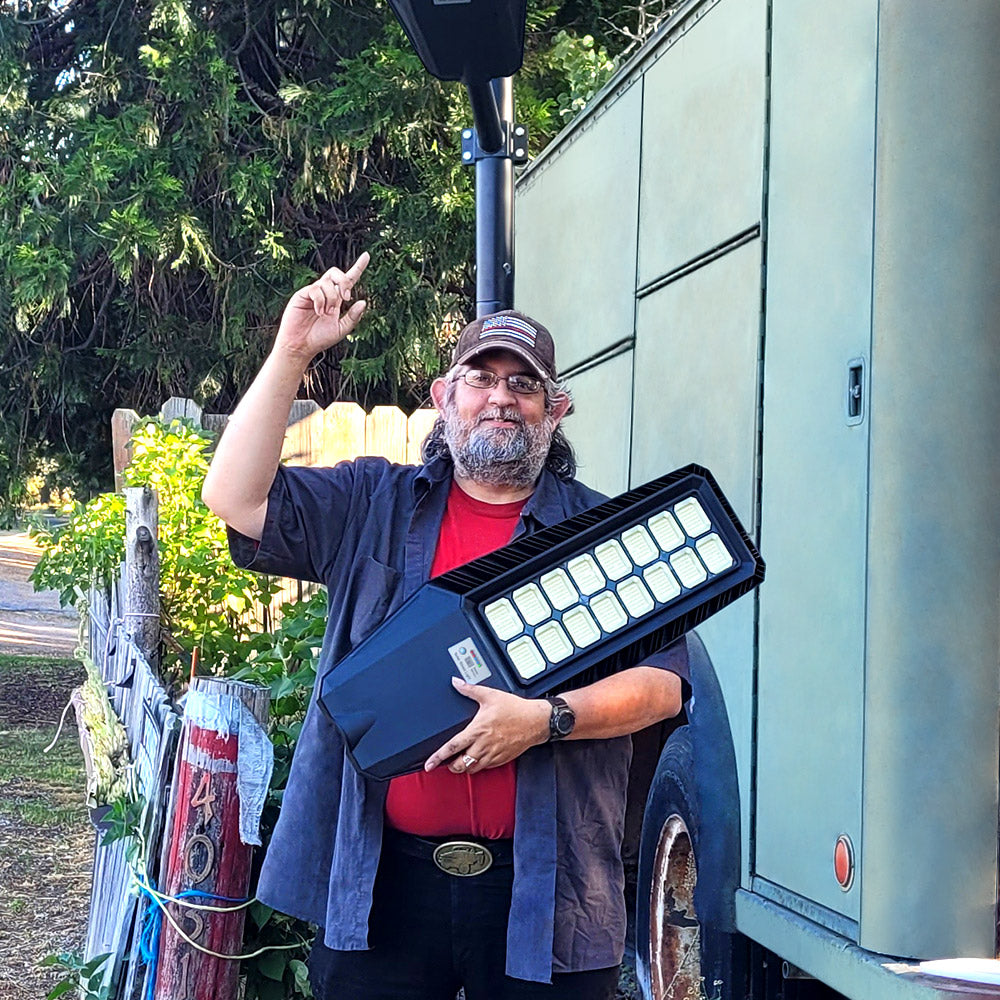
The Hykoont TW030 300W Solar Street Light is the fixture we'd recommend for large commercial parking lots where you need maximum coverage per pole. At 42,000 lumens, it's one of the highest-output solar street lights available at this price point.
The 2-pack is priced at $289.00 ($144.50 per fixture), which is genuinely competitive for a 42,000-lumen commercial fixture. The dusk-to-dawn sensor handles on/off automatically, and the motion sensing modes let you dial in the right balance between brightness and battery conservation for your specific lot.
If you only need one fixture to start, the TW030 single pack is available at $142.00.

Best for: Large open parking lots, wide spacing (30–40 feet between poles), properties in high-sunlight regions.
Best Value for Mid-Size Lots: Hykoont BM024 160W — 21,600 Lumens

For mid-size commercial parking lots — think strip mall lots, office building parking, apartment complex parking — the Hykoont BM024 160W Solar Street Light hits a sweet spot between output and cost.
At 21,600 lumens per fixture and a 2-pack price of $199.00 ($99.50 per fixture), the BM024 is one of the most cost-effective commercial solar street lights available. For a 20-fixture parking lot project, that's $1,990 in fixture costs — a fraction of what you'd spend on grid-powered alternatives when you factor in installation.
The integrated dusk-to-dawn sensor and motion detection make it genuinely set-and-forget. Mount it, let it charge for a day, and it handles the rest.
Best for: Mid-size lots, tighter budgets, properties with 20–30 foot pole spacing, first-time solar lighting buyers.
Best for Maximum Commercial Output: Hykoont SZ300 400W — 60,000 Lumens

If you're managing a large commercial property — a big-box retail center, an industrial facility, a large apartment complex — and you need the highest possible output per fixture, the Hykoont SZ300 400W Commercial Solar Street Light is worth serious consideration.
At 60,000 lumens, this is a genuinely high-output commercial fixture. The die-cast aluminum housing and monocrystalline solar panel are built for long-term commercial deployment. Pricing starts at $145.00 for a single unit, with multi-pack options available up to $293.00.
At this lumen level, you can space fixtures further apart — which reduces your total fixture count and installation cost on large lots. The math often works out favorably compared to buying more lower-output fixtures at closer spacing.
Best for: Large commercial lots, wide pole spacing (40+ feet), high-security applications, industrial facilities.
Shop SZ300 Commercial Solar Light — From $145.00 →
Best Flexible Option: BM024C 160W — 26,000 Lumens

The BM024C Solar Street Light offers 26,000 lumens at 6500K with a flexible price range of $79.00–$309.00 depending on configuration. This makes it a versatile option for properties that need different quantities or configurations across different zones.
The 6500K color temperature is on the cooler end of the daylight spectrum, which maximizes visibility and works well with security camera systems. For properties where camera performance matters, this color temperature is worth prioritizing.
Best for: Mixed-use properties, phased deployments, properties with varying lot sizes across locations.
Pole Height: The Variable Most Buyers Overlook
Here's something that doesn't get enough attention in most solar lighting guides: pole height has a massive impact on how well your fixtures perform, and it's something you need to decide before you buy.
The relationship between pole height, fixture output, and coverage area works like this: the higher the pole, the wider the coverage area — but the lower the foot-candle level at ground level. A 42,000-lumen fixture at 15 feet produces a much brighter pool of light than the same fixture at 25 feet, but covers a smaller area.
For most commercial parking lots, the optimal pole height is 18–25 feet. Here's why:
- Below 15 feet: coverage area is too small, you need more poles
- 15–20 feet: good for smaller lots, tighter spacing
- 20–25 feet: the commercial sweet spot for most applications
- Above 25 feet: requires very high-output fixtures (40,000+ lumens) to maintain adequate ground-level illumination
If you're installing new poles, 20 feet is a safe default for most commercial parking lots. If you're retrofitting existing poles, measure the height before selecting fixtures.
Solar Parking Lot Lights in Northern States: What You Need to Know
One of the most common concerns we hear from property managers in northern states — Minnesota, Michigan, Wisconsin, upstate New York, the Pacific Northwest — is whether solar parking lot lights can handle the combination of short winter days and cold temperatures.
The honest answer: yes, but you need to choose the right fixtures and set realistic expectations.
Short days: In December, northern states may get only 8–9 hours of daylight, and cloud cover can reduce effective charging hours further. This means your fixtures need larger battery reserves and more efficient panels. Look for fixtures with LiFePO4 batteries (better cold-weather performance) and monocrystalline panels (better low-light charging).
Cold temperatures: Battery capacity decreases in cold weather — typically 20–30% reduction at 14°F (-10°C). Quality LiFePO4 batteries handle this better than standard lithium-ion, but it's still a factor. Fixtures with larger battery capacity have more buffer to absorb this reduction.
Snow on panels: Solar panels mounted at an angle will shed snow naturally in most cases. Panels mounted flat (parallel to the ground) can accumulate snow and lose charging capacity. Check the panel angle on any fixture you're considering — a 15–30 degree tilt is ideal for snow shedding.
For northern states, we'd recommend sizing up on battery capacity and choosing fixtures with monocrystalline panels. The TW030 and SZ300 are both good choices for northern climates.

How to Calculate Your Total Project Cost (And Your Payback Period)
Before you commit to a solar parking lot lighting project, it's worth running the numbers. Here's a straightforward framework.
Step 1: Count Your Fixtures
Use the lumen and spacing guidelines above to estimate how many fixtures you need. For a typical 50-space commercial parking lot, you're usually looking at 8–15 fixtures depending on lot shape and pole height.
Step 2: Calculate Fixture Cost
Using the BM024 2-pack at $199 as a baseline: 10 fixtures = 5 packs = $995. Using the TW030 2-pack at $289: 10 fixtures = 5 packs = $1,445. For the SZ300 at $145/unit: 10 fixtures = $1,450.
Step 3: Estimate Installation Cost
Solar fixtures don't require electrical work, but they do require pole mounting. Budget $150–$300 per fixture for professional installation, including concrete anchor work if you're setting new poles. For 10 fixtures: $1,500–$3,000.
Step 4: Calculate Your Current Annual Lighting Cost
A standard 150W grid-powered parking lot fixture running 12 hours/night costs approximately $65–$85/year in electricity (at $0.12–$0.15/kWh). For 10 fixtures: $650–$850/year. Add maintenance costs (bulb replacements, ballast repairs): typically $50–$100/fixture/year for older fixtures.
Step 5: Calculate Payback Period
Total solar project cost (fixtures + installation): $2,495–$4,445 for 10 fixtures using BM024.
Annual savings (electricity + maintenance): $700–$950/year.
Payback period: 2.6–6.4 years, depending on your current electricity costs and installation complexity.
After payback, the savings are pure bottom-line improvement. For a 10-fixture lot, that's $700–$950/year in ongoing savings for the remaining 5–8 years of fixture life.
Installation Tips That Will Save You Headaches Later
Do a sun study before finalizing pole locations. Walk your lot at different times of day and note where shadows fall from buildings, trees, and other structures. Solar panels need unobstructed sky access — even partial shading can cut charging efficiency by 30–50%.
Orient panels south. In the U.S., solar panels should face south to maximize sun exposure. Most solar street lights have adjustable panel angles — make sure your installer sets them correctly for your latitude.
Allow a full charge before the first night of operation. New fixtures should charge for a full day before their first night of use. This ensures the battery starts at full capacity and gives you an accurate baseline for performance.
Check and clean panels twice a year. Dust, pollen, and bird droppings reduce panel efficiency. A quick wipe-down in spring and fall keeps your fixtures performing at spec.
Document your installation. Take photos of each fixture location, panel orientation, and mounting hardware. This makes troubleshooting and warranty claims much easier if issues arise later.
Red Flags to Watch for When Shopping for Commercial Solar Lights
Lumen claims without photometric data. Any serious commercial fixture manufacturer should be able to provide photometric data (IES files or photometric reports) that show actual light distribution. If a vendor can't provide this, be skeptical of their lumen claims.
No IP rating listed. Every outdoor fixture should have a clearly stated IP rating. If it's not listed, assume it's inadequate for commercial outdoor use.
Vague battery specs. "Large capacity battery" is not a spec. You want to see the battery type (LiFePO4 preferred), capacity in Wh or Ah, and cycle life rating. If these aren't listed, ask before you buy.
Prices that seem too good to be true. A genuine 42,000-lumen commercial solar fixture with LiFePO4 battery and monocrystalline panel cannot be manufactured and sold profitably for $30. If the price is dramatically lower than comparable fixtures, something in the spec sheet is inflated or the build quality is compromised.
No warranty or very short warranty. Commercial fixtures should come with at least a 2-year warranty. A 1-year warranty on a commercial product is a red flag — it suggests the manufacturer doesn't have confidence in long-term reliability.

Frequently Asked Questions
What is the minimum lumen output for a commercial parking lot solar light?
For most commercial parking lots, you need a minimum of 15,000 lumens per fixture at a mounting height of 15–20 feet. For taller poles (20–25 feet) or wider spacing, 25,000–42,000 lumens is more appropriate. The IES RP-20 standard recommends 1.0 foot-candle minimum at ground level for general parking areas.
How long will a solar parking lot light last through the night?
Quality commercial solar parking lot lights are designed to run 10–14 hours on a full charge. Most use motion-sensing dimming modes that extend battery life — running at 30–50% brightness when no motion is detected and ramping to 100% when motion is sensed. This allows the fixture to handle longer nights and partially cloudy days without running out of charge.
Do solar parking lot lights work in winter?
Yes, with some performance reduction. Solar panels generate power even on overcast days (10–25% of rated output), and quality LiFePO4 batteries handle cold temperatures better than standard lithium-ion. In northern states, expect 15–25% reduced performance in December–January compared to summer months. Choosing fixtures with larger battery capacity compensates for this seasonal variation.
How far apart should solar parking lot lights be spaced?
Spacing depends on fixture lumen output and mounting height. As a general guideline: 15,000–20,000 lumen fixtures at 15–20 feet height work well at 20–25 foot spacing; 25,000–42,000 lumen fixtures at 20–25 feet height work well at 25–35 foot spacing; 42,000+ lumen fixtures at 25 feet can handle 35–45 foot spacing. Always verify with photometric data from the manufacturer.
Can I install solar parking lot lights myself?
The fixtures themselves don't require electrical work — no wiring to grid power. However, pole mounting requires proper concrete anchoring and working at height, which requires appropriate equipment and safety training. Most commercial property managers hire a licensed contractor for installation. Budget $150–$300 per fixture for professional installation.
What's the difference between a solar street light and a solar parking lot light?
In practice, these terms are often used interchangeably. Both are pole-mounted fixtures designed to illuminate large outdoor areas. "Street light" typically implies a fixture designed for road illumination with a specific beam pattern optimized for linear coverage. "Parking lot light" may have a wider, more symmetrical beam pattern optimized for area coverage. Many commercial fixtures work well for both applications.
Are there rebates or tax incentives for commercial solar parking lot lights in the U.S.?
Potentially yes. Commercial solar installations may qualify for the federal Investment Tax Credit (ITC). Some states and utilities also offer rebates for energy-efficient lighting upgrades. The specific incentives available depend on your state, utility provider, and the nature of your installation. Consult with a tax professional or your local utility's energy efficiency program before purchasing.
How do I know if a solar parking lot light is genuinely commercial grade?
Look for: IP65 or higher rating, LiFePO4 battery with stated capacity in Wh or Ah, monocrystalline solar panel, die-cast aluminum housing, at least a 2-year warranty, and photometric data available from the manufacturer. Fixtures that meet all of these criteria are genuinely commercial grade. Fixtures that are missing several of these specs are likely consumer-grade products marketed as commercial.
What color temperature is best for commercial parking lot lighting?
5000K–6500K (cool white to daylight) is the standard for commercial parking lots. This range provides the best visibility, the highest color rendering index (CRI) for security cameras, and the most alert, safe environment for pedestrians and drivers. Warmer temperatures (3000K–4000K) reduce visibility and camera performance and are better suited for decorative or hospitality applications.
How do I compare solar parking lot lights from different brands?
Compare these specs side by side: lumen output (not wattage), battery type and capacity (Wh), solar panel type (mono vs. poly) and wattage, IP rating, color temperature (CCT), warranty length, and price per lumen. This gives you a standardized basis for comparison that cuts through marketing language and lets you evaluate actual value.
The Bottom Line
Choosing the right high-lumen solar parking lot lights for a commercial property comes down to matching the fixture's output to your lot's actual requirements — not just buying the brightest or cheapest option on the page.
For most U.S. commercial parking lots, the fixtures that make the most sense are:
- BM024 160W — 21,600 Lumens, $199 for 2-Pack — Best value for mid-size lots
- TW030 300W — 42,000 Lumens, $289 for 2-Pack — Best for large lots needing maximum coverage
- SZ300 400W — 60,000 Lumens, from $145 — Best for maximum output and wide spacing
- BM024C 160W — 26,000 Lumens, from $79 — Best flexible option for phased deployments
If you're not sure which fixture is right for your specific lot, reach out before you buy. Getting the fixture selection right upfront is much easier than dealing with a lighting system that underperforms after installation.

Leave a comment
This site is protected by hCaptcha and the hCaptcha Privacy Policy and Terms of Service apply.