








Here's a conversation that happens more than you'd think. A facilities manager in Portland or Seattle calls a solar supplier to ask why they'd even consider solar lighting given the eight months of overcast sky they live with. The supplier gives a vague answer about "diffuse light" and the conversation goes nowhere useful.
That facilities manager ends up with grid-tied fixtures they didn't need to buy and an electricity bill that never goes away.
The frustrating part? The supplier wasn't wrong about diffuse light. They just couldn't explain it well enough to be convincing. So let's fix that.
This is a proper explanation of how modern solar panels actually work in overcast conditions, why the 2023–2024 El Niño cycle was a real-world laboratory for this technology, and which solar street lights are engineered to perform when the sun doesn't cooperate.
First: What Is "Diffuse Light" and Why Does It Matter?
On a clear day, solar panels receive two types of light: direct beam radiation (the straight-line path from sun to panel) and diffuse radiation (sunlight scattered by the atmosphere, bounced off clouds, reflected off surfaces). On a perfect sunny day, direct beam makes up roughly 85% of your panel's output.
On an overcast day, direct beam drops to near zero. But diffuse radiation doesn't disappear — it scatters across the entire sky dome. A heavily overcast sky in Seattle or Portland still delivers 10–25% of a clear-day's solar irradiance. A lightly overcast or partly cloudy sky can hit 40–60%.
That's the number that surprises most people. Half the sun's energy on a partly cloudy day. That's not nothing — that's enough to meaningfully charge a well-sized LiFePO4 battery over the course of a full day, even if it's charging at a slower rate than it would in Phoenix in July.
The Spectral Advantage Nobody Talks About
Here's where it gets genuinely interesting. Cloud cover doesn't filter all wavelengths of light equally. Clouds preferentially scatter blue and UV wavelengths — the short-wave end of the spectrum — while partially absorbing infrared. Monocrystalline silicon solar cells respond most efficiently to wavelengths between 400–1100nm, with peak response around 800–900nm (near-infrared) and a solid secondary response in the 400–700nm visible range.
In practical terms: the spectral content of diffuse light under cloud cover is actually well-matched to monocrystalline cell response. The blue-scattered light that dominates under overcast skies lands squarely in the wavelength range where mono-Si cells are most productive.
This is why high-efficiency monocrystalline panels outperform polycrystalline panels specifically in low-light and overcast conditions. Poly cells have a less refined crystal structure, which creates more electron recombination losses — losses that become proportionally more significant when total irradiance is low. Mono cells, with their single-crystal structure and lower recombination rates, extract more electrons per photon at low light levels.
The difference? Typically 8–15% more output per unit area in overcast conditions when comparing equivalent mono vs. poly panels. Over an eight-month Pacific Northwest winter, that gap compounds significantly.

Where MPPT Changes Everything
The panel is only half the story. The charge controller — specifically, whether it uses MPPT (Maximum Power Point Tracking) or the older PWM (Pulse Width Modulation) technology — determines how much of what the panel generates actually makes it into the battery.
PWM Under Clouds: The Problem
A PWM controller works by directly connecting the panel to the battery and chopping the current at high frequency to regulate charge. It's simple, cheap, and fine for clear-sky applications where the panel is generating at or above its rated voltage. The problem is that a PWM controller forces the panel to operate at battery voltage, not panel voltage — typically 12–14V for a 12V battery system.
Under overcast conditions, a panel's optimal operating voltage (its maximum power point) may be 17–19V — but the PWM controller is pulling it down to 13V. You're harvesting maybe 70% of what the panel could theoretically deliver under those dim conditions. With a PWM controller, you're throwing away 30% of your already-reduced overcast output.
MPPT Under Clouds: The Solution
An MPPT controller continuously sweeps the panel's voltage-current curve to find the exact voltage at which the panel is delivering maximum power — the maximum power point. It then uses a DC-DC converter to step that voltage down to what the battery needs, transferring the full power (minus small conversion losses, typically 3–5%).
Under overcast conditions, this matters enormously. When your panel is only generating 15% of its rated output, an MPPT controller captures 95%+ of that 15%. A PWM controller captures maybe 65–70% of it. In energy terms, across a full overcast day, an MPPT-equipped system charges a meaningfully larger percentage of its battery capacity.
The industry benchmark is that MPPT outperforms PWM by 15–30% in clear-sky conditions and by 30–50% in low-light or overcast conditions. For El Niño's extended cloud cover periods — stretches of 5–10 overcast days in a row were common across the Pacific Coast in winter 2023–2024 — that gap is the difference between a light that stays on and one that goes dark by 2 AM.

El Niño 2023–2024: A Real-World Test Across the US
The 2023–2024 El Niño event delivered above-average precipitation and cloud cover across a broad swath of the US. The Pacific Northwest experienced some of the most persistently overcast stretches in a decade. Northern California, the Mountain West, and the Upper Midwest all saw extended low-light periods that tested solar installations built to Sun Belt specs.
What Failed and Why
Installations that struggled shared predictable characteristics:
- PWM charge controllers that couldn't harvest efficiently from dim panels
- Undersized battery packs — systems with only 1–1.5 days of reserve ran dry during 4–6 day overcast stretches
- Polycrystalline panels that performed noticeably worse than mono equivalents in diffuse light
- Aggressive power-saving modes that reduced brightness so severely the lights were functionally useless
What Survived and Why
Installations that came through with minimal issues had a consistent profile:
- High-efficiency monocrystalline panels (typically 160+ LM/W LED efficiency and 18V+ panel voltage)
- MPPT controllers with temperature compensation and low-light optimization
- LiFePO4 batteries sized at 3+ days of reserve capacity
- Intelligent multi-mode operation (full power for peak hours, 30–50% for late-night periods)
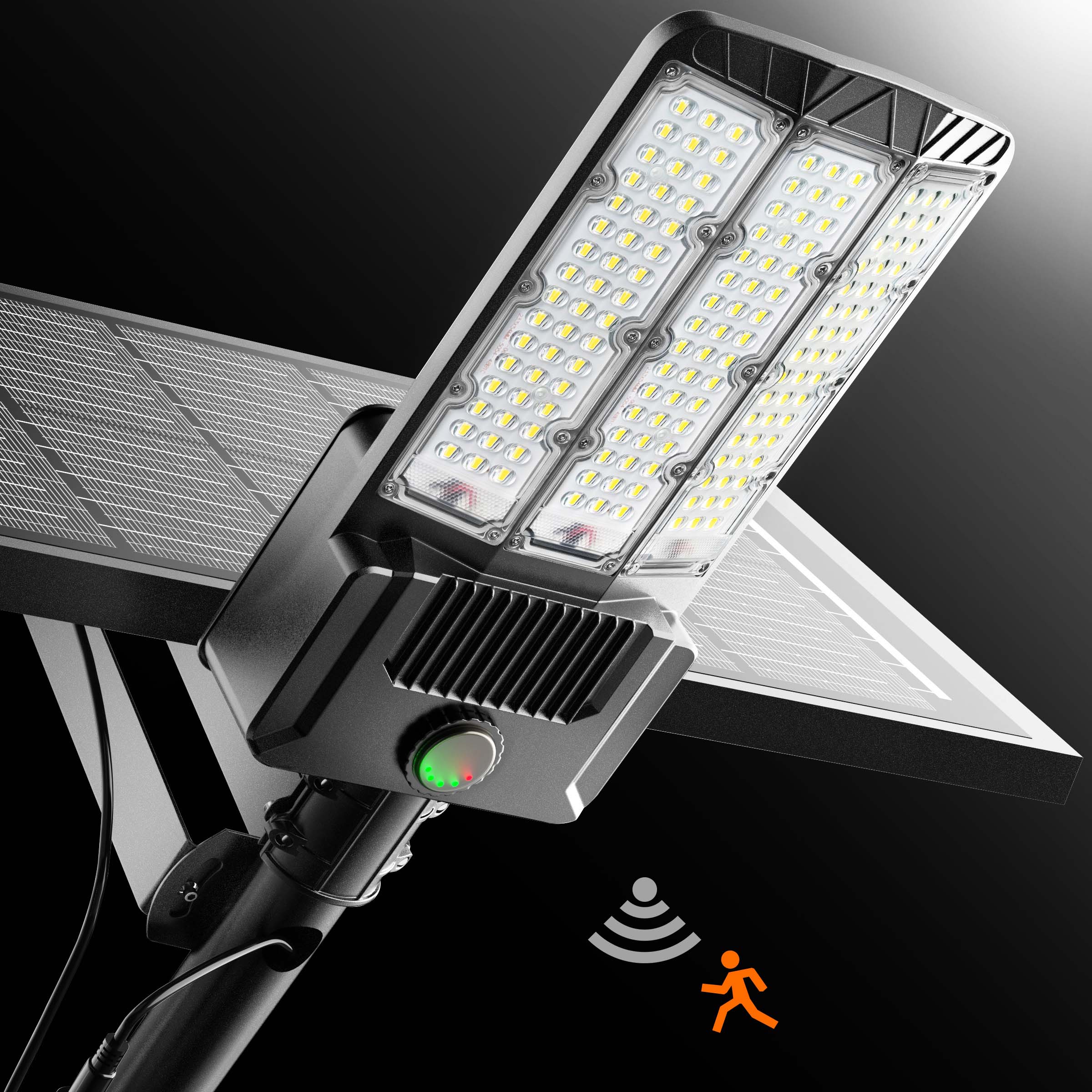
That profile maps directly onto the current Hykoont commercial lineup. Here's how the specific products stack up for cloudy-climate applications.

The Products Built for Overcast Climates
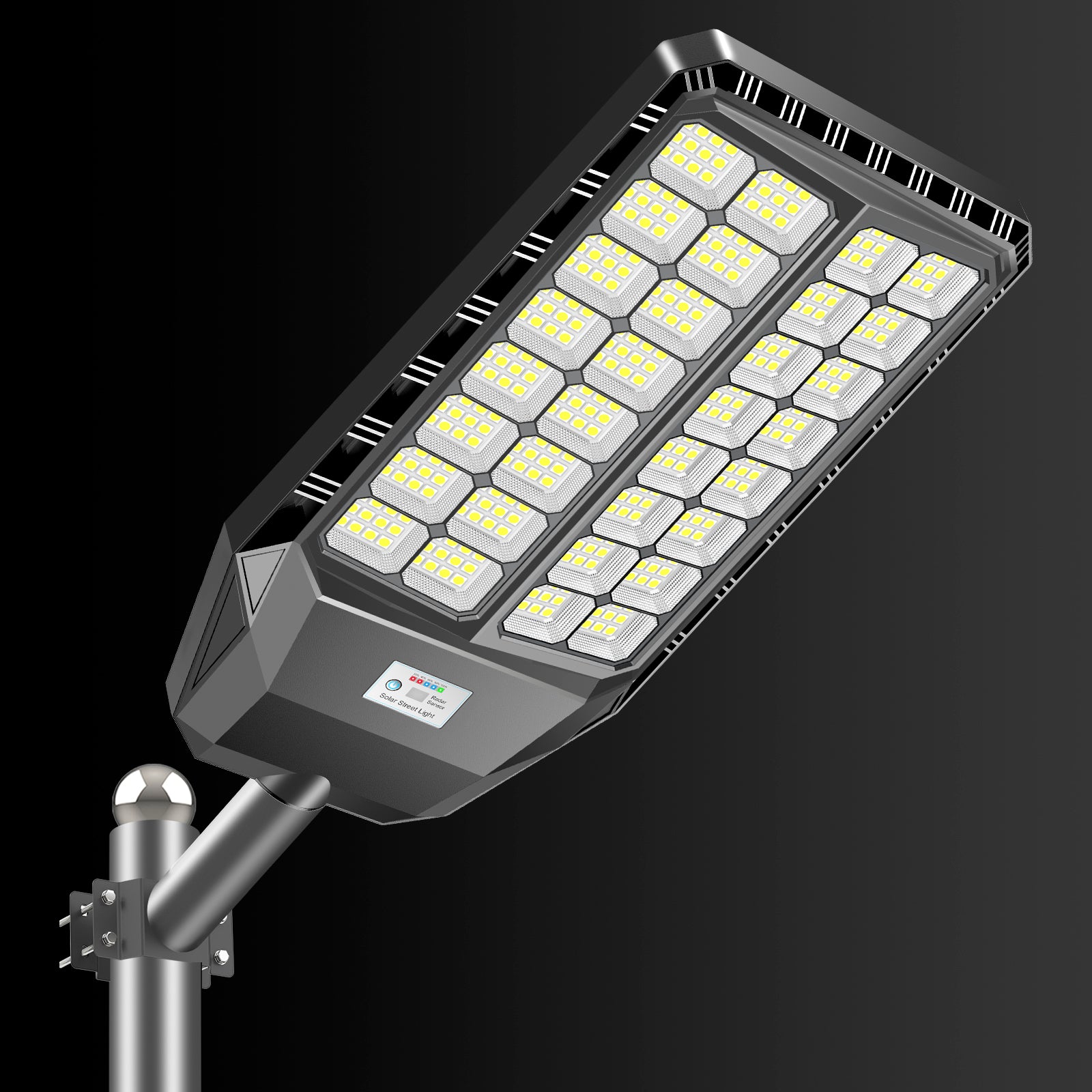
1. HY050 — 50W Commercial Solar Street Light with 480WH Reserve

The HY050's standout number for cloudy-climate buyers is the battery: 480WH (3.2V/150AH) LiFePO4, rated for 5 years. For a 50W output light, that's roughly 9–10 hours of full-power runtime per charge cycle. In practical terms, after a full clear-day charge, the HY050 has enough reserve to run through 2–3 consecutive fully overcast nights without any additional charging input.
The 80W monocrystalline panel with MPPT charging ensures that on partially overcast days, the system is still harvesting meaningful energy — potentially 40–60% of clear-day input, gradually replenishing the reserve. 72 SMD 5050 LEDs deliver 9,000 lumens at adjustable CCT (3000K–6500K). IP65-rated aluminum body, operating range -20°C to 60°C. Installation height 8–10m.
Price: $696.00
2. NT040 — 40W Solar Street Light with 240WH LiFePO4, 10-Year Battery Life

The NT040 is the entry point for buyers who want LiFePO4 chemistry, MPPT charging, and monocrystalline panel performance without the cost of a 100W+ commercial unit. The 3.2V/75AH LiFePO4 battery is rated for a 10-year service life — a spec that implies a very high cycle count at standard conditions and genuine longevity even under the accelerated degradation of real-world weather variation.
40W output, 3,600 lumens, 70°×140° beam angle. 18V/40W mono panel with MPPT. Adjustable CCT (3000K–6500K). Aluminum construction, IP65, -20°C to 60°C. Installation height 6–7m, covering 15–20m. Three-year warranty, CE/RoHS/ISO-9001.
For HOA entrance lighting, residential streets, or smaller commercial perimeters in the Pacific Northwest or Upper Midwest, this is the practical starting spec.
Price: $465.00
3. NT100A — 100W Solar Street Light with 320WH LiFePO4 + MPPT All-Weather

The "All-Weather" designation in the NT100A's full product name isn't decorative. It's the design brief. The 6.4V MPPT controller is specifically tuned for low-light charging performance, and the 320WH (12.8V/25AH) LiFePO4 battery provides the reserve depth to absorb the variability of overcast days without the light dimming prematurely.
100W output with 192 SMD 3030 chips producing 7,200+ lumens. 80W monocrystalline panel. Multiple operating modes: 100% for 1 hour, 70% for 3 hours, 50% for 4 hours, 30% for 4 hours — intelligently staged to preserve battery reserve through long nights. Rated for 3 consecutive cloudy days. Aluminum body, IP65, -20°C to 60°C, installation height 6–8m, coverage up to 30m.
Price: $762.00
4. HY100 — 100W Commercial Solar Street Light with 768WH + 150W Mono Panel

The HY100 earns its place in this list for one specific reason: the panel. A 36V/150W monocrystalline solar panel is significantly larger than what most 100W street lights carry. In clear-sky climates, that's oversized — you don't need 150W of panel to charge a 100W light in Phoenix. But in overcast climates, a larger panel is exactly the right move.
If your 150W panel is harvesting at 20% efficiency under dense cloud cover, that's still 30W of charging input — comparable to what a 60W panel produces under the same conditions. The extra panel area acts as a buffer against low-irradiance days. Combined with the 768WH (25.6V/30AH) LiFePO4 battery and MPPT controller, the HY100 has the energy input and storage depth to handle extended overcast stretches that would drain smaller systems.
72 SMD 5050 LEDs, 27,000 lumens. 70°+140° beam angle. IP65, aluminum alloy, -20°C to 60°C. Installation height 10–12m, suitable for large commercial lots. Three-year warranty.
Price: $1,399.00
5. HY120 — 200W Commercial Solar Street Light with 1,152WH + MPPT

The HY120 is what you specify when a property genuinely cannot have a lighting failure and the climate delivers months of cloud cover. The 25.6V/45AH LiFePO4 battery (1,152WH equivalent) is the largest in the Hykoont lineup, and the 36V/200W monocrystalline panel is an industry-leading input for a self-contained solar street light.
At 20% overcast harvesting efficiency, the 200W panel still delivers 40W of charging input continuously — enough to partially replenish the enormous battery reserve through even a dim winter day. The result is a system with genuine multi-day reserve depth that doesn't require a clear-sky event to recover from an extended overcast stretch.
72 SMD 5050 LEDs, 21,600 lumens. MPPT charging. Aluminum alloy, IP65, -20°C to 60°C. Installation height 12–14m, right for large commercial parking lots, campuses, and industrial sites. RoHS/CE/ISO-9001, three-year warranty.
Price: $1,914.00
How to Size a Solar Street Light for a Cloudy Climate
The Sun Belt sizing rules don't apply in the Pacific Northwest, Upper Midwest, or New England. Here's a framework that does.
Step 1: Establish Your Peak Sun Hours
Peak Sun Hours (PSH) is the standard solar industry metric — it represents the equivalent hours of full 1,000 W/m² irradiance your location receives per day, averaged over the year. A useful reference:
- Phoenix, AZ: ~6.5 PSH (annual average)
- Dallas, TX: ~5.2 PSH
- Chicago, IL: ~4.2 PSH
- Seattle, WA: ~3.5 PSH (winter average drops to ~2.0)
- Portland, OR: ~3.8 PSH (winter average ~1.8–2.2)
- Boston, MA: ~4.0 PSH (winter average ~2.5–3.0)
For commercial solar lighting, you should size for your winter minimum, not your annual average — because your worst performance month determines whether your lights stay on year-round.
Step 2: Calculate Your Daily Energy Demand
A 100W light running 12 hours at full power = 1,200Wh/day. With intelligent multi-mode operation (full power for 2 hours, 50% for the remaining 10), real-world consumption drops to roughly 700–800Wh/day. Use your actual operating mode plan, not the theoretical maximum.
Step 3: Size Your Panel for Your PSH Floor
Panel output (Wh/day) = Panel wattage × PSH × MPPT efficiency (~0.92–0.95)
For Seattle in winter (2.0 PSH), a 150W panel delivers: 150 × 2.0 × 0.93 = ~279Wh/day. That's enough to replace about 35–40% of a 100W light's nightly demand. Which brings us to step 4.
Step 4: Build Enough Battery Reserve for Your Overcast Stretch
If your panel can only replace 35% of nightly demand during a dim winter day, and you have 5 consecutive overcast days, your battery needs to carry the other 65% × 5 = 325% of one night's demand in reserve — while still maintaining enough charge to function on day 5. Practically, this means sizing your battery at 4–5× your nightly energy demand for Pacific Northwest or New England winter installations.
For a 700Wh/night load in Seattle, that points to a battery of 2,800–3,500Wh. The HY120's 1,152Wh pack covers a smaller light; for full-sized commercial lighting in deeply overcast climates, multiple units or higher-capacity configurations are the right approach.
The Practical Shortcut
For most US commercial applications outside the Sun Belt, the safe default is:
- Panel wattage ≥ 2× light wattage
- Battery capacity ≥ 4× nightly energy demand
- MPPT controller, non-negotiable
- Monocrystalline panel, non-negotiable
Every product in this article meets the MPPT and monocrystalline requirements. The HY050 and HY120 have the most favorable panel-to-light and battery-to-demand ratios for cloudy climates.
Panel Placement in Cloudy Climates: It's Different From Sun Belt Rules
In Sun Belt installations, you optimize panel angle for direct beam irradiance — typically 15–25° from horizontal, facing true south, to capture peak summer irradiance. In cloudy climates, the calculus shifts because you're primarily harvesting diffuse light, which comes from the entire sky dome, not a specific direction.
Flatter Is Often Better
A panel tilted at 10–15° from horizontal has a larger projected area facing the full sky dome. Under overcast conditions, this captures more diffuse radiation than a steeply tilted panel optimized for winter direct beam. In persistently overcast climates like the Pacific Northwest, flat or near-flat panel mounting often outperforms conventionally tilted arrays by 5–12% over a full winter season.
Keep Panels Clear of Shading
This matters everywhere but is especially critical in low-irradiance climates. A shadow covering even 10% of a panel's surface can cause a disproportionate power loss — in some cell configurations, a partial shadow can cut output by 30–50% due to the series-wiring of cells. In a climate where you're already working with 20% of clear-sky irradiance, a 40% shading loss cuts you to 12% — functionally nothing.
In overcast climates, a clear southern sky view is more valuable than a perfectly optimized tilt angle. Prioritize unobstructed exposure over precise angle.
The Buyer's Checklist for Cloudy-Climate Solar Street Lights
- ✅ Panel technology: Monocrystalline, confirmed — not polycrystalline or amorphous
- ✅ Panel wattage: At minimum 1.5×, ideally 2× the light's rated wattage
- ✅ Charge controller: MPPT only — PWM is not acceptable for low-PSH installations
- ✅ Battery chemistry: LiFePO4 for longevity and cold-weather performance
- ✅ Battery capacity: Sized for 3–5 days of reserve at your winter PSH floor
- ✅ Operating modes: Multi-stage dimming (not just on/off) to stretch reserve through long winter nights
- ✅ IP rating: IP65 minimum — overcast climates mean rain, humidity, and freeze-thaw cycles
- ✅ Operating temp: Confirmed to at least -20°C for climates with winter freezing
- ✅ Warranty: 3 years minimum on the complete unit
Frequently Asked Questions
1. Do solar panels actually work on cloudy days?
Yes — they just produce less power than on clear days. A heavily overcast sky typically delivers 10–25% of clear-day irradiance. Partly cloudy conditions can deliver 40–60%. Modern high-efficiency monocrystalline panels, especially with MPPT controllers, harvest this diffuse light effectively. The key is pairing that reduced input with a battery reserve sized for multi-day autonomy so the light can carry through multiple overcast days without clear-sky recharging.
2. What's the difference between MPPT and PWM in overcast conditions?
A PWM controller forces the solar panel to operate at battery voltage rather than its optimal power point — wasting 30% or more of available output in low-light conditions. An MPPT controller continuously finds the panel's maximum power point and uses DC-DC conversion to deliver that power to the battery efficiently. In overcast conditions, MPPT outperforms PWM by 30–50% in energy harvested. For any installation where cloudy days are common, MPPT is essential, not optional.
3. Why does monocrystalline perform better than polycrystalline in overcast conditions?
Monocrystalline cells have a single, uniform crystal structure that minimizes electron recombination losses — losses that become proportionally more significant when photon flux is low. Polycrystalline cells have grain boundaries in their crystal structure that create additional recombination sites. At full sun, both perform reasonably well. At 20% irradiance under heavy cloud cover, monocrystalline panels produce 8–15% more output per unit area — a meaningful margin when you're working with a small energy budget.
4. How many consecutive cloudy days can the Hykoont commercial lights handle?
It depends on the model and operating mode. The NT100A is rated for 3 consecutive cloudy days. The HY050, with its 480WH battery and 50W load, can theoretically run 4–5 days from a full charge with no additional input. The HY120, with its 1,152WH-equivalent battery and 200W panel still harvesting on dim days, offers the deepest reserve in the lineup — realistic 5–7 day autonomy in worst-case winter overcast.
5. Is solar street lighting practical in Seattle or Portland?
Yes, with the right specifications. Seattle averages ~3.5 PSH annually and drops to ~2.0 in winter — low but not zero. A system sized for 2.0 PSH (larger panel, larger battery, MPPT controller, monocrystalline panel) can maintain reliable year-round operation. The HY100 and HY120, with their 150W and 200W panels respectively, are the appropriate specs for Pacific Northwest commercial installations where reliability through winter is non-negotiable.
6. Does El Niño make solar street lights less reliable in general?
El Niño's effects vary by region. For the US Pacific Coast and parts of the Southwest, El Niño typically brings above-average precipitation and cloud cover — which challenges under-sized solar systems. For the Southeast and parts of Texas, El Niño often brings drier, sunnier winters — which can actually improve solar performance. The key is that El Niño years amplify the consequences of incorrect sizing. A properly sized system handles El Niño without incident. A borderline system fails during it.
7. Will cold temperatures affect my solar battery in overcast northern climates?
LiFePO4 batteries perform better in cold than NMC or lead-acid alternatives, but they do lose some capacity at low temperatures — typically 10–15% at 0°C and up to 20–25% at -10°C. All Hykoont LiFePO4 models are rated to -20°C operating temperature. For northern US installations where temperatures regularly drop below freezing, this performance dip is one more reason to size your battery conservatively — the same 3–5× nightly demand rule for cloudy climates provides adequate buffer for cold-weather capacity reduction.
8. What panel angle should I use in a cloudy northern US climate?
For persistently overcast climates, flatter is often better. A 10–15° tilt maximizes the panel's sky-facing projected area for diffuse light collection. In climates with a mix of clear and overcast days, 20–25° is a reasonable compromise. The most important factor in any low-PSH climate is avoiding shading — even partial shading in low-irradiance conditions causes disproportionate power loss. Prioritize a clear sky view over precise tilt optimization.
9. How does multi-mode operation help during extended cloud cover?
Intelligent multi-mode operation staggers light output across the night to match the battery's state of charge with lighting demand. Running at 100% for the high-traffic first 2 hours, stepping to 70% for the next 3 hours, and 30% for the quiet early-morning hours can cut total nightly energy consumption by 40–50% compared to running at 100% all night — without meaningfully reducing safety or usability. In overcast conditions where battery reserve is tighter, this mode flexibility is a critical feature, not a nice-to-have.
10. Which Hykoont model is best for a northern US commercial parking lot that gets heavy winter cloud cover?
For most northern US commercial parking lots — think Chicago, Minneapolis, Seattle, or Portland — the HY100 is the practical baseline recommendation. The 150W monocrystalline panel provides the extra input buffer for low-PSH winters, and the 768WH battery gives 3–4 days of reserve at typical operating power levels. For larger lots or higher-reliability requirements, step up to the HY120 with its 200W panel and ~1,152WH battery. Both are the correct specs for climates where a solar lighting failure in January carries real liability.
The Bottom Line
The cloud cover paradox isn't really a paradox once you understand the physics. Overcast skies don't turn off the sun — they scatter it. Monocrystalline panels and MPPT controllers are specifically well-suited to harvest that scattered light. And a properly sized LiFePO4 battery provides the reserve depth to bridge the gap when harvesting is reduced.
El Niño 2023–2024 was a stress test. The systems that failed were under-specified for the climate they were installed in. The ones that held up were engineered with diffuse-light harvesting as a design requirement, not an afterthought.
If you're sourcing solar street lights for a US property with serious winter cloud cover, the products in this article are the right starting point. The engineering is there. You just need to make sure the sizing is right for your specific location and load.



Leave a comment
This site is protected by hCaptcha and the hCaptcha Privacy Policy and Terms of Service apply.