






Let's cut to it: most "commercial solar street light" listings online are either underpowered residential units dressed up with marketing language, or genuine commercial-grade fixtures that cost more than they should. Finding the right one — something that actually runs all night, handles bad weather, and doesn't need a utility hookup — takes more than reading a spec sheet.
This guide is for property managers, facility directors, contractors, and anyone responsible for lighting a parking lot, private road, campus pathway, or industrial yard without running conduit. We'll walk through what the specs actually mean, which Hykoont models are worth your time, and how to match the right fixture to your specific situation.
No filler. Just the information you need to make a confident purchase.
Why "Dusk to Dawn" Is the Only Mode That Matters for Commercial Use
Residential solar lights often run on motion sensors or timers. That's fine for a backyard. For a commercial property, it's a liability. A parking lot that goes dark at 2 AM because the battery ran out — or because no one triggered the motion sensor — is a safety and security problem.
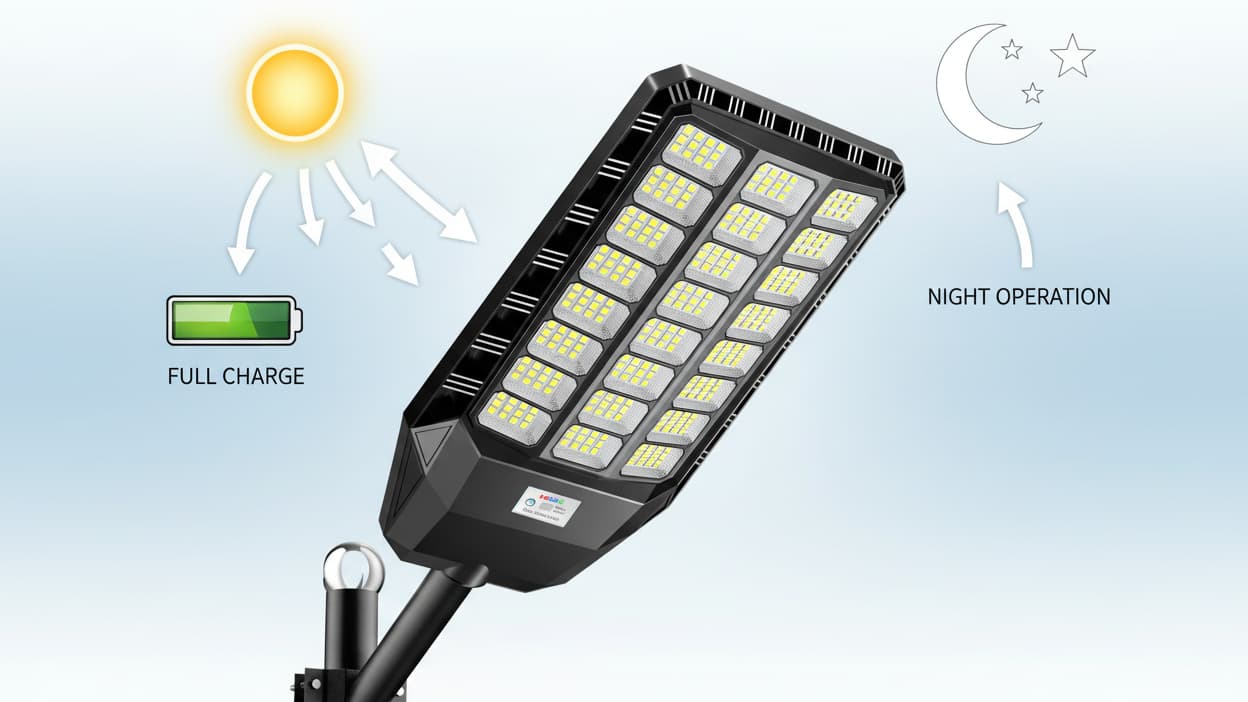
True dusk-to-dawn operation means the light turns on automatically at sunset and stays on at a consistent output until sunrise. Every night. Without someone adjusting a timer or replacing batteries.
The key to making this work reliably is the combination of three things:
- Battery capacity — enough stored energy to run through 12+ hours of darkness, even after a cloudy day
- Solar panel efficiency — monocrystalline panels charge faster and perform better in low-light conditions than polycrystalline
- Smart power management — MPPT controllers that optimize charging and multi-mode output settings that extend runtime without sacrificing safety lighting levels
When all three are dialed in, you get a light that genuinely works every night without intervention. When one is compromised — usually battery capacity or panel quality — you get a light that works great in summer and fails in winter.

What the Specs Actually Mean (Plain English Version)
Wattage: Solar Panel vs. LED Power Draw
This is where a lot of buyers get confused. A "400W solar street light" doesn't mean the LED draws 400 watts — it means the solar panel is rated at 400W input. The actual LED might draw 60–120W. Higher panel wattage means faster charging and better performance on cloudy days. Don't compare lights by panel wattage alone.
Lumens: The Number That Actually Tells You How Bright It Is
Watts measure power consumption. Lumens measure light output. For commercial applications:
- Under 10,000 lumens: Pathway lighting, residential driveways, small lots
- 10,000–30,000 lumens: Mid-size parking lots, private roads, campus paths
- 30,000–60,000+ lumens: Large commercial lots, industrial yards, main roadways
The Hykoont SZ300 hits 60,000 lumens — that's serious commercial output, comparable to traditional grid-tied fixtures used in municipal street lighting.
IP Rating: What Weather Can It Handle?
IP65 is the baseline for outdoor fixtures — dust-tight and protected against water jets. IP66 handles more powerful water exposure. For street lights in the US, where you're dealing with everything from Gulf Coast humidity to Midwest ice storms, IP65 is the minimum you should accept. IP66 gives you extra margin in harsh climates.
Color Temperature: 5000K–6500K for Safety, 3000K for Ambiance
Most commercial street lighting uses 5000K–6500K (cool white/daylight). This improves visibility, color rendering, and camera performance for security systems. Warmer temperatures (3000K) are better for residential areas or historic districts where harsh white light isn't appropriate.
Battery Chemistry: LiFePO4 vs. Standard Lithium
LiFePO4 (lithium iron phosphate) batteries have a significantly longer cycle life — typically 2,000–3,000 cycles vs. 500–800 for standard lithium. For a street light that charges and discharges every single day, this difference translates to 5–8 years of reliable operation vs. 1–2 years before capacity degrades. It's worth paying for.

The Hykoont Commercial Solar Street Light Lineup
Here's an honest look at the four active models worth considering for commercial applications, from entry-level to full commercial grade.
1. Hykoont TW020 Series — The Practical Starting Point

The TW020 is where most buyers start when they're transitioning from grid-tied to solar street lighting. It's not the most powerful fixture in the lineup, but it's the right size for a lot of real-world applications — private driveways, small parking areas, pathway lighting along a campus or park.
- Solar Panel: 200W monocrystalline
- Operation: Dusk to dawn with smart dimming
- Weatherproofing: Outdoor-rated
- Best For: Driveways, pathways, small lots, residential streets
- Price: $89.00
At $89, it's the most accessible entry point in the commercial solar lineup. If you're lighting a private road or a small parking area and want to test solar before committing to a larger installation, this is a reasonable starting point.
2. Hykoont TW024 Solar Street Light — Mid-Range Sweet Spot

The TW024 steps up in output and battery capacity, making it a better fit for mid-size commercial applications. If you're lighting a parking lot with 20–50 spaces, a campus pathway network, or a private industrial road, this is the range where you want to be shopping.
- Operation: Dusk to dawn
- Best For: Mid-size parking lots, campus paths, private roads
- Weatherproofing: Outdoor-rated for US climates
- Price: $99.00
The $10 step up from the TW020 gets you meaningfully more output and runtime. For most small-to-mid commercial projects, the TW024 hits the right balance of performance and cost.
3. Hykoont TW040 Solar Street Light — High-Output Commercial

The TW040 is where the lineup crosses into genuine high-output commercial territory. This is the fixture for larger parking lots, main entrance roads, industrial yards, and any application where you need consistent, high-lumen output across a wide area — every night, regardless of weather.
- Operation: Dusk to dawn with intelligent power management
- Best For: Large parking lots, industrial yards, main roadways, campuses
- Weatherproofing: Built for year-round outdoor use
- Price: $179.00
At $179, the TW040 is a serious fixture for serious applications. Compare that to the cost of trenching conduit and running grid power to a remote parking area — the math on solar starts looking very different when you factor in installation costs.
4. Hykoont SZ300 — Full Commercial Grade, 60,000 Lumens

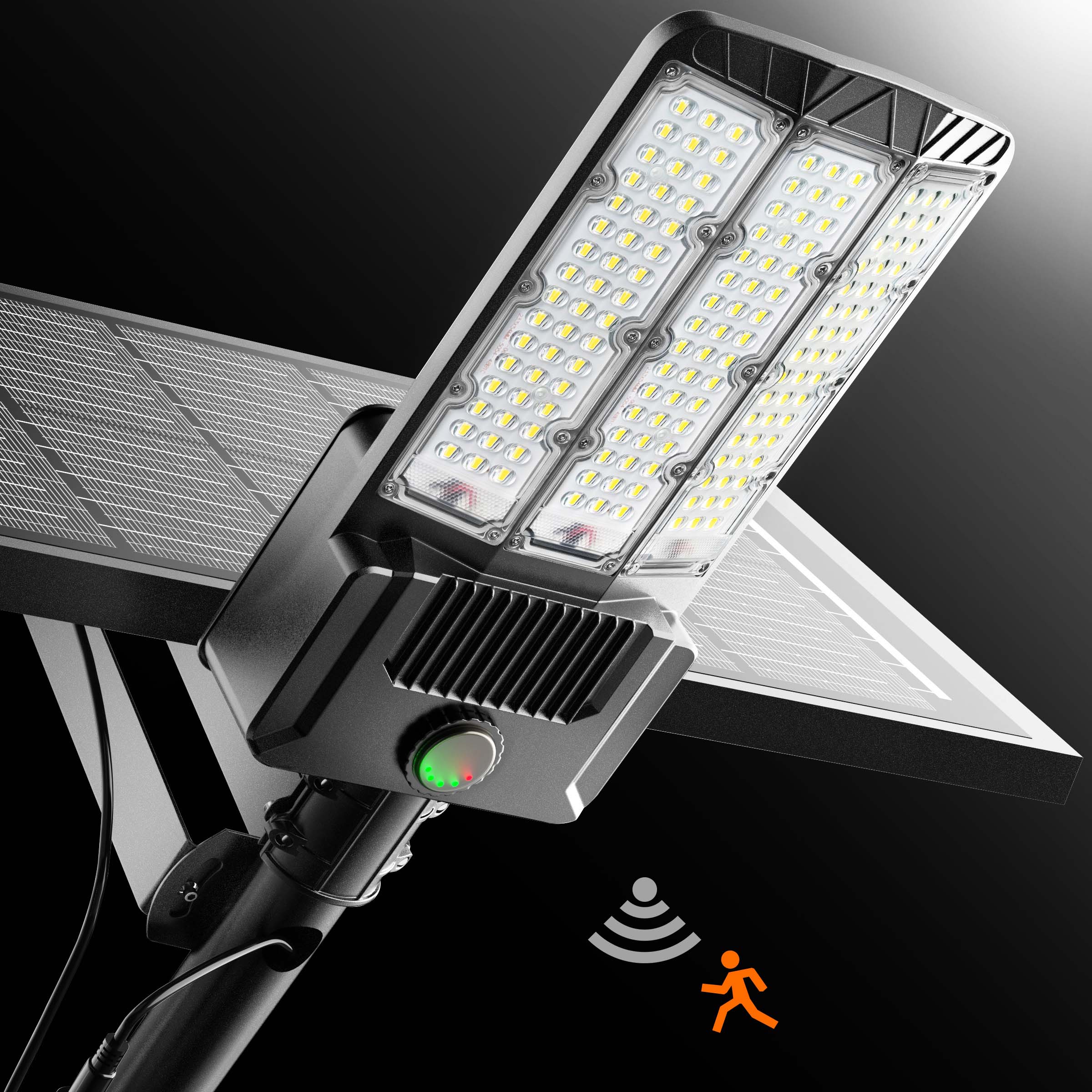
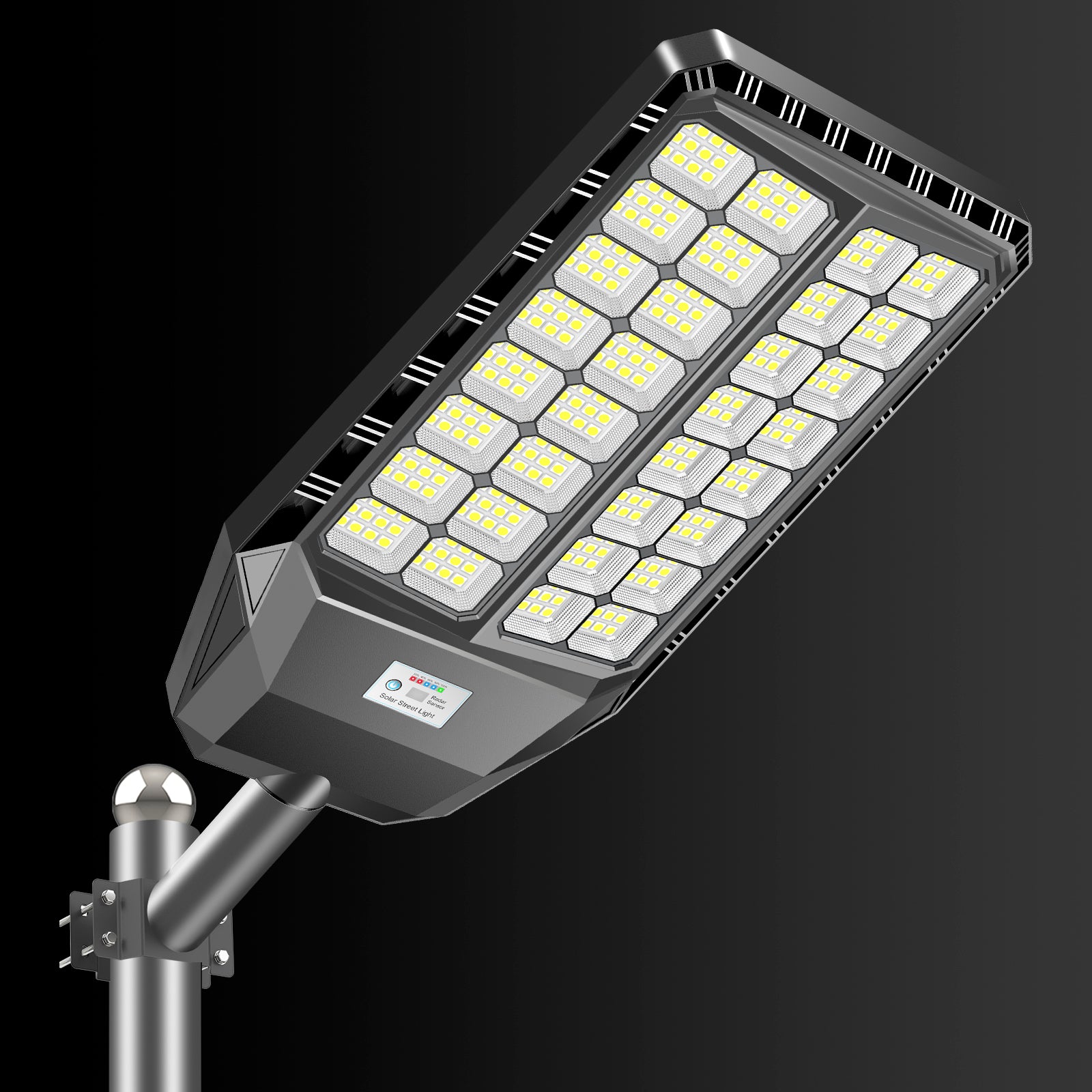
The SZ300 is the flagship. 400W monocrystalline solar panel. 60,000 lumens. Die-cast aluminum housing. This is the fixture that competes directly with grid-tied commercial street lighting — the kind you see in municipal parking structures, large retail lots, and highway service areas.
- Solar Panel: 400W monocrystalline
- Output: 60,000 lumens
- Housing: Die-cast aluminum (superior heat dissipation and durability)
- Operation: Dusk to dawn
- Best For: Large commercial lots, municipal applications, industrial facilities, main roadways
- Price: $145.00
The SZ300's price point is worth noting: at $145, it's actually less expensive than the TW040 despite being the higher-output flagship. That's because the SZ300 is positioned as a volume commercial product — it's designed for multi-unit installations where per-unit cost matters.
Side-by-Side Comparison
| Model | Solar Panel | Best Application | Price |
|---|---|---|---|
| TW020 | 200W Mono | Driveways, pathways, small lots | $89.00 |
| TW024 | — | Mid-size lots, campus paths | $99.00 |
| TW040 | — | Large lots, industrial yards | $179.00 |
| SZ300 | 400W Mono | Large commercial, municipal | $145.00 |
How to Size Your Installation: A Practical Framework
The most common mistake in commercial solar lighting projects is under-sizing. People pick a fixture based on price, install it, and then discover it doesn't provide adequate coverage or runs out of battery on cloudy nights. Here's how to avoid that.
Step 1: Define Your Coverage Area
Measure the area you need to light. A single high-output fixture like the SZ300 can cover a large area from a single pole. Lower-output fixtures need to be spaced closer together. More fixtures at lower cost per unit can sometimes be more economical than fewer high-output units — it depends on your pole infrastructure.
Step 2: Check Your Solar Resource
The US has significant variation in solar irradiance. Arizona and Southern California get 5.5–6.5 peak sun hours per day. The Pacific Northwest and New England average 3.5–4.5. A fixture sized for Phoenix will underperform in Seattle. Look up your location's average peak sun hours and factor that into battery sizing.
Step 3: Account for Consecutive Cloudy Days
A well-designed commercial solar street light should handle 2–3 consecutive cloudy days without failing. This requires adequate battery capacity relative to nightly energy consumption. If a fixture's spec sheet doesn't address this, ask the manufacturer directly.
Step 4: Consider Pole Height and Mounting
Mounting height affects coverage area and uniformity. A fixture at 20 feet covers a wider area than the same fixture at 12 feet, but with lower intensity at ground level. For parking lots, 20–25 feet is typical. For pathways, 12–15 feet is more common. Make sure the fixture you choose is rated for your intended mounting height.
Step 5: Factor in Total Cost of Ownership
The purchase price is only part of the equation. Grid-tied street lights have ongoing electricity costs — typically $50–$150 per fixture per year depending on local rates and runtime. Solar eliminates that cost entirely. Over a 10-year period, a $145 solar fixture that saves $100/year in electricity pays for itself in under 18 months.

Installation Considerations for Commercial Projects
Pole Selection and Foundation
Solar street lights require poles rated for the combined wind load of the fixture and solar panel. In high-wind areas (coastal regions, tornado alley, mountain passes), this is a critical engineering consideration. Use poles rated for your local wind zone and ensure the foundation is properly engineered for soil conditions.
Panel Orientation
In the continental US, solar panels should face south for maximum annual energy production. Tilt angle should approximate your latitude — roughly 30–35° for most of the southern US, 40–45° for the northern states. Many integrated solar street lights have fixed panel angles; verify the angle is appropriate for your latitude before purchasing.
Permitting
Most commercial lighting installations require permits. Solar street lights are generally easier to permit than grid-tied fixtures because they don't require electrical work, but you'll still need to comply with local zoning, height restrictions, and potentially dark-sky ordinances. Check with your local building department before ordering fixtures.
Maintenance Access
Plan for periodic maintenance — cleaning the solar panel (dust and bird droppings reduce output significantly), inspecting connections, and eventually replacing the battery. Make sure your pole design allows for safe access to the fixture head.

Solar Street Lights vs. Grid-Tied: When Solar Wins (and When It Doesn't)
Solar isn't always the right answer. Here's an honest breakdown:
Solar Wins When:
- The location is remote and trenching conduit would cost $5,000–$50,000+
- You want to eliminate ongoing electricity costs
- The project is in a high-solar-resource area (Southwest, Southeast, Plains states)
- You need to add lighting quickly without waiting for utility coordination
- The property is off-grid or has unreliable grid power
Grid-Tied May Be Better When:
- Electrical infrastructure already exists at the site
- The location has very low solar resource (Pacific Northwest in winter)
- You need extremely high, consistent output regardless of weather
- Local utility rates are very low (making the electricity cost argument weaker)
For most new commercial lighting projects in the US — especially in parking lots, campuses, and industrial facilities where conduit runs would be expensive — solar is the economically superior choice.
Federal and State Incentives Worth Knowing About
Commercial solar lighting installations may qualify for the federal Investment Tax Credit (ITC), which currently allows businesses to deduct a percentage of solar equipment costs from federal taxes. The specific percentage depends on when the system is placed in service and whether prevailing wage requirements are met.
Additionally, many states offer their own incentives — rebates, accelerated depreciation, or property tax exemptions for solar equipment. The Database of State Incentives for Renewables and Efficiency (DSIRE) at dsireusa.org is the most comprehensive resource for state-specific programs.
For commercial installations with multiple fixtures, these incentives can meaningfully reduce the net cost of the project. Consult with a tax professional familiar with energy credits before finalizing your budget.
☀️ Shop Commercial Solar Street Lights →
Frequently Asked Questions
Q: Do commercial solar street lights really work all night?
A: Yes — when properly sized for your location and application. The key variables are battery capacity, solar panel wattage, and your local solar resource (peak sun hours). A well-designed fixture like the SZ300 with a 400W monocrystalline panel and adequate battery capacity will run dusk to dawn reliably, including after cloudy days. Fixtures that fail at night are typically under-sized for their application or installed in locations with insufficient solar resource.
Q: How many solar street lights do I need for a parking lot?
A: It depends on the fixture's lumen output, mounting height, and your target illumination level. As a rough starting point, a high-output fixture like the SZ300 (60,000 lumens) mounted at 20–25 feet can cover approximately 2,500–4,000 square feet at commercial illumination levels. A 100-space parking lot of roughly 40,000 square feet might require 10–16 fixtures. For precise calculations, use a photometric analysis tool or consult a lighting designer.
Q: What happens on cloudy days or in winter?
A: Quality commercial solar street lights are designed to handle 2–3 consecutive cloudy days using stored battery capacity. In winter, shorter days mean less charging time, which is why battery capacity and panel efficiency matter more in northern states. Monocrystalline panels (used in the SZ300 and TW020) perform better in low-light conditions than polycrystalline alternatives. For locations with extended cloudy periods, look for fixtures with larger battery reserves or consider a hybrid solar/grid backup system.
Q: Are solar street lights approved for commercial and municipal use in the US?
A: Commercial solar street lights can meet the same photometric standards as grid-tied fixtures. For municipal applications, look for fixtures that comply with IES (Illuminating Engineering Society) standards and, where applicable, DLC (DesignLights Consortium) listing. Check with your local authority having jurisdiction (AHJ) for specific requirements in your area.
Q: How long do the batteries last?
A: LiFePO4 batteries typically last 2,000–3,000 charge cycles, which translates to roughly 5–8 years of daily use. Standard lithium batteries degrade faster — typically 1–3 years in daily cycling applications. When evaluating fixtures, ask specifically about battery chemistry and warranty coverage for battery capacity degradation.
Q: Can I install solar street lights myself, or do I need a contractor?
A: The electrical work involved in solar street light installation is minimal compared to grid-tied fixtures — there's no conduit, no panel connections, and no utility coordination. However, commercial installations typically require permits, and pole foundation work should be done by qualified contractors. The fixture mounting itself is straightforward, but working at height on commercial poles requires proper equipment and safety training.
Q: What's the warranty on Hykoont commercial solar street lights?
A: Warranty terms vary by model. Check the individual product pages for current warranty information. For commercial applications, pay attention to whether the warranty covers battery capacity degradation, not just manufacturing defects — battery performance is the most common long-term issue with solar lighting systems.
Q: Do solar street lights work in cold climates?
A: Yes, with some caveats. LED fixtures actually perform better in cold temperatures (LEDs are more efficient when cool). The concern is battery performance — lithium batteries lose capacity in extreme cold. LiFePO4 chemistry handles cold better than standard lithium. For installations in northern states or high-altitude locations where temperatures regularly drop below 0°F (-18°C), look for fixtures with battery management systems designed for cold-weather operation.
Q: How do I compare solar street light quotes from different suppliers?
A: Focus on these key metrics: actual LED lumen output (not panel wattage), battery capacity in watt-hours (Wh), battery chemistry (LiFePO4 vs. standard lithium), IP rating, and warranty terms. Many suppliers inflate panel wattage numbers while using undersized batteries — the battery capacity is the more important number for dusk-to-dawn reliability. Ask for photometric data (IES files) if you need to verify coverage area claims.
Q: Can I get a bulk discount for a large commercial project?
A: For multi-unit commercial projects, contact Hykoont directly to discuss volume pricing. Large installations — 10+ fixtures — typically qualify for project pricing that's not reflected in the standard online price. Include your project details (location, number of units, timeline) when reaching out.
Ready to spec your project?
Browse the full Hykoont commercial solar street light lineup and find the right fixture for your application.

Leave a comment
This site is protected by hCaptcha and the hCaptcha Privacy Policy and Terms of Service apply.