


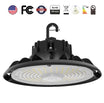
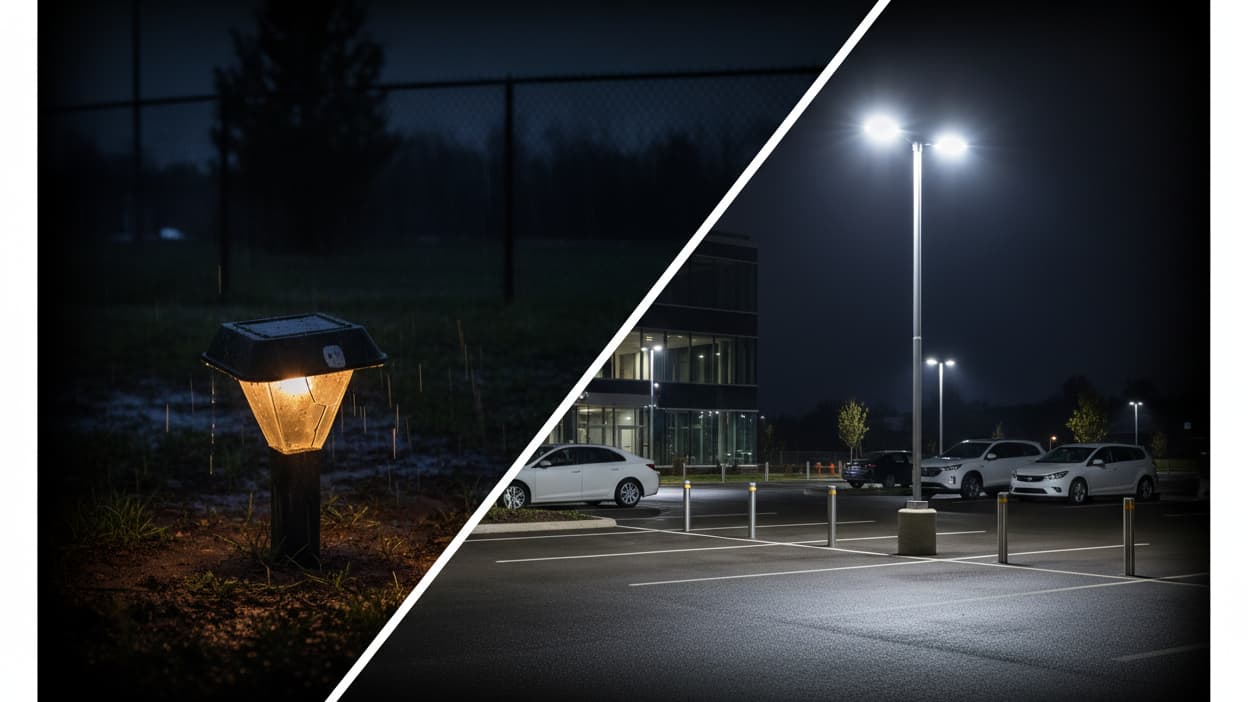
You bought a set of solar lights last spring. They looked great in the photos. The reviews were decent. The price was hard to argue with.
By October, half of them were dead.
Sound familiar? You're not alone — and it's not bad luck. There's a very specific reason cheap solar lights fail, and once you understand it, you'll never waste money on a bad unit again.
Let's get into it.
It's Not the Solar Panel. It's Almost Never the Solar Panel.
Most people assume the solar panel is the weak link. It's the most visible part, so it gets the blame. But panels — even mediocre ones — are actually pretty durable. They're solid-state, no moving parts, and they degrade slowly over years, not months.
The real culprits are hiding inside the housing where you can't see them:
- The battery
- The charge controller
- The LED driver
- The weatherproofing (or lack of it)
Any one of these can kill a solar light in a single season. Cheap manufacturers cut corners on all four.

The Battery Problem: Why Your Lights Die After 6 Months
Here's the dirty secret of the budget solar light industry: most cheap units use lithium-ion batteries that are rated for 300–500 charge cycles. Sounds like a lot, right?
Do the math. One charge cycle per day. That's less than 18 months before the battery starts losing significant capacity — and that's under ideal conditions. Real-world conditions (heat, cold, partial charging on cloudy days) cut that number in half.
By month six, your lights are running at 60% capacity. By month twelve, they're barely making it through the night.
What Good Batteries Actually Look Like
Quality commercial solar lights use LiFePO4 (lithium iron phosphate) batteries. The chemistry is fundamentally different. LiFePO4 cells are rated for 2,000–4,000+ charge cycles, they handle temperature extremes far better, and they don't degrade as sharply when partially charged.
That's not a 2x improvement. That's a 6–10x improvement in battery lifespan.
The Hykoont HY100C uses a 960Wh LiFePO4 battery pack rated for a 10-year lifespan. That's not marketing language — that's the actual chemistry delivering on its promise.
Yes, it costs more upfront at $1,890. But divide that over 10 years and compare it to replacing $40 lights every season. The math isn't close.

→ See the HY100C — $1,890 | 960Wh LiFePO4 | 10-Year Battery Life
The Charge Controller Nobody Talks About
The charge controller sits between the solar panel and the battery. Its job is to regulate how power flows — preventing overcharging, managing discharge depth, and optimizing the charging cycle based on available sunlight.
Cheap lights use PWM (Pulse Width Modulation) controllers. They work, but they're inefficient — especially in low-light conditions. On a partly cloudy day, a PWM controller might capture 60–70% of available solar energy.
Quality lights use MPPT (Maximum Power Point Tracking) controllers. MPPT continuously adjusts to find the optimal operating point for the panel, capturing 93–97% of available energy. On a cloudy day in Seattle or Portland, that difference is the gap between a light that charges enough to run all night and one that dies at 2 AM.
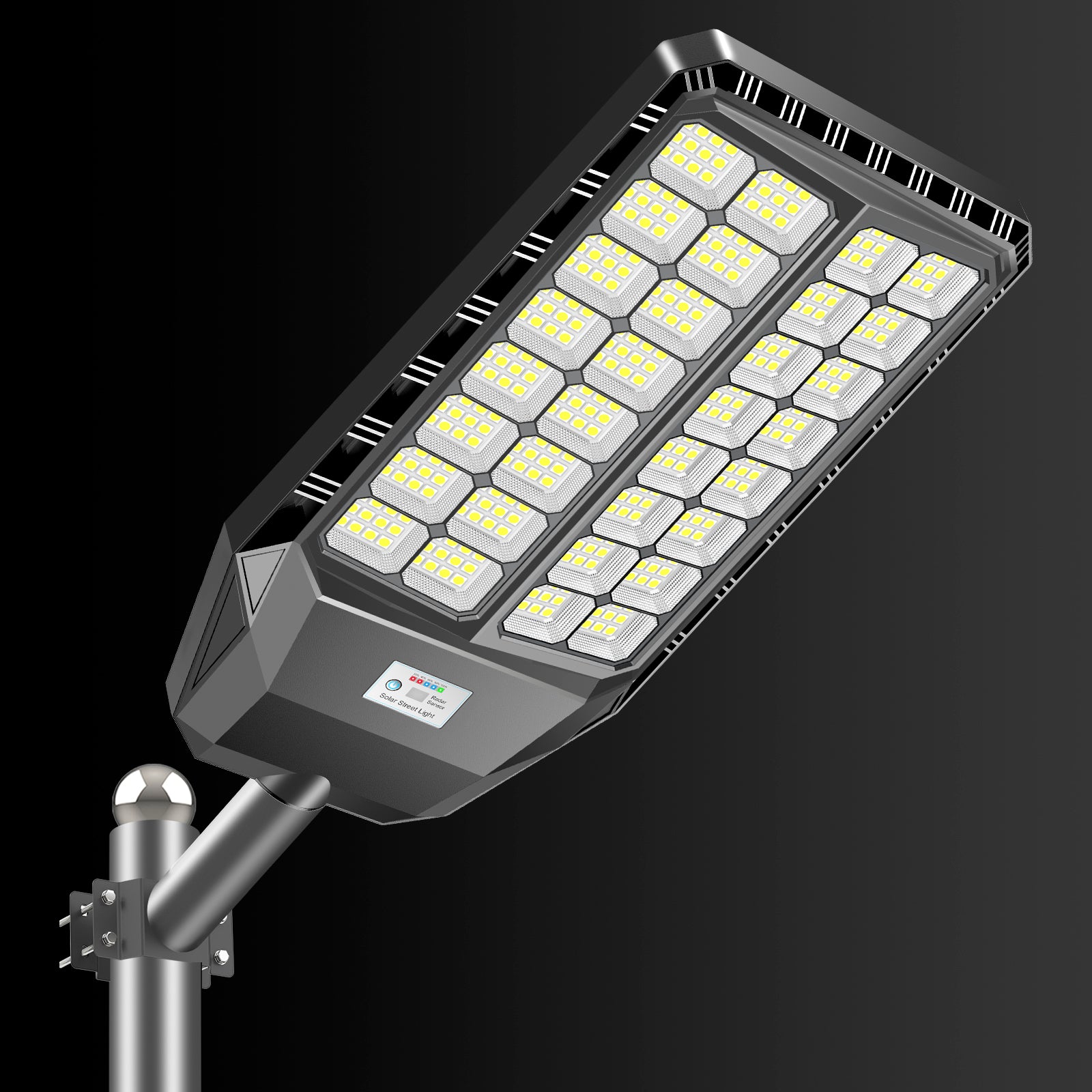
The Hykoont YK080 Pro runs an MPPT controller paired with an 80W monocrystalline panel and a 160Wh battery. It's built for locations that don't get perfect sun every day — which is most of the US.

→ Shop the YK080 Pro — $365 | MPPT Controller | 12,800LM | Adaptive Lighting
LED Drivers: The Component That Quietly Kills Your Light
The LED itself is rarely the problem. Modern LEDs are incredibly durable — rated for 50,000+ hours in most cases. The LED driver, though? That's a different story.
The driver converts battery voltage to the precise current the LED needs. A bad driver runs the LED too hot, causes flickering, or fails outright when temperatures swing. Budget lights use the cheapest drivers available — often unbranded components with no thermal protection.
When a cheap solar light starts flickering after a few months, people assume the LED is dying. It's almost always the driver.
Quality drivers include thermal management, constant-current regulation, and surge protection. They're not glamorous, but they're the difference between a light that lasts 2 years and one that lasts 10.
IP Ratings: What They Mean and Why Cheap Lights Lie About Them
You've seen the "IP65" or "IP66" labels on solar lights. Here's what those numbers actually mean:
- The first digit (6) = dust-tight. No dust ingress under any conditions.
- The second digit (5 or 6) = water resistance. IP65 handles water jets from any direction. IP66 handles powerful water jets.
The problem? IP ratings are self-reported by manufacturers. There's no mandatory third-party testing for most consumer products. A cheap light can slap "IP65" on the box and ship it with gaskets that fail after one winter.
Real IP66 housing means die-cast aluminum construction, silicone gaskets that don't crack in cold weather, and cable entry points that are properly sealed — not just wrapped in electrical tape.
The Hykoont TW016 uses a genuine IP66-rated housing with die-cast aluminum and optical lens design for precise light distribution. At $79.99, it's one of the most accessible entry points into commercial-grade solar lighting.

→ Get the TW016 — $79.99 | IP66 | Optical Lens | Commercial-Grade Build
The Solar Panel Quality Gap Is Real — Just Not Where You Think
We said panels aren't usually the first thing to fail. That's true. But panel quality still matters — just in a different way than most people expect.
The issue isn't durability. It's efficiency.
Cheap lights use polycrystalline panels. They're less efficient per square inch, which means manufacturers have to use larger panels to hit the same wattage — or they just use smaller panels and accept lower performance.
Quality lights use monocrystalline panels. Higher efficiency, better low-light performance, and more consistent output over the panel's lifespan. In northern states where winter sun angles are low and days are short, monocrystalline panels can mean the difference between a light that works in December and one that doesn't.
The Hykoont HY100 pairs a 150W monocrystalline panel with a 768Wh battery and 18,000LM output. It's designed for parking lots, campuses, and commercial properties where reliability isn't optional.

→ Shop the HY100 — $1,399 | 18,000LM | 768Wh Battery | Monocrystalline Panel
The "Lumen Inflation" Problem
A cheap solar light advertises 5,000 lumens. You buy it. It's noticeably dimmer than your old 60W incandescent porch light (which puts out about 800 lumens).
What happened?
Lumen ratings on cheap lights are almost always measured at the LED chip level — not at the fixture output. By the time light passes through a cheap diffuser lens, bounces off a poorly designed reflector, and exits through a yellowed plastic cover, you might be getting 40–50% of the rated lumens.
Legitimate commercial fixtures report delivered lumens — what actually comes out of the fixture and hits the ground. The difference is significant.
How to Actually Evaluate a Solar Light Before You Buy
Here's a practical checklist. Run any solar light through these questions before you hand over your credit card:
1. What battery chemistry does it use?
If the listing doesn't specify LiFePO4 or lithium iron phosphate, assume it's standard lithium-ion. That's not automatically bad, but it's a shorter lifespan and you should factor that into your cost calculation.
2. What's the actual battery capacity in Wh?
Watt-hours (Wh) tell you how much energy the battery stores. A light claiming "10,000mAh" without specifying voltage is hiding the real number. Multiply mAh × voltage to get Wh. A 10,000mAh battery at 3.7V is only 37Wh — barely enough to run a modest LED for a few hours.
3. Does it use MPPT or PWM charging?
MPPT is better. If the listing doesn't mention it, it's probably PWM.
4. What's the IP rating, and is it third-party verified?
Look for mentions of testing standards (IK ratings for impact resistance are a bonus). Die-cast aluminum housing is a good sign. Plastic housing with a high IP claim is a red flag.
5. What's the warranty?
A 1-year warranty on a light that's supposed to last 5 years tells you everything you need to know about the manufacturer's confidence in their product. Look for 2–5 year warranties minimum on commercial-grade fixtures.
6. Can you find the actual company?
This sounds basic, but it matters. If the brand has no website, no contact information, and no history beyond Amazon listings, you have no recourse when something goes wrong.

What "Commercial Grade" Actually Means for Solar Lights
The term gets thrown around a lot. Here's what it should mean in practice:
- Thermal management: Heat is the enemy of electronics. Commercial fixtures have heat sinks, thermal paste, and airflow design that keeps components cool.
- Surge protection: Lightning strikes and power surges happen. Commercial drivers include protection circuits. Budget drivers don't.
- Vibration resistance: Lights mounted on poles experience wind vibration constantly. Commercial fixtures are designed and tested for this. Cheap ones aren't.
- Serviceable components: On a quality fixture, you can replace the battery or driver without replacing the entire unit. On a cheap light, everything is glued together.
These aren't luxury features. They're the baseline for anything you're mounting 15–20 feet in the air and expecting to work without attention for years.
The Real Cost Comparison: Cheap vs. Quality Solar Lights
Let's run the actual numbers for a parking lot with 10 light poles.
Option A: Budget solar lights at $60 each
- Initial cost: $600
- Replacement every 18 months: $600
- 5-year total: ~$2,400 (plus labor for replacements)
- Performance: inconsistent, especially in winter
Option B: Hykoont YK080 Pro at $365 each
- Initial cost: $3,650
- Expected lifespan: 5–8 years with minimal maintenance
- 5-year total: $3,650
- Performance: consistent, MPPT-optimized, adaptive lighting
The budget option looks cheaper until you account for replacements, labor, and the fact that half of them are underperforming at any given time. For a commercial property, the math almost always favors quality.
And that's before you factor in the avoided cost of trenching electrical conduit — which typically runs $5–$15 per linear foot. A 200-foot run to a remote parking area can cost $1,000–$3,000 in electrical work alone. Solar eliminates that entirely.

Climate Considerations: What Works Where
Not all solar lights perform equally across the US. Here's a quick regional breakdown:
Southwest (Arizona, Nevada, Southern California)
High sun hours, but extreme heat. Battery thermal management is critical. LiFePO4 chemistry handles heat better than standard lithium-ion. Look for fixtures with active or passive thermal management.
Pacific Northwest (Oregon, Washington)
Low sun hours, frequent overcast. MPPT controllers are essential. Larger battery capacity matters more here than anywhere else. A 160Wh+ battery with MPPT charging is the minimum for reliable winter performance.
Northeast (New York, Massachusetts, Pennsylvania)
Cold winters, variable sun. LiFePO4 batteries maintain capacity better in cold than lithium-ion. IP66 housing is important for ice and snow exposure.
Southeast (Florida, Georgia, Texas)
High humidity, hurricane-season wind loads. IP66 minimum. Look for IK08+ impact ratings if you're in a storm-prone area. Corrosion-resistant hardware matters in coastal locations.
Midwest (Illinois, Ohio, Michigan)
Wide temperature swings, moderate sun. LiFePO4 for temperature resilience, MPPT for efficiency during shorter winter days.
Installation Tips That Actually Matter
Even a great solar light will underperform if it's installed wrong. A few things that make a real difference:
Panel orientation: In the US, solar panels should face south (or within 30° of south) for maximum exposure. East or west-facing panels lose 15–25% of potential output.
Shading: Even partial shading — a tree branch crossing the panel for two hours a day — can cut output significantly. MPPT controllers handle partial shading better than PWM, but avoiding shade entirely is always better.
Mounting height: Street lights are typically mounted at 15–25 feet. Higher mounting gives wider coverage but requires more lumens to maintain ground-level illumination. Match your fixture's lumen output to your mounting height.
Pole spacing: For parking lot applications, poles are typically spaced 30–50 feet apart depending on fixture output and mounting height. Overlapping coverage zones eliminate dark spots.
Initial charging: Before first use, let the battery charge for 2–3 full days in direct sunlight. This conditions the battery and gives you a baseline for performance expectations.

When to Choose a Flood Light vs. a Street Light
People often ask whether they need a solar street light or a solar flood light. The answer depends on what you're trying to illuminate:
Solar street lights are designed for area lighting — parking lots, pathways, campuses, roadways. They distribute light in a wide, even pattern optimized for horizontal surfaces. The optics are engineered to minimize glare while maximizing ground coverage.
Solar flood lights are designed for targeted illumination — building facades, signage, security cameras, loading docks. They throw a concentrated beam in a specific direction.
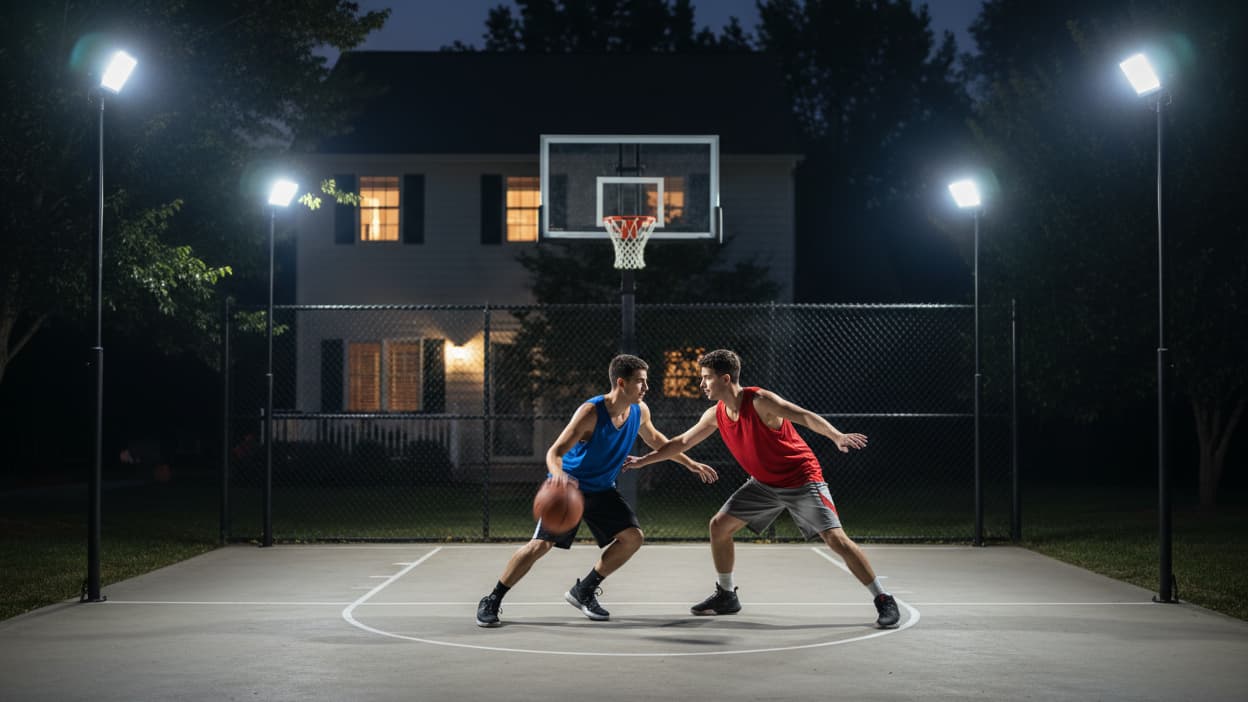
For most commercial applications, you'll use both. Street lights for the parking field, flood lights for building perimeters and entry points.
The XC100 flood light at $85 handles targeted security lighting. The YK080 Pro at $365 handles area coverage. For large commercial properties, the HY100 at $1,399 delivers 18,000LM of commercial-grade output.
Frequently Asked Questions
Why do my solar lights stop working after a few months?
The most common cause is battery degradation. Budget solar lights use standard lithium-ion batteries rated for 300–500 charge cycles — less than 18 months of daily use under ideal conditions. Real-world conditions (heat, cold, partial charging) accelerate the decline. Upgrading to a fixture with LiFePO4 chemistry solves this problem at the source.
Can solar lights work in cloudy or rainy climates?
Yes, but performance depends heavily on the charge controller and battery capacity. MPPT controllers capture significantly more energy on overcast days than PWM controllers. Larger battery capacity provides more reserve for consecutive cloudy days. For the Pacific Northwest or Northeast, look for fixtures with MPPT charging and at least 160Wh of battery storage.
How long do commercial solar lights last?
Quality commercial solar lights with LiFePO4 batteries are rated for 8–10+ years. The LED itself typically lasts 50,000+ hours (roughly 13 years at 10 hours per night). The battery is usually the limiting factor, which is why battery chemistry matters so much.
What does IP66 mean on a solar light?
IP66 means the fixture is completely dust-tight and protected against powerful water jets from any direction. It's the appropriate rating for outdoor fixtures exposed to rain, snow, and pressure washing. IP65 is the minimum acceptable for outdoor use; IP66 is better for harsh environments.
Are solar street lights bright enough for parking lots?
It depends on the fixture. The IES (Illuminating Engineering Society) recommends 0.5–2 foot-candles for parking lot illumination. A fixture like the HY100 (18,000LM) mounted at 20 feet can cover a 30×30 foot area at adequate illumination levels. For large lots, you'll need multiple fixtures — the key is matching lumen output and mounting height to your coverage requirements.
Do solar lights work in winter?
Yes, with caveats. Shorter days mean less charging time, and cold temperatures reduce battery capacity (especially with standard lithium-ion). LiFePO4 batteries maintain better capacity in cold. MPPT controllers maximize energy capture during short winter days. In northern states, size up your battery capacity by 20–30% compared to what you'd need in the South.
Can I use solar lights for security cameras?
Solar flood lights work well for illuminating areas covered by security cameras. For camera power itself, you'd need a separate solar power system sized to the camera's consumption. Many commercial installations use solar street lights for area illumination and run cameras on a separate dedicated solar circuit.
How do I know if a solar light's lumen rating is accurate?
Look for fixtures that specify "delivered lumens" or "luminaire lumens" rather than just "LED lumens." Ask the manufacturer for photometric data (IES files). Reputable commercial manufacturers provide this; budget brands don't. If you can't get photometric data, treat the lumen rating with skepticism.
What's the difference between MPPT and PWM solar charge controllers?
PWM (Pulse Width Modulation) controllers are simpler and cheaper. They work by connecting the panel directly to the battery and pulsing the connection to regulate charging. MPPT (Maximum Power Point Tracking) controllers continuously calculate the optimal operating point for the panel and convert excess voltage to additional current. MPPT is 20–30% more efficient, especially in low-light conditions.
Is it worth buying commercial-grade solar lights for a residential property?
For a driveway or garden path, probably not — the scale doesn't justify the cost. But for a large residential property with a long driveway, detached garage, barn, or outbuilding that would otherwise require trenching electrical conduit, commercial-grade solar lights often make economic sense. The avoided electrical installation cost alone can justify the premium.
The Bottom Line
Cheap solar lights fail because of battery chemistry, cheap charge controllers, poor LED drivers, and inadequate weatherproofing. None of these failures are random. They're predictable consequences of cost-cutting decisions made during manufacturing.
The good news: you don't have to spend a fortune to avoid them. The TW016 at $79.99 and the XC100 at $85 are entry points into commercial-grade construction without the commercial price tag. For larger applications, the YK080 Pro at $365 and HY100 at $1,399 deliver the kind of reliability that makes the cost-per-year math work in your favor.
Buy once. Install once. Move on.

Leave a comment
This site is protected by hCaptcha and the hCaptcha Privacy Policy and Terms of Service apply.