


You finally built the court. The concrete is cured, the lines are painted, the hoop is level. And then the sun goes down — and you realize you have no idea how to light the thing properly.
So you start Googling. "How many lumens for a basketball court?" And you get a dozen different answers, half of which are clearly written by people who've never actually stood on a court at night trying to track a fast break.
This guide is different. We're going to give you real numbers, explain why they matter, and help you pick the right lights without overbuilding or underbuilding your setup.
First: Why Lumens Aren't the Whole Story
Lumens measure total light output. But what you actually care about on a basketball court is foot-candles — the amount of light that lands on a specific surface area.
Here's the relationship: one foot-candle equals one lumen per square foot.
A standard backyard half-court is roughly 30 × 25 feet = 750 square feet. A full court runs about 50 × 84 feet = 4,200 square feet. The lumens you need from your fixtures depend on how efficiently your lights deliver that output to the playing surface — which depends on mounting height, beam angle, fixture placement, and whether you're using reflectors or optical lenses.
So when someone says "you need 50,000 lumens for a basketball court," that number is meaningless without context. What matters is how many foot-candles hit the court surface.

The Actual Foot-Candle Standards for Basketball
The Illuminating Engineering Society (IES) publishes recommended illuminance levels for sports facilities. Here's how they break down for basketball:
- Recreational / backyard play: 10–20 foot-candles
- Club / intramural level: 20–30 foot-candles
- High school competition: 30–50 foot-candles
- College / semi-pro: 50–75 foot-candles
- Professional / broadcast: 100+ foot-candles
For a backyard court where you're playing pickup games with friends and family, 10–20 foot-candles is the target. That's enough to track the ball, see the rim clearly, and play without eye strain.
If you're running serious evening practices or hosting competitive games, push toward 20–30 foot-candles.
So How Many Lumens Does That Actually Require?
Let's do the math for a standard backyard half-court (750 sq ft) targeting 15 foot-candles — a solid middle-ground for recreational play.
Target lumens on surface: 750 sq ft × 15 fc = 11,250 lumens delivered to the court
But here's the catch: no fixture delivers 100% of its rated lumens to your target surface. Light spills, bounces, and gets absorbed. A well-aimed flood light with a focused beam might deliver 60–75% of its rated output to the court. A poorly aimed or wide-angle fixture might deliver 30–40%.
Using a 65% efficiency estimate:
Required fixture lumens: 11,250 ÷ 0.65 = ~17,300 lumens from your fixtures
For a half-court, that means roughly two 28,000LM fixtures (one on each side) or four 8,000–10,000LM fixtures positioned at the corners.
For a full court (4,200 sq ft at 15 fc):
Required fixture lumens: 4,200 × 15 ÷ 0.65 = ~96,900 lumens total
That's a bigger installation — typically 4–6 high-output fixtures mounted at 15–20 feet.

Mounting Height Changes Everything
This is the part most guides skip, and it's critical.
The inverse square law tells us that light intensity drops with the square of the distance. Double the mounting height, and you need four times the lumens to maintain the same foot-candles on the surface.
Practical implications for backyard courts:
- 8–10 ft mounting: Lower lumens needed, but you'll get harsh shadows and glare directly in players' eyes. Not recommended.
- 12–15 ft mounting: The sweet spot for most backyard courts. Good coverage, manageable glare, reasonable lumen requirements.
- 18–20 ft mounting: Better uniformity, less glare, but you need significantly more lumens and a proper pole installation.
If you're mounting at 12 feet, a pair of 28,000LM solar flood lights positioned at opposite corners of a half-court will give you excellent coverage. At 18 feet, you'd want to step up to higher-output fixtures or add a third light.

Solar vs. Wired: Which Makes More Sense for a Backyard Court?
This comes up constantly, so let's address it directly.
Wired flood lights give you consistent output regardless of weather or season. They're the right choice if you already have electrical infrastructure near the court, or if you're in a northern state where winter sun hours are limited.
Solar flood lights eliminate trenching and electrical work entirely. For a backyard court that's 50+ feet from the nearest outlet, the avoided installation cost alone can justify the premium. In most of the US (roughly south of the 40th parallel — that's roughly Kansas City, Columbus, and Philadelphia), solar flood lights perform reliably year-round.
The honest answer: if you're in the Sun Belt or Mid-Atlantic and your court is more than 30 feet from power, solar is almost always the better choice. If you're in Minnesota and playing through December, wire it.
The Lights That Actually Work for Basketball Courts
Here are four options across different budgets and use cases, all with real specs and honest pricing.
Best Entry-Level Option: Hykoont XH200 Solar Flood Light — $68
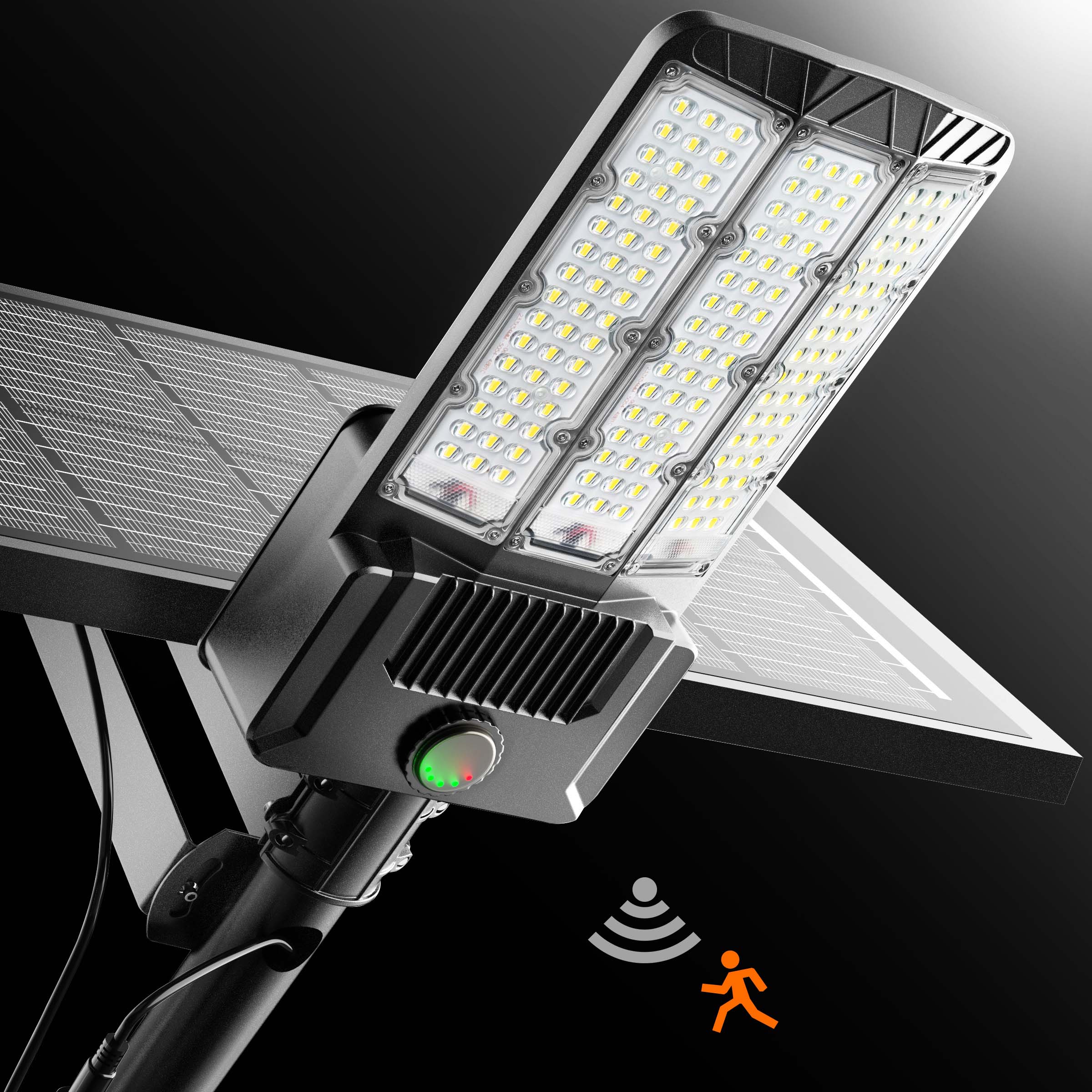
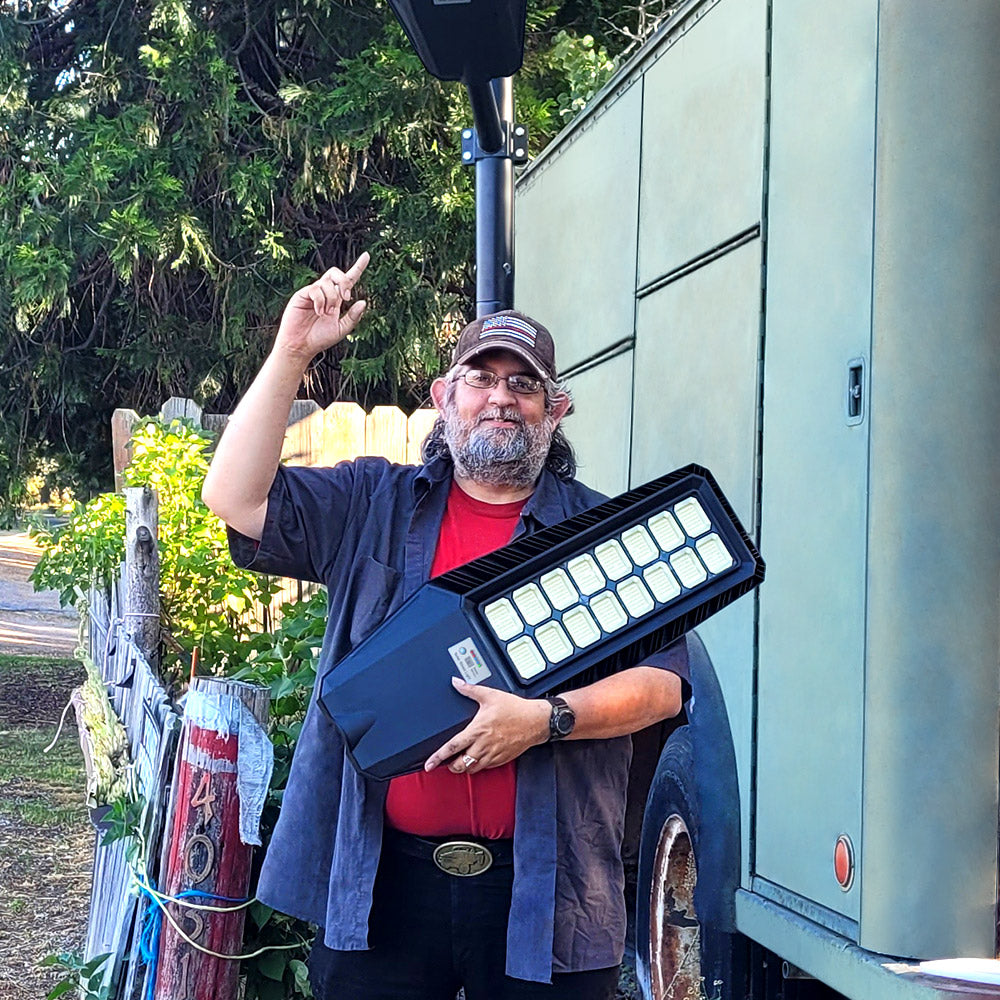
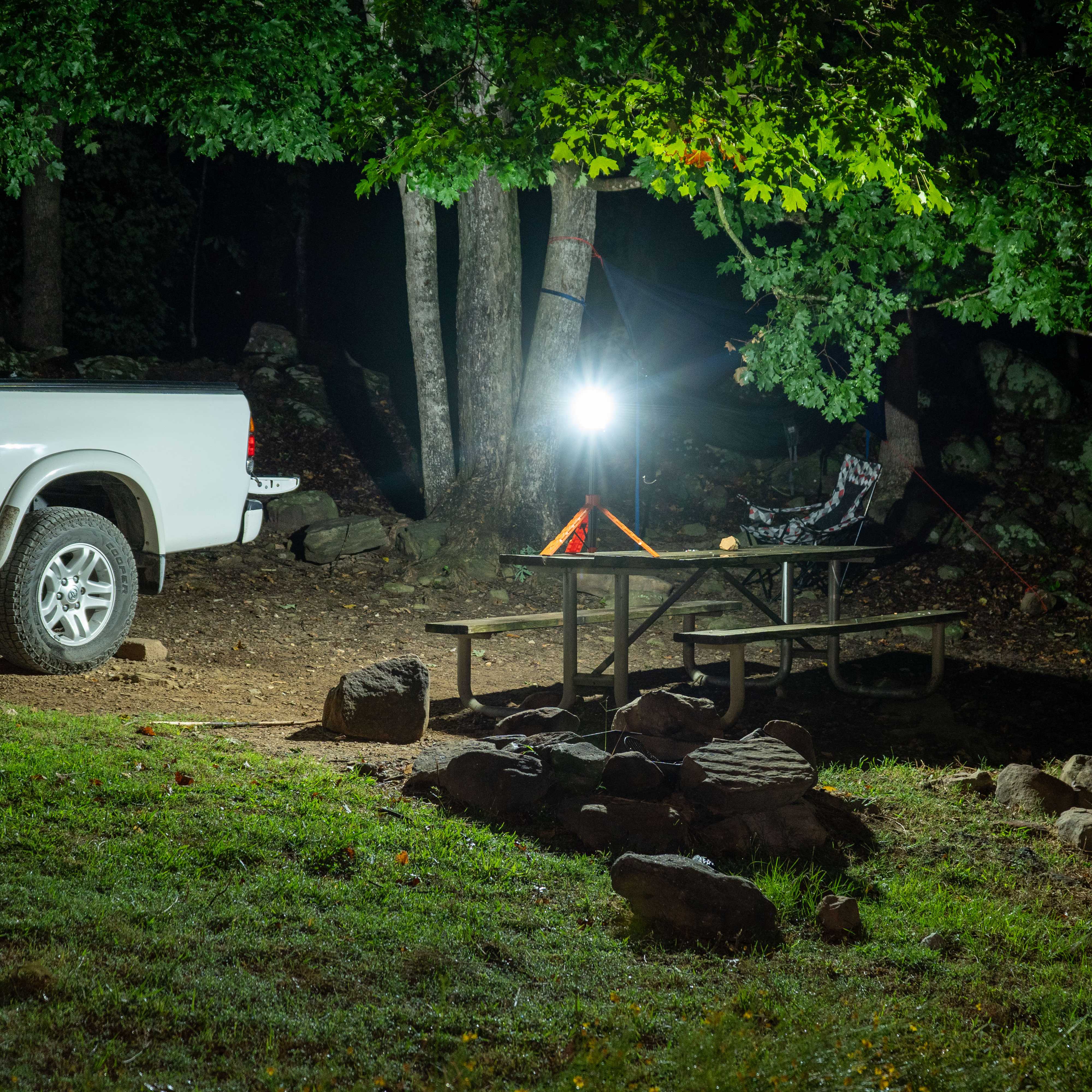
28,000LM from a single fixture. That's a lot of light for $68. The XH200 is a motion-sensing solar flood light designed for large outdoor areas — driveways, yards, building perimeters. For a backyard half-court, two of these mounted at 12 feet on opposite corners will get you to 15+ foot-candles across most of the playing surface.
It's not a commercial fixture, but for casual evening pickup games, it does the job without running conduit or hiring an electrician.

→ Get the XH200 — $68 | 28,000LM | Solar | Motion Sensing
Best Mid-Range Option: Hykoont XH300 Solar Flood Light — $79
42,000LM. This is where things get serious. The XH300 puts out enough light to cover a full half-court from a single mounting point, or to give a full court solid coverage with four fixtures at the corners.
At $79 per unit, it's one of the best lumen-per-dollar values in solar flood lighting. For a full backyard court, budget for four units — two on each long side at 15-foot mounting height. Total investment: $316 in fixtures, zero in electrical work.

→ Shop the XH300 — $79 | 42,000LM | Solar | Full Court Coverage
Best for Serious Play: Hykoont XC100 100W Solar Flood Light — $85
The XC100 is built differently from the XH series. It's a 100W commercial-grade solar flood light with a more focused beam pattern — better for targeted illumination of specific court zones rather than broad area coverage.
If you're running evening practices where you need consistent, glare-free light on the key and three-point line, the XC100's optical design delivers more usable light where players actually need it. Pair two of these with an XH300 for a half-court setup that covers both area lighting and targeted key illumination.

→ Get the XC100 — $85 | 100W | Commercial-Grade | Focused Beam
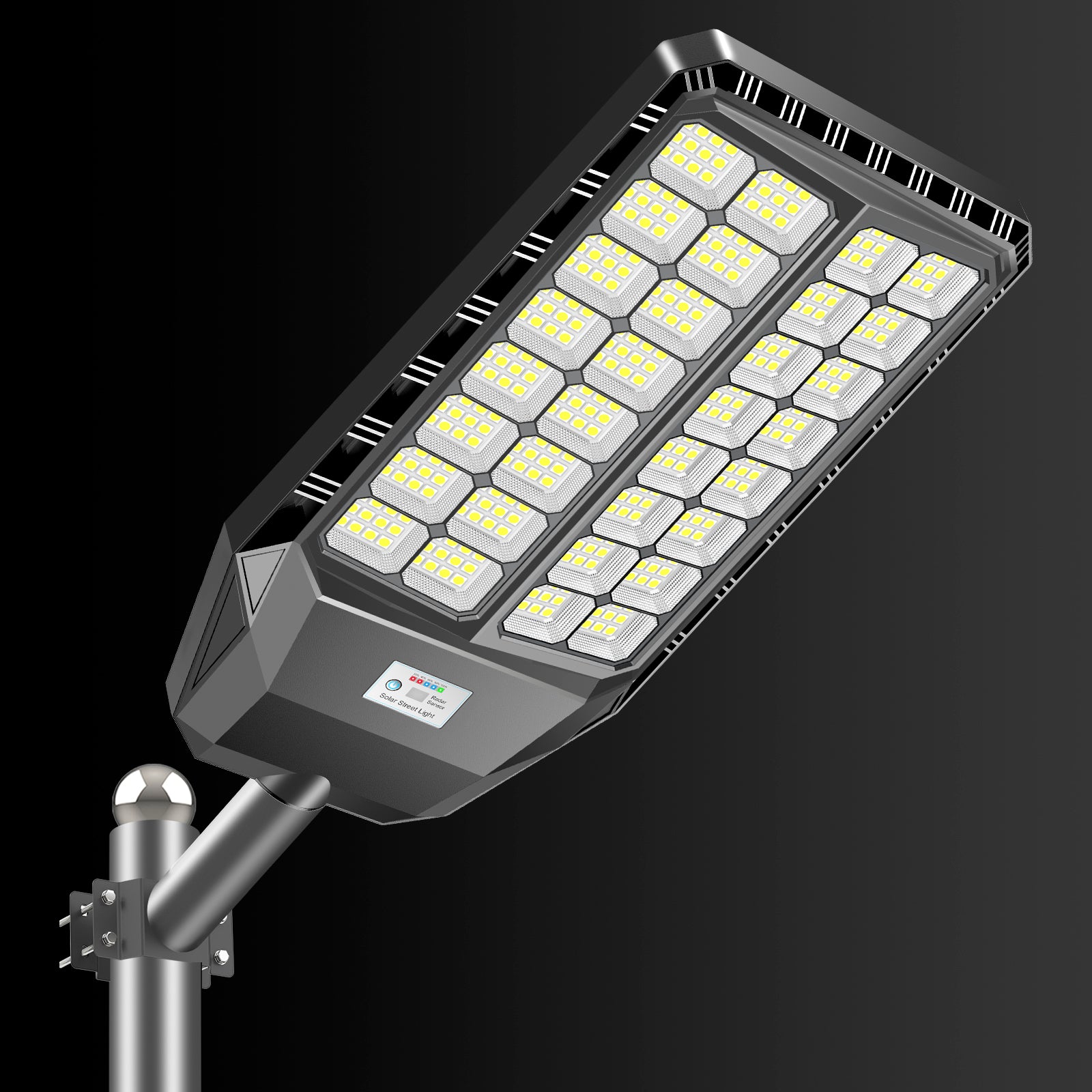
Best High-Output Option: Hykoont BD820 200W Solar Flood Light — $115
When you need serious output — full court, high mounting, competitive play — the BD820 delivers. At 200W with a high-efficiency solar panel and large battery capacity, this is the fixture for courts where you're not willing to compromise on light quality.
Two BD820s mounted at 18–20 feet on opposite long sides of a full court will get you to 20+ foot-candles across the playing surface. That's club-level illumination from a solar fixture with no electrical infrastructure required.

→ Shop the BD820 — $115 | 200W | High-Output | Full Court
Fixture Placement: Where You Put the Lights Matters as Much as How Many You Use
Bad placement is the most common reason backyard court lighting fails. Here's what actually works:
The Corner Mount (Most Common for Half-Courts)
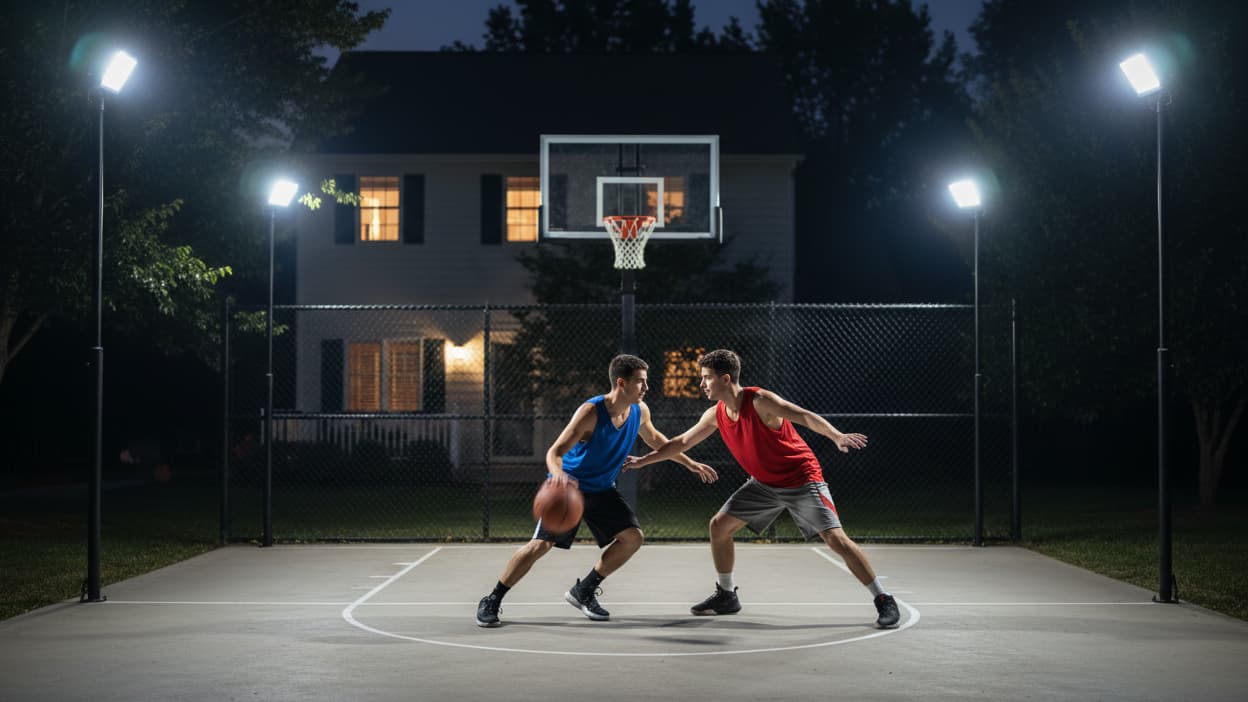
Mount two fixtures at opposite corners of the court, angled inward at roughly 30–45 degrees. This gives you overlapping coverage across the entire playing surface with minimal shadow zones. The downside: players driving the baseline may occasionally look directly into a fixture. Aim the lights slightly above horizontal to reduce direct glare.
The Sideline Mount (Best for Full Courts)
Mount fixtures along both long sides of the court, spaced evenly. This is how professional courts are lit — it minimizes glare for players moving up and down the court and gives the most uniform illumination. For a backyard full court, two fixtures per side (four total) at 15–18 feet gives excellent results.
The Endline Mount (Avoid This)
Mounting lights behind the backboard seems logical but creates serious problems. Players driving to the basket look directly into the light source. Shadows fall across the key — exactly where you need the most visibility. Don't do it.
Pole vs. Wall Mount
If you have a fence, wall, or garage adjacent to the court, wall mounting is the easiest installation. For freestanding courts, you'll need poles — either dedicated light poles or repurposed fence posts rated for the fixture weight. Most solar flood lights weigh 5–15 lbs; a standard 4-inch steel fence post handles that easily.
Color Temperature: 5000K vs. 6500K for Sports Lighting
Color temperature affects how well you can track a fast-moving ball and read the court surface. Here's the practical breakdown:
- 3000K (warm white): Too yellow for sports. Fine for ambiance, bad for tracking a basketball.
- 4000K (neutral white): Acceptable. Better contrast than warm white, still slightly yellow.
- 5000K (cool white): The sweet spot for most sports applications. Crisp, natural-looking light with good contrast.
- 6500K (daylight): Maximum contrast and visibility. Can feel slightly harsh but excellent for competitive play.
For a backyard court, 5000K–6500K is the right range. Most quality solar flood lights default to 6500K, which is fine — it's what most players prefer for evening games.
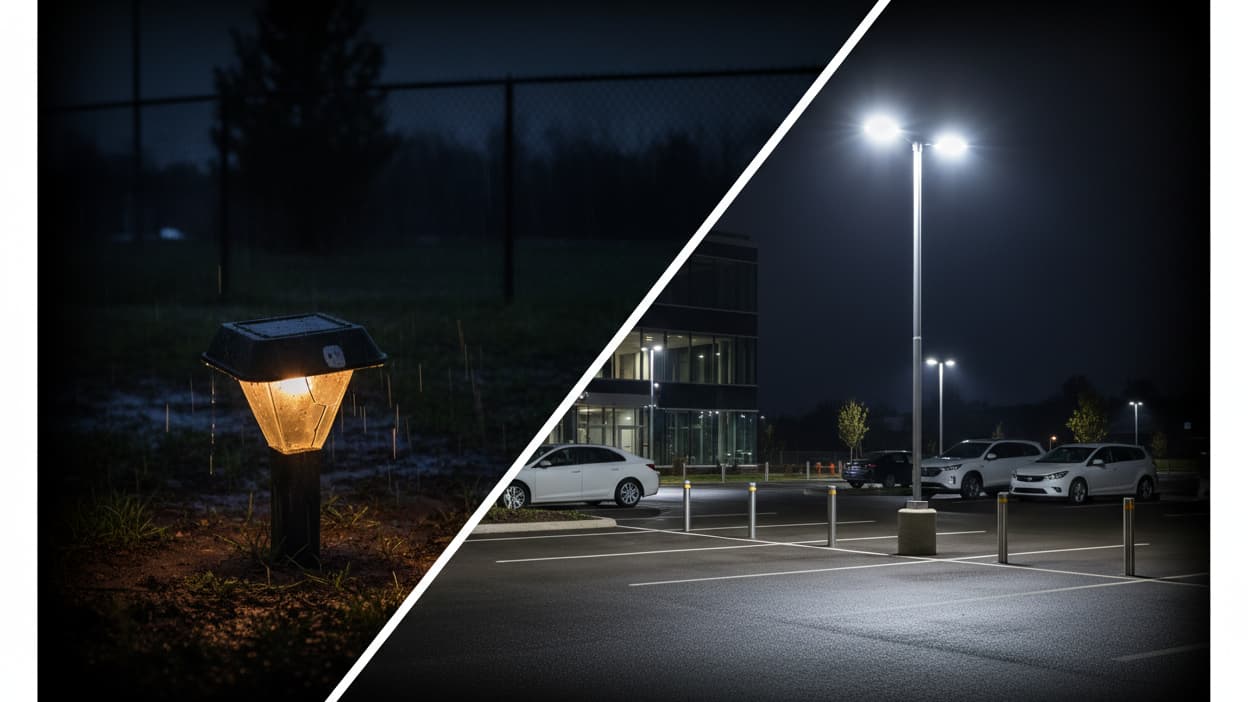
Glare Management: The Problem Nobody Talks About
Glare is the enemy of good sports lighting. A 42,000LM fixture aimed directly at eye level is worse than a 15,000LM fixture aimed correctly.
A few things that reduce glare without sacrificing illumination:
Aim down, not across. The fixture should be angled so the beam center hits the court surface, not the players' faces. A 15-degree downward tilt from horizontal is a good starting point.
Use fixtures with optical lenses. Optical lens designs concentrate light into a specific beam pattern rather than scattering it in all directions. You get more usable light on the court and less wasted light in players' eyes.
Mount higher when possible. The higher the fixture, the steeper the angle to players' eyes, and the less direct glare. This is why professional courts mount lights at 30+ feet — not just for coverage, but for glare control.
Avoid white or reflective surfaces behind fixtures. A white garage wall behind a flood light acts as a secondary light source and increases ambient glare. Dark or matte surfaces behind fixtures reduce this effect.
Real-World Setups: What Works for Different Court Sizes
Small Half-Court (20 × 20 ft) — Driveway Hoop Setup
Target: 10–15 foot-candles for casual shooting and 1-on-1
Recommended: 2× XH200 ($68 each) mounted at 10–12 feet on opposite sides
Total cost: $136 in fixtures
Result: Solid illumination for casual play, easy solar installation
Standard Half-Court (30 × 25 ft)
Target: 15–20 foot-candles for regular pickup games
Recommended: 2× XH300 ($79 each) at corner mounts, 12–15 feet
Total cost: $158 in fixtures
Result: Excellent coverage, minimal dark spots, good for 3-on-3
Full Court (50 × 84 ft)
Target: 15–20 foot-candles for competitive recreational play
Recommended: 4× BD820 ($115 each) on sideline mounts at 18–20 feet
Total cost: $460 in fixtures
Result: Club-level illumination, uniform coverage, no electrical work required
Installation Tips That Save You Headaches Later
Orient solar panels south. In the US, solar panels should face true south (not magnetic south — there's a difference). Use a compass app and account for magnetic declination in your area. A panel facing southeast or southwest loses 10–20% of potential output.
Clear the panel of shade. Even a small branch crossing the panel for two hours a day can cut charging efficiency significantly. Solar panels are surprisingly sensitive to partial shading — a shadow on 10% of the panel can reduce output by 30–50% depending on the cell configuration.
Pre-charge before first use. Leave solar fixtures in direct sunlight for 2–3 full days before first use. This conditions the battery and gives you a realistic baseline for how long they'll run on a full charge.
Adjust sensitivity settings. Most solar flood lights have motion sensitivity and lighting mode settings. For a basketball court, you want continuous lighting mode (not motion-activated) during play hours. Set the timer to match your typical playing schedule — most fixtures allow 4, 6, or 8-hour runtime settings.
Check mounting hardware torque. Flood lights on poles experience significant wind load. Check all mounting bolts after the first week of installation and again after the first major storm. Loose mounts cause vibration that shortens fixture life.

What About Wired LED Flood Lights?
If you have electrical access near the court and want the absolute most consistent output regardless of weather, wired LED flood lights are worth considering. They're not affected by cloudy weeks, they don't have batteries to degrade, and they're generally less expensive per lumen than solar.
The tradeoff is installation cost. Running conduit to a backyard court typically costs $500–$2,000 depending on distance and local labor rates. For courts within 20–30 feet of an existing outlet, wired lights often make economic sense. Beyond that, solar usually wins on total cost.
If you go wired, the same lumen and foot-candle math applies — you just don't have to worry about battery capacity or solar panel orientation.
Frequently Asked Questions
How many lumens do I need for a backyard basketball half-court?
For recreational play at 15 foot-candles, a standard 30×25 ft half-court needs roughly 17,000–20,000 delivered lumens. In practice, two 28,000–42,000LM fixtures mounted at 12–15 feet at opposite corners will cover this comfortably, accounting for beam spread and efficiency losses.
Can solar flood lights really handle a full basketball court?
Yes, for recreational and club-level play. A full court (50×84 ft) at 15–20 foot-candles requires roughly 100,000+ fixture lumens. Four high-output solar flood lights (200W class) mounted at 18–20 feet on the sidelines will achieve this. For broadcast-quality lighting (100+ foot-candles), you'd need wired infrastructure.
What color temperature is best for basketball court lighting?
5000K–6500K (cool white to daylight). This range provides the best contrast for tracking a fast-moving ball and reading court markings. Warm white (3000K) is too yellow for sports applications.
How high should I mount flood lights for a basketball court?
12–15 feet is the practical range for most backyard installations. Higher mounting (18–20 feet) gives better uniformity and less glare but requires more lumens and a more substantial pole installation. Avoid mounting below 10 feet — you'll get harsh shadows and direct glare into players' eyes.
Do I need a permit to install outdoor lights for a backyard basketball court?
For solar flood lights that don't require electrical work, permits are generally not required. For wired installations, most jurisdictions require an electrical permit for new outdoor circuits. Check with your local building department — requirements vary significantly by city and county.
How long will solar flood lights run on a full charge?
Most quality solar flood lights are rated for 8–12 hours of runtime on a full charge in continuous mode. In motion-sensing mode, runtime extends significantly since the light only activates when triggered. For a basketball court, set the fixture to continuous mode during your typical playing hours and motion-sensing mode the rest of the night.
Will solar lights work in winter for evening basketball games?
In most of the US south of roughly the 40th parallel (Kansas City, Columbus, Philadelphia), yes. Winter sun hours are reduced but still sufficient for daily charging. In northern states (Minnesota, Wisconsin, upstate New York), winter performance is less reliable — shorter days and lower sun angles reduce charging significantly. For year-round northern use, wired lights are more dependable.
What's the difference between lumens and watts for flood lights?
Watts measure power consumption; lumens measure light output. Modern LEDs produce far more lumens per watt than older technologies. A 100W LED flood light typically produces 10,000–14,000 lumens. A 200W LED produces 20,000–28,000 lumens. Always compare lumens, not watts, when evaluating flood light brightness.
How do I reduce glare on a backyard basketball court?
Mount lights as high as practical (15+ feet), angle them downward so the beam center hits the court surface rather than eye level, use fixtures with optical lens designs rather than bare reflectors, and avoid mounting lights at endline positions where players drive toward the basket. Sideline or corner mounts with proper downward tilt minimize glare significantly.
Can I use motion-sensing solar lights for a basketball court?
Motion-sensing mode works for security lighting but is frustrating for active play — the light will cycle on and off as players move in and out of the detection zone. Most quality solar flood lights offer a continuous lighting mode alongside motion sensing. Use continuous mode during games and switch to motion-sensing mode when the court isn't in use to conserve battery.
The Bottom Line
Lighting a backyard basketball court isn't complicated once you understand the actual numbers. Target 10–20 foot-candles for recreational play, mount at 12–15 feet, use 5000K–6500K fixtures, and position lights at corners or sidelines — not endlines.
For most backyard half-courts, two XH300 fixtures at $79 each is the sweet spot — enough output, easy solar installation, and no electrical work. For a full court or more serious play, step up to the BD820 at $115 and mount four of them on the sidelines.
The court is already built. Don't let the sun going down end the game.

Leave a comment
This site is protected by hCaptcha and the hCaptcha Privacy Policy and Terms of Service apply.