


Let's be honest about something most storage facility owners already know but don't talk about: the lighting situation at most self storage properties is terrible after dark.
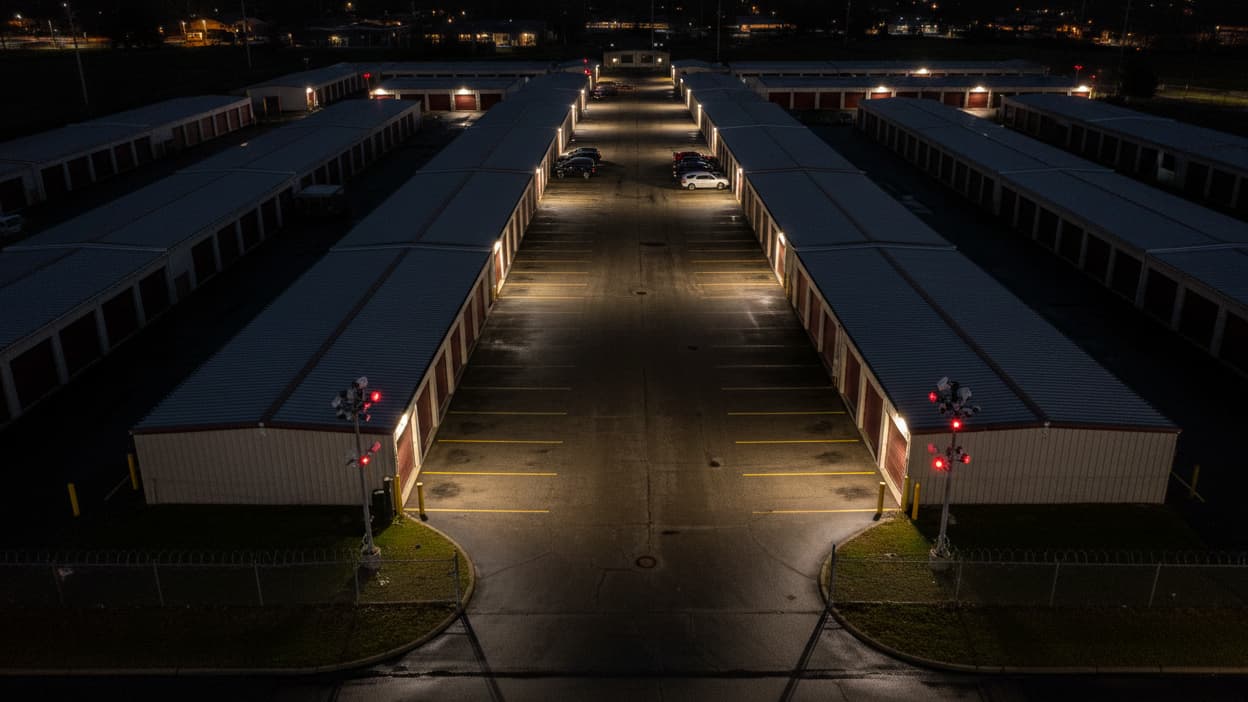
Drive past any mid-size storage facility at 10 PM and you'll see it — a few dim pole lights casting yellow pools of light, long stretches of shadow between rows, and a camera system that's basically recording darkness. Tenants notice. And so do the people who shouldn't be there.
The standard response used to be: call an electrician, trench new circuits, add fixtures, pay the monthly bill. For a facility with 10 rows of units, that's a $15,000–$40,000 project before you've bought a single bulb. And then you're paying $300–$600/month in electricity costs, forever.
There's a better way. High-output commercial solar lights have crossed a threshold in the last few years where they're genuinely viable for security applications — not just pathway markers, but real illumination that covers 30–50 foot wide drive aisles, triggers on motion, and runs all night without touching your electric bill.
This guide covers the five best-selling solar security lights for self storage facilities, based on actual sales data from operators across the US. We'll cover what each model does well, where it fits in a facility layout, and what you should know before you order.
Why Self Storage Facilities Are Uniquely Hard to Light
Most commercial lighting guides treat all outdoor spaces the same. Storage facilities have a specific set of challenges that make them harder than a parking lot or a warehouse exterior.
Long, narrow drive aisles. A typical storage row is 150–300 feet long and 20–30 feet wide. You need fixtures that throw light down the length of the aisle, not just in a circle around the pole. Beam pattern matters more here than raw lumen count.
No existing electrical infrastructure between rows. Most facilities were built with perimeter lighting only. Adding wired fixtures between rows means trenching through asphalt — $8–$20 per linear foot, plus permits, plus an electrician. For a 200-foot row, that's $2,000–$4,000 in trenching alone before you've bought anything.
Tenants accessing units at odd hours. A storage facility isn't a 9-to-5 operation. Tenants show up at 6 AM, 11 PM, and everything in between. Your lighting needs to work reliably every night, not just when the weather cooperates.
Security camera effectiveness depends on lighting. A $2,000 camera system is worthless if the scene is underlit. Most storage facility cameras are rated for low-light performance, but "low-light" means 1–5 lux. A quality solar street light delivers 20–50 lux at ground level. That's the difference between a usable image and a dark blur.
Insurance and liability. Inadequate lighting is a documented factor in premises liability claims. If a tenant is assaulted or injured in a poorly lit area of your facility, your lighting records become evidence. This isn't hypothetical — it's a standard line of questioning in storage facility liability cases.

What to Look for in a Solar Security Light for Storage Facilities
Not all solar lights are built for commercial security applications. Here's what separates the ones that work from the ones that look good in a product photo.
Lumen output: 20,000 minimum, 40,000+ preferred. Consumer solar lights top out around 3,000–5,000 lumens. For a 25-foot wide drive aisle, you need at least 20,000 lumens to achieve meaningful ground-level illumination. The fixtures in this guide range from 26,000 to 60,000 lumens.
Beam pattern: rectangular, not circular. A circular beam wastes light on areas you don't need illuminated (the sky, the tops of unit doors). A rectangular or asymmetric beam pattern throws light down the aisle where you actually need it. Look for fixtures with lens optics or adjustable beam angles.
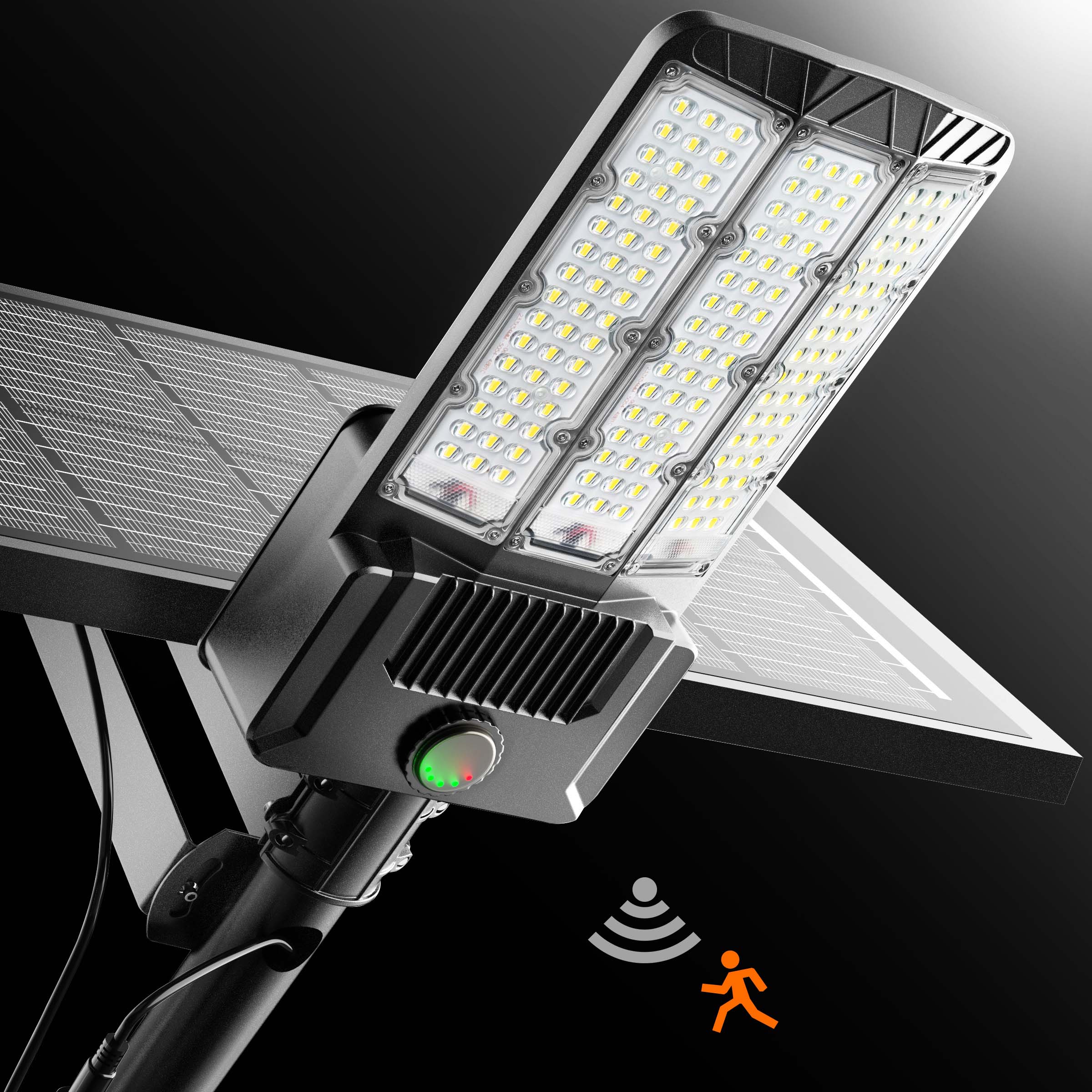
Motion sensor with adjustable sensitivity. You want the light to trigger on a person or vehicle approaching, not on a leaf blowing across the aisle. Adjustable sensitivity and detection range (20–40 feet is standard) lets you tune the sensor for your specific layout.
LiFePO4 battery chemistry. This is non-negotiable for commercial applications. LiFePO4 batteries handle temperature extremes better, last longer (2,000–3,000 cycles vs. 500–800 for standard lithium-ion), and don't degrade as fast in partial-charge conditions. A facility in Minnesota needs lights that work in January. LiFePO4 is the answer.
IP66 or better weatherproofing. Storage facilities are exposed environments. Rain, dust, humidity, temperature swings — your fixtures need to handle all of it without maintenance calls.
Pole or wall mounting flexibility. Some rows have existing poles you can retrofit. Others need new poles. Some facilities prefer wall-mounted fixtures on unit door frames. The best commercial solar lights support all three mounting configurations.

→ Browse Commercial Solar Security Lights
The 5 Best-Selling Solar Security Lights for Self Storage Facilities
These are ranked by actual sales volume from US operators over the past year — not by spec sheet numbers or marketing claims.
#1 Best Seller: Hykoont TW001 Solar Street Light Dual-Lamp — from $49.99

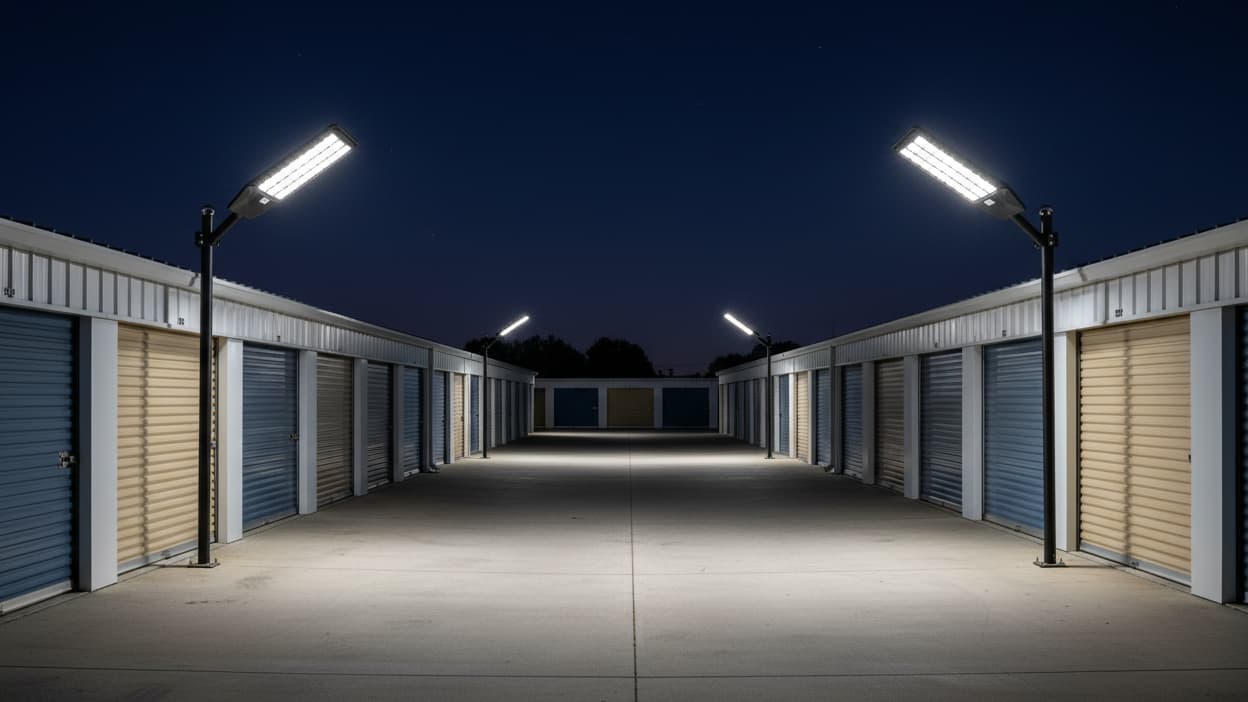
The TW001 is the most-ordered solar light in our catalog, and it's not hard to see why for storage facility applications. The dual adjustable lamp heads are the key feature: you can aim one head down the drive aisle and one toward the unit doors, covering both the approach and the access point from a single pole.
For facilities with existing poles between rows, the TW001 is a direct retrofit — bolt it on, aim the heads, done. No trenching, no electrician, no permit in most jurisdictions. The entry-level configuration starts at $49.99, which makes it easy to pilot a single row before committing to a full facility rollout.
The higher-output variant (up to $275) is what most facility operators end up choosing for primary security coverage. The dual-head design at that output level covers a 25-foot wide aisle with enough light to make camera footage actually usable.
Best placement: Mid-row poles, gate entry points, corners where two aisles meet.
View TW001 Dual-Lamp — from $49.99 →
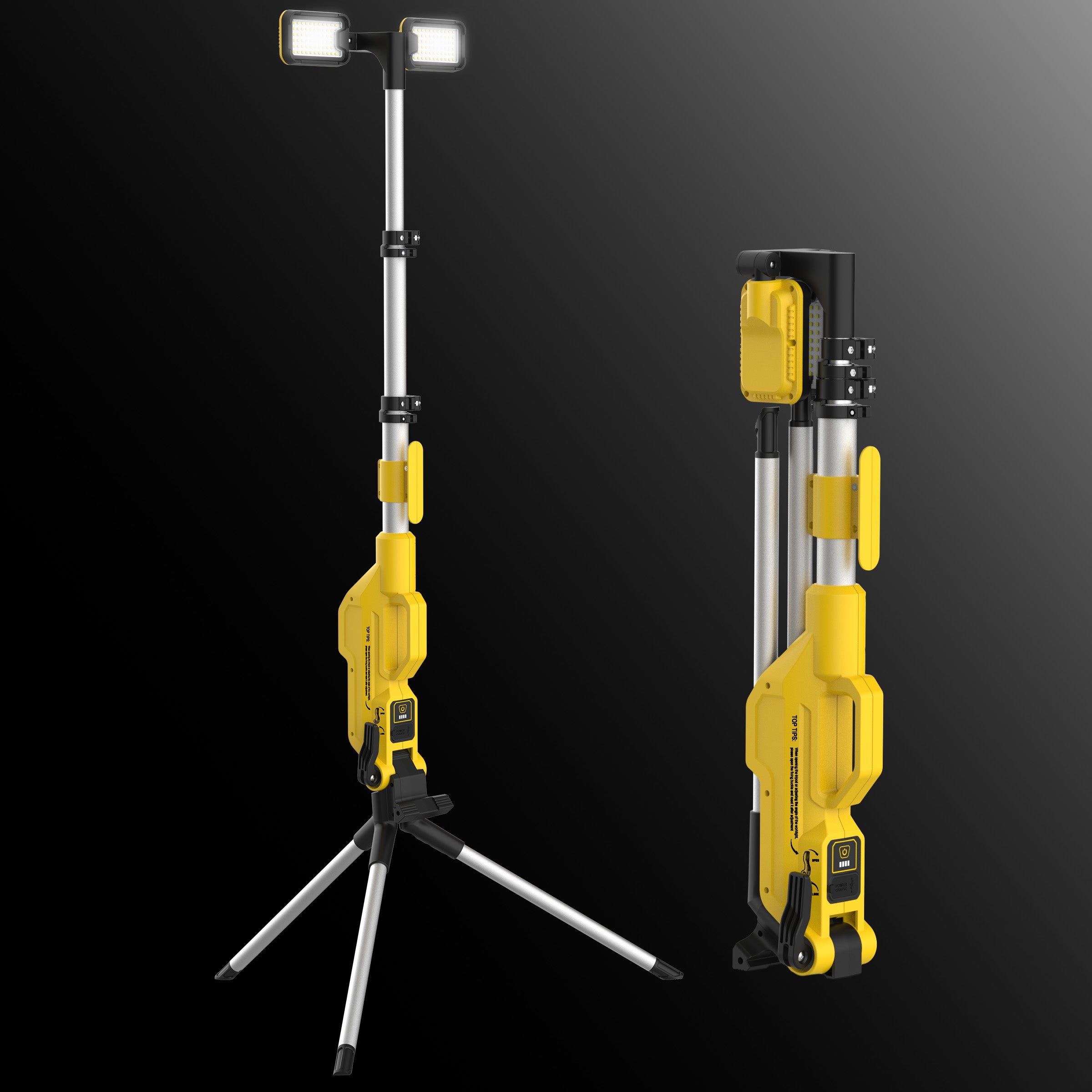
#2: Hykoont MX5085 WorkMax LED Light with Power Bank — $118.00

The MX5085 is a different kind of tool, and it earns its place on this list because of how storage facility operators actually use it. At 8,000 lumens with a built-in power bank and tripod compatibility, it's the light you reach for when a tenant calls at 9 PM because their unit is dark, when your maintenance crew is working after hours, or when you need temporary lighting during a power outage.
It's not a permanent security fixture — it's the operational workhorse that fills the gaps your fixed lighting can't cover. IP65 rated, portable, and it charges phones and equipment via the built-in power bank. For a facility manager who's on-site at odd hours, this is the light that lives in the office or the maintenance cart.
At $118, it's also the most versatile purchase on this list. One unit serves as emergency lighting, maintenance lighting, and a power source for small devices.
Best use: Maintenance operations, emergency backup, tenant assistance, temporary lighting during outages.
View MX5085 WorkMax — $118.00 →
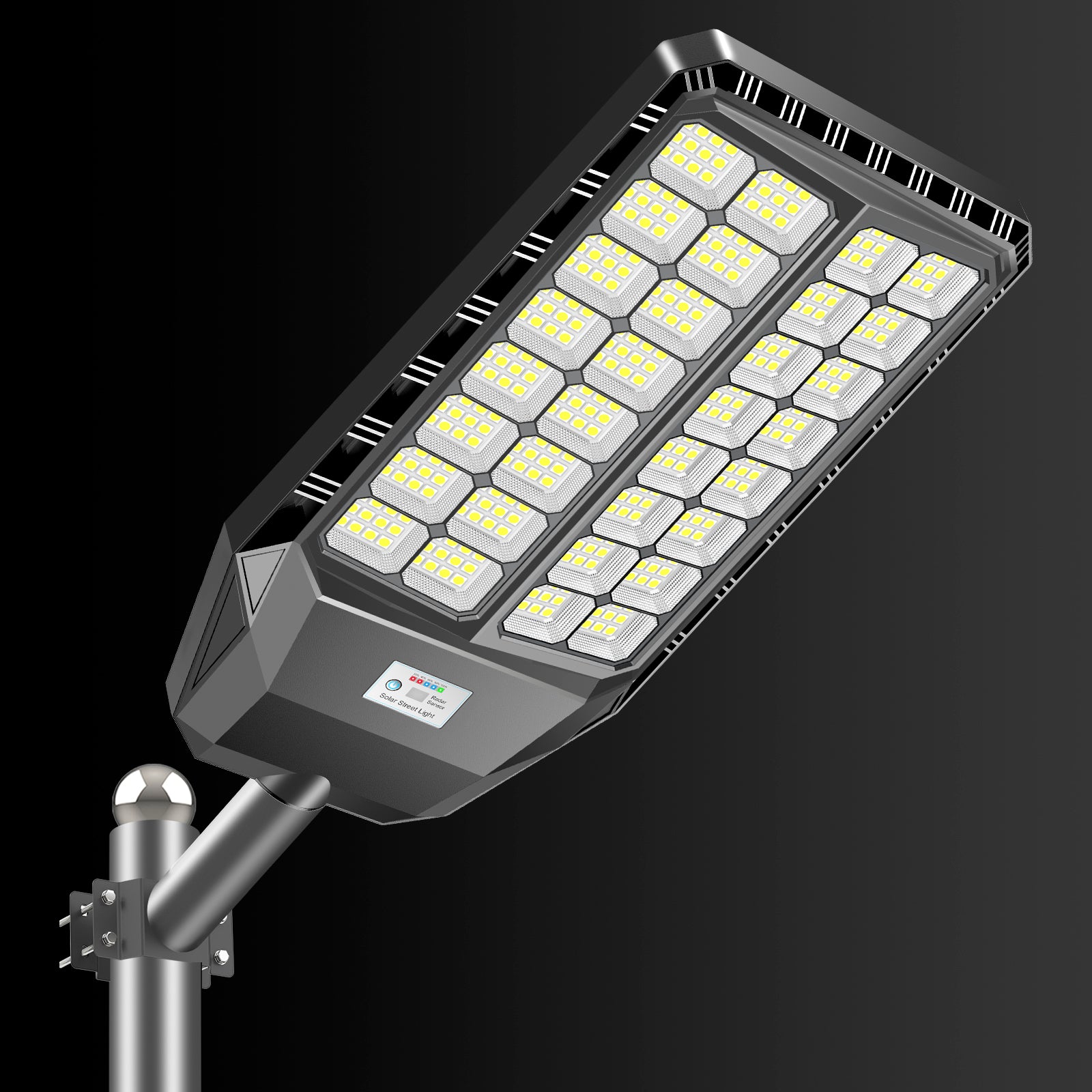
#3: Hykoont SZ300 Commercial Solar Street Light 400W 60,000LM — from $145.00

The SZ300 is the heavy hitter. 400W equivalent, 60,000 lumens, die-cast aluminum housing, monocrystalline panel. This is the fixture you put at the facility entrance, at the main gate, or at the end of your longest row where you need a single fixture to cover serious ground.
60,000 lumens is roughly 12–15x what a standard residential streetlight produces. At a storage facility, that means one SZ300 can illuminate a 40-foot wide drive aisle for 80–100 feet in each direction from the pole. For facilities with wide central lanes or large open areas between building clusters, this is the fixture that eliminates dark zones without requiring multiple smaller units.
The die-cast aluminum housing is worth noting specifically for storage facility applications — it handles the thermal cycling that comes with outdoor commercial use far better than plastic-bodied fixtures. These are built to last 8–10 years in the field, not 2–3.
Starting at $145 for the single-unit configuration and up to $293 for multi-pack options, the SZ300 is the most cost-effective high-output option on this list when you factor in coverage area per dollar.
Best placement: Facility entrance, main gate, wide central lanes, large open areas, perimeter corners.
View SZ300 Commercial — from $145.00 →
#4: Hykoont TW030 300W Solar Street Light 42,000LM 2-Pack — $289.00

The TW030 2-pack is how most facility operators buy this model, and the math makes sense: $289 for two 42,000-lumen fixtures works out to $144.50 per unit — comparable to the SZ300 single but with two fixtures to deploy. For a standard storage row (150–200 feet), two TW030s spaced 80–100 feet apart gives you overlapping coverage with no dark gaps.
The TW030 runs at 300W equivalent and uses dusk-to-dawn automation with motion sensor override — meaning it stays on at reduced brightness all night and hits full power when it detects movement. For a storage facility, that's the right operating mode: constant low-level illumination for camera visibility, full blast when someone's actually moving through the aisle.
This is the model that operators choose when they want to light an entire row in one order. Two units, one purchase, one delivery, one installation session. For a 10-row facility, that's 20 fixtures in 10 orders — straightforward procurement and a consistent look across the property.
Best placement: Drive aisles (one per 80–100 feet), perimeter lighting, secondary gate coverage.
#5: BM024C Solar Street Lights 26,000LM 160W — from $79.00

The BM024C is the value play on this list, and it earns its spot because of what it delivers at the entry price point. 26,000 lumens at 160W equivalent, starting at $79 — that's more output than most facilities' existing wired fixtures, at a fraction of the installation cost.
For facilities that are just starting to upgrade their lighting, the BM024C is the right first purchase. It's enough output to make a real difference in a single aisle or at a problem area (a dark corner, a blind spot near the gate), without requiring a full facility commitment. If it performs well in your location — and it will, assuming reasonable sun exposure — you scale from there.
The upper end of the BM024C range ($309) covers multi-pack configurations for operators who want to move faster. At that price point, you're getting commercial-grade output at a price that makes the ROI calculation very short.
Best placement: Problem areas and dark corners, secondary aisles, pilot installations before full facility rollout.
→ See All Commercial Solar Security Lights & Current Pricing
How to Plan a Solar Lighting Layout for a Self Storage Facility
A lighting plan for a storage facility isn't complicated, but it does require thinking about coverage zones rather than just fixture count. Here's a practical framework.
Start with the gate and entrance. This is your highest-priority zone. The entrance is where tenants form their first impression of security, and it's where most incidents involving unauthorized access begin. One SZ300 or TW030 at the gate gives you 40,000–60,000 lumens at the most visible point on the property.
Map your drive aisles by length. For aisles under 100 feet, one high-output fixture (TW030 or SZ300) at the midpoint covers the full length. For aisles 100–200 feet, two fixtures spaced evenly. For aisles over 200 feet, three fixtures or a combination of a high-output center fixture and supplemental units at each end.
Identify your dark corners and blind spots. Walk the property at night with a flashlight and mark every spot where you lose visibility. These are your secondary priority zones — typically the far ends of rows, areas behind building clusters, and the perimeter fence line. The BM024C is a cost-effective solution for these supplemental locations.
Consider your camera system. Map your camera coverage zones and cross-reference with your lighting plan. Every camera field of view should have at least one fixture providing 20+ lux at ground level. If a camera covers a 30-foot wide aisle, the fixture serving that zone needs to be sized accordingly.
Account for panel orientation. Solar panels need to face south (in the US) with no shade between 9 AM and 3 PM. In a storage facility with tall buildings on both sides of a narrow aisle, the south-facing exposure may be limited. For east-west oriented aisles, this is usually fine. For north-south oriented aisles, check the shade pattern before committing to pole locations.

The ROI Math: Solar vs. Wired for a 10-Row Facility
Let's run the numbers on a typical 10-row facility, each row 150 feet long, currently underlit.
Wired lighting upgrade (20 new fixtures):
- Trenching: 10 rows × 150 feet × $12/ft = $18,000
- Fixtures and installation: 20 fixtures × $400 = $8,000
- Electrician and permits: ~$5,000
- Total upfront: ~$31,000
- Monthly electricity (20 fixtures × 150W × 12hrs × $0.13/kWh): ~$70/month
- 5-year total cost: $31,000 + ($70 × 60) = $35,200
Solar lighting upgrade (20 fixtures, TW030 2-packs):
- 10 × TW030 2-pack at $289 = $2,890
- Poles and installation (DIY or handyman): ~$2,000
- Total upfront: ~$4,890
- Monthly electricity: $0
- 5-year total cost: $4,890
The difference is $30,310 over five years. That's not a rounding error — that's a meaningful capital allocation decision. And the solar option goes up faster, doesn't require permits in most jurisdictions, and can be relocated if you reconfigure the facility layout.
Installation: What It Actually Takes at a Storage Facility
The installation process for solar security lights at a storage facility is simpler than most operators expect. Here's the realistic breakdown.
Existing poles: If you have existing light poles between rows, retrofitting is straightforward. Remove the old fixture, attach the new solar unit with the included bracket, aim the panel south and the sensor down the aisle. One person, 30–45 minutes per fixture.
New poles: For rows without existing poles, you'll need to set new poles. A standard 10–12 foot steel pole in a concrete footing takes about 2 hours per location (dig, set, pour, wait 24 hours for cure). A two-person crew can set 4–6 poles per day. For a 10-row facility, that's 2–3 days of pole work before fixture installation begins.
Wall mounting: For facilities where poles aren't practical, the TW001 and BM024C both support wall mounting on unit door frames or building exteriors. This eliminates the pole-setting step entirely and is often the fastest installation path for facilities with existing structures to mount on.
No electrician required. This is the part that surprises most facility operators. There's no wiring, no panel work, no conduit. The fixtures are self-contained. In most US jurisdictions, solar pole lights don't require an electrical permit. Check with your local building department, but the answer is usually no permit needed.

Common Questions from Storage Facility Operators
Q: Will solar lights work reliably enough for a commercial security application?
A: Yes, with the right fixtures. The key variables are battery capacity (LiFePO4 rated for 3–5 cloudy days), panel efficiency (monocrystalline), and output (20,000+ lumens). The fixtures in this guide meet all three criteria. They're used by storage facilities, parking lots, and commercial properties across the US.
Q: What happens during extended cloudy periods in winter?
A: Quality solar lights with LiFePO4 batteries are rated for 3–5 consecutive cloudy days before dimming. In motion-sensor mode (dim at 20–30% when no movement, full power when triggered), battery life extends significantly. For facilities in consistently overcast climates (Pacific Northwest, upper Midwest in winter), sizing up to a higher-capacity model like the SZ300 provides additional buffer.
Q: Can I mix solar and wired lighting on the same property?
A: Absolutely. Many facilities use existing wired perimeter lighting and add solar fixtures for interior rows and secondary areas. Solar fills the gaps that wired infrastructure doesn't reach without the cost of extending circuits.
Q: How do I handle facilities with tall buildings that shade the aisles?
A: Panel orientation is the key variable. For east-west oriented aisles, mount the panel on the south-facing side of the pole above the roofline of adjacent buildings. For north-south aisles with tall buildings on both sides, you may need to mount the panel on a separate arm that clears the shade zone. Contact us before ordering if you have a complex shade situation — we can help you spec the right solution.
Q: What's the warranty on these fixtures?
A: All fixtures in this guide carry manufacturer warranties. Check the individual product pages for current warranty terms, as they vary by model.
Q: Do I need to do anything to maintain these lights?
A: Minimal maintenance. Clean the solar panel surface 2–3 times per year (dust and debris reduce charging efficiency). Check the mounting hardware annually. The LED arrays and LiFePO4 batteries are rated for 5–8 years of service without replacement.
Q: Can these lights integrate with my existing security camera system?
A: The lights themselves don't integrate electronically with camera systems — they're standalone fixtures. But they dramatically improve camera performance by providing the illumination that cameras need to capture usable footage. Position fixtures to cover your camera fields of view and you'll see an immediate improvement in footage quality.
Q: What's the best way to pilot solar lighting before committing to a full facility rollout?
A: Start with one row — your darkest or most problematic aisle. Install two TW030s or three BM024Cs and run them for 60–90 days across different seasons. If performance meets your standards (and it will, assuming reasonable sun exposure), scale to the rest of the facility. The BM024C at $79 is the lowest-risk entry point for a pilot.
Q: Are there any tax incentives for commercial solar lighting?
A: The federal Investment Tax Credit (ITC) applies to solar energy systems, and commercial solar lighting may qualify depending on how the system is classified. Consult your tax advisor — the ITC has historically provided a 26–30% credit on qualifying solar installations, which meaningfully changes the ROI calculation.
Q: How do I order enough fixtures for a full facility without over-buying?
A: Map your aisles, measure the lengths, and use the spacing guidelines in this article (one fixture per 80–100 feet for high-output models, one per 60–80 feet for mid-range). Add 10–15% buffer for problem areas and future expansion. If you're ordering 10+ fixtures, contact us directly — bulk pricing is available.
The Bottom Line for Storage Facility Operators
The lighting situation at most self storage facilities is a solved problem. The technology exists, the economics are compelling, and the installation is simpler than most operators expect.
The five fixtures in this guide cover every scenario a storage facility is likely to encounter — from a single problem aisle to a full 10-row facility upgrade. The TW001 is the most flexible for retrofit installations. The SZ300 is the highest output per fixture. The TW030 2-pack is the most efficient way to light a full row. The BM024C is the lowest-risk entry point. And the MX5085 is the operational tool that every facility manager should have on hand.
Start with your darkest aisle. Run a pilot. Then scale. The ROI math works, the installation is manageable, and your tenants — and your insurance carrier — will notice the difference.
→ Shop Commercial Solar Security Lights — Bulk Pricing Available

Leave a comment
This site is protected by hCaptcha and the hCaptcha Privacy Policy and Terms of Service apply.