


If you've spent any time searching for solar bug zappers online, you already know the problem: every product claims to cover "up to 1 acre," every listing has five stars, and every description reads like it was written by the same person. It's genuinely hard to figure out what's actually worth buying.
I've been through this process the hard way. Bought three different units over two summers before landing on ones that actually worked. Along the way I figured out exactly what specs matter, which claims are marketing fluff, and what questions you should be asking before you spend a dollar.
This guide is what I wish existed when I started. No affiliate padding, no recycled spec comparisons. Just the five things that actually determine whether a solar bug zapper will work for your situation — and how the Hykoont models stack up against each one.
Thing #1: Solar Panel Wattage Is the Spec That Actually Matters Most
Most people shopping for solar bug zappers focus on coverage area or UV tube count. Those matter, but they're downstream of the real question: does the solar panel generate enough power to run the unit all night, every night, including after cloudy days?
Here's the math that most product listings don't show you. A bug zapper running UV tubes and a zapper grid draws a meaningful amount of power over 8–10 hours of nighttime operation. If the solar panel can't fully recharge the battery during the day — especially on partially cloudy days — the unit will start shutting off before dawn. After a few cloudy days in a row, it may not run at all.
The cheap units I tried first had 5W and 8W panels. They worked fine in July in full sun. They were useless after two overcast days in a row.
What to look for: For reliable all-night operation in most US climates, you want at least 15W of monocrystalline silicon panel. For the Pacific Northwest, Southeast (frequent afternoon storms), or any property with partial shading, 25W+ is the safer choice.
The two Hykoont models I've tested sit at 19W and 30W respectively — both monocrystalline silicon, which is the higher-efficiency panel type. The difference between them shows up most clearly during cloudy stretches.
Hykoont 19W Standard — $125

Handles 1–2 consecutive cloudy days without issue. Starts cutting out around 3 AM after the third cloudy night. Fine for most of the US — not ideal for the Pacific Northwest or frequently overcast climates.
Hykoont 30W Pro — $259

Ran through 4 consecutive overcast days in my testing without shutting off early. The larger panel builds up enough reserve that a partially sunny day is sufficient to top off the battery. This is the one for climates with frequent cloud cover.
Thing #2: "Coverage Area" Claims Are Almost Always Overstated — Here's How to Read Them
Every solar bug zapper on the market claims a coverage area. "Covers up to 1 acre!" "Effective range: 1,500 sq ft!" These numbers are measured under ideal conditions — still air, open flat terrain, full darkness, peak UV output. Real-world coverage is typically 60–80% of the rated spec.
More importantly, coverage area is a radius measurement, not a square footage guarantee. A unit rated for 1,500 sq ft is attracting insects from a roughly 22-foot radius in all directions. If you place it in the center of a 3,000 sq ft space, it's not covering the whole space — it's covering the area immediately around it.
The practical implication: For spaces larger than about 2,000 sq ft, you almost always need more than one unit, or you need to think carefully about placement to maximize the coverage you do have.
Here's how I think about the Hykoont models in real-world terms:
- 19W Standard: Reliably effective within about 2,500 sq ft of the unit. Good for a deck, patio, or individual campsite.
- 30W Pro: Reliably effective within about 6,000–7,000 sq ft. Good for a large backyard, communal outdoor area, or small commercial space.
The 30W Pro is rated for 8,000 sq ft. In my testing, 6,000–7,000 sq ft is the honest real-world number. That's still excellent — just don't expect the full rated spec in typical conditions.

Thing #3: Single Tube vs. Triple Tube Is Not a Minor Difference
This is the one that surprised me most when I started paying attention to it.
A single UV tube casts light in essentially one direction — forward from the tube. Insects approaching from the sides or behind the unit are much less likely to be attracted to it. In practice, a single-tube unit has a narrow effective attraction cone, maybe 90–120 degrees.
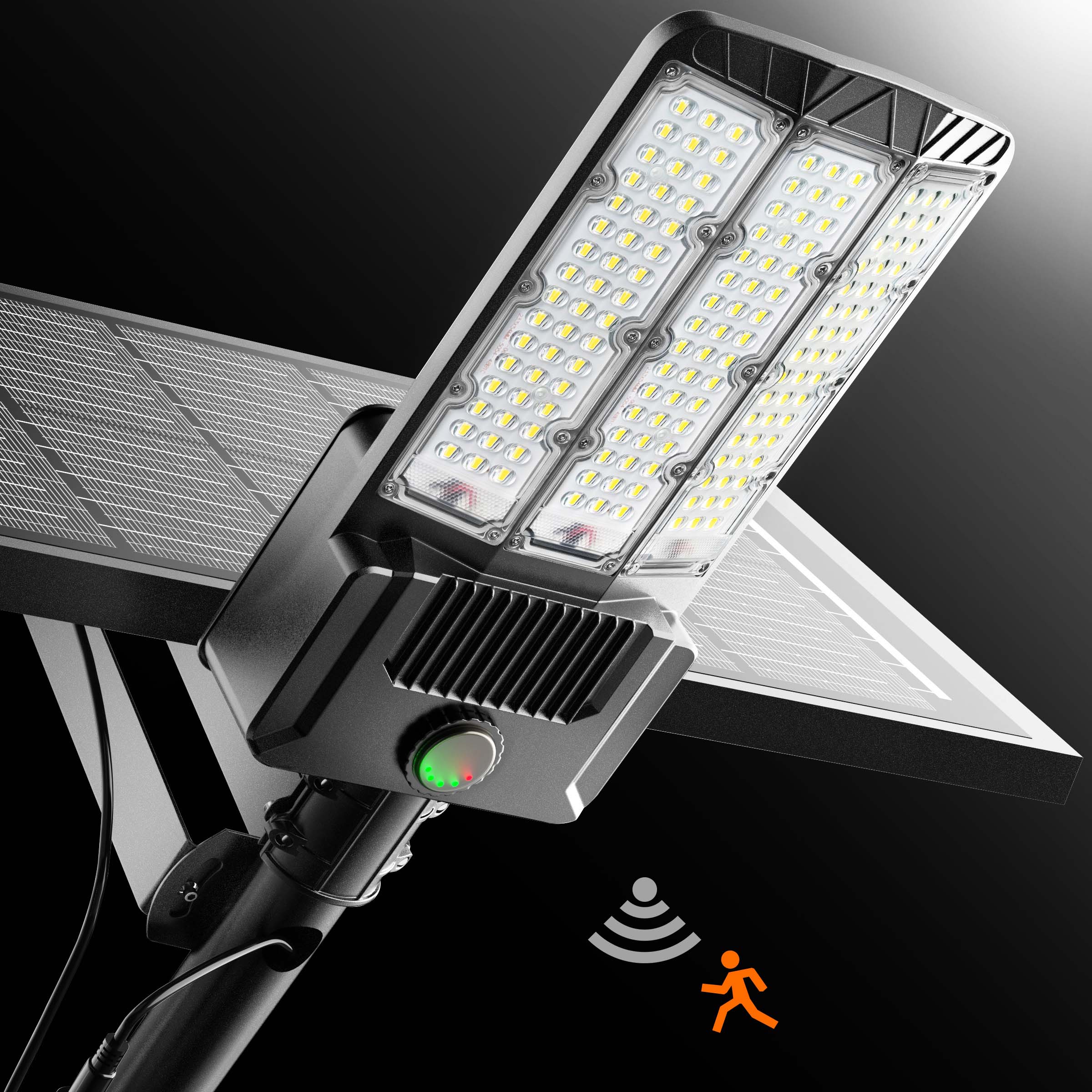
A triple UV tube configuration — like both Hykoont models use — spreads UV light in multiple directions simultaneously. The effective attraction angle is much wider, closer to 270–360 degrees depending on the tube arrangement. For an open outdoor space where insects can approach from any direction, this is a meaningful difference in how much of your space actually gets covered.
When I replaced a single-tube unit with the Hykoont 19W Standard in the same location, the catch tray volume roughly doubled over the same two-week period. Same location, same season, same mosquito pressure. The triple tube design was pulling in significantly more insects.
If you're comparing solar bug zappers and one has a single tube and one has triple tubes at a similar price, the triple tube unit will outperform it in open outdoor spaces. This isn't a spec that's easy to fake — you can see the tube count in the product photos.

19W Standard — Triple UV Tube Configuration

30W Pro — Triple UV Tube Configuration
Thing #4: Where You Put It Matters More Than Which One You Buy
I've seen people buy good bug zappers and get mediocre results because of placement mistakes. Here are the four most common ones:
Mistake 1: Placing it next to seating areas
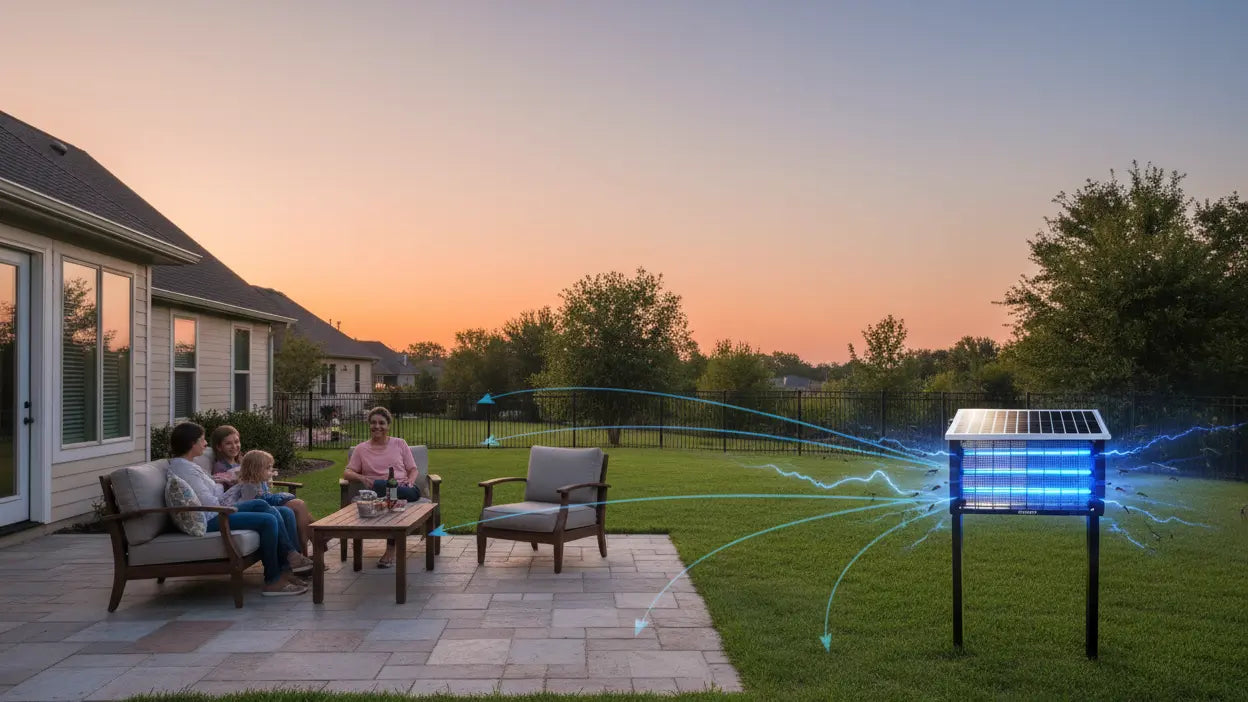
Bug zappers attract insects toward the light. If you put the zapper right next to your patio chairs, you're creating an insect attraction point right where people are sitting. Place it at the perimeter of your space — at least 15–20 feet from seating — so it draws mosquitoes away from people, not toward them.
Mistake 2: Putting it in partial shade
The solar panel needs direct sunlight during peak hours (roughly 10 AM–3 PM) to charge effectively. A unit in dappled shade under a tree will undercharge and underperform at night. If your outdoor space is shaded, you may need to position the unit where it gets sun even if that's not the most convenient spot for mosquito control.
Mistake 3: Placing it too low in areas with tall grass or brush
The ground stake puts the unit at about 3–4 feet high, which works well in open lawn areas. In areas with taller vegetation, the UV light gets partially blocked by the surrounding plants. In those situations, use the hanging hook to get the unit up to 6–8 feet, above the vegetation line.
Mistake 4: Pointing it away from the mosquito source
If you know where your mosquitoes are coming from — a pond, a creek, a wooded area, a neighbor's overgrown yard — orient the unit to face that direction. You want to intercept mosquitoes as they move toward your space, not after they've already arrived.
The Setup That Works
Both Hykoont models come with a ground stake and a hanging hook, which gives you flexibility to address all four of these situations. The ground stake is faster to install; the hanging hook gives you more height control. I've used both depending on the specific location.

Ground Stake Installation — 19W Standard

Hanging Installation — 30W Pro
Thing #5: The Ongoing Cost Comparison Changes the Math Completely
When people see $125 or $259 for a bug zapper, the instinct is to compare it to the $30–50 units on Amazon. That's the wrong comparison. The right comparison is total cost of ownership over two or three years.
Here's what the alternatives actually cost:
| Solution | Upfront Cost | Annual Ongoing Cost | 3-Year Total |
|---|---|---|---|
| Cheap single-tube solar zapper | $30–50 | $30–50 (replacement) | $90–$150 |
| Propane CO2 trap | $300–$500 | $480 (propane) | $1,740–$1,940 |
| Professional spray treatment | $0 | $400–$800 | $1,200–$2,400 |
| Citronella candles/torches | $20–40 | $60–$120 (refills) | $200–$400 |
| Hykoont 19W Standard | $125 | $0 | $125 |
| Hykoont 30W Pro | $259 | $0 | $259 |
The cheap solar zappers look like a deal until you factor in that most of them need replacing every season. The propane traps are effective but the ongoing fuel cost is brutal. Professional spray is the most expensive option and raises chemical exposure questions.
The solar units have zero ongoing cost after purchase. No propane, no replacement bulbs (LED tubes last 30,000–50,000 hours), no refills. Over three years, the 30W Pro at $259 is cheaper than almost every alternative except doing nothing.
Which Model Is Right for Your Situation?
Here's the decision framework I'd use:
Choose the 19W Standard ($125) if:
- Your outdoor space is under 3,000 sq ft (deck, patio, small backyard)
- You're in a region with mostly sunny summers (Southwest, Southeast, Midwest)
- You want solid residential performance without commercial-grade investment
- You're buying multiple units to cover a larger space on a budget
Choose the 30W Pro ($259) if:
- Your space is 3,000–8,000+ sq ft
- You're in a frequently overcast climate (Pacific Northwest, Great Lakes, Northeast)
- You're running a commercial outdoor space (restaurant, campground, event venue)
- You want maximum reliability with zero manual intervention
- You're near a water source (pond, creek, wetland) with high mosquito pressure
The Red Flags to Watch For When Shopping
Since you're probably comparing multiple options, here are the warning signs I've learned to look for:
Panel wattage not listed: If a listing doesn't specify the solar panel wattage, that's usually because it's embarrassingly low (3W–5W). Any reputable product will list this prominently.
"Up to X acres" without specifying conditions: Coverage claims without context are meaningless. Ask yourself: under what conditions? Still air? Full darkness? Open flat terrain? Real-world coverage is always less.
Single tube design at the same price as triple tube: If you're comparing two units at similar prices and one has a single UV tube and one has triple, the triple tube unit will outperform it in open outdoor spaces. Don't pay the same price for less coverage.
No IPX rating listed: Any outdoor electrical device should have a water resistance rating. If it's not listed, assume it's not rated — which means rain will eventually damage it.
Reviews that all mention the same phrases: A pattern of reviews using identical language is a sign of review manipulation. Look for reviews that mention specific use cases, specific problems, or specific locations.

Frequently Asked Questions
Q: I've tried cheap bug zappers before and they didn't work. Why would these be different?
A: The failure mode of cheap solar zappers is almost always the solar panel — it's too small to charge the battery adequately, so the unit runs at reduced power or shuts off before dawn. The Hykoont models use 19W and 30W monocrystalline panels, which are in a completely different performance category than the 3W–5W panels on budget units. The triple UV tube design also significantly outperforms single-tube units at the same price point. These aren't incremental improvements — they're a different class of product.
Q: Do I need to do anything to set these up, or is it truly plug-and-play?
A: Genuinely plug-and-play. Stake it in the ground or hang it, make sure the solar panel faces south with unobstructed sky access, and you're done. The dusk-to-dawn sensor handles on/off automatically. No app, no wiring, no configuration. The only ongoing task is cleaning the catch tray every 10–14 days during peak season.
Q: What's the difference between monocrystalline and polycrystalline solar panels?
A: Monocrystalline panels (what both Hykoont models use) are more efficient at converting sunlight to electricity, especially in low-light conditions like overcast days or early morning/late afternoon sun. Polycrystalline panels are cheaper to manufacture but less efficient. For a solar bug zapper that needs to charge adequately on partially cloudy days, monocrystalline is the right choice.
Q: How do I know if I need one unit or multiple units?
A: Rough rule: one 19W Standard covers up to ~2,500 sq ft effectively; one 30W Pro covers up to ~6,500 sq ft effectively. Measure your outdoor space and divide by the effective coverage of the unit you're considering. Round up — it's better to have slightly overlapping coverage than gaps. Also add one extra unit if you're near a significant mosquito source like standing water or dense vegetation.
Q: Will these work in Texas / Florida / the Deep South where mosquitoes are intense?
A: Yes, and the high-sun climate of the South actually helps — the solar panels charge faster and build up more reserve. The challenge in high-mosquito-pressure environments is that you're fighting a larger population, so results take longer to become noticeable (typically 3–4 weeks rather than 1–2 weeks). Near standing water or wetlands, you may want to combine with other control methods for maximum effect.
Q: Can I leave these out year-round, or should I bring them in during winter?
A: IPX4 water resistance handles rain and snow adequately. The main consideration in winter is that shorter days and lower sun angles reduce solar charging efficiency. If you're in a climate with very short winter days (northern states), the unit may not charge fully during winter months. For year-round use in northern climates, the 30W Pro's larger panel handles winter charging better than the 19W Standard.
Q: How long before I notice a difference in mosquito pressure?
A: Typically 2–4 weeks of consistent nightly operation. The first week or two, the zappers are working but the local mosquito population is still at its baseline level. As the population gets reduced night after night, you'll start noticing fewer mosquitoes around your seating areas. Near high-density breeding sources (standing water, wetlands), it takes longer because the population is constantly replenishing.
Q: Is the zapping sound going to be annoying?
A: You'll hear it if you're sitting near the unit, especially on active nights. It's not loud enough to be disruptive from inside the house. The practical solution is to place the unit at the perimeter of your space rather than right next to seating — which is also the correct placement for effectiveness. At 15–20 feet away, the zapping sound is barely noticeable.
Q: What's the warranty on these units?
A: Check the product page for current warranty terms. For any warranty questions or post-purchase support, reach out through the store directly.
Q: Are there any ongoing costs after purchase?
A: No. Solar charging means no electricity cost. LED UV tubes last 30,000–50,000 hours (10+ years of nightly use). No propane, no replacement bulbs, no refills. The only thing you'll spend is two minutes every couple of weeks cleaning the catch tray.
The Short Version
If you take nothing else from this guide, take these four things:
First, solar panel wattage is the most important spec — it determines whether the unit actually runs all night. Look for 15W+ monocrystalline for most climates, 25W+ for overcast regions.
Second, triple UV tube designs significantly outperform single-tube units in open outdoor spaces. Both Hykoont models have triple tubes. Most budget units don't.
Third, placement matters as much as the unit itself. Perimeter placement, facing the mosquito source, with unobstructed solar panel access.
Fourth, the total cost of ownership math strongly favors quality solar units over cheap replaceable ones or propane-dependent alternatives.
Ready to stop guessing and get something that actually works?
For decks, patios, and residential backyards under 3,000 sq ft:
For large properties, commercial spaces, and overcast climates:



Leave a comment
This site is protected by hCaptcha and the hCaptcha Privacy Policy and Terms of Service apply.