


You've read the product listings. "Long-lasting battery." "Up to 12 hours of runtime." "Advanced energy storage." What does any of that actually mean?
Here's the honest answer: usually not much — unless you know what questions to ask.
Solar lighting has matured significantly as a technology. The hardware engineering behind a well-built commercial solar street light in 2026 is genuinely impressive. But the way that technology gets communicated to buyers? Still stuck in 2015 marketing language designed to sound good without committing to anything specific.
This article is for the buyer who wants to skip the vague claims and understand what's actually happening inside that fixture. Whether you're sourcing lighting for a commercial property, a municipal infrastructure project, or your own home, these five things will change how you evaluate every solar light you look at from here on out.
No jargon for the sake of it. No upselling. Just the stuff that actually matters.
Thing #1: "Battery" Is Not a Specification — Battery Chemistry Is
This is the single most important thing we can tell you, and it's almost never front-and-center in product listings.
When a manufacturer says their solar light has a "high-capacity lithium battery," they have told you almost nothing useful. Lithium is a category, not a specification. Within that category, there are at least four distinct chemistries used in solar lighting products — and their real-world performance differences are enormous.
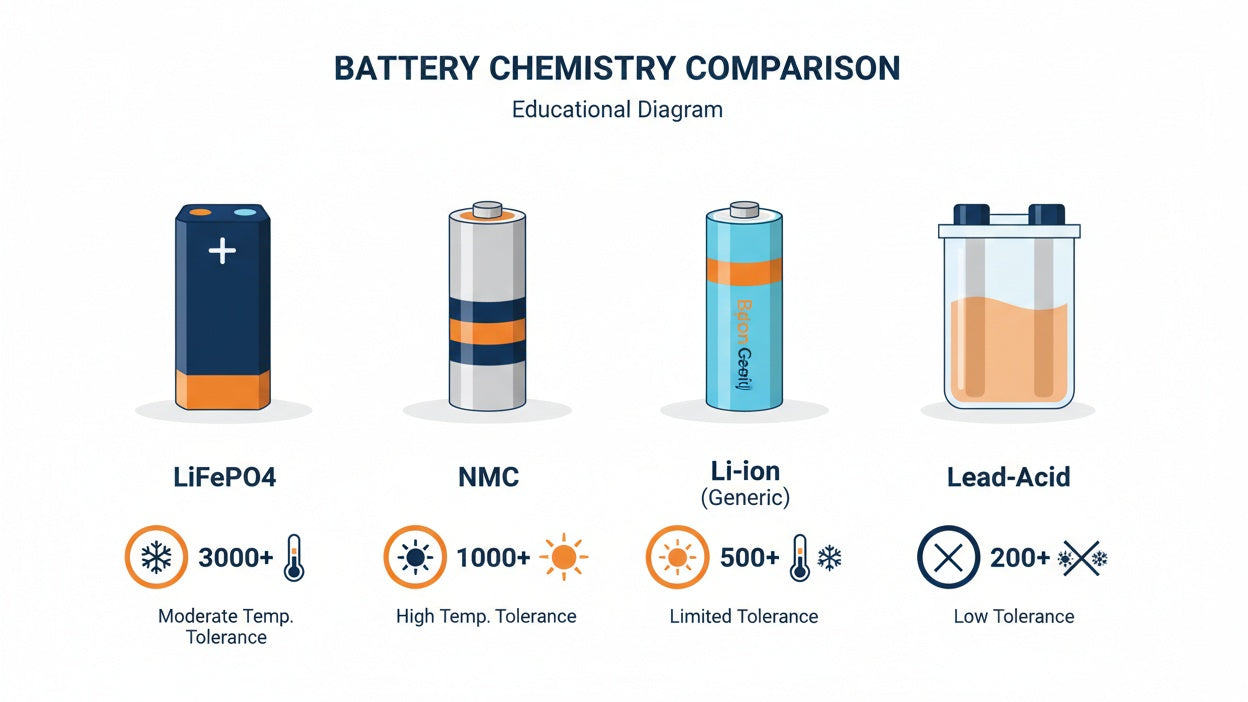
The Main Battery Chemistries in Solar Lights (Ranked by Quality)
1. LiFePO4 (Lithium Iron Phosphate) — The Gold Standard
LiFePO4 batteries are what serious commercial solar lighting applications use. Here's why:
- Cycle life: 2,000–4,000+ cycles — at one full charge/discharge cycle per day, that's 5.5 to 11 years before meaningful capacity loss
- Temperature stability: performs from -4°F to 140°F with minimal capacity drop
- No thermal runaway: the safest lithium chemistry — no fire risk if damaged or overcharged
- Flat discharge curve: maintains consistent brightness throughout the discharge cycle, not just at full charge
- Self-discharge rate: very low — sits for months without significant charge loss
2. NMC / NCR (Nickel Manganese Cobalt / Nickel Cobalt) — Middle Tier
Higher energy density than LiFePO4, which means more capacity in a smaller package. Used in many mid-range solar products. Downsides: 500–1,500 cycle life, more sensitive to temperature extremes, thermal runaway risk if damaged.
3. Generic Li-ion (Unspecified) — Buyer Beware
When a manufacturer just says "lithium-ion" without specifying the chemistry, it's usually one of the lower-performing variants. Expect 300–800 cycles and accelerated degradation in temperature extremes.
4. Lead-Acid (SLA / VRLA) — Avoid for Most Applications
Still found in budget solar fixtures. Heavy, low cycle life (200–400 cycles), terrible cold-weather performance, and environmentally problematic disposal. If a solar light listing mentions "sealed lead acid" or "VRLA" battery, treat that as a disqualifier for any serious application.
How to Check Before You Buy
Look for the specific chemistry designation in the product specs. "LiFePO4" or "Lithium Iron Phosphate" should be explicitly stated. If the listing only says "lithium battery" or "Li-ion" without further specification, that's a yellow flag. Contact the manufacturer and ask directly: what is the cathode chemistry? Any manufacturer with confidence in their battery will answer that question immediately.
Products that openly disclose LiFePO4 chemistry — like the fixtures in Hykoont's commercial line — are telling you something meaningful about how seriously they approached the hardware.

Thing #2: Runtime Claims Are Almost Always Best-Case Numbers
"Up to 12 hours of runtime" sounds great until you understand what "up to" means in practice.
Runtime in solar lighting is a function of three variables that manufacturers almost never fully disclose together:
- Battery capacity (Wh) — the actual energy stored
- Power draw at stated brightness — how fast the battery depletes at full output
- Dimming profile — whether "12 hours" means 12 hours at 100% brightness or 4 hours at 100% + 8 hours at 30%
Here's the math that manufacturers hope you don't run:
A solar light with a 100Wh battery running a 15W LED at full brightness will last approximately 6.5 hours — not 12. To claim "12 hours of runtime," the product either needs a 180Wh+ battery at that wattage, or it needs to spend most of those 12 hours dimmed down significantly.
Dimming isn't inherently bad — intelligent dimming profiles (bright during peak hours, reduced after midnight) are actually smart design. But they should be disclosed, not hidden behind runtime claims.
What Real Runtime Transparency Looks Like
A properly specified solar light listing will tell you:
- Battery capacity in Wh (watt-hours) — not just "mAh" at an unspecified voltage
- LED power consumption at different modes (100%, 50%, motion-triggered, etc.)
- Estimated runtime per mode
- Days of backup autonomy in zero solar input conditions
That last metric — backup autonomy — is arguably the most important for commercial applications. A system with 3+ days of backup autonomy at functional brightness levels means it will survive a full cloudy week without going dark.
Wh vs. mAh: Why Manufacturers Use mAh (And Why You Should Convert It)
Many listings advertise battery capacity in mAh (milliamp-hours) without disclosing voltage. This is a deliberately incomplete specification.
The actual energy stored in a battery is: Capacity (Wh) = Voltage (V) × Capacity (Ah)
A "10,000mAh" battery at 3.7V stores 37Wh. The same "10,000mAh" rating at 12.8V stores 128Wh — nearly 3.5x more energy. When manufacturers advertise mAh without voltage, they can make small batteries sound impressive. Always ask for or calculate the Wh figure.

Thing #3: Cold Weather Destroys Cheap Batteries — and Manufacturers Know It
This is the one that catches the most buyers off guard, particularly in northern states.
Lithium batteries lose capacity in cold weather. That's basic chemistry. But the degree to which they lose capacity — and how quickly they recover — varies enormously by battery chemistry and quality.
What Happens to Battery Capacity at Low Temperatures
| Temperature | Generic Li-ion Capacity | NMC Capacity | LiFePO4 Capacity |
|---|---|---|---|
| 77°F (25°C) | 100% | 100% | 100% |
| 32°F (0°C) | ~75% | ~85% | ~92% |
| 14°F (-10°C) | ~55% | ~70% | ~82% |
| -4°F (-20°C) | ~35% | ~55% | ~70% |
At 14°F — a typical January night in Chicago, Minneapolis, or Boston — a cheap Li-ion battery is operating at roughly half capacity. A LiFePO4 battery in the same conditions retains over 80% of its rated capacity.
That difference is the gap between a light that stays on until sunrise and one that goes dark at 2 AM.
What This Means for US Regional Buyers
If your property is in USDA Hardiness Zones 1–6 (roughly everything north of a line from Virginia to Kansas), cold-weather battery performance isn't a nice-to-have consideration. It's a critical selection criterion.
For installations in Minnesota, Wisconsin, Michigan, Maine, Montana, the Dakotas, and similar markets: LiFePO4 chemistry and adequate battery reserve (at minimum 2x your calculated nightly energy need) are non-negotiable specifications.
The good news: once you know to ask about this, the right products become obvious. Any manufacturer that publishes low-temperature performance specs is telling you they've done the engineering work. Any manufacturer that doesn't mention temperature performance at all is giving you a hint about what would happen if they did.
Thing #4: The Charge Controller Is as Important as the Battery — Maybe More
Battery chemistry gets most of the attention in solar lighting discussions. The charge controller — the component that manages how the solar panel charges the battery — gets almost none. That's backwards.
A great battery paired with a poor charge controller is like a high-performance engine paired with a bad transmission. The controller determines how efficiently energy harvested from the panel actually makes it into storage.
PWM vs. MPPT: The Spec That Separates Budget from Professional
PWM (Pulse Width Modulation) Controllers
PWM controllers are the standard on budget solar lights. They work by connecting the panel directly to the battery and regulating charge by rapidly switching the connection on and off. Simple, inexpensive, and — critically — inefficient.
PWM controllers operate the solar panel at battery voltage, which is almost never the panel's optimal operating voltage. In practical terms, this means you're leaving 15–30% of your panel's potential energy unharvested every single day.
MPPT (Maximum Power Point Tracking) Controllers
MPPT controllers continuously calculate the panel's maximum power point — the voltage/current combination that produces the highest wattage at any given moment — and operate the panel at that point regardless of battery voltage. The result is 15–30% more energy harvested from the same panel, in all conditions.
In low-light conditions (overcast days, early morning, late afternoon), the efficiency advantage of MPPT widens further — sometimes to 40%+. This is exactly when you most need every watt of available solar input.
Why This Matters More Than Panel Wattage
Consider two systems: one with a 100W panel + PWM controller, one with an 80W panel + MPPT controller. In real conditions, the 80W/MPPT system will typically harvest more energy per day than the 100W/PWM system — because MPPT extracts a higher percentage of available capacity.
Manufacturers who spec PWM controllers know this. They compensate by advertising larger panel wattage numbers while delivering worse real-world performance. MPPT is the honest specification. When you see it explicitly called out — as it is in quality commercial solar products — it means the manufacturer isn't trying to paper over an efficiency gap with a larger panel claim.

Thing #5: "Waterproof" and "IP65" Are Not the Same Thing
Solar lights are outdoor products. Weather resistance is fundamental. And yet "waterproof" as a marketing term means almost nothing without a specific IP rating to back it up.
The IP Rating System Explained
IP (Ingress Protection) ratings follow the format IP[X][Y], where X is solid particle protection (0–6) and Y is liquid ingress protection (0–9K).
| IP Rating | Liquid Protection | Appropriate For |
|---|---|---|
| IP44 | Splashing water from any direction | Covered outdoor areas only |
| IP54 | Water spray from any direction | Light outdoor use |
| IP65 | Water jets from any direction | Commercial outdoor — minimum standard |
| IP66 | Powerful water jets | Harsh outdoor environments |
| IP67 | Temporary submersion (1m/30min) | Flood-prone or coastal installations |
IP65 is the minimum acceptable rating for any fixture claiming commercial outdoor suitability. A product rated IP44 or IP54 will work initially but will progressively fail as moisture infiltrates seals, corrodes driver components, and degrades battery connections.
The Seal Degradation Problem Nobody Mentions
Here's what even IP65-rated products don't always tell you: gasket and seal materials degrade over time, particularly under UV exposure and thermal cycling. A fixture that's IP65 on day one may be effectively IP54 after two years of outdoor service if the seal compounds used are low-grade.
Signs of quality sealing: silicone gaskets (vs. foam or rubber), stainless steel or marine-grade fasteners, conformal-coated circuit boards, and UV-stabilized polycarbonate or anodized aluminum housings. These details appear in the product documentation of manufacturers who take durability seriously — and are conspicuously absent from those who don't.
The Die-Cast Aluminum Advantage
Die-cast aluminum housings do double duty: they provide superior structural integrity versus stamped or extruded aluminum, and they act as a heat sink for the LED module and driver. Better heat dissipation means longer LED life (LEDs degrade faster at elevated temperatures) and more reliable driver operation.
When you see "die-cast aluminum" called out explicitly in a commercial solar light specification, it's a meaningful indicator of build quality — not just a cosmetic choice.
Products That Actually Check All Five Boxes
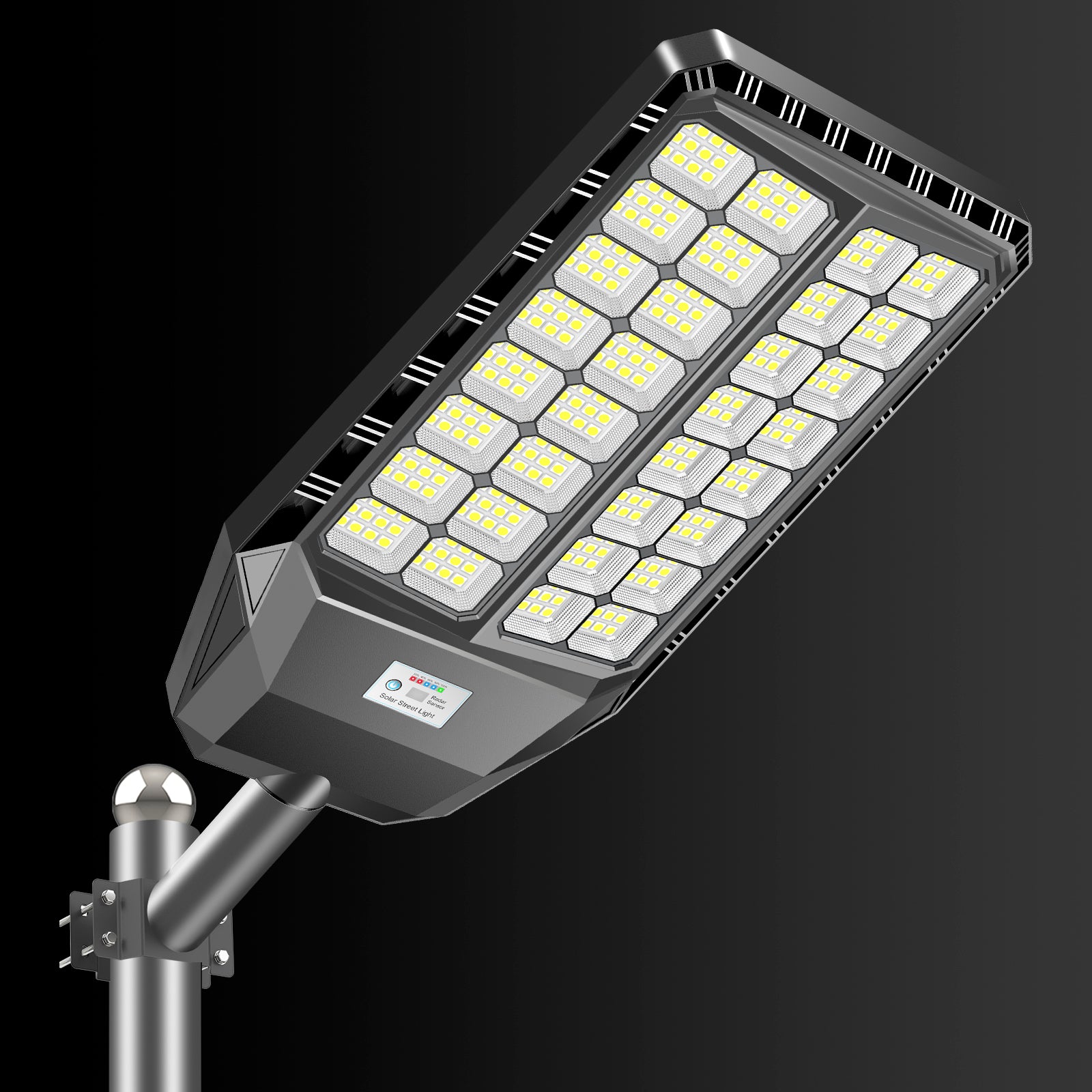
Enough theory. Here are specific Hykoont products that disclose LiFePO4 chemistry, MPPT controllers, real Wh capacity, and IP65+ ratings — openly, in the product specs.
NT60A — 60W Solar Street Light, 230Wh LiFePO4 + MPPT | $582

The NT60A is one of the most honestly-specified mid-range commercial solar street lights on the market. The listing tells you exactly what you need to know: 60W LED, 12.8V / 230Wh LiFePO4 battery, MPPT controller, 7,200 lumens, waterproof aluminum body.
No vague "lithium battery" claim. No undisclosed charge controller. No mystery Wh number.
Key specs:
- Battery: 12.8V / 230Wh LiFePO4 — approximately 2,000+ cycle life
- Charge controller: MPPT — 15–30% better harvest vs. PWM equivalents
- Output: 7,200 lumens — effective for 20–30 ft pole height, 20–25 ft spacing
- Housing: waterproof aluminum body, IP65
- Designed for: parking lots, commercial walkways, small street segments
Price: $582/unit
→ View NT60A Details & Buy Now
NT100A — 100W Solar Street Light, 320Wh LiFePO4 + MPPT | $762

Step up to the NT100A when you need higher output and more battery reserve. At 320Wh with an MPPT controller, this fixture has the energy budget to handle multiple consecutive overcast days without performance degradation.
Key specs:
- Battery: 320Wh LiFePO4 — 38% more reserve than the NT60A
- Output: 100W LED, high-brightness — suitable for main parking areas, roadways, campus paths
- Charge controller: MPPT
- All-weather rated — IP65, aluminum housing
- Backup autonomy: 2–3 cloudy days at full brightness
Price: $762/unit
→ View NT100A Details & Buy Now
HY080 — 80W Solar Street Light, 538Wh LiFePO4 + Adjustable CCT | $999

The HY080 is where the battery spec becomes exceptional. At 538Wh LiFePO4, this fixture carries nearly double the reserve capacity of the NT100A — designed specifically for applications where extended cloudy-weather autonomy is a priority, or where the installation site has sub-optimal solar exposure.
The adjustable CCT feature is a practical bonus: dial in 3000K for residential-adjacent zones, 4000K for general commercial areas, or 5000K for security-critical lighting — all from the same fixture.
Key specs:
- Battery: 538Wh LiFePO4 — one of the highest reserve capacities in this power class
- CCT: adjustable — warm to daylight spectrum
- Output: 80W LED with adjustable brightness modes
- Ideal for: northern climates, shaded installations, properties with high reliability requirements
- Backup autonomy: 3–5 cloudy days depending on dimming profile
Price: $999/unit
→ View HY080 Details & Buy Now
HY100C — 100W Commercial Solar Light, 960Wh LiFePO4, 10-Year Panel | $1,890

This is the specification for property owners who calculate total cost of ownership rather than just purchase price. The HY100C's 960Wh LiFePO4 battery represents a fundamentally different category of autonomy — approaching a full week of operational reserve at reduced brightness.
The 10-year solar panel lifespan spec is also meaningful: most panels are rated for 20–25 years at 80%+ efficiency, but specifying a 10-year guarantee communicates a manufacturer's confidence in their panel sourcing and quality control.
Key specs:
- Battery: 960Wh LiFePO4 — 3x the reserve of the NT100A
- Output: 100W LED, commercial-grade lumen output
- Solar panel: 10-year rated lifespan
- Housing: commercial aluminum, IP65+
- Best for: critical infrastructure, northern installations, high-reliability commercial properties, large-scale projects where downtime is unacceptable
Price: $1,890/unit
→ View HY100C Details & Buy Now
OK15A — 15W Solar Flood Light, 90Wh LiFePO4 | $184

Not every application needs a commercial street light spec. The OK15A applies the same LiFePO4 + monocrystalline panel combination to a compact flood light form factor — making quality battery chemistry accessible at a residential-friendly price point.
At $184, this is the honest answer to the question: "Can I get a genuinely good solar light without spending $700+?" For accent lighting, entry paths, driveway edges, garden areas, and low-mount security lighting, yes — if the chemistry is right.
Key specs:
- Battery: 90Wh LiFePO4 (monocrystalline panel pairing)
- Output: 15W LED flood configuration
- Form factor: compact, wall/surface/stake mount options
- Best for: residential entries, garden paths, low-mount security lighting, small commercial accent applications
Price: $184/unit
→ View OK15A Details & Buy Now
The Battery Evaluation Checklist (Print This Out)
When evaluating any solar light purchase, run through these questions before committing:
- ☐ What is the battery chemistry? (LiFePO4 = good; "lithium" alone = ask more questions; lead-acid = pass)
- ☐ What is the capacity in Wh? (Not just mAh — convert to Wh by multiplying Ah × voltage)
- ☐ What is the rated cycle life? (2,000+ cycles = commercial-grade; under 500 = consumer-grade)
- ☐ What is the charge controller type? (MPPT = good; PWM = acceptable only for very simple/low-cost applications)
- ☐ What is the cold-temperature performance spec? (Should list capacity retention at 0°F or lower)
- ☐ What is the IP rating? (IP65 minimum for commercial outdoor; verify seal material quality)
- ☐ What are the dimming modes and runtime per mode? (Total runtime should break down by brightness level)
- ☐ What is the backup autonomy claim? (How many consecutive days without solar input?)
A manufacturer who can answer all eight of these questions confidently — in writing, in the product listing — is selling you a product they believe in. Vague answers or non-answers tell you something too.
A Note on Price vs. Battery Quality
LiFePO4 batteries cost more to manufacture than generic Li-ion or lead-acid alternatives. This is a real cost difference, not a marketing markup. When you see a 100W solar street light for $89, the math doesn't work for LiFePO4 chemistry — those cells simply cost more than that product's total bill of materials can accommodate.
This doesn't mean all expensive solar lights are good. It does mean that any solar light claiming commercial-grade battery performance at sub-$150 price points for high-wattage systems should be treated with significant skepticism.
The right frame isn't "how cheap can I go?" It's "what's the minimum specification I need for this application, and what's the lowest cost product that genuinely meets it?"
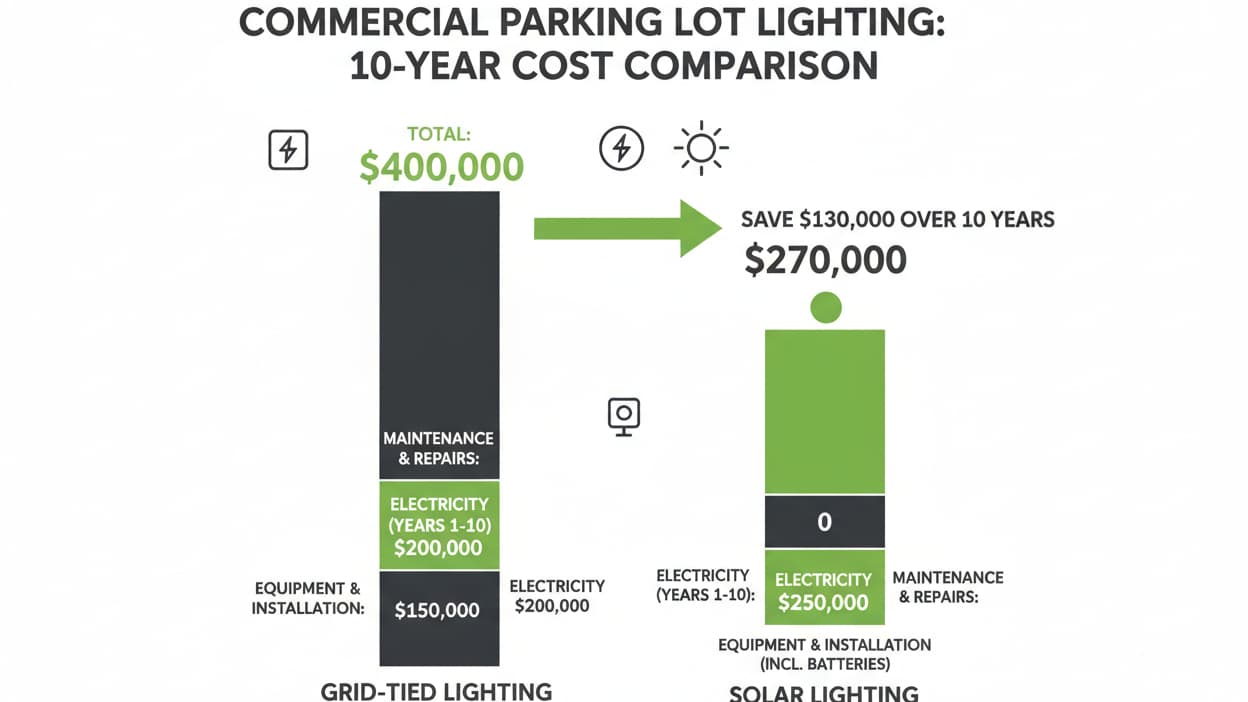
For a residential garden accent light with modest requirements: the OK15A at $184 with real LiFePO4 cells represents honest value. For a 20-fixture commercial parking lot installation: spending $582–$999 per unit to get MPPT + LiFePO4 chemistry pays back in 3–4 years through lower replacement costs alone — before energy savings are even factored in.
Frequently Asked Questions
How long does a LiFePO4 solar battery actually last?
LiFePO4 batteries are rated for 2,000–4,000 charge cycles at 80% depth of discharge. At one full cycle per day (typical for a solar light that charges during the day and discharges at night), that's 5.5 to 11 years before the battery drops below 80% of its original capacity. After that threshold, the battery still works — it just holds less charge. Most users replace batteries between years 7–10, well after the fixture's ROI has been achieved.
Can I replace the battery in a solar street light?
In most quality commercial solar lights, yes — the battery is a replaceable component. Battery replacement is typically more straightforward than it sounds: the fixture's housing opens, the battery module disconnects from the controller (usually a standard connector), and a replacement slides in. Always verify replaceability before purchase if long-term maintenance cost is a concern for your application.
Why does my solar light go dim after a few months in winter?
Two likely causes: battery capacity loss from cold weather (especially if the fixture uses non-LiFePO4 chemistry), or insufficient solar panel wattage to fully recharge the battery during short winter days. The fix depends on your fixture. If it uses LiFePO4 and the battery is properly sized, the issue is probably panel-side — the panel isn't harvesting enough to replenish what's used each night. An MPPT controller helps significantly here by extracting maximum energy during limited daylight hours.
What's the difference between MPPT and PWM charge controllers in practice?
In ideal conditions (full sun, mid-day), the difference is 15–20% more energy harvested with MPPT. In marginal conditions (overcast, partial shade, early morning, late afternoon), the MPPT advantage grows to 30–40% or more. For commercial applications that need consistent performance through seasons, MPPT is meaningfully better. For a simple garden accent light that only needs occasional operation, PWM is acceptable.
Is IP65 waterproofing enough for coastal installations?
For coastal areas with salt spray exposure, IP65 is the minimum — but pay close attention to housing and fastener materials. Aluminum housings should be anodized or powder-coated, and fasteners should be 316 stainless steel rather than standard zinc-plated steel. Salt spray corrodes inferior fasteners and compromises IP-rated seals over 2–3 years. Some manufacturers offer marine-grade variants specifically for coastal applications.
How do I know if a solar light's battery claim is accurate?
Ask for the battery cell model number or chemistry designation. Any manufacturer confident in their battery will provide this. You can then cross-reference the cell spec sheet for rated cycle life, temperature performance, and capacity. If a manufacturer is unwilling or unable to provide battery cell information, that itself is useful information about their product.
Do solar lights need maintenance?
Minimal, but yes. Best practice: clean solar panel surfaces 1–2 times per year (dust and pollen reduce harvest efficiency by 5–15%), inspect mounting hardware and housing seals annually, and check battery terminal connections every 2–3 years. MPPT controllers and LiFePO4 batteries are largely self-managing, but a brief annual inspection catches any developing issues before they become outright failures.
Can solar lights work in areas that get snow?
Yes, with caveats. Snow accumulation on solar panels obviously reduces or eliminates charging. Well-designed commercial fixtures minimize this through panel tilt angles that encourage snow shedding. More importantly, a properly sized LiFePO4 battery with 3–5 days of reserve autonomy can sustain full operation through most snowstorms and associated cloudy periods. For areas with persistent snow cover (Alaska, northern Minnesota, high-altitude locations), hybrid grid-backup systems may be worth evaluating.
What does "monocrystalline" mean and why does it matter for solar panels?
Monocrystalline silicon solar cells are cut from a single crystal structure, resulting in higher electron mobility and better efficiency — typically 20–22% vs. 15–17% for polycrystalline panels. In practical terms, a monocrystalline panel harvests more energy per square inch, which matters when panel size is constrained by fixture design. Higher efficiency also means better low-light performance — useful during overcast conditions or in the first and last hours of daylight.
Are there federal tax incentives for commercial solar lighting?
Potentially yes. Solar lighting systems may qualify for the federal Investment Tax Credit (ITC) under Section 48 of the Internal Revenue Code, depending on system configuration and how the installation is classified. The ITC has historically provided a 26–30% credit on qualifying solar energy equipment. Commercial property owners should consult a tax advisor to determine specific eligibility — the rules around what qualifies as "solar energy property" have nuances that require professional review for your specific situation.
The Bottom Line
The solar lighting industry has a transparency problem. Not because the technology doesn't work — it does, impressively well when properly engineered — but because marketing language has evolved faster than buyer education.
Five things worth remembering from this article:
- Battery chemistry (LiFePO4 vs. generic Li-ion vs. lead-acid) determines real-world lifespan more than any other single factor
- Runtime claims mean nothing without Wh capacity and dimming profile disclosure
- Cold-weather performance is a dealbreaker specification for northern US installations
- MPPT controllers harvest 15–30% more energy than PWM — and that difference compounds over years
- IP65 is the floor, not the ceiling, for commercial outdoor weatherproofing
The products that openly disclose all five of these specifications — like the NT60A ($582), NT100A ($762), and HY100C ($1,890) — aren't just marketing honestly. They're telling you their engineers did the work that makes those specifications worth disclosing.
That's the filter. Use it.
→ Shop NT100A — 100W LiFePO4 Solar Street Light ($762)

Leave a comment
This site is protected by hCaptcha and the hCaptcha Privacy Policy and Terms of Service apply.