







Here's a conversation we have on repeat with facility managers: they installed commercial solar lights three years ago, the fixtures still look fine, but by month 30 the lights are dim by 9 p.m. and dark by 2 a.m. Nothing broke. No vandalism, no cracked panel, no water in the housing. The battery just quietly gave up years ahead of schedule. Nine times out of ten, the culprit is sitting inside the pole housing the whole time: a cheap PWM charge controller that's been overcharging or undercharging the battery every single day since installation.
This is where MPPT — Maximum Power Point Tracking — earns its keep. It's not a marketing sticker. It's the difference between a solar street light that limps to year 3 and one that's still running strong at year 8 or 10. If you're specifying commercial solar street lights for parking lots, warehouse yards, campuses, or municipal roads, understanding what's inside that controller box matters more than the wattage number on the spec sheet.
The problem nobody warns you about: solar lights that die young
Ask anyone who's managed a fleet of solar area lights and they'll tell you the same story. The first year, everything's great. The second year, a few units start dimming early. By year three, you're replacing batteries — sometimes the whole fixture — on lights that were sold with a "10-year lifespan" on the box.
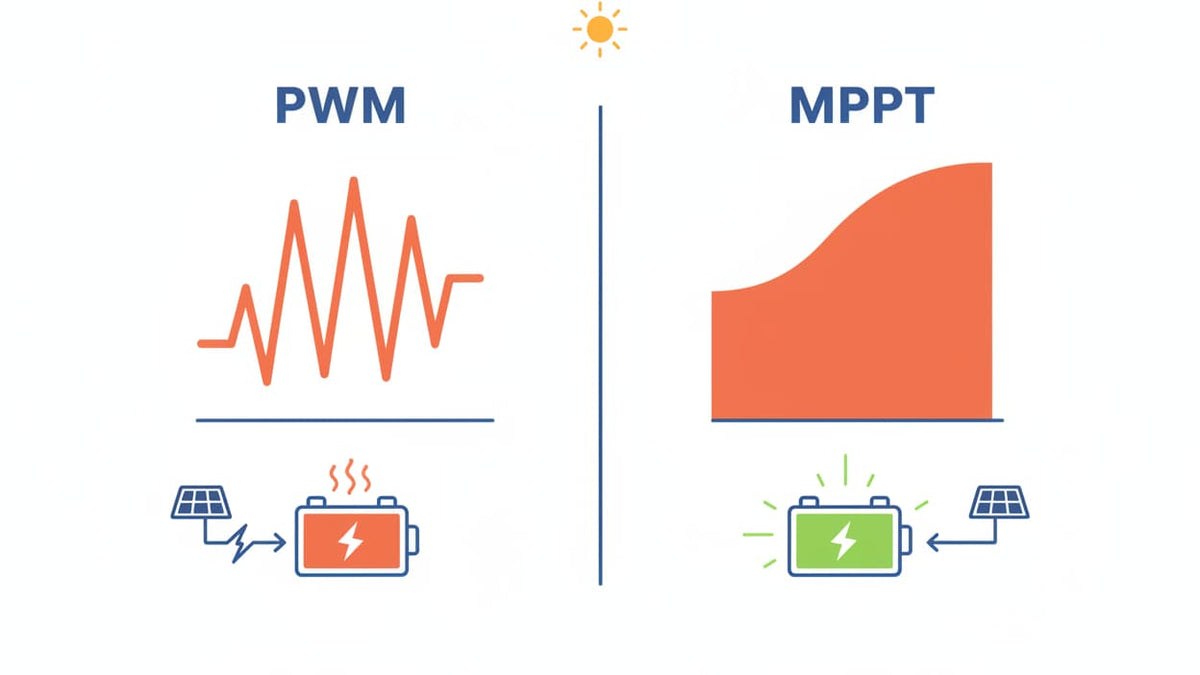
The battery is almost always the first thing to go, and it's rarely a defective cell. It's death by a thousand small overcharges. A basic PWM (pulse-width modulation) controller connects the solar panel almost directly to the battery. When the panel is producing more voltage than the battery needs — which happens constantly on clear days — that excess voltage gets dumped straight into the battery instead of being converted into usable current. The battery runs hot, the internal chemistry degrades faster, and the usable capacity shrinks year over year. It's a bit like constantly overfilling a gas tank until it starts leaking from the seams.
MPPT controllers solve this at the source. Instead of forcing a direct voltage match, an MPPT controller constantly hunts for the sweet spot on the panel's power curve — the exact voltage and current combination that pulls the most watts out of the panel — and then converts that into the precise voltage and current the battery actually wants. The result is a battery that charges efficiently, runs cooler, and isn't chemically abused every single afternoon.

So what does "double the lifespan" actually mean in practice?
We don't throw that number around loosely. Lithium batteries (LiFePO4, which is what you'll find in any solar light worth buying today) are rated in charge cycles — typically 2,000 to 3,000+ full cycles before capacity drops below 80%. But that cycle rating assumes proper charging. Feed a LiFePO4 battery a rough, unregulated charge every day for a few years and you can knock 30-50% off its real-world service life, even though the cycle count on paper hasn't changed.
Field data from commercial installs backs this up pretty consistently: sites running MPPT-equipped fixtures are seeing 7-10 years of reliable nightly operation before a battery swap is even on the table, versus 3-4 years for PWM-based units under the same sun exposure and load. That's not a marginal upgrade — that's the difference between one battery replacement cycle and two or three over the life of the fixture. When you're managing 40, 80, or 200 poles across a property, that math adds up fast in labor and parts alone, before you even count the downtime of dark parking lots.
There's a second, quieter benefit too: MPPT controllers squeeze more usable energy out of the same panel, especially on cloudy days, in winter, or when a panel is partially shaded by a tree branch or an adjacent building. That efficiency gain — commonly 20-30% more harvested energy compared to PWM under identical conditions — means your battery starts each night fuller, which means less deep discharging, which loops right back into longer battery life. It's a compounding effect, not a one-time bump.
Why this matters more for commercial sites than residential ones
A homeowner with a single solar light in the backyard can tolerate some inefficiency — worst case, the light dims a little early and nobody's calling a lawyer about it. Commercial sites don't get that luxury. Parking lots, loading docks, apartment complexes, and municipal walkways carry real liability if lighting fails: slip-and-fall claims, security incidents, insurance requirements, ADA and lighting-code compliance. A dark corner of a parking structure isn't just an inconvenience, it's exposure.
That's exactly why commercial-grade fixtures need to be engineered for consistency, not just peak output. A 100W fixture that produces 18,000 lumens on day one but drops to 9,000 lumens by year three because of battery degradation isn't actually a 100W commercial light — it's a light that was commercial-grade for about 30% of its advertised lifespan. MPPT control is what keeps that lumen output honest year after year.

Fixtures built around real MPPT control, not just the checkbox
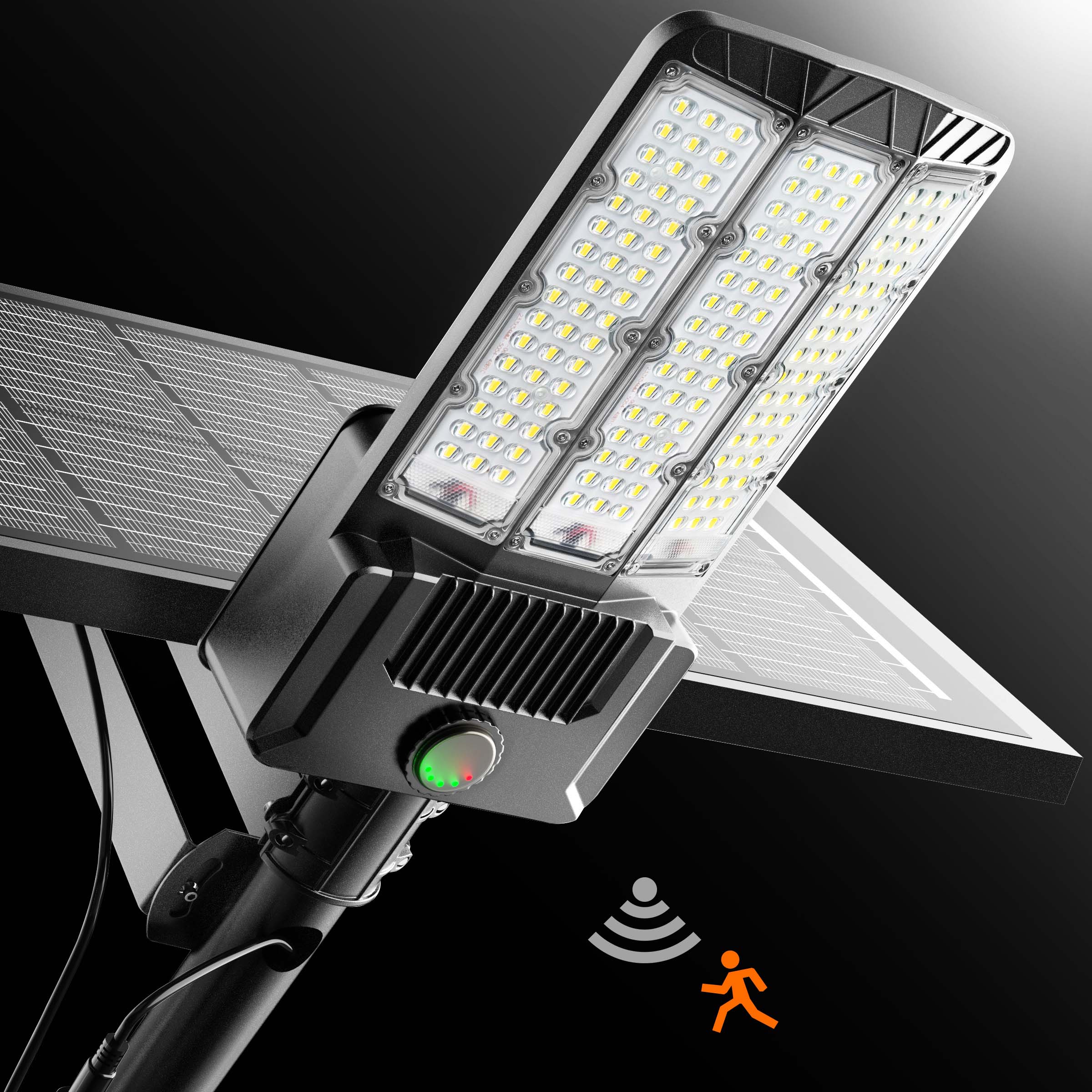
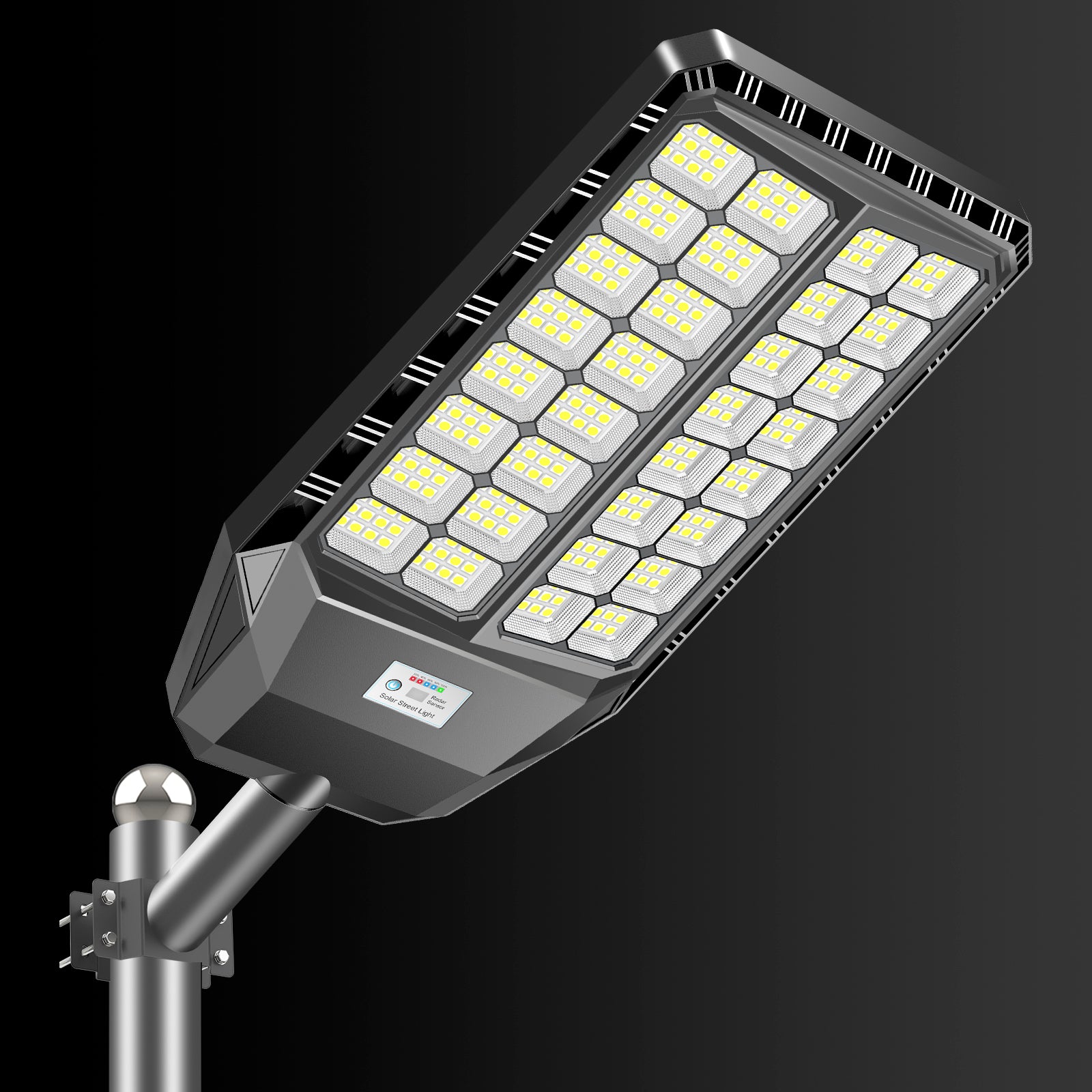
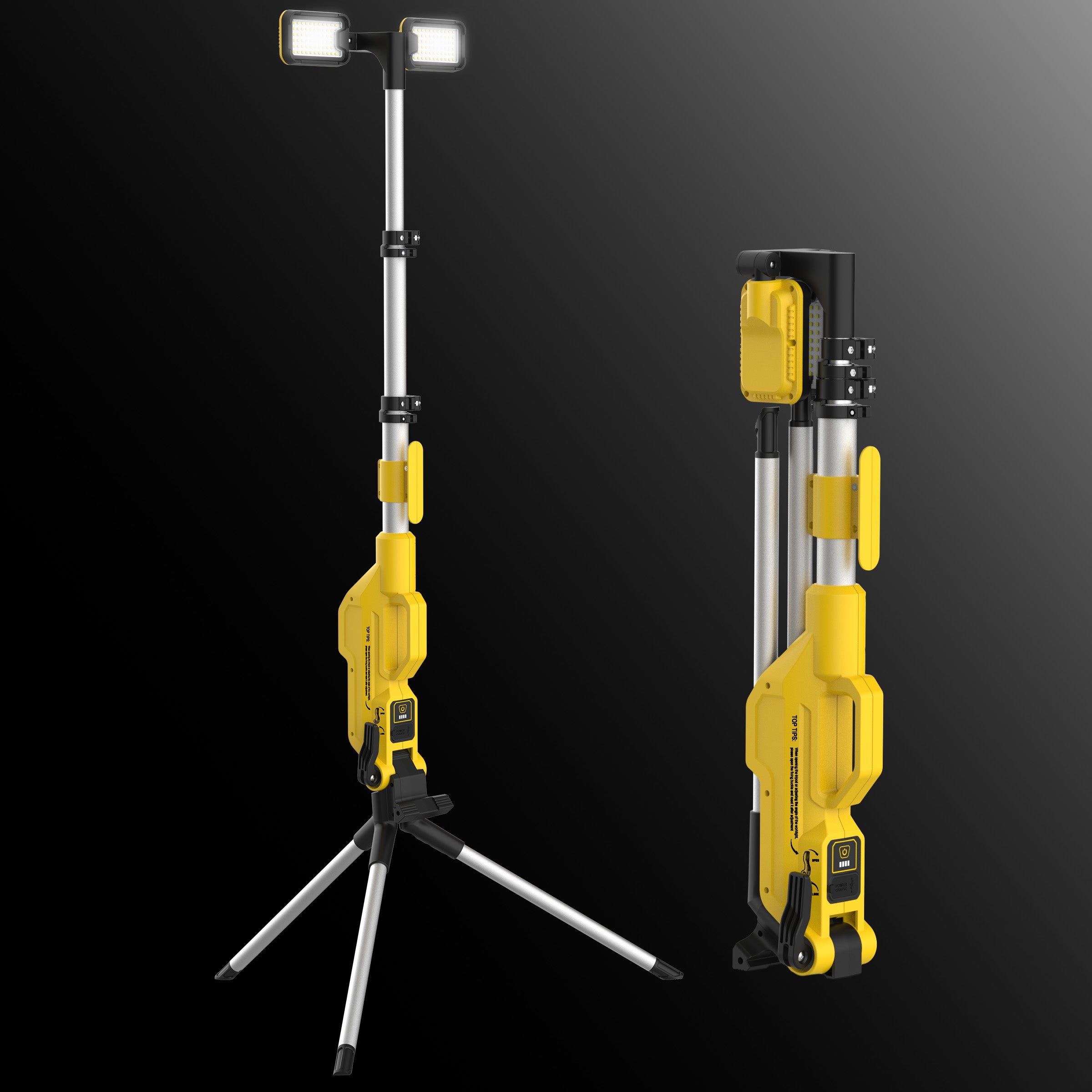
We get asked a lot which of our own lights actually use proper MPPT charging versus a basic regulator with an MPPT label slapped on it for the spec sheet. Here are four commercial-grade options from the current lineup that use genuine MPPT/intelligent charge control, along with what they cost and where they fit:
HY120 — 200W Commercial Solar Street Light, 1152Wh LiFePO4, Adjustable CCT with MPPT Control

Price: $1,914
This is the workhorse for large commercial lots — think big-box retail parking, distribution yards, and long municipal roadways where you need serious throw distance and all-night reliability through overcast winter stretches. The 1152Wh battery bank paired with real MPPT charging is what lets this fixture run at full output through 3-4 consecutive cloudy days without a noticeable dip. Adjustable color temperature lets you match it to existing site lighting during a phased retrofit.
HY100C — 100W Commercial Solar Light, 960Wh LiFePO4, 10-Year Rated Solar Panel

Price: $1,890
If your priority is maximum battery reserve over raw brightness, this is the one to look at. The oversized 960Wh bank gives it days of stored runway, and because the charging circuit is MPPT-managed, that big battery actually gets filled efficiently instead of sitting at a chronic partial charge — a common failure mode on oversized batteries paired with weaker controllers.
NT100A — 100W High-Brightness Solar Street Light, 320Wh LiFePO4 with MPPT Controller

Price: $762
A solid mid-tier pick for smaller commercial applications — think church lots, self-storage facilities, and neighborhood entrances — where you still want dependable all-weather output but don't need the battery capacity of the HY-series. The MPPT controller here does the same efficiency work at a smaller scale, so you're not paying commercial pricing for residential-grade charging.
YK080 Pro — 80W Solar Street Light, 160Wh Battery, MPPT Control with 40W Solar Panel

Price: $365
This is the budget-conscious commercial option that still refuses to cut corners on the charging side. Adaptive lighting dims the fixture during low-traffic hours to stretch the battery further, and the MPPT controller is doing exactly what it does on the bigger units — just sized down. Good fit for walkways, smaller lots, and secondary access roads where a 200W fixture would be overkill.
Every one of these ships with the MPPT controller built into the fixture housing — there's no separate box to mount or wire, which keeps installation as simple as a standard pole-top fixture.
How to actually tell if a controller is real MPPT or dressed-up PWM
This is where a lot of buyers get burned, because "MPPT" gets printed on spec sheets pretty loosely these days. A few things worth checking before you commit to a large order:
- Ask for the conversion efficiency number. Real MPPT controllers typically run 93-97% efficiency. If a supplier can't produce that number, or it's suspiciously close to 100%, be skeptical.
- Ask how the controller performs in partial shade. True MPPT tracks the power curve dynamically, so it should maintain reasonable output even when part of the panel is shaded. A relabeled PWM unit will show a sharp, disproportionate drop.
- Check the temperature compensation spec. Good MPPT controllers adjust charging voltage based on battery temperature, which matters a lot if you're deploying across regions with real seasonal swings.
- Look at the battery chemistry match. A controller advertised as MPPT should have charge profiles specific to LiFePO4 — not a generic lead-acid profile awkwardly applied to a lithium pack.
If you want a second opinion on any spec sheet before placing a bulk commercial order, our team is happy to walk through it — just reach out through the store and mention which fixture you're comparing.
A closer look at how the tracking actually works
It helps to picture the solar panel's output as a curve rather than a fixed number. At any given moment — depending on sun angle, cloud cover, temperature, and time of day — a panel has one specific combination of voltage and current where it's producing the most watts. Move away from that point in either direction and you leave power on the table, even though the panel itself hasn't changed.
A PWM controller doesn't care about that curve at all. It just ties the panel's voltage to whatever the battery happens to be sitting at, which is almost never the panel's most efficient operating point. Early morning and late afternoon — exactly when a lot of real-world solar charging happens, especially in fall and winter — are when this mismatch is worst, because the panel is producing power at a voltage the battery doesn't want yet.
An MPPT controller runs a constant scanning routine, usually dozens of times per second, nudging its input voltage up and down and measuring the resulting power output. When it finds the peak, it locks onto it and converts that power down to whatever voltage and current the battery needs at that moment, adjusting continuously as clouds pass, the sun moves, or temperature shifts. That conversion step is also where the temperature compensation comes in — a quality controller reads the battery's temperature and adjusts the target charge voltage accordingly, since a battery in Phoenix in July needs a different charge profile than one in Minneapolis in January.
None of this is visible to anyone standing under the pole at night. What's visible is the outcome: a battery that's consistently topped off without being overstressed, a fixture that holds its rated lumen output for years instead of months, and a lot fewer 2 a.m. calls about a dark corner of the lot.
Running the numbers: what a battery swap actually costs you
It's worth putting real numbers next to the "double the lifespan" claim instead of just taking it on faith. Say a property has 40 solar pole lights running PWM controllers, and the batteries need replacing every 3.5 years on average — which lines up with what we consistently hear from facilities teams running older fixtures. A commercial-grade LiFePO4 replacement pack for a mid-size fixture typically runs somewhere between $150 and $400 depending on capacity, and that's before you add labor, since most of these packs are sealed inside the pole head and require a lift truck and an electrician's time to access.
Over a 10-year ownership period, that 3.5-year cycle means roughly two full battery replacement rounds across the property — once around year 3-4, and again around year 7. At even a conservative $250 per battery plus $75 in labor per fixture, that's about $13,000 in battery-related costs alone across 40 poles, on top of the schedule disruption of coordinating a lift truck for two separate rounds of maintenance.
Now compare that to an MPPT-equipped fixture holding out 7-10 years before its first battery swap. Across that same 10-year window, you're looking at zero to one replacement rounds instead of two, cutting that battery-related cost roughly in half — and that's before counting the soft costs of dim or dark lighting: complaint calls, security incident risk, and the reputational hit of a shopping center or apartment complex with visibly neglected lighting. The upfront price difference between an MPPT fixture and a bargain PWM unit is almost always smaller than what you'll spend chasing the PWM unit's battery problems over the same decade.

Sizing the right fixture for your property
A question we get constantly: "which wattage do I actually need?" It's less about matching a number on a spec sheet and more about matching battery capacity and MPPT efficiency to your site's actual light-hours and sun exposure. A few rules of thumb that hold up across most commercial installs:
- Main parking lots and high-traffic driveways generally call for the 100-200W range with a large battery bank, like the HY120 or HY100C, since these areas run all night at higher brightness and can't afford a dim night after a stretch of cloudy weather.
- Secondary lots, storage yards, and access roads can usually run comfortably on 80-100W fixtures like the NT100A, especially if the site allows some dimming during off-peak overnight hours.
- Walkways, smaller entrances, and lower-traffic areas are a good match for something like the YK080 Pro, where adaptive dimming stretches the smaller battery further without sacrificing the sightline safety these areas need.
- Northern latitudes and regions with long winters — think the upper Midwest or New England — benefit disproportionately from MPPT's efficiency gains, since shorter winter days and lower sun angles are exactly the conditions where PWM controllers lose the most potential charging power. If your property is in one of these regions, err toward the larger battery options.
- Sunbelt states get more forgiving charging conditions year-round, but the heat itself is harder on batteries, which is another reason a controller with proper temperature compensation — not just raw MPPT tracking — matters as much as capacity.
If you're not sure which category your property falls into, it's worth measuring actual dusk-to-dawn hours for your latitude in the depths of winter, since that's the stress-test condition every commercial fixture eventually has to survive.
What this looks like across different commercial site types
Retail and shopping center parking lots: These sites live and die by perceived safety. Shoppers avoid dim lots, and property insurers increasingly ask for documented lighting uptime. The HY120's big battery reserve means you're not gambling on a string of overcast days knocking out half your lot's lighting during the holiday shopping season, which is exactly when foot traffic — and liability exposure — peaks.
Warehouse and distribution yards: Yard lighting runs hard, often dusk to dawn with minimal dimming because of forklift and truck traffic safety requirements. That's a heavier nightly draw, which makes charging efficiency even more critical — a PWM controller under this load profile will show battery degradation noticeably faster than under lighter residential-style use.
Campus and municipal walkways: These sites often mix older PWM-based installs with newer replacements, which makes for a useful side-by-side. Facilities teams managing mixed fleets consistently report the MPPT-equipped poles need far less mid-cycle maintenance — fewer battery swaps, fewer dimming complaints logged with the grounds department.
Self-storage and secondary access roads: Lower traffic, smaller budgets, but liability doesn't disappear just because the site is smaller. This is where something like the NT100A or YK080 Pro earns its keep — commercial-grade charging discipline without the price tag of a flagship fixture.

The warranty question worth asking every supplier
Here's a detail that separates a serious commercial supplier from someone just importing generic fixtures and slapping a spec sheet on them: what exactly does the warranty cover, and for how long? A lot of budget solar lights advertise a "5-year warranty," but read the fine print and it's often 5 years on the aluminum housing and 1 year — sometimes less — on the battery and controller. Given that the battery and controller are the two components actually doing the wear-and-tear work every single day, that's the part of the warranty that should matter most to a commercial buyer.
When you're comparing fixtures, ask specifically: what's the battery warranty period, is the controller covered separately or bundled with the housing, and does the warranty require any specific maintenance documentation to stay valid. A supplier confident in their MPPT charging system will usually back the battery for several years without much hesitation, because they know the charging profile isn't going to prematurely kill the cells.
The maintenance side: what changes once MPPT is doing its job
One thing property managers don't expect: switching to MPPT-controlled fixtures doesn't just extend battery life, it also changes what your maintenance schedule looks like. Instead of budgeting for battery replacement every 3 years across the whole fleet, you're looking at staggered replacements much further out, which is a lot easier to plan and budget for. It also means fewer emergency truck rolls for "the light in row C went dark again" calls, since a well-charged LiFePO4 battery degrades gradually and predictably rather than falling off a cliff.
We'd still recommend a basic annual check — clearing dust or pollen off the panel surface, confirming the pole wiring seals are intact, and glancing at the battery voltage reading if the fixture has one. None of that is unique to MPPT units, but it's worth doing regardless since a dirty panel reduces the energy available for even the best controller to work with.
Installation doesn't get more complicated with MPPT
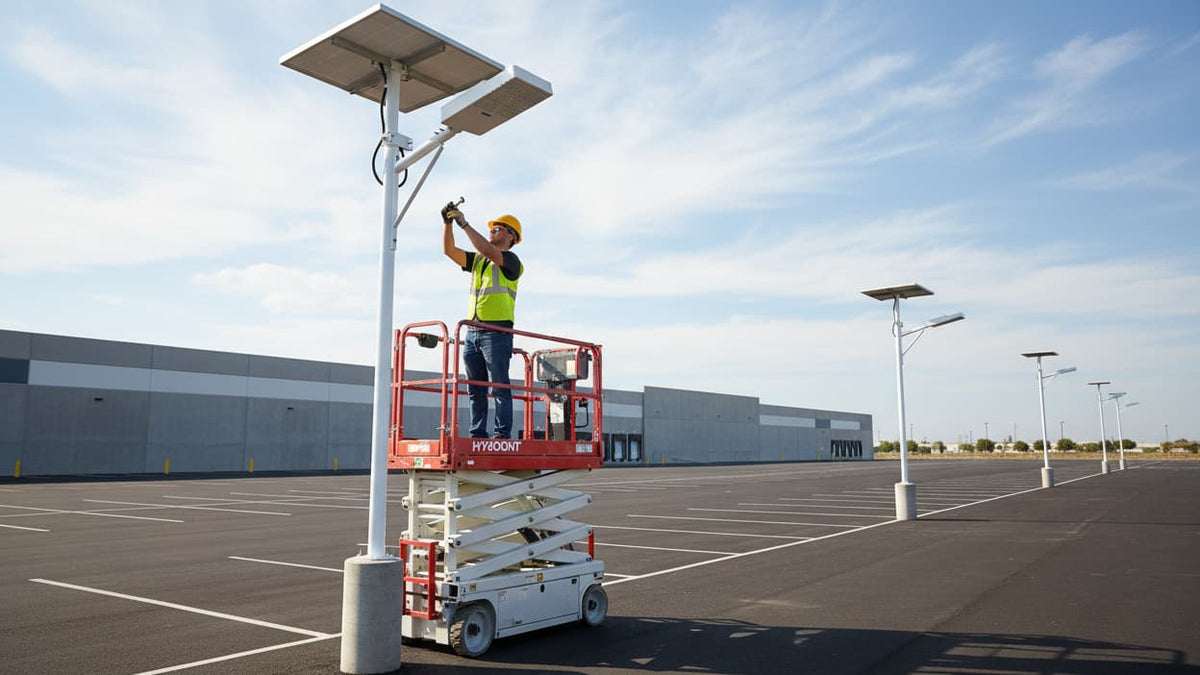
One misconception we run into is that a "smarter" controller means a more complicated install. In practice, since the MPPT circuitry is fully integrated into the fixture housing on all four models above, installation looks exactly like mounting any other pole-top solar light: bracket to the pole, secure the fixture, and it's operational — there's no separate controller box to wire in, no extra conduit run, and no additional programming required on-site. The intelligence is baked in and runs automatically from the moment the panel sees sunlight.
That matters for larger rollouts especially, since it means your electrical contractor isn't billing extra hours for a more complex install just because the internal charging technology is more advanced. The labor cost is the same as installing a basic fixture; the performance difference shows up entirely in year 3, 5, and 8, not on install day.
Making the switch on an existing property
If you're managing a property with older PWM-based solar lights that are starting to show their age, you don't necessarily need to rip out every pole at once. A lot of our commercial customers phase it in: replace the worst-performing 20-30% of fixtures first — usually the ones in the most shaded or heavily-used spots — then use that first season's performance data to justify budget for the rest. It's an easier conversation with a finance department than "replace all 150 lights at once."
Whatever your rollout speed, the specs to compare are the same three: rated MPPT efficiency, battery chemistry and capacity, and how the manufacturer backs the battery specifically (not just the fixture housing) under warranty. A fixture that only warranties the housing for 5 years but not the battery is telling you something about how confident they are in the charging system.
Frequently asked questions
What's the actual difference between MPPT and PWM solar controllers?
PWM controllers connect the solar panel almost directly to the battery and simply switch the connection on and off to control charging, which wastes a lot of the panel's potential output as heat. MPPT controllers actively track the panel's optimal voltage/current point and convert the power to exactly what the battery needs, typically harvesting 20-30% more usable energy from the same panel.
Will an MPPT controller really double my solar light's lifespan?
In practical field comparisons, yes — commercial fixtures with proper MPPT charging commonly reach 7-10 years of reliable service before a battery replacement is needed, versus 3-4 years for PWM-based units under similar conditions. The gain comes from gentler, more consistent charging that avoids the overcharge stress that degrades lithium cells early.
Do all Hykoont commercial solar lights use MPPT controllers?
The fixtures highlighted in this article — the HY120, HY100C, NT100A, and YK080 Pro — all use MPPT or intelligent MPPT-based charge control built into the housing. If you're comparing a specific model not listed here, check its product page for the charge controller spec or ask our team directly.
Is MPPT worth the extra upfront cost for a small property?
Usually, yes, once you look past the sticker price. A cheaper PWM fixture that needs a battery replacement in year 3 often costs more over a 10-year period than an MPPT fixture that doesn't, once you factor in the labor and downtime of a mid-life battery swap.
How many cloudy days can an MPPT-controlled light handle before it dims?
It depends on battery capacity, but fixtures with larger banks — like the HY120's 1152Wh or the HY100C's 960Wh — are generally rated to maintain full output through 3-4 consecutive overcast days, thanks to both the reserve capacity and the efficiency gains from MPPT charging.
Can I retrofit an existing solar light pole with an MPPT controller?
Sometimes, if the fixture design allows access to the controller and the battery chemistry is compatible, but in most commercial fixtures the controller is integrated into the sealed housing. It's usually more practical and cost-effective to replace the head unit with an MPPT-equipped fixture rather than attempt a field retrofit.
Does MPPT charging affect how bright the light is at night?
Not directly — brightness is set by the LED driver and lumen output of the fixture. What MPPT changes is how consistently that brightness is maintained over years of use, since a well-charged battery doesn't force the fixture into early dimming or low-power mode to conserve a weak charge.
What battery chemistry pairs best with MPPT controllers in solar street lights?
LiFePO4 (lithium iron phosphate) is the standard for commercial solar lighting today, and it's what all four fixtures above use. It handles more charge cycles than older lead-acid or generic lithium-ion batteries and responds well to the precise charge profiles an MPPT controller can deliver.
How do I know if my current solar lights are underperforming because of a bad controller?
Common signs include the light dimming noticeably earlier each night over a period of months, reduced runtime after a few cloudy days, or the battery reading low voltage even on sunny mornings. If you're seeing that pattern across multiple fixtures on the same property, the charge controller is a likely place to start troubleshooting.
Bottom line
The wattage and lumen numbers on a spec sheet get all the attention, but the charge controller is what determines whether your commercial solar lights are still doing their job in year 8 or already dark by year 3. If you're planning a new install or replacing aging fixtures, take a hard look at the HY120, HY100C, NT100A, or YK080 Pro — real MPPT charging built into every one of them, at price points that scale from small-lot budgets up to full commercial retrofits.
→ Shop the HY120 | Shop the HY100C | Shop the NT100A | Shop the YK080 Pro




Leave a comment
This site is protected by hCaptcha and the hCaptcha Privacy Policy and Terms of Service apply.