





There is a moment in almost every commercial lighting project when someone asks, “Should we go bifacial or monocrystalline?” It sounds like a clean either-or decision. It usually is not.
Bifacial describes how a solar module collects light. Monocrystalline describes the type of silicon cells used inside the module. A panel can be monocrystalline and bifacial at the same time. That small distinction matters because a parking lot does not reward a technology label by itself. It rewards the setup that produces dependable overnight energy, fits the pole layout, survives the site, and does not turn a simple lighting project into an expensive science experiment.
This guide looks at the choice from the point of view of a US commercial property owner, facilities manager, contractor, or lighting designer. We will compare what each approach can realistically do, where bifacial can help, where it may add no meaningful value, and how the panel decision fits with the battery, fixture, pole, controls, and installation price.
You will also find a practical parking-lot decision framework, a free comparison worksheet, worked numbers, current Hykoont product price examples, and questions to ask before you order.
Product prices and availability were checked for this article and may change. Listed product prices are equipment prices, not complete installed project prices.
First, fix the comparison: bifacial and monocrystalline are not opposites
“Monocrystalline” refers to the silicon cell material and manufacturing approach. “Bifacial” refers to a module designed to receive light from both the front and rear surfaces. A bifacial module may use monocrystalline cells. In other words, you could compare:
- A conventional monofacial monocrystalline panel.
- A bifacial monocrystalline panel.
- Another cell technology in a monofacial or bifacial design.
For a commercial parking lot, the better question is not “Which word wins?” It is: Will the rear side of the panel receive enough useful light, for enough of the year, to justify the added cost and installation complexity?
That question moves the conversation from showroom language to site conditions. If the rear of the panel is blocked by a fixture housing, pole, battery enclosure, roof, wall, or a nearly opaque mounting arrangement, bifacial capability may contribute very little. If the panel is elevated above a bright, reflective surface with open space behind it, the rear side may collect meaningful additional light.

The quick answer for most commercial parking lots
For a typical parking-lot solar street light installed on a pole, a well-sized monocrystalline panel is usually the simpler starting point. It offers a familiar, compact design and straightforward modeling. It is often the sensible choice when the panel faces the sky, the rear is partially obstructed, the pavement is dark, or the fixture is mounted as an all-in-one unit.
A bifacial design becomes more interesting when the panel has an open rear surface, the mounting geometry allows light to reach it, the ground or roof below is relatively reflective, and the additional energy can be verified with a site-specific calculation. It can also make sense on a larger commercial project where small per-light gains add up across dozens or hundreds of locations.
That does not mean bifacial is “better” in every parking lot. It means bifacial is more sensitive to how the system is installed. A good bifacial module in a poor mounting arrangement can lose to a good monocrystalline module that is aimed, sized, and maintained correctly.
What monocrystalline panels bring to a parking-lot project
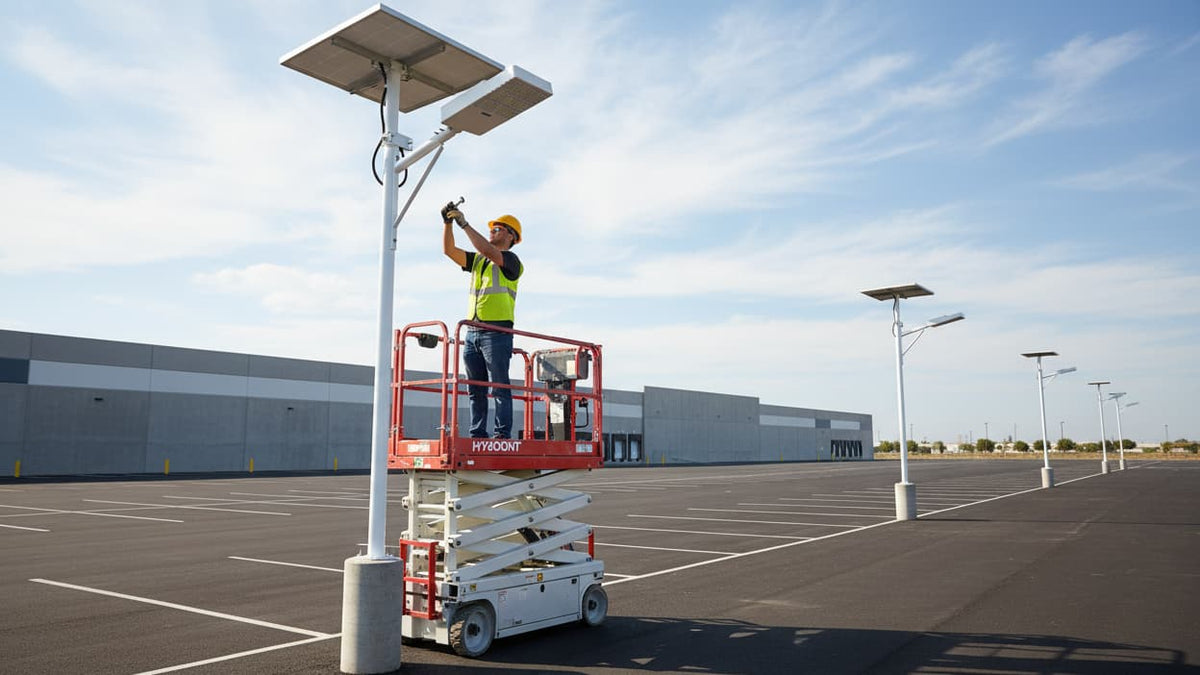
Monocrystalline panels are common in commercial solar lighting because they make efficient use of a limited surface area. A parking-lot fixture has practical size limits. The panel has to fit above or beside the light, stay within the wind profile, clear nearby trees and structures, and look acceptable to the property owner. A panel that delivers useful energy without requiring a large footprint is valuable.
A conventional monofacial panel is also easier to reason about. The main energy input is the light arriving at the front surface. That makes the initial solar estimate less dependent on pavement color, rear clearance, ground reflectance, or the exact angle of surrounding surfaces.
For a parking lot, that simplicity can be a feature. Facilities teams often care more about consistent operation and predictable maintenance than about squeezing out a theoretical gain under ideal conditions. The best panel is the one that gives the battery enough energy for the actual nighttime schedule, including the less glamorous parts of the year.
There is another practical point: panel choice is only one part of the system. A high-efficiency panel does not rescue a poorly sized battery, a shaded pole location, an aggressive all-night output schedule, or a fixture that is aimed away from the area people actually use. Start with the lighting requirement, then size the energy system around it.

Where bifacial panels can earn their place
A bifacial module has a chance to outperform a comparable front-only module when light reaches its rear surface. That can happen when the panel is elevated above a bright roof or light-colored surface, mounted with an open gap behind it, or placed in a structure that does not block rear illumination.
In a parking lot, useful rear light may come from reflected daylight off concrete, a light-colored roof, pale gravel, or other bright surfaces. The amount depends on the surface, sun angle, panel height, panel spacing, nearby buildings, weather, and how much of the rear surface is actually exposed.
That last point is easy to miss. A panel can be called bifacial, but if it is pressed against a mounting plate or surrounded by a deep opaque housing, the rear cells may not have much to see. The label tells you the module can receive rear light. It does not promise that your parking lot will provide it.
Bifacial can also be attractive when the project has a large number of repeatable poles and the design team can validate the gain. A two-percent or ten-percent improvement that is real across 200 lights is a different business case from a hard-to-measure gain on four poles behind a building.
Parking-lot conditions that decide the outcome
1. The surface below the panel
Bright concrete, pale roofing, and light gravel generally offer more reflected light than dark asphalt. That does not mean a white surface automatically makes bifacial the winner. The panel still needs an open path to the reflected light, and the useful angle changes through the day and across seasons.
If the parking lot is mostly fresh concrete, note that condition in your design brief. If it is dark asphalt with oil staining, mature trees, and tall neighboring buildings, use a conservative assumption for rear-side gain.
2. The panel’s rear clearance
Measure the actual space behind the panel, not the space shown in a catalog illustration. Check the pole, arm, fixture body, battery enclosure, backplate, cable routing, and any wind bracing. A bifacial panel needs more than a marketing claim. It needs usable exposure.
3. Shade from cars, trees, and buildings
Cars are temporary shade, but rows of vehicles can still reduce light at the wrong time of day. Trees and buildings create more predictable shading. Walk the site at different times, review a shade study for complex locations, and avoid assuming that a clear view from the driveway means a clear view from the panel.
4. Pole spacing and panel orientation
Parking-lot poles are not always oriented for maximum solar collection. They are positioned for light coverage, vehicle clearance, property lines, and aesthetics. If the best lighting direction puts the panel in a poor solar orientation, the energy model needs to reflect that compromise.
5. Dirt, pollen, and snow
Rear-side collection does not bypass maintenance. Dust on the front still reduces front-side output. Dirt or snow behind the panel can reduce the value of a bifacial design. A site beside a farm, construction yard, unpaved lot, or heavily traveled road may need a more realistic cleaning allowance.
6. The nighttime schedule
The extra daytime energy only matters if it improves nighttime performance, reduces the chance of low-battery dimming, or allows a smaller system to meet the requirement. If the battery is already oversized and the light runs at a conservative schedule, a small additional gain may not change the customer experience.

A simple comparison table
| Question | Conventional monocrystalline panel | Bifacial panel |
|---|---|---|
| What does the name describe? | Cell material and construction | Front-and-rear light collection |
| Does it need an open rear surface? | Less dependent on rear exposure | Yes, if you want meaningful rear-side contribution |
| Best fit | Compact pole-mounted lights, shaded or dark sites, predictable design | Open mounting, reflective surfaces, repeatable large projects |
| Modeling difficulty | Usually simpler | More sensitive to layout and reflectance assumptions |
| Maintenance concern | Front-side cleaning and normal service | Front and rear exposure, plus the same normal service |
| Main buying risk | Undersizing the panel or battery | Paying for rear-side potential the site cannot use |
Think of this as a decision filter, not a universal ranking. The “better” option is the one that gives you enough energy and lighting performance with the lower lifetime cost and lower operational risk.
Current Hykoont products to use as real commercial price references
The store currently has active commercial solar street light products that explicitly reference monocrystalline panels, plus higher-capacity commercial systems that are useful for comparing the whole lighting package. The current listings do not identify a bifacial product, so the examples below should not be described as bifacial. They are real product references for the monocrystalline and system-design side of the decision.

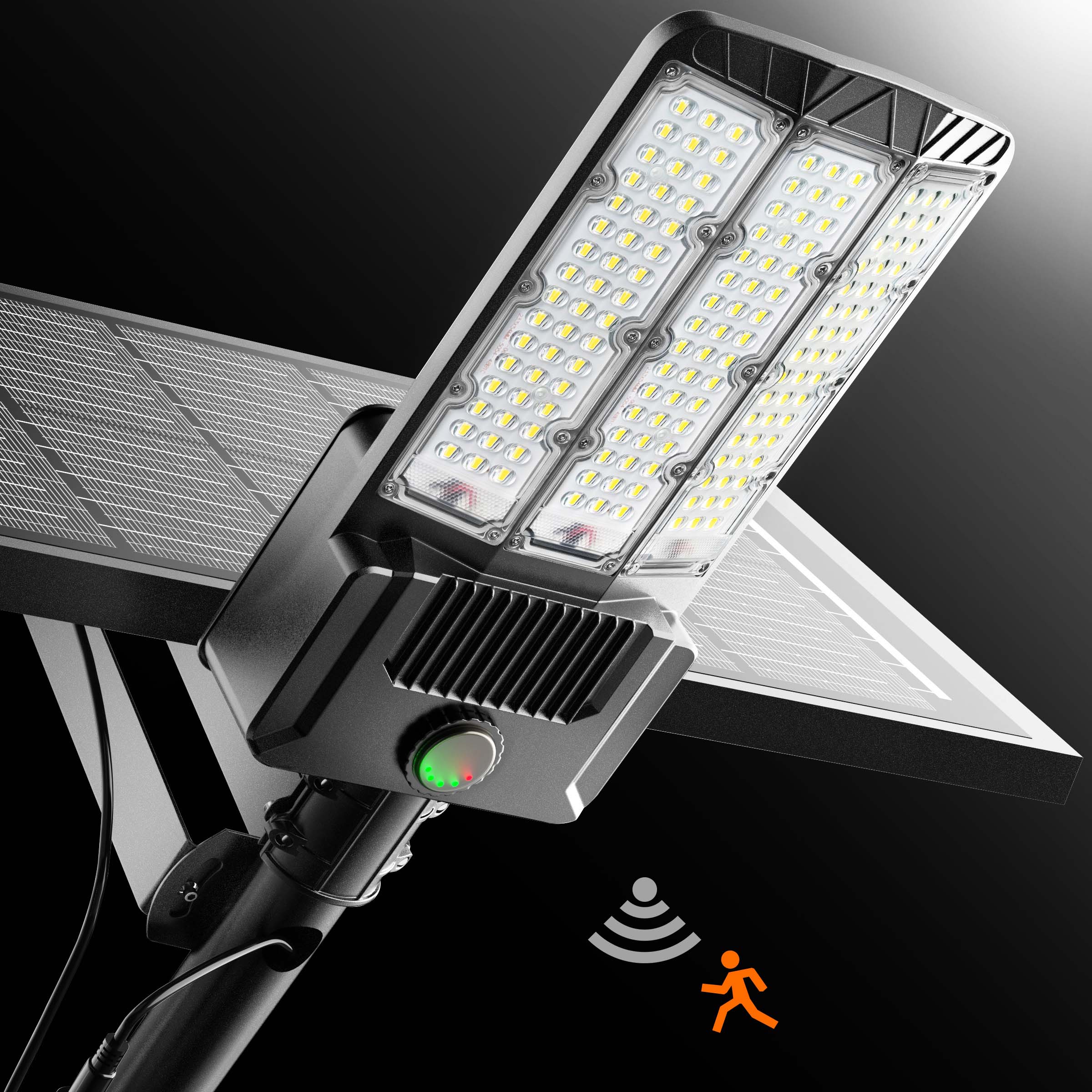
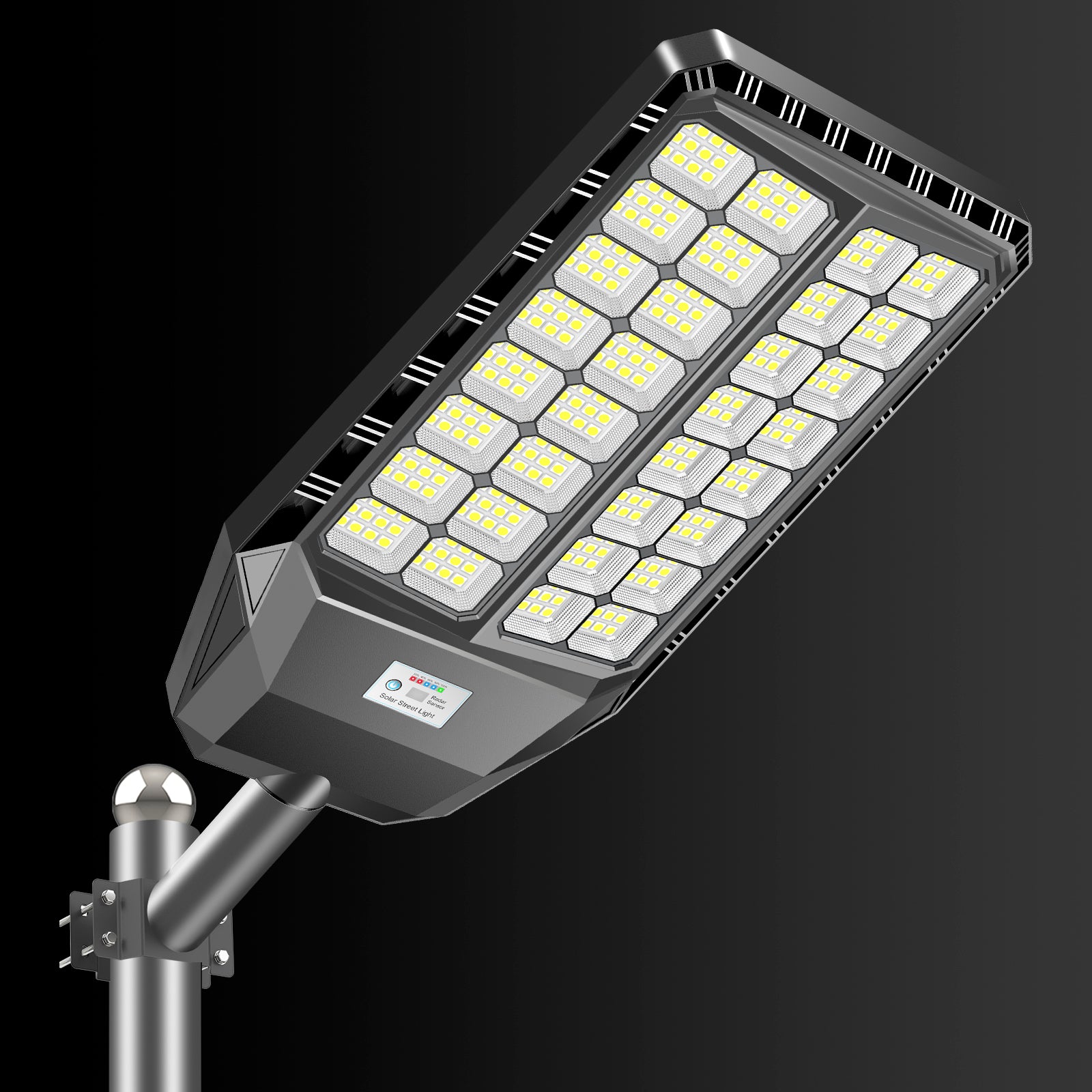
The ZD490 is the clearest product-page example for this comparison because its title explicitly references monocrystalline panels, wind resistance, and high-efficiency commercial solar lighting. The listed range matters: do not use $853 in a project model if the configuration you need is closer to $1,475. Confirm the panel, battery, mounting arrangement, and selected variant before you build the final quote.

The HY100 listing identifies a 100W commercial street light, 18,000 lumens, a 768Wh battery, and a monocrystalline solar panel in the product title. That makes it a useful reference for a parking-lot design where the energy system and the light need to be considered together. The $1,399 price is the listed product price, not the price of a pole, foundation, lift, freight, or installation.

The HY120 is a higher equipment-cost reference, listed with 200W output, a 1,152Wh battery, adjustable CCT, and MPPT control. Its product title also references a monocrystalline solar panel. For a large parking lot or commercial access road, the bigger question may be whether the added battery and control capability solve a real site problem. If the answer is yes, a higher equipment price can still produce a better project result than a cheaper light that needs wider spacing or more frequent service.

The HY100C is listed at $1,890 and includes a 960Wh LiFePO4 battery and a solar panel described with a 10-year life span in the product title. It is a useful example of why a panel comparison cannot be separated from storage. A panel with good daytime production still needs a battery and control strategy that can carry the required overnight schedule.

The HY080 is listed at $999 with adjustable CCT and a 538Wh LiFePO4 battery in the product title. It does not need to be treated as a bifacial or monocrystalline example to be useful here. It shows the other side of the commercial decision: output control, battery capacity, and the light’s schedule can matter more to a parking lot than a small theoretical panel gain.
The free parking-lot panel decision worksheet
Before you choose a panel type, fill in these fields for each candidate system:
| Field | Why it matters |
|---|---|
| Panel type and whether it is bifacial | Separates cell technology from rear-side collection. |
| Panel rated power | Sets the rough daytime energy ceiling. |
| Open rear-area percentage | Shows how much of the back surface can actually receive light. |
| Surface below the panel | Dark asphalt, concrete, gravel, roof, grass, or mixed surface. |
| Shade hours | Accounts for trees, buildings, cars, and neighboring structures. |
| Battery capacity | Converts daytime charging into overnight operating reserve. |
| Required nightly schedule | Full output, dimmed output, motion control, or a mixed schedule. |
| Equipment price | Use the exact configuration, not the lowest range shown online. |
| Installation and maintenance | Captures the lifetime cost beyond the panel label. |
Then ask the supplier for two numbers: the expected daily energy production for your site and the expected delivered energy after realistic losses. If the quote gives only a headline panel rating, it is not enough to make a bifacial-versus-monocrystalline decision.
A simple energy model for two candidate systems
For a first-pass comparison, you can use this structure:
Usable daily energy = rated panel power × equivalent sun hours × system efficiency
For a bifacial system, add a rear-side contribution only if the supplier provides a documented assumption for your mounting and surface conditions:
Bifacial usable daily energy = front-side usable energy + verified rear-side contribution
Do not plug a large rear-side percentage into the model because it sounds good. Ask what the percentage assumes. Does it require white roofing? A specific panel height? Open rack mounting? A clear rear surface? A certain ground-reflectance value? Does it apply in winter, or only under a particular test condition?
For the parking lot, the important check is whether the result covers the nighttime load with a reasonable reserve:
Nightly energy requirement = average light input watts × operating hours
Then compare required energy with the expected charging energy across the difficult season, not only a perfect summer day. A bifacial gain that looks attractive in July may be less useful when winter sun is low, the lot is shaded earlier, or the panel is covered with snow.
Worked example: when the cheaper panel wins
Imagine a 20-light commercial parking lot with dark asphalt, several mature trees, and all-in-one pole-mounted fixtures. The panels sit close to the light bodies, leaving only limited rear exposure. The site needs the lights to run from dusk through early morning, with dimming after the busiest hours.
The project team compares a standard monocrystalline configuration at $1,399 per light with a bifacial configuration priced at $1,560 per light. The bifacial option adds $161 per location, or $3,220 across 20 lights, before any changes to mounting hardware or labor.
Because the back of the panel is partly blocked and the lot is dark asphalt, the team uses a conservative rear-side contribution. The model shows that both systems meet the required schedule when paired with their planned batteries. The bifacial option does not reduce the number of poles, does not allow a smaller battery, and does not eliminate a maintenance visit.
In that case, the standard monocrystalline option may be the better business decision. It meets the lighting brief without paying for a benefit the site cannot use. The conclusion is not that bifacial technology is bad. It is that the particular parking lot is not giving it a strong enough stage.
Worked example: when bifacial becomes worth investigating
Now change the project. The parking lot is next to a large light-colored commercial roof. The panels are mounted with an open rear surface above a bright concrete area, the poles are not shaded, and the owner is installing 120 repeatable fixtures. The contractor can keep the mounting geometry consistent and provide a site-specific production estimate.
Here, even a modest verified energy gain may matter. It could provide more reserve after cloudy days, support a longer overnight schedule, or allow the team to avoid upgrading the battery on every pole. The value is not just “more watts.” It is the avoided cost of a larger storage system, fewer low-battery complaints, or a more reliable operating schedule.
Run the numbers across the full project. If bifacial adds $100 per light across 120 lights, that is $12,000 of additional equipment cost. If it avoids $180 per light in battery or installation upgrades, the project may already have a $9,600 offset before operating benefits are counted. If it changes nothing except the theoretical production number, the business case is weaker.
This is the right moment to ask for a pilot or a detailed engineering estimate. Large repeatable sites can justify more design work. Small sites usually need a simpler answer.
Panel performance is not the same as parking-lot performance
A panel can produce impressive numbers while the parking lot still feels poorly lit. Lighting performance depends on the fixture optics, mounting height, spacing, aiming, controls, and the area that needs illumination. The solar panel supplies energy. It does not decide where the light lands.
For a commercial lot, review the lighting layout separately from the energy model. Look for pedestrian paths, accessible parking, loading areas, entrances, corners, dumpster enclosures, payment kiosks, and the spaces between parked vehicles. A panel decision should never distract from a missing light where people actually walk.
Also consider glare. More light is not always more comfortable light. A good design balances visibility with a controlled beam and reasonable color temperature. The right choice may be a system with adjustable CCT or a thoughtful schedule, even if another system has a slightly more ambitious panel specification.
How the panel choice affects the battery
The battery is where daytime production becomes nighttime service. If the panel produces more energy but the battery or controller cannot use it effectively, the gain may not reach the light. Conversely, a well-managed system can use a smaller panel and battery if the nighttime schedule is modest and the site has reliable sun.
Ask these questions before comparing panels:
- What is the expected battery state of charge at the end of a typical day?
- What happens after several cloudy or snowy days?
- Does the controller accept the panel’s voltage and power range?
- Can the light dim after a chosen hour, use motion control, or adjust output?
- What reserve is required for the owner’s safety and security expectations?
- What is the replacement price and access plan for the battery?
If a bifacial panel changes the controller or mounting package, include those changes in the cost model. A panel gain is not free if it requires a different pole head, bracket, enclosure, or service procedure.
Maintenance: the quiet part of the decision
Commercial buyers tend to notice panel efficiency at purchase and maintenance access later. Reverse that order. Look at the actual site and ask how a technician will reach the panel, fixture, controller, and battery.
A bifacial panel may have two exposed surfaces to keep clear. The rear surface may face dust, leaves, bird activity, snow, or reflected debris. If cleaning the rear side requires a lift or lane closure, the maintenance cost can erase a small production gain.
Monocrystalline does not mean maintenance-free either. Front-side dirt, cracked modules, loose mounting hardware, wiring, batteries, and controls still need attention. The advantage is that the energy model can be simpler when rear-side contribution is not part of the promise.
Put an annual maintenance allowance in the project worksheet. Then add a replacement reserve for batteries and control equipment. A realistic cost model is more persuasive than a dramatic performance claim.
What to ask a supplier about a bifacial quote
If a supplier recommends bifacial for your lot, ask for answers in writing:
- Is the module monocrystalline bifacial, or is the cell type different?
- What rear-side gain is assumed, and what surface reflectance does it require?
- How much of the rear panel is exposed in the proposed mounting arrangement?
- Does the estimate account for shading from the pole, fixture, battery, and arm?
- Is the production estimate monthly or annual, and does it include seasonal losses?
- What changes in bracket, pole, wind loading, wiring, controller, or installation?
- What does the warranty cover for the panel, fixture, battery, and controller?
- How is the panel cleaned and serviced at the installed height?
- Can the supplier provide a layout showing the light pattern and the solar exposure?
If the answer is just “bifacial produces more,” keep asking. More under which conditions? More than what baseline? More energy delivered to the battery, or only more theoretical module output? Those are different claims.
Five common mistakes in a bifacial-versus-monocrystalline comparison
1. Treating the technologies as mutually exclusive
A bifacial module can use monocrystalline cells. Clarify the cell technology, the front-only or front-and-rear design, and the complete mounting arrangement.
2. Using a test-condition gain as a site guarantee
Laboratory or idealized gains do not automatically appear on a shaded asphalt parking lot. Use site conditions and conservative assumptions.
3. Ignoring the back of the panel
Rear-side collection needs space and light. A pole, fixture, housing, or opaque bracket can block the very surface you paid for.
4. Comparing panel prices instead of system prices
Compare the panel, fixture, battery, controller, bracket, pole, foundation, labor, maintenance, and replacement costs as one project.
5. Choosing energy technology before defining the lighting job
First decide where people drive and walk, when the lot must be lit, how much light is needed, and what weather reserve is acceptable. Then choose the energy system.
A practical buying path for US commercial properties
For a small lot or a site with dark asphalt and partial shade, start with a well-specified monocrystalline system. The Hykoont HY100 is a useful reference at a current listed price of $1,399, while the ZD490 gives you a higher-efficiency commercial reference with a listed range of $853–$1,475.
For larger coverage or a more demanding overnight schedule, compare the HY120 at $1,914 with the HY100C at $1,890. Their listed battery and control details are a reminder that commercial performance is a system question, not only a panel question.
For a smaller or more schedule-sensitive installation, review the HY080, currently listed at $999, and consider whether adjustable output is more valuable to your lot than a theoretical rear-side panel gain. These links use the complete product handles so the product pages resolve correctly.
Final decision checklist
- Have we clarified whether “bifacial” and “monocrystalline” are being compared as separate attributes?
- Is the rear of the proposed bifacial panel genuinely open to light?
- What is the surface below the panel, and how reflective is it throughout the year?
- How much shade comes from trees, buildings, parked vehicles, and the fixture itself?
- Does the extra panel energy change the battery size, operating schedule, or pole count?
- Have we compared complete installed project costs instead of equipment prices alone?
- Do the product price and variant match the actual configuration in the quote?
- Can the site be maintained without an expensive lift or traffic closure?
- Does the light distribution cover pedestrian and vehicle areas evenly?
- Have we modeled winter, cloudy weather, dirt, and future battery replacement?
FAQs
1. Are bifacial solar panels better than monocrystalline panels for commercial parking lots?
That comparison needs a small correction: bifacial describes rear-side light collection, while monocrystalline describes the silicon cell type. A bifacial module can be monocrystalline. For many pole-mounted parking-lot lights, a conventional monocrystalline panel is the simpler and more predictable choice. Bifacial may be worthwhile when the rear surface is open, the area below is reflective, and the added energy is verified for the actual installation.
2. Does bifacial always produce more energy?
It can collect more energy when its rear side receives useful light, but the gain depends on mounting, shading, surface reflectance, orientation, dirt, weather, and system design. If the rear is blocked or the ground is dark, the practical gain may be small.
3. Can a solar panel be both bifacial and monocrystalline?
Yes. These terms describe different attributes. Monocrystalline refers to the cells, while bifacial refers to the ability to collect light from the front and rear surfaces.
4. Is monocrystalline a good choice for parking-lot solar street lights?
It is often a practical choice because parking-lot fixtures have limited panel area and need predictable charging. The right result still depends on shade, panel size, battery capacity, operating hours, and lighting layout.
5. Does white concrete make bifacial worth the extra cost?
It may improve the conditions for rear-side collection, but it does not prove the project will pay back. Check the panel height, rear clearance, sun angles, seasonal conditions, and verified production estimate. Compare the added equipment and installation cost with the energy or battery benefit.
6. What is more important, panel type or battery size?
Neither can be judged alone. The panel must collect enough energy during the available daylight, and the battery must store enough energy for the required nighttime schedule and weather reserve. A strong system balances both.
7. How do I compare the price of a bifacial and monocrystalline system?
Compare the complete installed system: fixture, panel, battery, controller, bracket, pole, foundation, freight, labor, permits, cleaning, and replacement reserve. Use the exact product variant rather than the lowest price in a listing range.
8. Will a bifacial panel work if it is mounted close to the light fixture?
It may work, but the fixture and mounting hardware can shade the rear surface. Ask for a drawing of the actual installation and a production estimate that includes the obstruction.
9. Should I choose higher wattage for a large parking lot?
Not automatically. Higher wattage can help with coverage, but the decision also involves optics, mounting height, pole spacing, battery, controls, glare, and the required light level. A lighting layout is more useful than wattage alone.
10. Does the Hykoont catalog currently include bifacial solar street lights?
The active products checked for this article include commercial systems and products whose titles explicitly reference monocrystalline panels, but the products reviewed do not explicitly identify a bifacial configuration. Confirm the live product specification if bifacial capability is a requirement for your project.
Bottom line
For most commercial parking lots, do not start by picking a fashionable panel label. Start by looking up at the actual pole location. Is the panel shaded? Is its rear surface open? Is the ground bright or dark? How many hours does the light need to run? What happens after three cloudy days? Who will service the battery?
A monocrystalline system is often the clean, dependable answer when the site is compact, shaded, or mounted as an all-in-one light. A bifacial monocrystalline system deserves a closer look when the rear has real access to reflected light and the project is large enough for the gain to matter. Neither wins on the word printed on the box.
Ready to compare real equipment? Start with the ZD490, price the HY100, and compare the higher-capacity HY120 against your site’s complete installation cost. Then choose the panel design that makes the parking lot easier to light, easier to maintain, and easier to defend on a budget review.


Leave a comment
This site is protected by hCaptcha and the hCaptcha Privacy Policy and Terms of Service apply.