





Nobody budgets for outdoor lighting and then thinks about it again. It just runs. Month after month, the meter spins, the utility invoice arrives, and facilities managers sign off without questioning whether there's a better way to keep the parking areas, walkways, loading docks, and perimeter zones lit.
That quiet, unexamined line item is often costing commercial properties $8,000 to $40,000 per year — just for outdoor lighting electricity and maintenance. And most of it is completely avoidable with off-grid solar lighting installed correctly.
This isn't a pitch for solar on principle. It's a practical look at where the money actually goes in commercial outdoor lighting budgets, and where off-grid solar lights specifically — not rooftop solar, not grid-tied systems — can put a real dent in those numbers.
Where Commercial Outdoor Lighting Costs Actually Come From
Before talking about the fix, it helps to understand the problem clearly. Most facility managers think of outdoor lighting as a fixed cost. It's not. It's a variable cost with several components that compound over time.
1. Electricity Consumption
A typical commercial property running 30 outdoor fixtures at 150W each, 12 hours per night, consumes roughly 197,100 kWh over 10 years. At the current US commercial average of $0.13/kWh, that's about $25,600 in electricity — before rate escalation.
Commercial electricity rates have risen at a compound rate of 2.5–3.5% annually for the past decade. Run that forward and your Year 10 electricity bill is 28–40% higher than today's. The meter doesn't care about your operating budget.
2. Reactive Maintenance
Burned-out fixtures, tripped breakers, damaged conduit, water intrusion into junction boxes — grid-tied outdoor lighting generates reactive maintenance calls that rack up fast. A service truck visit from a licensed electrician in most US markets runs $150–$350 per call, before parts. Annual maintenance budgets for mid-size commercial properties with grid-tied outdoor lighting typically run $2,000–$8,000/year.
3. Infrastructure Aging
Underground conduit corrodes. Poles rust at grade. Breaker panels get overcrowded as properties add lighting zones. Every 10–15 years, most commercial properties face a partial infrastructure reinvestment that runs well into five figures — not for the fixtures, but for the wiring and conduit underneath them.
4. Demand Charges
Many commercial utility accounts include demand charges — fees based on your peak power draw during any 15-minute window in a billing period. If your outdoor lighting comes on at dusk across the whole property simultaneously, it creates a demand spike. Depending on your utility tariff, this can add $100–$500/month to your bill beyond simple kWh consumption.
Off-grid solar lighting eliminates all four of these cost categories simultaneously. That's not obvious from looking at a product listing — it becomes clear only when you map it against an actual facility budget.

What "Off-Grid" Actually Means for a Commercial Property
Off-grid solar lights aren't underpowered garden lights. The commercial-grade units relevant to facility managers are self-contained systems with:
- A monocrystalline solar panel (integrated or on a separate arm) sized to fully recharge the battery in 4–6 peak sun hours
- A lithium iron phosphate (LiFePO4) battery with 3–5 days of autonomy — meaning the lights run normally for 3–5 consecutive nights with no solar input
- An intelligent LED driver with motion sensing, dusk-to-dawn scheduling, and dimming profiles that preserve battery reserve during low-charge periods
- IP65 or IP66 weatherproofing for all-season outdoor operation
- Die-cast aluminum housings that handle -22°F to 140°F operating ranges without cracking or warping
When these components are properly matched, the result is a light that runs reliably every night, charges itself every day, and requires essentially no interaction from your maintenance team.
The Five Commercial Facility Zones Where Off-Grid Solar Wins
Zone 1: Parking Lots and Surface Areas
The highest-impact application. Surface parking lots rarely have existing underground infrastructure worth preserving, and the open sky exposure is ideal for solar panel performance. Replacing or installing lighting here with off-grid solar eliminates both the electricity cost and the trenching cost that grid-tied installs require.
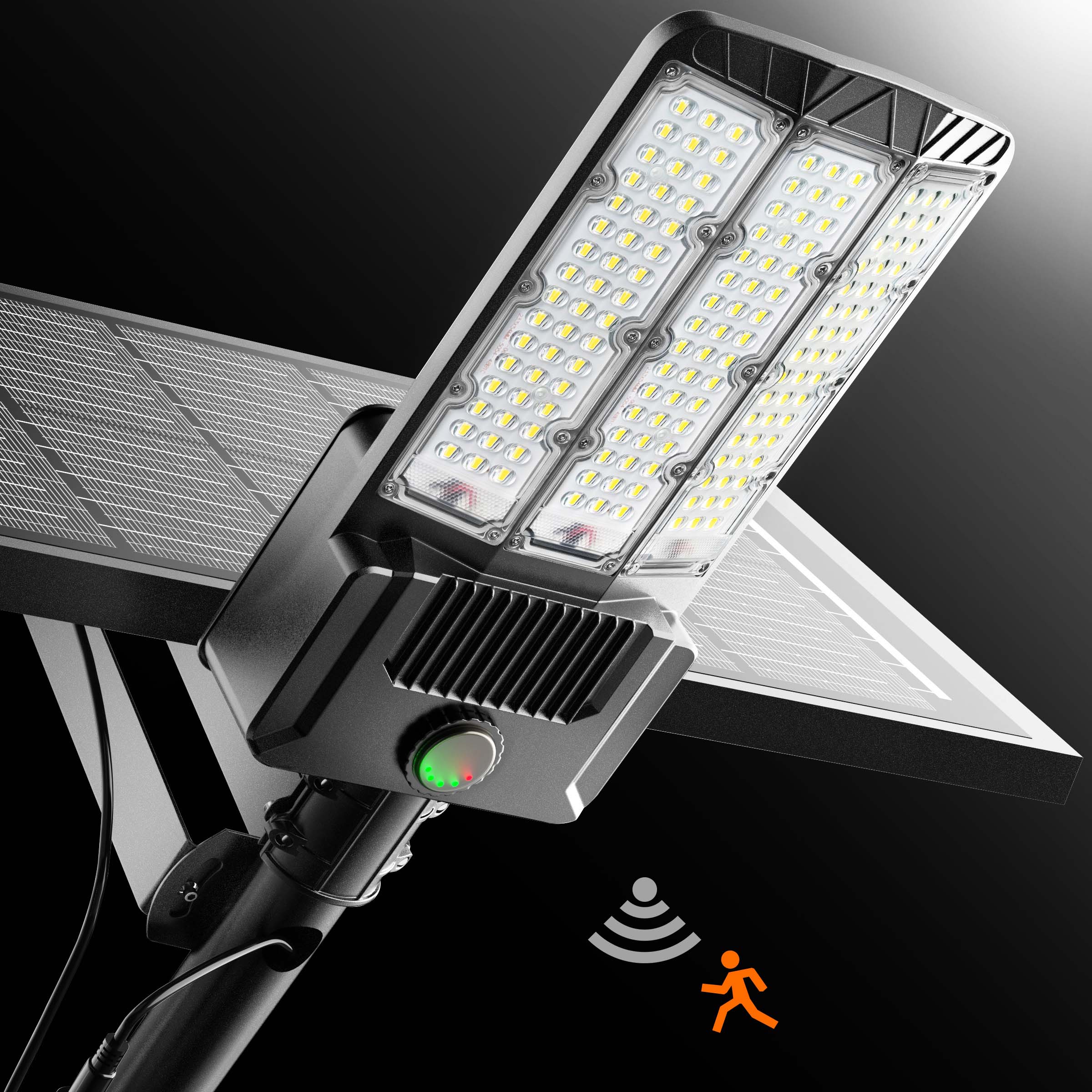
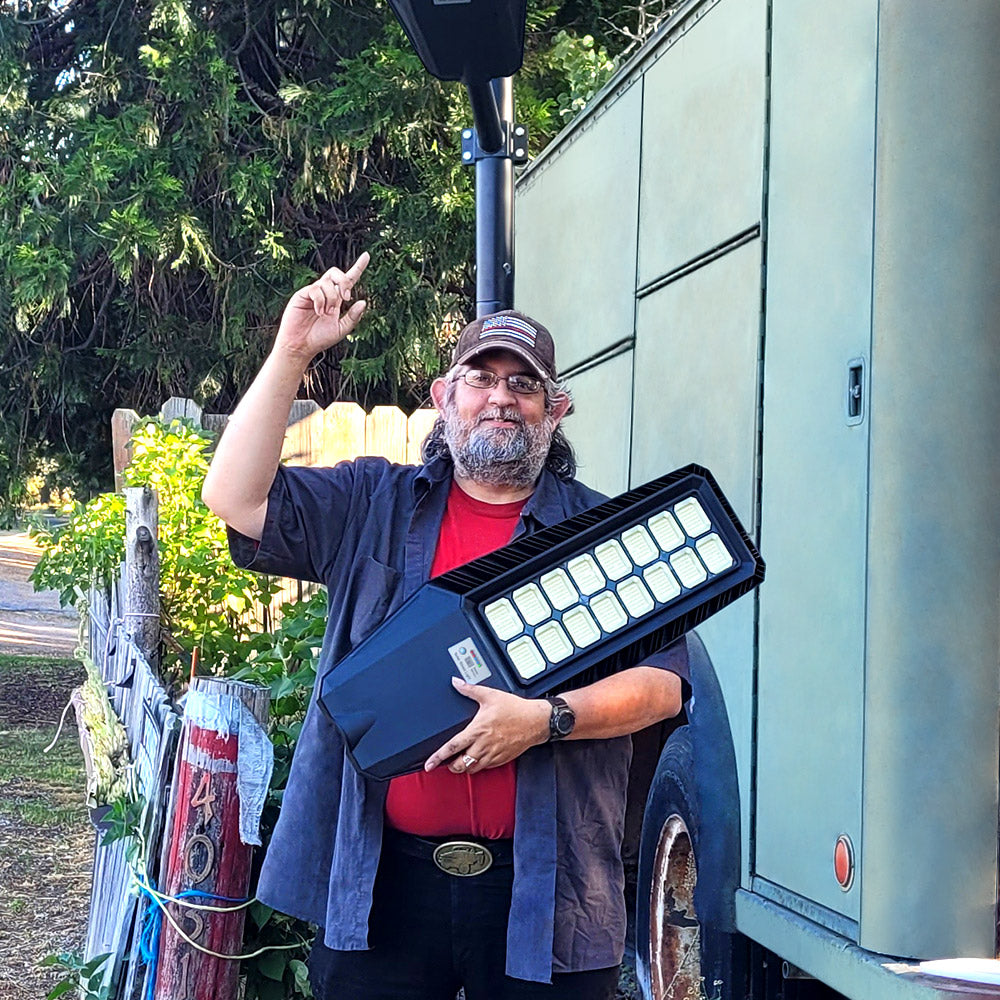
For medium to large parking areas, you want a high-output fixture. The Hykoont TW040 Solar Street Light is a good fit here — it's a commercial-grade all-in-one unit with sufficient lumen output and battery capacity for a full dusk-to-dawn cycle in most US climate zones.

→ Hykoont TW040 Solar Street Light | From $152
Zone 2: Loading Docks and Service Areas
Loading docks operate at odd hours — early morning deliveries, late-night pickups — and need reliable, consistent illumination regardless of time. Off-grid solar lights with motion-activated boost modes work well here: they maintain a baseline security level (40–60% output) all night and ramp to 100% when a truck pulls in or a worker enters the area. That intelligent power management extends battery life without compromising function.
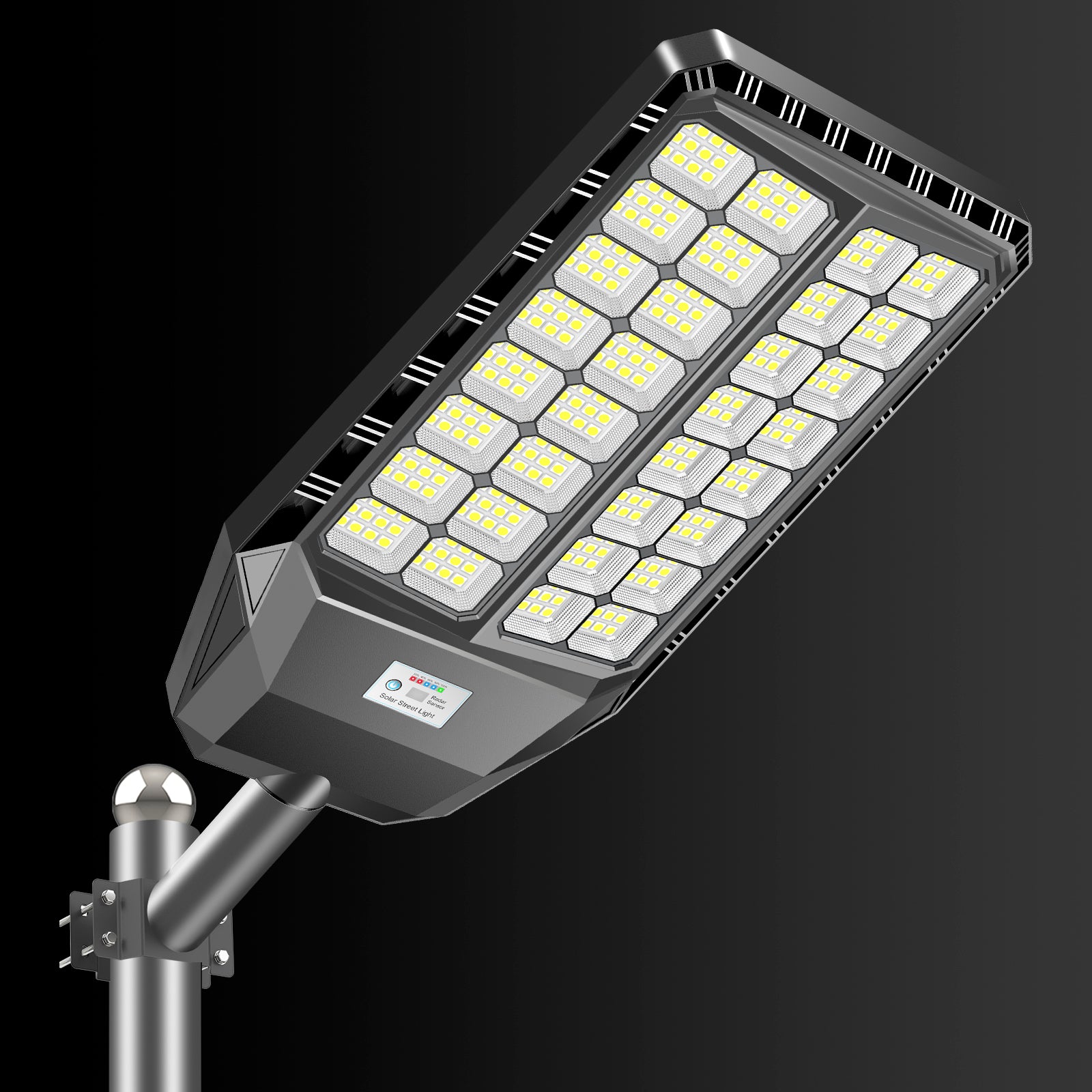
The BC024 Solar Street Light (180W) handles this zone well — the 180W rating and integrated panel deliver strong illumination for high-activity service areas without oversizing the system.

→ BC024 Solar Street Light 180W | From $159
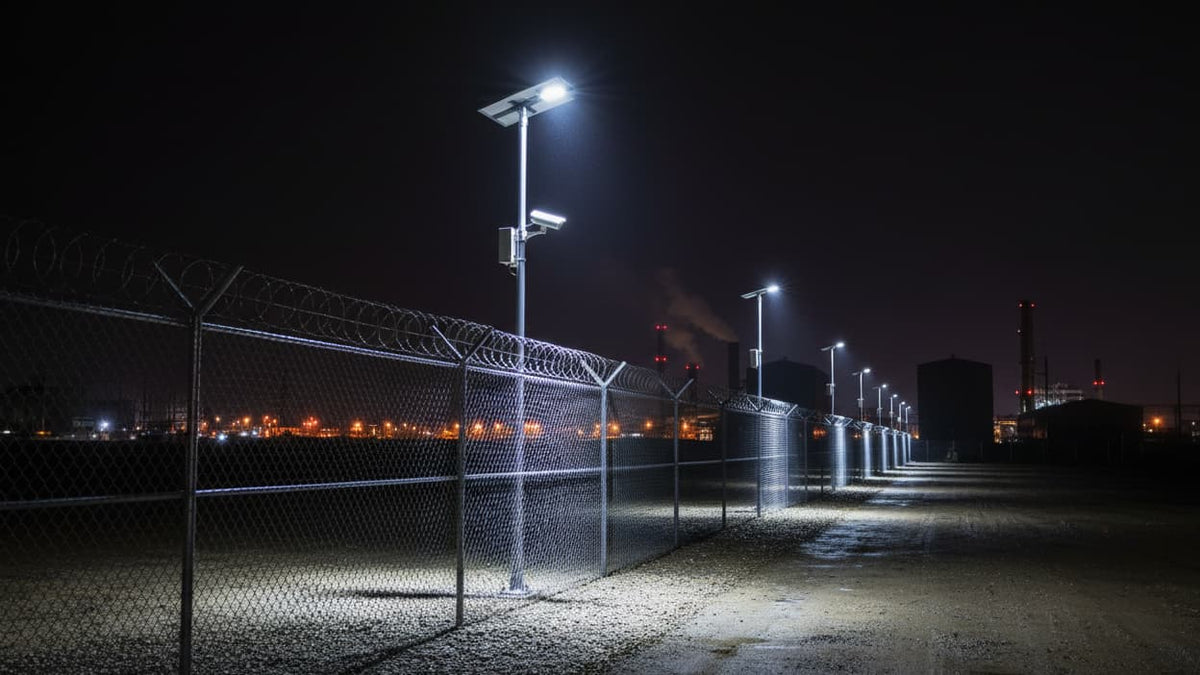
Zone 3: Perimeter Fencing and Security Corridors
Perimeter lighting often gets the least attention and the worst infrastructure. These runs are long, remote from the main electrical panel, and expensive to wire. Solar is almost always the right answer here — no trenching across hundreds of feet of property, no conduit to maintain, and each fixture is independent so a single failure doesn't take down an entire run.
The Hykoont SZ300 (400W, 60,000LM) is worth considering for perimeter applications where you need both range and reliability. At $129/unit, the economics for long perimeter runs are hard to argue with compared to trenching costs.

→ Hykoont SZ300 Commercial Solar Street Light — 400W, 60,000LM | From $129
Zone 4: Walkways, Pathways, and Pedestrian Areas
Lower mounting heights, closer spacing, and more modest lumen requirements make pathway lighting an easy win for solar. The Hykoont TW016 Solar Street Light is a solid fit for pedestrian-scale applications — it uses an optical lens design to distribute light efficiently across walkway surfaces without over-illuminating adjacent areas.

→ Hykoont TW016 Solar Street Lights | From $79.99
Zone 5: Remote or Expansion Areas
New construction additions, overflow lots, temporary staging areas, agricultural outbuildings, remote gate entries — any location that's far from existing electrical infrastructure is where off-grid solar truly has no competition. The cost of running conduit to a remote location often exceeds the cost of the entire solar lighting system for that area. This is the simplest financial case to make in any facilities budget review.
The Hykoont BC020C (150W) at just $79/unit is a practical, no-fuss option for remote or secondary areas where you need reliable coverage without a large per-unit investment.

→ Hykoont BC020C 150W Solar Street Light | From $79
Running the Numbers: A Real Facility Budget Comparison
Let's make this concrete with a mid-size commercial property — a 120,000 sq ft industrial/office campus with the following outdoor lighting zones:
- Surface parking lot: 20 fixtures
- Perimeter fence line: 12 fixtures
- Loading dock / service area: 6 fixtures
- Pedestrian walkways: 8 fixtures
- Total: 46 fixtures
Scenario A: Grid-Tied LED Replacement
| Cost Item | Estimate |
|---|---|
| Fixture replacement (46 units × $120 avg) | $5,520 |
| Electrical labor (wiring, connections) | $14,000–$22,000 |
| Conduit / panel work for perimeter run | $8,000–$16,000 |
| Annual electricity (46 fixtures × $90/yr avg) | $4,140/yr |
| Annual maintenance budget | $3,500/yr |
| 10-Year Total | $103,000–$119,000 |
Scenario B: Off-Grid Solar Retrofit
| Cost Item | Estimate |
|---|---|
| Solar fixtures (46 units, mixed spec, avg $110) | $5,060 |
| Poles and foundations (where needed) | $6,000–$12,000 |
| Mounting labor (no electrician needed) | $4,000–$8,000 |
| Annual electricity | $0 |
| Battery replacement Year 6–7 (46 units × $50) | $2,300 (one-time) |
| Annual maintenance (cleaning, inspection) | $600–$1,200/yr |
| 10-Year Total | $24,360–$39,500 |
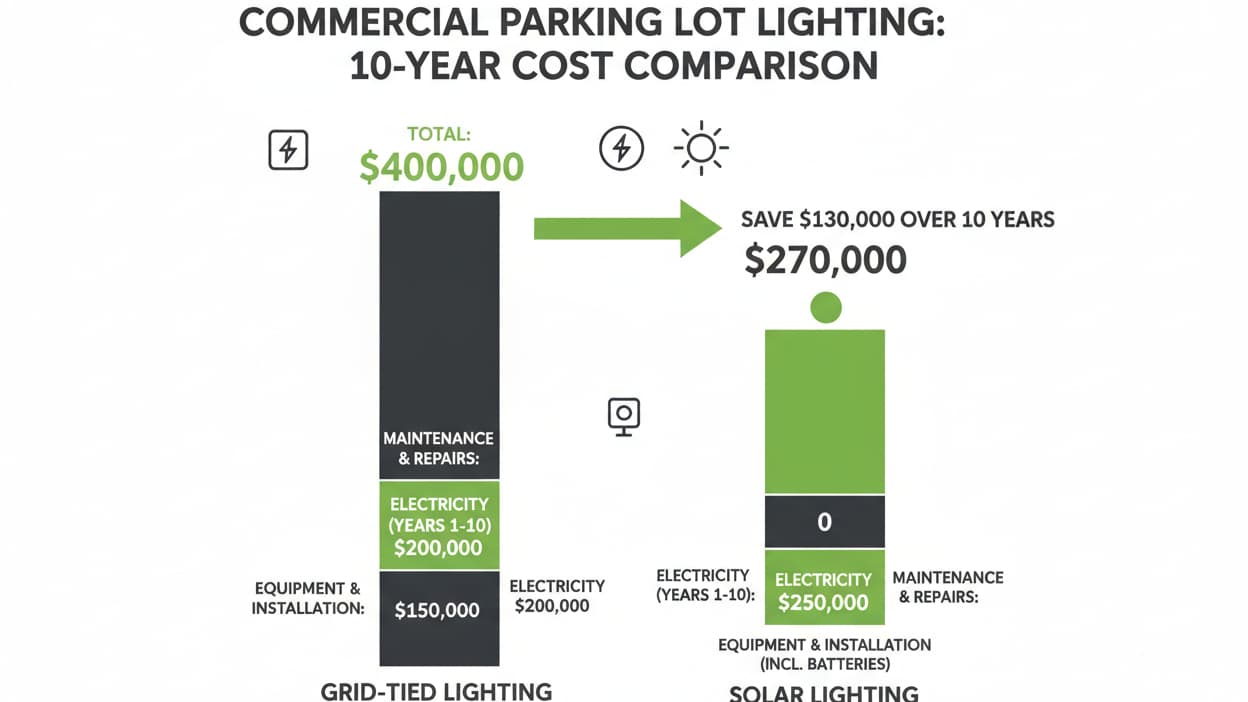
10-year savings: $63,500–$94,640. On a 46-fixture property. That number scales linearly — a 100-fixture campus saves proportionally more.
And that's before applying the Section 48 Investment Tax Credit (ITC), which allows businesses to deduct 30% of the solar system cost from their federal tax liability. On a $15,000 solar lighting project, that's a $4,500 direct tax credit in Year 1.
The Maintenance Equation Nobody Talks About
Cost savings from electricity get all the attention. Maintenance savings are just as real and often more immediately felt by facilities teams.
Grid-tied outdoor lighting generates maintenance calls for reasons that have nothing to do with the fixture itself:
- Tripped GFI breakers from moisture intrusion
- Corroded wire connections in underground junction boxes
- Voltage drop issues on long runs causing dim or flickering fixtures
- Conduit damage from landscaping equipment or freeze-thaw ground movement
Every one of these requires a licensed electrician. Off-grid solar fixtures have none of these failure modes because there's no underground wiring. The only serviceable components are the LED driver (usually replaceable without tools) and the battery (a bolt-on swap every 5–8 years).
Facilities managers who've made the switch consistently report that solar lights just stop generating maintenance tickets. Not fewer — essentially zero routine calls. That's a real operational benefit that doesn't show up in a spec sheet but shows up very clearly in a work order log after 12 months.

Addressing the Common Objections
"We're in a northern state — solar won't work reliably in winter."
This comes up often and deserves a direct answer. Northern US states — Minnesota, Michigan, Wisconsin, upstate New York — do have lower winter solar irradiance. December and January average 2.5–3.5 peak sun hours in these markets vs. 5–6 hours in Texas or Arizona.
The solution isn't to avoid solar — it's to size the system correctly for your worst-case month. Commercial solar street lights with 3–5 day battery autonomy handle typical winter cloudy stretches without issue. The intelligent dimming mode (typically 30–50% output during low-charge periods) maintains security-level illumination even during extended overcast weather. A properly-specified system for Minneapolis performs reliably year-round. An improperly-specified system (undersized battery, wrong panel angle) does not. Specification matters.
"Our insurance requires consistent illumination levels — we can't have lights dimming."
Fair concern. Most commercial solar street lights allow you to configure a minimum output floor — typically 50–70% — that the dimming algorithm never drops below. Some facilities set this to 100% for areas with strict liability requirements and accept slightly shorter autonomy in exchange for guaranteed full output. This is a configuration setting, not a hardware limitation.
"We already have poles in the ground — do we have to replace them?"
Often not. Many commercial solar street lights can be retrofitted onto existing poles with adapter mounts, provided the pole diameter and structural rating are compatible. This is especially common for facilities converting from HPS or older LED fixtures. Confirm pole compatibility before ordering, but in many cases you're buying only fixtures and adapters, not poles — which significantly reduces project cost.
"What's the warranty situation if something fails?"
Quality commercial solar lights carry 3–5 year warranties on the full fixture. The LED modules themselves are typically rated for 50,000+ hours — at 12 hours/night, that's 11+ years before the LEDs themselves become a concern. The battery is the component most likely to need replacement (Year 5–8), and it's the least expensive part to swap. An entire battery pack replacement typically runs $30–$80 per unit.

How to Build the Business Case Internally
Getting approval for a solar lighting conversion at a commercial facility usually means presenting to a CFO, property manager, or board — people who care about numbers, not technology. Here's a simple framework that works:
- Pull your last 12 months of utility bills. Isolate outdoor lighting consumption if your system is sub-metered, or estimate based on fixture count and hours of operation. This is your baseline.
- Get a fixture count and zone map. Walk the property, count fixtures, note which zones have existing pole infrastructure vs. needing new poles.
- Request a project quote. Get pricing from a solar lighting supplier for the full fixture count. Most will provide bulk pricing for projects of 20+ units.
- Apply the ITC. 30% of system cost comes off your federal tax bill. Run this past your accountant before the presentation.
- Build a simple 5-year P&L comparison. Grid cost (electricity + maintenance) vs. solar cost (fixtures + minimal maintenance). The crossover point is usually Year 2–3 for most commercial properties.
- Add the non-financial arguments. Grid independence during outages, no utility rate risk, ESG/sustainability reporting value. These don't drive the decision alone but they support it.
Present this as a capital allocation decision, not a green initiative. Decision-makers respond to ROI. The ROI on commercial off-grid solar lighting is real and documentable — you don't need to rely on environmental arguments to get approval.

Phased Implementation: You Don't Have to Convert Everything at Once
One of the underappreciated advantages of off-grid solar is that each fixture is independent. You don't need to convert the entire property in one project. A sensible phased approach:
- Phase 1: Convert the perimeter fence line and remote areas first. These have the highest infrastructure cost savings (no conduit to run) and the lowest disruption risk.
- Phase 2: Convert the parking lot. Highest volume of fixtures, highest ongoing electricity savings.
- Phase 3: Convert walkways and entry points. Lower priority, smaller savings, but completes the zero-electricity footprint for outdoor lighting.
Each phase is self-contained — you can pause between phases without any integration issues. And each phase generates its own electricity savings immediately upon completion, which helps fund subsequent phases from operational savings rather than fresh capital.
→ Shop Commercial Solar Street Lights — Starting at $79
Choosing the Right Fixture for Each Zone: A Quick Reference
| Zone | Recommended Product | Price | Why |
|---|---|---|---|
| Large parking lot | TW040 Solar Street Light | From $152 | High output, commercial-grade autonomy |
| Perimeter / large areas | SZ300 400W, 60,000LM | From $129 | Maximum lumen output, die-cast aluminum |
| Loading dock / service | BC024 180W | From $159 | Strong output for high-activity zones |
| Pedestrian walkways | TW016 with Lens Optics | From $79.99 | Efficient light distribution at human scale |
| Remote / secondary areas | BC020C 150W | From $79 | Cost-effective, reliable, easy to deploy |
View TW040 — $152 View BC024 180W — $159 View TW016 — $79.99
Frequently Asked Questions
1. How much can a commercial facility realistically save by switching to off-grid solar lights?
For a mid-size commercial property with 30–50 outdoor fixtures, realistic 10-year savings vs. grid-tied LED lighting run $50,000–$100,000, depending on your current electricity rates, maintenance costs, and whether you're doing a new install (higher grid infrastructure savings) or a retrofit (lower, since infrastructure is already paid). The more remote your lighting zones, the more the savings skew toward the high end.
2. Do off-grid solar lights work during power outages?
Yes — and this is one of their most underappreciated benefits for commercial properties. Because they're entirely grid-independent, a utility outage has zero effect on solar-powered outdoor lighting. For facilities where continuous perimeter or parking lot illumination is a security or liability requirement, this reliability advantage is significant. Grid-tied lights go dark; solar lights don't.
3. What permits are typically required for commercial solar light installation?
Most jurisdictions require a building permit for pole foundation work (concrete anchor installation), but electrical permits are generally not required since there's no utility connection. This simplifies the permitting process considerably compared to grid-tied installs, which require electrical permits and often utility coordination. Check with your local building department — requirements vary by municipality.
4. Can I mix solar and grid-tied lights on the same property?
Absolutely. Many facilities run hybrid setups — solar for open outdoor zones (parking, perimeter, pathways) and grid-tied for areas where solar isn't practical (covered canopies, underground garages, enclosed loading areas with no sky access). Each solar fixture is independent, so mixing is not a technical issue at all.
5. How do I calculate the right fixture wattage for my parking lot?
Start with your target footcandle level. IES RP-20 specifies a minimum of 1.0 FC average (0.5 FC minimum) for general parking lots, with security-critical areas at 2–5 FC. From there, a photometric simulation using your lot dimensions and pole spacing gives you the fixture wattage and mounting height needed to hit target. Most commercial solar lighting suppliers will run a free photometric layout if you provide your lot dimensions and target FC level.
6. What's the realistic lifespan of a commercial solar street light?
LED module: 50,000–100,000 hours (11–22 years at 12 hrs/night). Battery (LiFePO4): 5–8 years. Solar panel: 20–25 years. The battery is the first scheduled replacement — at $30–$80 per unit, it's a minor maintenance event, not a capital replacement. The fixture housing and LED board are typically good for 15+ years with no scheduled service.
7. How do commercial solar lights handle motion detection for loading docks or entry gates?
Most commercial solar street lights include a PIR (passive infrared) motion sensor that triggers a boost to 100% output when motion is detected, then steps back to a preset baseline (typically 30–60%) after a set dwell time (30 seconds to 5 minutes, configurable). This smart mode dramatically extends battery life while still providing full illumination when it's actually needed — which is ideal for loading docks where truck arrivals are intermittent.
8. Are off-grid solar lights vandal-resistant enough for commercial use?
Commercial-grade solar street lights use die-cast aluminum housings with tempered glass or polycarbonate lenses rated at IK08 or IK10 (impact resistance). This is the same rating used for grid-tied commercial fixtures. They're not indestructible, but they're not fragile garden lights either. For high-vandalism environments, fixtures can be mounted at heights (18–25 ft) that make access impractical without equipment.
9. Can solar street lights be controlled remotely or integrated with a facility management system?
Higher-end commercial solar street lights support wireless control via RF remote or app-based configuration. Some models support group control (adjusting multiple fixtures simultaneously) for large lots. Full BMS (Building Management System) integration via Modbus or BACnet is available in enterprise-tier solar lighting systems, though this is typically relevant only for large campus deployments with centralized energy management.
10. What happens if a solar panel is shaded by a nearby tree or building overhang?
Partial shading reduces panel output and, over time, will cause the battery to chronically undercharge, leading to reduced runtime. The solution is either relocating the fixture to a position with clear sky exposure, or (for fixtures with a separate panel arm) adjusting the panel angle and orientation to maximize unshaded collection. During site planning, it's worth checking seasonal sun angles — a panel with clear access in summer may be shaded by a low winter sun if there's a building or structure to the south.
The Bottom Line for Facilities Teams
Outdoor lighting is not a fixed cost. It's a manageable cost — one that most commercial facilities are currently managing poorly by default, simply because the status quo (grid-tied, utility-billed) was set up once and never revisited.
Off-grid solar lighting is the single highest-ROI capital improvement most commercial properties can make to their outdoor lighting infrastructure. The upfront cost is lower than a grid-tied install. The operating cost is essentially zero. The maintenance burden is minimal. And the payback period — typically 2–4 years — is shorter than almost any other facility improvement category.
If you're responsible for a facilities budget and you haven't run the numbers on solar conversion, now is a good time to start. The products are mature, the incentives are real, and the savings are durable.


Leave a comment
This site is protected by hCaptcha and the hCaptcha Privacy Policy and Terms of Service apply.