




Every spring, the same conversation happens in HOA board rooms, municipal planning offices, and contractor job-site trailers across the country: the lighting budget is approved, the project scope is set, and someone has to figure out which solar street lights to actually order — and how many. Get it right and you're the hero. Get it wrong and you're the person who ordered 40 units that dim out by 3 a.m. in November.
This guide is written for the people making those calls. Property managers, electrical contractors, municipal procurement officers, HOA board members, and anyone else who's responsible for lighting a parking lot, a subdivision street, a campus pathway, or a commercial facility — and needs to do it at scale without blowing the budget or the timeline.
We're going to skip the marketing language and get into what actually matters when you're buying solar street lights in quantity: lumen output per dollar, battery chemistry and reserve capacity, warranty terms, and which models hold up when you're deploying 10, 20, or 50 units across a property.
Why Bulk Solar Street Light Orders Are Different from Single-Unit Purchases
Buying one solar street light for your driveway is a pretty forgiving decision. If it underperforms, you swap it out. Buying 30 units for a subdivision entrance road or a commercial parking lot is a different calculation entirely.
When you're ordering at volume, a few things change:
- Per-unit cost matters more. A $20 difference per unit is $600 on a 30-unit order. A $50 difference is $1,500. Wholesale pricing and multi-pack options can meaningfully shift your project budget.
- Consistency is non-negotiable. All 30 lights need to perform the same way on night 1 and night 300. Batch variation in cheap fixtures is a real problem at scale.
- Installation labor is a significant cost. If a fixture requires a service call 18 months in, that's not just a warranty claim — it's a crew, a lift, and a half-day of labor. Reliability isn't a nice-to-have; it's a line item.
- Spec matching across the project is critical. Mixing lumen outputs, color temperatures, or beam patterns across a single property creates an inconsistent, unprofessional result. Standardizing on one or two models simplifies everything.
With that context in mind, here's how to think through a commercial bulk solar lighting project from spec to order.

Step 1: Define Your Lumen Requirement Before You Look at Products
The single biggest mistake in commercial solar lighting procurement is starting with a product and working backward to justify it. Start with your illumination requirement instead.
A few reference points for common commercial applications:
- Parking lots (commercial): IESNA RP-20 recommends 1.0–5.0 footcandles average maintained illuminance for commercial parking. At a 20-foot mounting height with a Type III beam pattern, you need roughly 25,000–40,000 lumens per fixture to achieve this across a 50×80 foot zone.
- Subdivision streets and HOA roads: IESNA RP-8 recommends 0.4–1.2 footcandles for residential streets. At 18–22 foot mounting height, 20,000–35,000 lumens per fixture with 80–100 foot spacing typically meets this standard.
- Campus pathways and pedestrian areas: 0.5–2.0 footcandles. Lower lumen fixtures (10,000–20,000 lm) at closer spacing (40–60 feet) work well here.
- Industrial yards and logistics facilities: 2.0–10.0 footcandles depending on task. High-output fixtures (40,000–60,000+ lm) at 25–30 foot mounting height are appropriate.
Once you know your target footcandle level and your fixture spacing, you can calculate how many units you need and what lumen output each one requires. That number drives your product selection — not the other way around.
Step 2: Choose Your Battery Chemistry — This Is Not Optional
For any commercial installation where you expect 5+ years of reliable operation, LiFePO4 (lithium iron phosphate) is the only battery chemistry worth specifying. Here's why this matters at scale:
- Cycle life: LiFePO4 delivers 2,000–3,000+ charge cycles. Lead-acid delivers 300–500. Li-ion (standard) delivers 500–1,000. On a 5-year project, you're looking at roughly 1,825 charge cycles. Only LiFePO4 handles that without significant capacity degradation.
- Cold weather performance: LiFePO4 retains 80%+ capacity at -4°F (-20°C). This matters enormously for installations in the northern US — Minnesota, Wisconsin, Michigan, upstate New York, the mountain states. A fixture that dims to 40% output on cold January nights is a liability, not an asset.
- Thermal stability: LiFePO4 chemistry is significantly more thermally stable than standard Li-ion, which matters for fixtures that spend summers in Arizona, Texas, or the Southeast baking in direct sun.
- Total cost of ownership: A LiFePO4 fixture that costs $200 more upfront but doesn't need a battery replacement at year 3 is cheaper over the project lifecycle than a lead-acid unit that needs a $80 battery swap every 2–3 years — plus the labor to do it.
When evaluating products for bulk orders, ask specifically about battery chemistry and rated cycle life. If the spec sheet doesn't list it, that's your answer.
The Commercial Lineup: Products Built for Bulk Orders
Here are the Hykoont models that make the most sense for commercial and wholesale buyers, organized by application and scale.
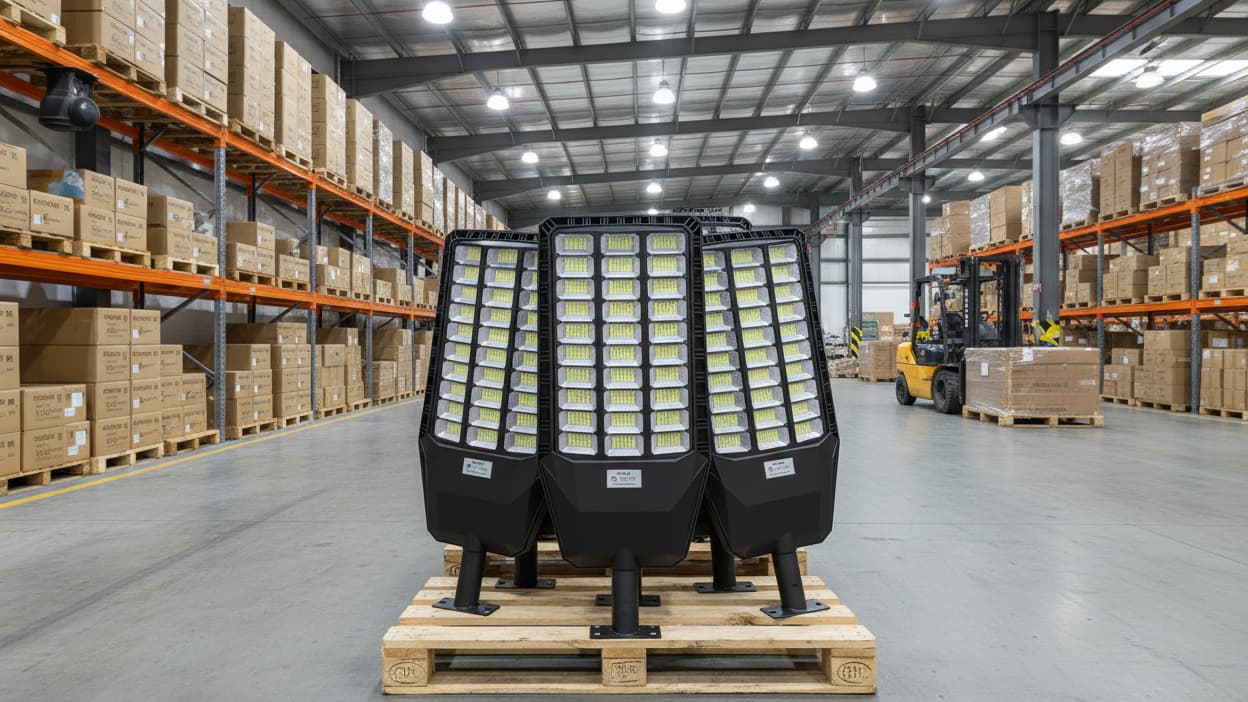
1. Best High-Volume Value: Hykoont SZ300 — 60,000 Lumens, 400W

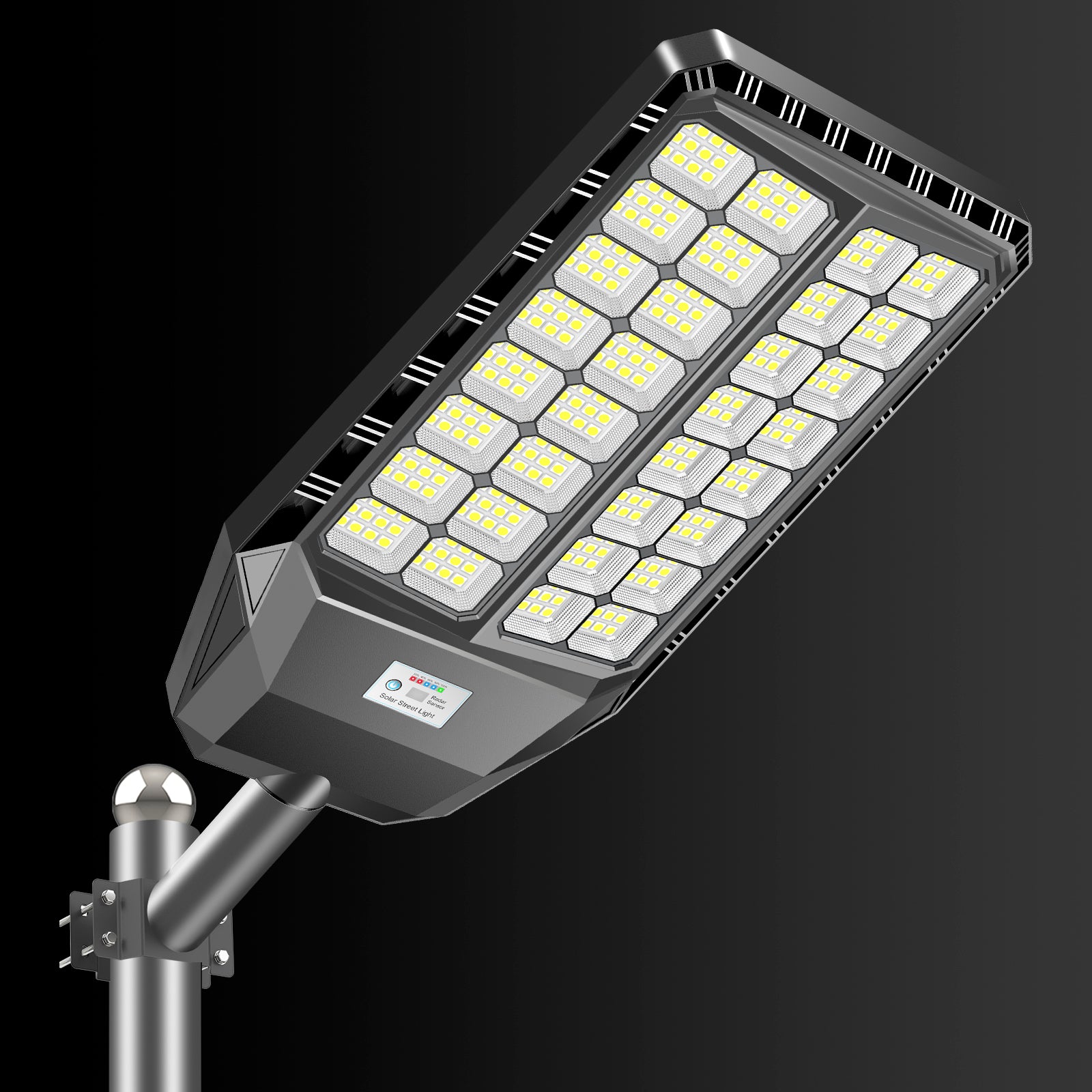
For commercial parking lots, industrial yards, and large HOA common areas, the SZ300 is the workhorse. 60,000 lumens from a 400W monocrystalline panel, die-cast aluminum housing, MPPT charge controller, and a build quality that's designed for years of unattended operation. This is the fixture you specify when you need serious light output and you can't afford service calls.
The monocrystalline panel charges efficiently in partial sun — important for installations in the Pacific Northwest, upper Midwest, or anywhere that sees real cloud cover. The MPPT controller squeezes every usable watt out of available daylight, which translates to more reserve capacity on consecutive overcast days.
For bulk orders, the SZ300's price range of $145–$293 per unit (depending on configuration) makes it one of the most cost-effective high-output commercial solar fixtures available. At 60,000 lumens per unit, you need fewer poles to cover a given area — which means lower installation costs as well as lower hardware costs.
2. Best for Subdivision Streets & HOA Roads: Hykoont TW030 — 42,000 Lumens, 300W

The TW030 is the right call for HOA subdivision streets, shared community roads, and campus pathways where you need consistent, reliable illumination across a long linear stretch. At 42,000 lumens and 300W, it exceeds IESNA RP-8 residential street lighting standards with room to spare — which means you're not right at the edge of compliance, you're comfortably above it.
The 2-pack option at $242 ($121/unit) is the smart buy for bulk HOA projects. Order 10 2-packs and you've got 20 fixtures for $2,420 — covering roughly 1,600–2,000 linear feet of road at 80–100 foot spacing. Dusk-to-dawn operation is automatic, and the motion sensor mode lets you run at reduced power during low-traffic hours to extend battery reserve.
Shop TW030 2-Pack — $242 Shop TW030 1-Pack — $129
3. Best Premium Commercial: Hykoont TS048 — 84,000 Lumens

When the project calls for maximum output — large commercial parking structures, logistics facility yards, sports facility perimeters, or wide industrial roads — the TS048 delivers 84,000 lumens in a single fixture. That's the kind of output that lets you space poles further apart, reduce your total fixture count, and still exceed your footcandle targets.
For procurement officers doing the math: fewer poles means lower civil work costs (concrete footings, pole procurement, installation labor). On a large project, the higher per-unit cost of a premium fixture often pays for itself in reduced installation scope. A 20-unit TS048 installation covering the same area as a 35-unit mid-range installation saves 15 sets of pole installation, concrete, and wiring — that's real money.
Price: $199–$378 per unit
4. Best for Long-Runtime Municipal Applications: HY100 — 100W, 768WH LiFePO4

The HY100 is a different category of fixture — built for municipal and infrastructure applications where runtime reliability is the primary specification, not just raw lumen output. The 768WH LiFePO4 battery bank gives this fixture enough reserve to run through 5–7 consecutive overcast days without dimming. That's the kind of spec that matters for a county road installation in the upper Midwest, a coastal installation that sees extended storm systems, or any application where the light simply cannot go dark.
At 18,000 lumens from a 100W true LED system with a 150W monocrystalline panel, the HY100 is engineered for efficiency rather than peak output. The MPPT controller and LiFePO4 chemistry work together to maximize the ratio of stored energy to usable light output — which is why this fixture can sustain full-brightness operation through weather conditions that would leave a cheaper unit running at 30% by midnight.
For municipal procurement, the HY100's 10-year rated lifespan and LiFePO4 battery chemistry align well with typical infrastructure project lifecycles. This is the fixture you specify when the project has a 10-year maintenance budget and you need the hardware to match.
Price: $1,399 per unit
5. Best for Mixed-Use Campus & Pathway Networks: YK060 — 60W, 9,600 Lumens, Smart MPPT

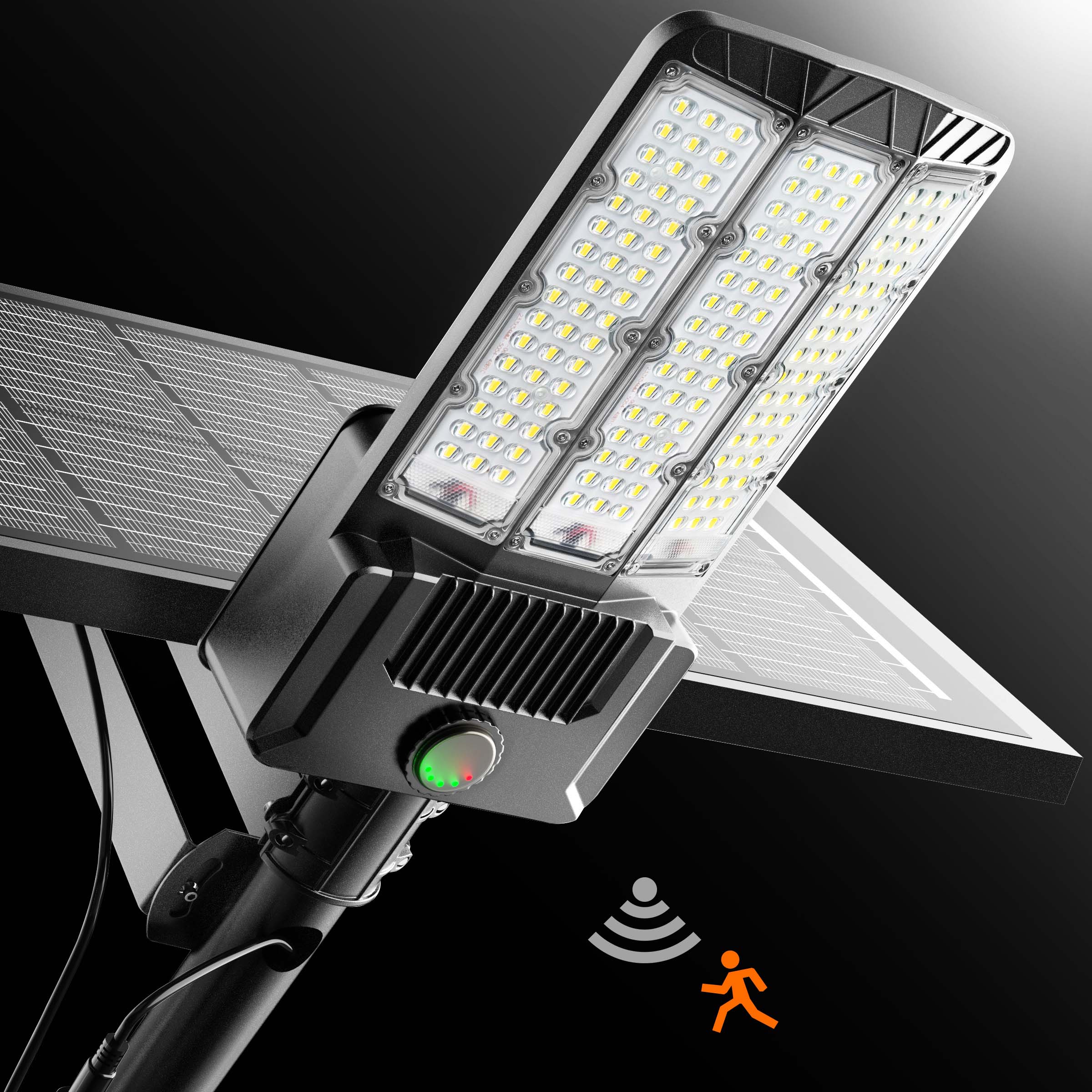
University campuses, corporate parks, hospital grounds, and mixed-use developments often need a fixture that's bright enough for pedestrian safety but not so overpowering that it creates glare or light pollution in residential-adjacent areas. The YK060 hits that balance well: 9,600 lumens, intelligent MPPT control, 144WH LiFePO4 battery, and a smart dimming system that adjusts output based on time of night and motion detection.
The smart MPPT controller in the YK060 does something that simpler fixtures don't: it actively manages the charge/discharge cycle based on available solar input and projected nighttime demand. In practical terms, this means the fixture is less likely to run low on battery during a stretch of cloudy weather because it's been managing its reserve more intelligently throughout the week.
For campus-scale bulk orders, the YK060 at $305 per unit is a solid mid-range specification that delivers genuine smart-lighting functionality without the premium price of full municipal-grade hardware.
Shop YK060 Smart Solar Light →
Bulk Order Planning: A Practical Framework
Here's a step-by-step framework for taking a commercial solar lighting project from scope to purchase order.
Phase 1: Site Survey (Week 1)
- Map the area to be illuminated — total linear footage for roads/pathways, total square footage for area lighting
- Identify existing pole locations or determine new pole placement
- Note any shading obstructions (trees, buildings, structures) that could affect solar panel charging
- Determine mounting height requirements based on road width or area coverage needs
- Check local ordinances for pole height limits, light trespass restrictions, and any required photometric submittals
Phase 2: Photometric Calculation (Week 1–2)
- Use your target footcandle level (from IESNA standards or local code) to back-calculate required lumen output per fixture
- Factor in fixture spacing and mounting height to determine total unit count
- Add 10–15% buffer to your unit count for coverage gaps, future expansion, or replacement stock
- Verify that your selected fixture's beam pattern (Type II, III, or IV) matches your application
Phase 3: Product Selection & Pricing (Week 2)
- Select 1–2 fixture models that meet your lumen and battery requirements
- Request wholesale or volume pricing for your projected quantity
- Factor in accessories: poles, mounting hardware, concrete anchor bolts, remote controls
- Build a total project cost including hardware, shipping, and installation labor
Phase 4: Pilot Installation (Optional but Recommended)
- For projects over 20 units, consider a 2–4 unit pilot installation before committing to the full order
- Run the pilot for 30–60 days across different weather conditions
- Verify actual lumen output, battery performance, and motion sensor behavior in your specific environment
- Adjust your full-order specification based on pilot results
Phase 5: Full Order & Installation
- Place the full order with confirmed delivery timeline
- Coordinate pole installation and concrete work to be ready before fixture delivery
- Install fixtures in a single mobilization to minimize labor cost
- Document installation date, fixture serial numbers, and warranty registration for each unit

Seasonal Timing: Why "Fleet Upgrade Season" Is a Real Thing
There's a reason commercial solar lighting projects cluster in spring and early fall. It's not arbitrary — it's driven by real operational and logistical factors that experienced contractors and property managers know well.
Spring (March–May) is the most popular installation window for good reason. Days are getting longer, which means solar panels start charging more aggressively right after installation. You have the full summer charging season ahead of you to build battery reserve before the shorter days of fall and winter. Installation crews can work in reasonable weather. And for HOA and municipal projects, spring installations mean the property looks good for the summer season when residents and visitors are most active.
Early Fall (August–October) is the second-best window. You're catching the tail end of long days, installation weather is still good, and you're getting the fixtures operational before the winter lighting demand peaks. For northern US installations, getting lights up in September means they've had 6–8 weeks to establish their charge cycles before the first hard freeze.
What to avoid: Mid-winter installations in northern states are problematic for two reasons. First, the short days mean your new fixtures are immediately operating in their most demanding charging conditions without any established battery conditioning. Second, frozen ground makes pole installation significantly more expensive and time-consuming.
If you're reading this in late summer or early fall, now is the right time to finalize your specification and place your order. Lead times for commercial quantities can run 2–4 weeks, and you want your fixtures in the ground before the days get short.

Total Cost of Ownership: The Calculation That Actually Matters
Commercial buyers who focus only on purchase price consistently make suboptimal decisions. The number that matters is total cost of ownership (TCO) over the project lifecycle — typically 5–10 years for a commercial lighting installation.
Here's a simplified TCO comparison for a 20-unit parking lot installation:
Option A: Budget solar fixtures at $80/unit
- Hardware: $1,600
- Battery replacement at year 2–3 (lead-acid): $800 + $1,200 labor = $2,000
- Battery replacement at year 4–5: $2,000
- 2–3 fixture failures requiring replacement: $500
- 5-year TCO: ~$6,100
Option B: Hykoont SZ300 at $200/unit average
- Hardware: $4,000
- LiFePO4 battery: no replacement needed in 5 years
- Fixture failures: minimal (commercial-grade build)
- 5-year TCO: ~$4,200
The "cheaper" option costs $1,900 more over 5 years — and delivers worse performance throughout. This is the math that justifies commercial-grade hardware to budget committees and HOA boards.
Ready to Place Your Bulk Order?
Whether you're outfitting a 10-unit HOA entrance, a 50-unit commercial parking lot, or a 100-unit municipal road project, the right fixture and the right quantity pricing make a significant difference in your project outcome.
SZ300 — 60,000 LM | $145–$293 TW030 2-Pack | $242 TS048 — 84,000 LM | $199–$378
Have a specific project scope you'd like to discuss? Contact our commercial team — we work with contractors, HOA managers, and municipal buyers on volume pricing and project-specific specifications.
FAQ: Commercial Solar Street Lights Bulk Orders
Q: What's the minimum order quantity for wholesale pricing?
A: There's no hard minimum — you can order a single unit or a hundred. That said, multi-pack options (like the TW030 2-pack) offer built-in per-unit savings, and for larger projects, contacting us directly about volume pricing is worth the conversation. Projects of 10+ units typically qualify for additional pricing consideration.
Q: How do I calculate how many fixtures I need for a commercial parking lot?
A: Start with your lot dimensions and your target illuminance level (typically 1.0–3.0 footcandles average for commercial parking per IESNA RP-20). At a 20-foot mounting height with a Type III beam pattern, a 60,000-lumen fixture like the SZ300 covers roughly 3,000–4,500 sq ft at 1.5+ footcandles. Divide your total lot area by that coverage figure to get your fixture count, then add 10–15% buffer. For a precise photometric calculation, we can provide IES files for specific fixtures on request.
Q: Do these fixtures meet IDA (International Dark-Sky Association) standards?
A: Fixtures with Type II, III, or IV beam patterns and full-cutoff optics minimize upward light spill and are generally compatible with dark-sky ordinances. If your project is in a dark-sky designated area or a municipality with specific light trespass ordinances, specify the beam pattern and color temperature (5000K or below is typically preferred) when ordering, and we can confirm compliance for your specific application.
Q: What warranty do commercial bulk orders carry?
A: Warranty terms vary by model — typically 2–5 years on the fixture and LED components, with LiFePO4 battery warranties of 2–3 years. For commercial projects, we recommend documenting installation dates and registering each unit's serial number at time of installation to ensure warranty coverage is trackable across a large fleet.
Q: Can I mix models on a single project?
A: Technically yes, but we'd recommend against it for aesthetic and maintenance reasons. Mixing lumen outputs or color temperatures across a single property creates visual inconsistency. If you have genuinely different lighting needs in different zones (e.g., high-output fixtures for the main parking field and lower-output fixtures for pedestrian pathways), use clearly defined zones with consistent fixtures within each zone.
Q: How do solar street lights perform in states with harsh winters — Minnesota, Wisconsin, Montana?
A: LiFePO4 battery chemistry is the key spec for cold-climate installations. It retains 80%+ capacity at -4°F (-20°C), compared to 50–60% for standard Li-ion and significantly worse for lead-acid. The HY100 and HY120 series, with their large LiFePO4 battery banks (768WH and 1,152WH respectively), are specifically appropriate for northern US installations where consecutive overcast days and cold temperatures are the norm. The SZ300 and TW030 are also solid performers in cold climates given their monocrystalline panels and MPPT controllers.
Q: What poles and mounting hardware do I need?
A: Most commercial solar street lights mount on standard 2.5–3-inch OD steel poles. Mounting height recommendations vary by fixture and application — typically 18–25 feet for road and parking applications. Poles are not included with fixtures and should be sourced locally to reduce shipping costs. Anchor bolt patterns for concrete footings are available in the installation documentation for each fixture model.
Q: How long does shipping take for bulk orders?
A: Standard orders typically ship within 3–7 business days. For large commercial orders (20+ units), lead time may extend to 2–3 weeks depending on inventory levels. If you have a hard installation deadline, contact us before placing your order to confirm availability and shipping timeline.
Q: Can these fixtures be integrated with a smart lighting management system?
A: The YK series (YK060, YK080 Pro) and HY series (HY100, HY120) include intelligent MPPT controllers with programmable dimming schedules and motion-triggered brightness modes. For full network-level smart lighting management (centralized monitoring, remote control, fault alerts), contact us about compatibility with specific SCMS (Street lighting Control and Management Systems) platforms.
Q: What's the lead time for a 50-unit commercial order?
A: For orders of 50+ units, we recommend reaching out directly to confirm stock levels and production lead times before finalizing your project schedule. Typical lead time for large commercial orders is 3–5 weeks from order confirmation to delivery. Planning your installation window around this lead time — and ordering before your target installation date — is the most reliable way to keep your project on schedule.

Leave a comment
This site is protected by hCaptcha and the hCaptcha Privacy Policy and Terms of Service apply.