





You've done the research. You know solar street lights are the move — no trenching, no electric bills, no utility permits. But then you hit the wall every serious buyer hits: all-in-one or split system?
It sounds like a simple question. It isn't. The wrong choice can mean a light that barely makes it through winter nights, a panel that gets shaded by a roofline, or a fixture that takes two people and a ladder to install when one person and a pole would've done the job.
This guide is for buyers who are past the "solar lights are cool" phase and into the "I need this to actually work" phase. We'll walk through both designs honestly — what they're good at, where they fall short, and which one fits your specific situation.
First, Let's Get the Terminology Straight
Before diving into comparisons, it helps to know exactly what we're talking about.
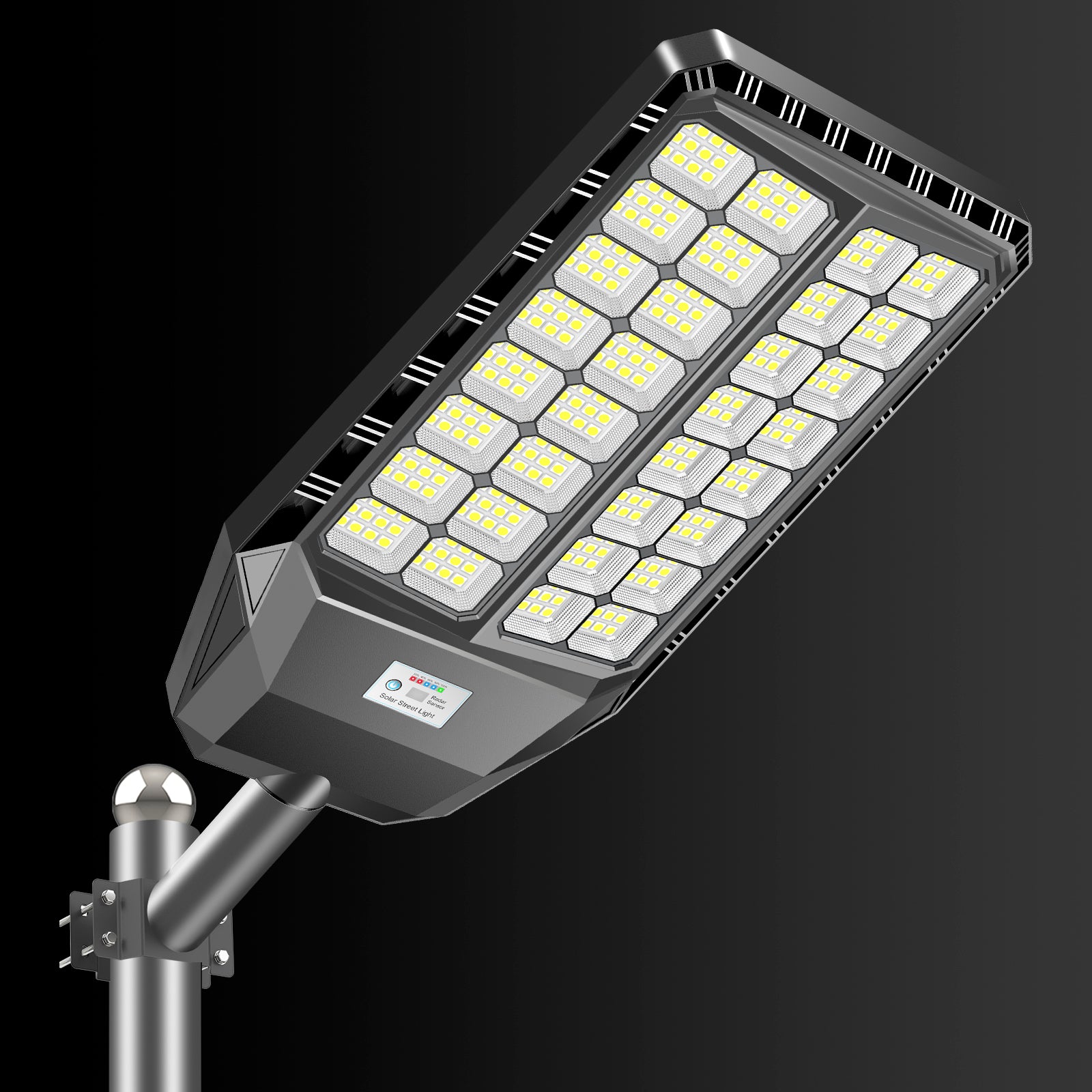
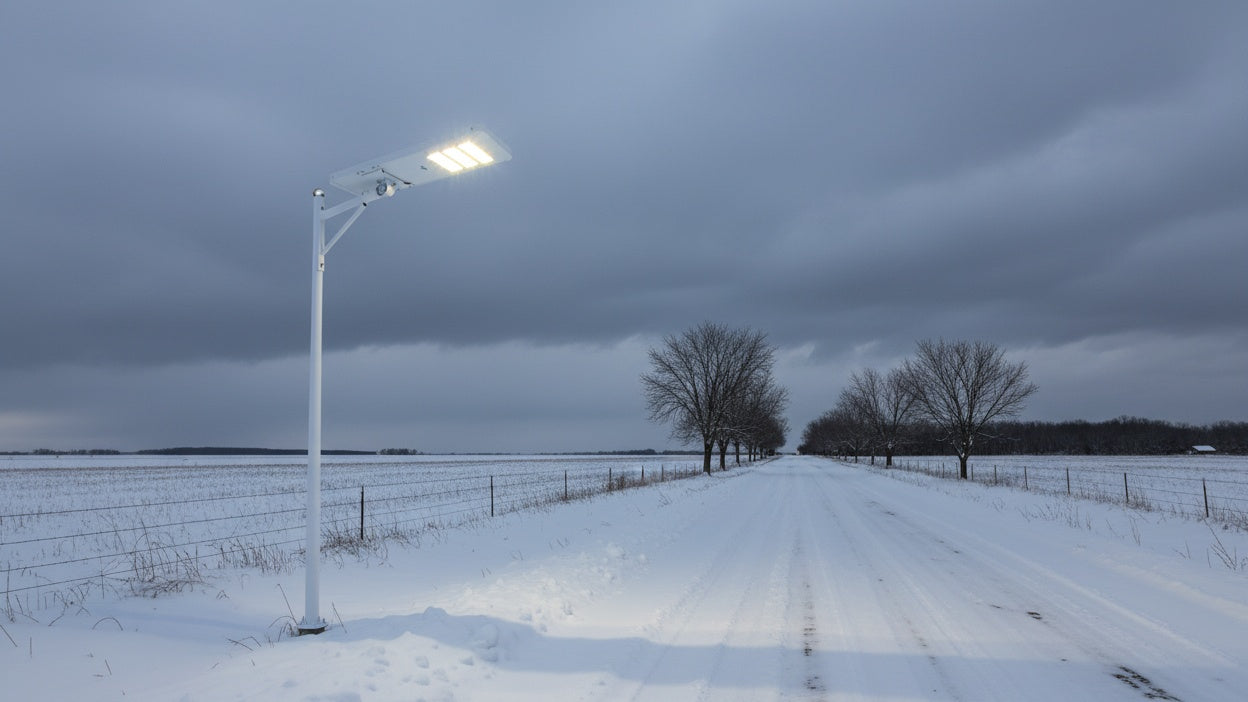
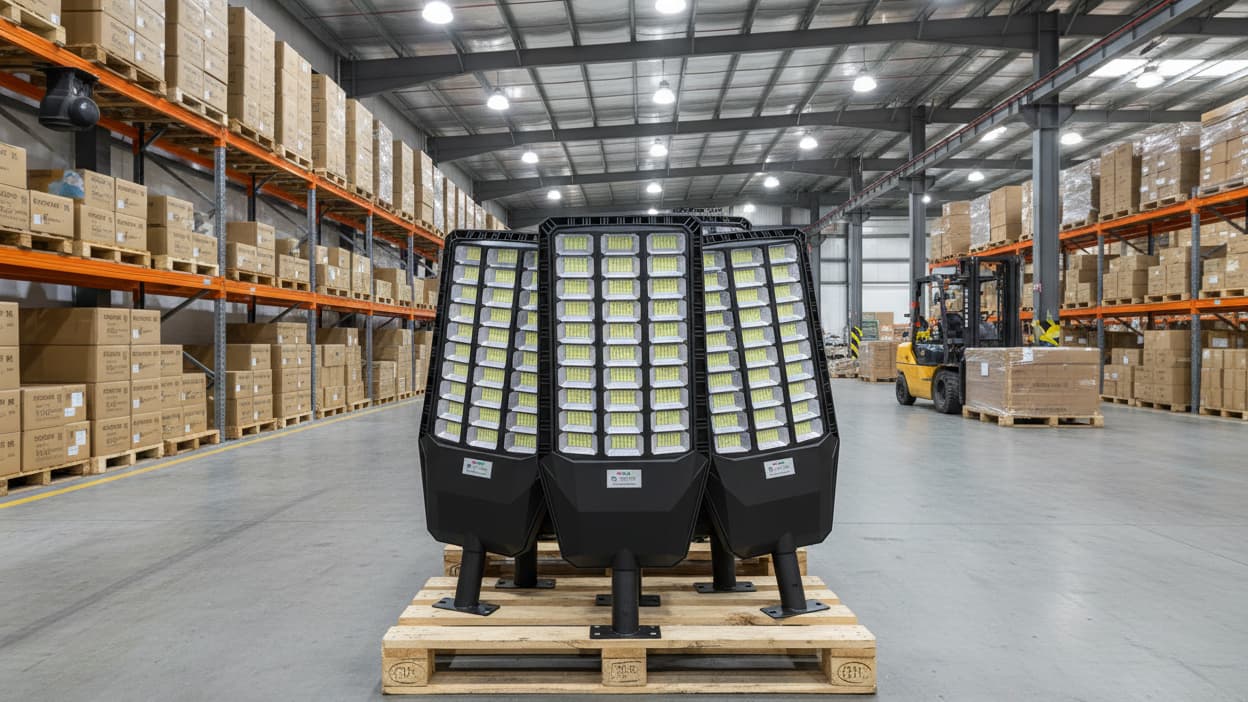
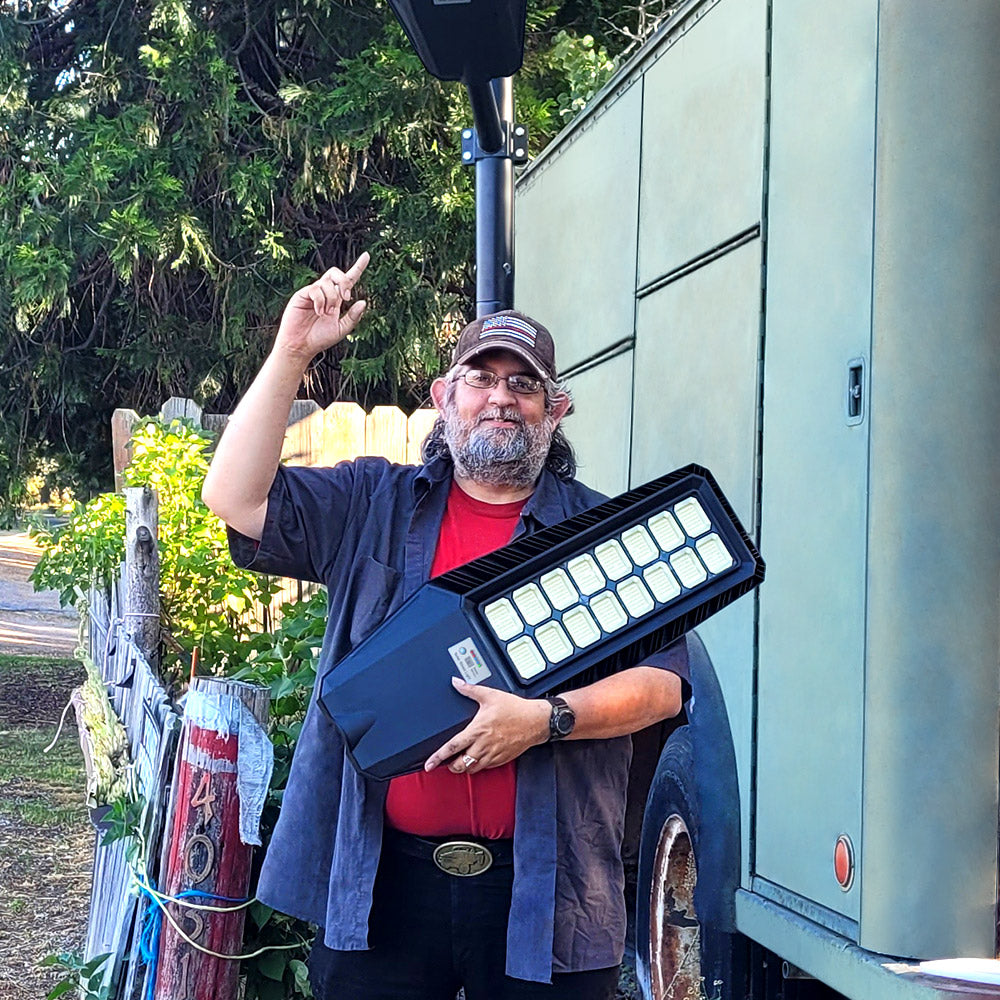
All-in-one solar street lights (also called integrated solar lights) pack the solar panel, LED fixture, battery, controller, and motion sensor into a single compact unit. Everything ships together, mounts together, and works together out of the box. You'll see these described as "monoblock" or "integrated" designs.
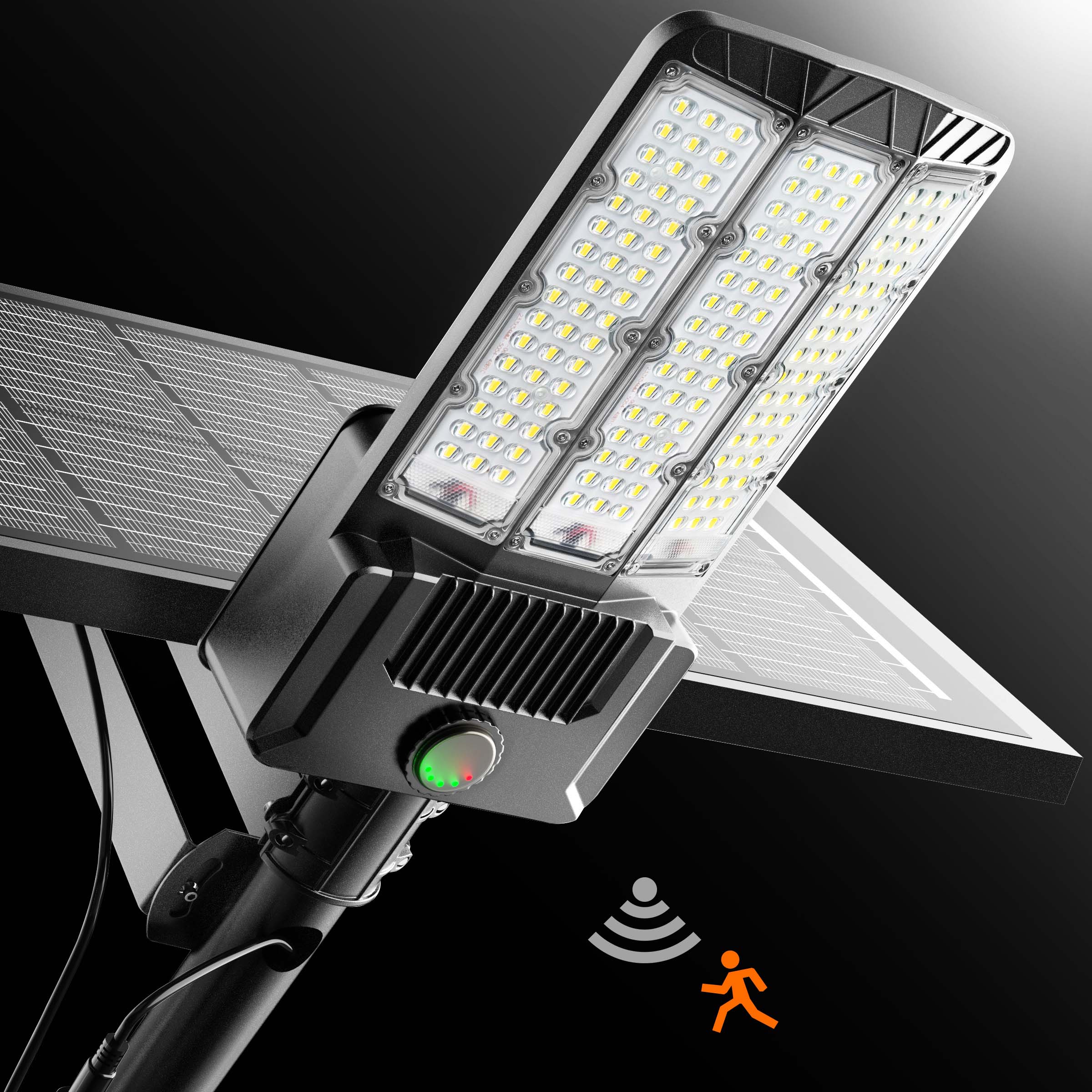
Split solar street lights separate the solar panel from the light head. The panel mounts independently — usually on top of the pole or on a nearby rooftop or ground frame — while the LED fixture hangs or brackets off the pole separately. The battery is typically housed in a weatherproof box at the base or inside the pole.
Both designs use the same core technology: photovoltaic panels charging lithium batteries (ideally LiFePO4) that power LED arrays through an MPPT charge controller. The difference is in how those components are arranged — and that arrangement has real consequences for performance, installation, and long-term reliability.

The All-in-One Case: Why So Many Buyers Start Here
Walk into any solar lighting conversation and all-in-one units dominate the first half. There are good reasons for that.
Installation Is Genuinely Simple
Mount the pole. Attach the light. Done. There's no separate panel bracket to align, no cable run between panel and fixture, no junction box to weatherproof. For a property manager handling 20 parking lot lights solo, or a contractor who needs to get 50 units up in two days, that simplicity has real dollar value.
Most all-in-one units arrive with the panel pre-angled at the factory — typically 15° to 25° — which works well across most of the continental US (roughly 25°N to 49°N latitude). You're not doing trig on a job site.
Lower Upfront Cost Per Unit
Because everything is integrated, there's less hardware to source, less packaging, and simpler logistics. All-in-one units at comparable wattages typically run 15–30% less than equivalent split systems. For large deployments where you're buying 20, 50, or 100 units, that gap adds up fast.
Take the BM024C Solar Street Light (160W, 26,000 Lumens) — starting at $79 for the single-pack entry configuration and scaling up to $309 for the full 2-pack commercial setup. That's a serious amount of light per dollar for parking lots, driveways, and pathway applications.

Or the TW030 300W Solar Street Light (42,000 Lumens, 1-Pack) at $129 — one of the highest lumen-per-dollar ratios in the commercial solar space right now.

Where All-in-One Lights Struggle
Here's the honest part. All-in-one units have a fundamental geometric constraint: the panel has to face the same direction as the light. On a standard pole, that means the panel tilts south (in the northern hemisphere) while the light points down. That works fine in open areas.
But put that pole next to a building, under a tree canopy, or in a spot where the south-facing angle gets partially blocked, and your charging efficiency drops — sometimes significantly. A panel that's 20% shaded during peak hours can cut your effective charging by 40–60% depending on the cell configuration.
Battery capacity in all-in-one units is also constrained by the fixture's physical size. You can only fit so much battery into a housing that also contains the LED driver, controller, and panel mount. That's why most all-in-one units are rated for 3–5 rainy/cloudy days of backup, while split systems with external battery boxes can push 5–10 days.
For most US locations, 3–5 days is fine. But if you're in the Pacific Northwest, coastal Alaska, or anywhere that sees extended overcast stretches in winter, that margin matters.
The Split System Case: When Separation Is a Feature, Not a Bug
Split solar street lights look more complicated. They are more complicated — but that complexity buys you something real.
Panel Placement Freedom
The single biggest advantage of a split system is that you can point the panel wherever it gets the best sun, independent of where the light needs to shine. Mounting a light on the north side of a building? The panel can go on the roof facing south. Installing in a tree-lined area? The panel can extend out on a side arm to clear the canopy.
This isn't a niche use case. A significant percentage of real-world commercial installations have some kind of shading or orientation constraint. Split systems handle those situations; all-in-one units don't.
Larger Battery Capacity
With the battery in a separate enclosure, you're not limited by fixture size. Split systems routinely carry 200–500Wh of LiFePO4 capacity, compared to 50–150Wh in most all-in-one units. That translates directly to longer backup duration and more consistent performance through cloudy stretches.
The NT060 60W Solar Street Light with 288WH Battery at $560 is a good example of what split-style architecture enables: nearly 300Wh of storage in a commercial-grade package designed for extended cloudy-weather operation.

Easier Maintenance and Component Replacement
In a split system, if the battery degrades after 5–7 years, you replace the battery box — not the entire fixture. If the LED driver fails, you swap the light head. Components are modular and accessible.
In an all-in-one unit, everything is integrated. A failed battery often means replacing the whole unit. That's fine when units are inexpensive, but it's worth factoring into your total cost of ownership calculation over a 10-year horizon.
Where Split Systems Fall Short
Installation takes longer and requires more skill. You're running cables, mounting two separate components, and making sure the panel angle is optimized for your latitude. For a DIY homeowner doing one or two lights, that's manageable. For a contractor doing 100 units on a deadline, the labor cost difference is real.
Split systems also cost more upfront. The HY100C 100W Commercial Solar Light with 960WH LiFePO4 — a true commercial-grade split system with a 10-year battery lifespan — is priced at $1,890. That's not a casual purchase. It's an infrastructure investment, and it should be evaluated like one.

Side-by-Side: The Numbers That Actually Matter
| Factor | All-in-One | Split System |
|---|---|---|
| Installation time (per unit) | 15–30 min | 45–90 min |
| Panel placement flexibility | Fixed to fixture | Independent |
| Typical battery capacity | 50–150Wh | 150–960Wh+ |
| Cloudy-day backup | 3–5 days | 5–10+ days |
| Entry price range | $79–$389 | $285–$1,890+ |
| Component replaceability | Limited | High |
| Best for shaded sites | No | Yes |
| Ideal deployment scale | 1–100+ units | 1–50 units |
Real Scenarios: Which One Wins?
Scenario 1: HOA Parking Lot, 20 Lights, Open Sky
This is all-in-one territory. Open exposure means no shading issues. The HOA wants lights up fast with minimal maintenance calls. Budget matters because 20 units is a real spend.
The TW030 300W 2-Pack at $242 gives you two 42,000-lumen fixtures for the price of one mid-range split unit. Run the math: 10 packs covers 20 lights at $2,420 total. That's a parking lot lit for under $2,500 with zero electrical infrastructure.

Scenario 2: Rural Road, Partial Tree Cover, 8 Lights
Mixed situation. Some poles will have clear sky; a few will have canopy interference on the south side. Here you'd want to evaluate each pole location individually. For the clear-sky poles, all-in-one works fine. For the shaded poles, a split system with a panel arm that clears the canopy is the right call — even if it costs more per unit.
Don't let the desire for uniformity push you into a bad technical decision. A shaded all-in-one will underperform every night. A split system at a shaded pole will work correctly.
Scenario 3: Warehouse Perimeter, 6 Lights, North-Facing Wall
Split system, no question. The lights need to face outward (north), but the panels need to face south. An all-in-one unit mounted on a north-facing wall will charge at maybe 30–40% of rated capacity. A split system with the panel on the roof or on a south-facing arm solves the problem cleanly.
Scenario 4: Farm Road, 4 Lights, Remote Location, Extended Cloudy Winters
This is where battery capacity becomes the deciding factor. If you're in the upper Midwest or Pacific Northwest and you need lights to run reliably through 5–7 consecutive overcast days, you need a split system with serious battery reserves.
The HY100C with 960WH LiFePO4 is built for exactly this. Yes, it's $1,890 per unit. But it's also rated for a 10-year battery lifespan and designed to operate through extended low-sun periods without dimming or shutting off. For a remote farm road where you can't easily swap batteries, that reliability has real value.
Scenario 5: Residential Driveway or Pathway, 2–4 Lights
All-in-one, almost certainly. The BM027 Outdoor Solar Street Light (starting at $169) is purpose-built for exactly this use case — yard, garage, pathway — with IP66 weatherproofing and a clean aesthetic that doesn't look industrial in a residential setting.

The Battery Question: LiFePO4 vs. Standard Lithium
Whichever design you choose, the battery chemistry matters more than most buyers realize.
Standard lithium-ion (NMC or LCO chemistry) batteries are cheaper to manufacture and common in budget solar lights. They work fine in moderate climates but degrade faster in temperature extremes — both hot summers and cold winters. After 3–4 years, you'll often see noticeable capacity loss.
LiFePO4 (lithium iron phosphate) batteries are more stable chemically, handle temperature swings better, and typically last 2,000–3,000 charge cycles versus 500–800 for standard lithium. For a solar street light that charges and discharges every single day, that difference is enormous. A LiFePO4 battery in a solar light can realistically last 7–10 years. A standard lithium battery might need replacement in 3–4.
When you're evaluating products, look for explicit LiFePO4 callouts in the specs. The YK-series lights (YK030, YK060, YK080 Pro) all use LiFePO4 and are worth considering if long battery life is a priority:
- YK030 30W / 4,800LM / 96WH LiFePO4 — $235
- YK060 60W / 9,600LM / 144WH LiFePO4 with MPPT — $305
- YK080 Pro 80W / 12,800LM / 160WH LiFePO4 — $365
MPPT Controllers: The Quiet Efficiency Multiplier
Most buyers focus on panel wattage and lumen output. Fewer pay attention to the charge controller, which is a mistake.
A basic PWM (pulse-width modulation) controller is simple and cheap. It works, but it leaves efficiency on the table — typically operating at 70–80% of the panel's potential output.
An MPPT (maximum power point tracking) controller continuously adjusts to extract the maximum available power from the panel given current conditions — temperature, angle, cloud cover. In real-world conditions, MPPT controllers deliver 15–30% more usable energy than PWM. On a cloudy day when every watt of charging matters, that gap is the difference between a light that makes it through the night and one that dims out at 3 AM.
Look for MPPT in the specs of any light you're seriously considering for commercial or extended-use applications. The YK-series and NT060 all include MPPT as standard.
Wind Rating: The Spec Most Buyers Skip
If you're in Florida, the Gulf Coast, the Carolinas, or anywhere in a hurricane-prone region, wind rating is not optional information.
Most all-in-one solar street lights are rated for wind speeds of 80–100 mph. That's adequate for most of the US but marginal for coastal areas that see Category 1–2 hurricane conditions. Split systems with separate panel mounts can be engineered for higher wind loads because the panel and fixture can each be independently secured.
The YK030 is specifically rated for 16-grade wind resistance — that's approximately 113–136 mph, which covers Category 3 hurricane conditions. If you're in a high-wind zone, that spec matters.

Installation Tips That Save You Headaches Later
Regardless of which design you choose, a few installation practices make a real difference in long-term performance:
Pole height matters more than most people think. A light mounted at 10 feet illuminates a much smaller area than the same fixture at 15–20 feet. For parking lots and roads, 15–25 feet is the standard range. Going too low means you need more poles to cover the same area.
Spacing is a function of lumen output and mounting height. A 42,000-lumen fixture at 20 feet can cover 30–40 feet of road width with good uniformity. A 9,600-lumen fixture at the same height covers maybe 15–20 feet. Don't assume more lumens always means fewer poles — the beam angle matters too.
For all-in-one units, orient the pole so the panel faces south. This sounds obvious but gets missed on job sites where poles are set before anyone thinks about panel orientation. Mark your poles before installation.
For split systems, optimize panel tilt for your latitude. A rough rule: set the panel angle equal to your latitude in degrees. In Atlanta (33°N), that's about 33°. In Minneapolis (45°N), about 45°. Most split system panels have adjustable tilt brackets — use them.
Check your soil before setting poles. Sandy or loose soil requires deeper footings or concrete anchoring. A light that leans 5° after the first storm is a light that's not charging efficiently.
Total Cost of Ownership: The 10-Year View
Upfront price is the number everyone focuses on. It's also the least important number for a long-term infrastructure decision.
Here's a rough 10-year TCO comparison for a 20-light parking lot installation:
All-in-One (TW030, $129/unit):
- Initial hardware: $2,580 (20 units)
- Installation labor: ~$1,000 (DIY or simple contractor work)
- Battery replacement at year 4–5 (if non-LiFePO4): ~$1,200
- 10-year total: ~$4,780
Split System (YK060, $305/unit with LiFePO4):
- Initial hardware: $6,100 (20 units)
- Installation labor: ~$3,000 (more complex)
- Battery replacement: minimal (LiFePO4 rated 10+ years)
- 10-year total: ~$9,100
Grid-powered LED (comparable output):
- Trenching and electrical: $15,000–$40,000
- Fixtures: $3,000–$6,000
- 10 years of electricity: $4,000–$8,000
- 10-year total: $22,000–$54,000
The all-in-one solar option wins on pure cost in open-sky applications. The split system wins when you factor in shading, extended cloudy weather, or locations where battery replacement is difficult. Both solar options beat grid power by a wide margin.
Which One Should You Actually Buy?
Here's the honest decision tree:
Choose all-in-one if: Your installation sites have clear southern sky exposure, you're deploying 10+ units and installation speed matters, your budget is the primary constraint, or you're doing residential/light commercial applications where 3–5 days of battery backup is sufficient.
Choose split system if: Any of your poles will be in shaded or north-facing locations, you're in a region with extended cloudy winters (Pacific Northwest, upper Midwest, New England), you need 7+ days of battery backup, or you're doing a permanent commercial installation where component replaceability over a 10-year horizon matters.
When in doubt, ask yourself this: Is the south-facing sky at my pole location clear and unobstructed? If yes, all-in-one. If no, split.
Ready to Choose? Start Here
If you're still working through the decision, here are the products we'd point you toward based on the most common buyer scenarios:
- Best all-in-one for parking lots and roads: TW030 300W / 42,000LM — $129
- Best all-in-one value pack: TW030 2-Pack — $242
- Best all-in-one for residential/pathway: BM027 — from $169
- Best split system for extended cloudy climates: NT060 288WH — $560
- Best commercial-grade split system: HY100C 960WH LiFePO4 — $1,890
Not sure which fits your site? Send us your location, pole count, and site description and we'll give you a straight recommendation — no sales pitch, just the right light for your situation.
FAQ: All-in-One vs. Split Solar Street Lights
Q: Are all-in-one solar street lights as bright as split systems at the same wattage?
Generally yes — LED output is determined by the LED array and driver, not the panel configuration. A 60W all-in-one and a 60W split system will produce similar lumen output. The difference is in how long they can sustain that output through cloudy periods, which comes down to battery capacity.
Q: Can I install an all-in-one solar street light myself?
Yes. Most all-in-one units are designed for DIY installation. You'll need to set a pole (or use an existing one), attach the mounting bracket, and connect the light. No electrical license required, no utility coordination. Most installations take 20–45 minutes per unit with basic tools.
Q: How do solar street lights perform in winter in northern states like Minnesota or Michigan?
This is where battery capacity and LiFePO4 chemistry matter most. In northern states, you're dealing with shorter days (less charging time) and longer nights (more discharge time) simultaneously. A light with 3 days of backup might struggle through a 5-day overcast stretch in January. For northern climates, prioritize lights with 5+ days of backup and LiFePO4 batteries that handle cold temperatures without significant capacity loss.
Q: What's the difference between IP65 and IP66 weatherproofing?
Both ratings indicate complete dust protection. IP65 means the fixture is protected against low-pressure water jets from any direction. IP66 means it can handle high-pressure water jets. For most outdoor applications, IP65 is sufficient. For coastal areas with salt spray or locations that get pressure-washed, IP66 is worth the upgrade.
Q: Do solar street lights work during a power outage?
Yes — that's one of their core advantages. Solar street lights operate completely independently of the grid. During a power outage, they continue to charge during the day and illuminate at night exactly as they would on any other day. This makes them particularly valuable for emergency access roads, hospital parking lots, and critical infrastructure.
Q: How many solar street lights do I need for a parking lot?
It depends on mounting height, lumen output, and your target foot-candle level. A rough starting point: for a standard parking lot requiring 1–2 foot-candles of illumination, a 42,000-lumen fixture at 20 feet can cover approximately 40×40 feet of area. For a 100-space parking lot (roughly 200×200 feet), you'd typically need 12–20 fixtures depending on layout and pole placement.
Q: Can I mix all-in-one and split solar lights in the same installation?
Technically yes — they operate independently, so there's no electrical reason you can't mix them. Practically, you'd want to do this intentionally: all-in-one for the open-sky poles, split systems for the shaded or north-facing poles. It's not the cleanest aesthetic solution, but it's the right technical solution for mixed-condition sites.
Q: What happens to solar street lights during a hurricane?
Wind rating is the key spec. Most standard solar street lights are rated for 80–100 mph winds. For hurricane-prone areas, look for lights rated for 110+ mph (Category 2–3 conditions). The YK030 is rated for 16-grade wind resistance (~113–136 mph). Beyond the fixture rating, pole installation depth and concrete anchoring are equally important — a well-rated fixture on a poorly anchored pole is still a liability.
Q: How long do the batteries last in solar street lights?
LiFePO4 batteries: 7–10 years under normal cycling conditions. Standard lithium-ion: 3–5 years. The battery is typically the first component to need replacement in a solar street light, so chemistry matters for long-term cost planning. If a product doesn't specify LiFePO4, assume standard lithium.
Q: Are there any tax incentives for commercial solar street light installations in the US?
Potentially yes. Commercial solar installations may qualify for the federal Investment Tax Credit (ITC), which as of 2026 covers a percentage of the cost of solar energy systems. Solar street lights with dedicated panels and batteries may qualify as solar energy property. Consult a tax professional familiar with commercial solar incentives — the rules around what qualifies as "solar energy property" versus general lighting equipment have nuances that depend on your specific installation and business structure.

Leave a comment
This site is protected by hCaptcha and the hCaptcha Privacy Policy and Terms of Service apply.