


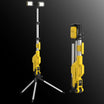
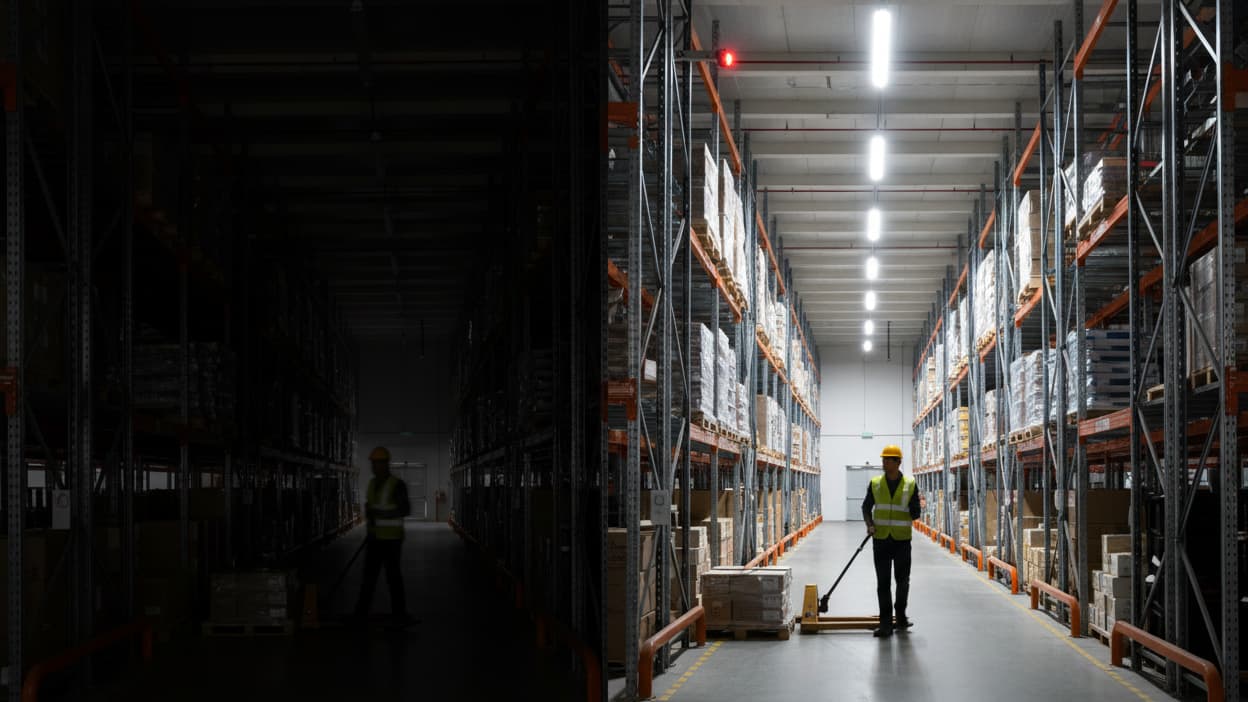
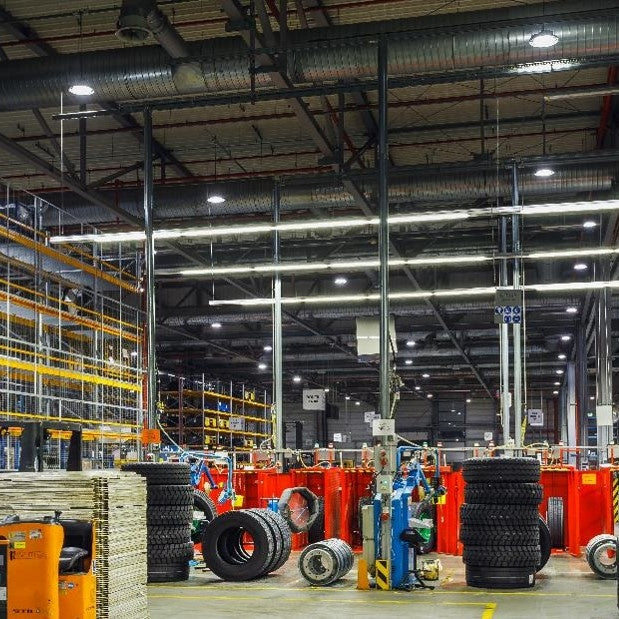
Walk into any warehouse, distribution center, or large shop floor and look up. Chances are you'll see rows of long, tube-style lights running the length of the ceiling. Those are linear strip lights — and if you're planning a new install or retrofitting old fluorescents, you've probably already hit the first real decision: 4FT or 8FT?
It sounds simple. It's not. The "right" answer depends on your ceiling height, bay width, wiring setup, and how much flexibility you want down the road. This guide walks through all of it — no filler, just the stuff that actually matters when you're planning a warehouse lighting layout.
Why Linear Strip Lights Are the Go-To for Warehouses
Before we get into the 4FT vs 8FT debate, let's quickly cover why linear strip lights dominate warehouse and industrial spaces in the first place.
Unlike round high bay lights (which throw light in a cone pattern), linear strip lights spread illumination in a long, narrow band. That's ideal for:
- Aisle-based layouts — shelving rows, racking systems, conveyor lines
- Low-to-mid ceiling heights — typically 12–25 feet, where round high bays are overkill
- Daisy-chain wiring — run one circuit across multiple fixtures without individual home runs
- Retrofit projects — they drop right into existing T8/T12 fluorescent housings in many cases
They're also significantly cheaper per lumen than round high bays at lower mounting heights. If your ceiling is under 20 feet, a linear strip layout almost always wins on cost and coverage efficiency.

The Core Difference: 4FT vs 8FT Linear Strip Lights
Here's the honest breakdown — not a spec sheet comparison, but the practical stuff installers and facility managers actually care about.
Coverage Per Fixture
An 8FT fixture covers twice the linear distance of a 4FT. That sounds obvious, but the implication is that you need half as many fixtures to cover the same run length. In a 200-foot aisle, that's 25 fixtures at 8FT vs 50 at 4FT. Fewer fixtures = fewer mounting points, fewer wire connections, less labor.
But here's the catch: 8FT fixtures are heavier and more awkward to handle on a ladder or lift. In tight spaces or areas with obstructions (sprinkler heads, HVAC ducts, structural beams), 4FT fixtures give you more flexibility to work around obstacles.
Wattage and Lumen Output
This is where it gets interesting. An 8FT fixture doesn't automatically produce twice the lumens of a 4FT — it depends on the wattage configuration.
Take the Hykoont SP07 Linear Strip Light as a real example:
- Available in 4FT and 8FT lengths
- Power range: 24W to 80W
- Efficacy: up to 130 lm/W
- So an 80W 8FT version delivers roughly 10,400 lumens
- A 40W 4FT version delivers roughly 5,200 lumens
The lumen-per-foot ratio is roughly the same — what changes is how you distribute that output across your space. Two 4FT fixtures at 40W each = one 8FT at 80W, same total lumens, but different mounting flexibility.
👉 Shop SP07 4FT/8FT Linear Strip Light — From $129.00 
Wiring and Circuit Planning
This is the factor most people underestimate. Your wiring layout has a huge impact on which fixture length makes sense.
8FT fixtures are great when your bays are long and your runs are straight. You can daisy-chain 4–6 fixtures on a single 20A circuit (depending on wattage), and the longer fixture means fewer connection points to fail over time.
4FT fixtures shine in irregular spaces. Got a column in the middle of your bay? A loading dock cutout? An HVAC unit hanging at an awkward spot? 4FT gives you the ability to skip, offset, or reposition individual fixtures without redesigning the whole run.
Also worth noting: if you're retrofitting existing fluorescent fixtures, check what you have. Most commercial fluorescent strips are either 4FT (T8 single or tandem) or 8FT (T12 slimline). Matching the new LED to the existing housing length can save significant labor cost.
Cost Per Foot
Let's talk real numbers. Using Hykoont's current pricing:
- SP05 4FT Linear Strip Light — $60.00 per fixture → $15.00/foot
- SP07 8FT Linear Strip Light — $129.00 per fixture → $16.13/foot
The per-foot cost is close, but the 8FT fixture edges slightly higher. However, when you factor in labor (fewer fixtures to mount and wire), the 8FT often comes out cheaper on total installed cost for large, open spaces.
For smaller spaces or retrofit projects where you're reusing existing mounting hardware, the 4FT can be the more economical choice.

Real-World Warehouse Scenarios
Let's get specific. Here are four common warehouse situations and which fixture length wins in each.
Scenario 1: Large Distribution Center, 24-Foot Ceilings, Open Floor Plan
Winner: 8FT
Long, unobstructed runs. High ceilings mean you want higher wattage per fixture to maintain adequate foot-candles at floor level. Fewer fixtures to install and maintain. The SP07 8FT at 60–80W is purpose-built for this.
Scenario 2: Auto Repair Shop, 14-Foot Ceilings, Multiple Bays
Winner: 4FT
Lower ceilings mean you don't need massive lumen output per fixture. Individual bays benefit from targeted placement. 4FT fixtures are easier to position over specific work areas. The SP05 4FT at 40–50W hits the sweet spot for task lighting at this height.
Scenario 3: Retail Warehouse (Costco-Style), 20-Foot Ceilings, Mixed Racking
Winner: Mix of both
Main aisles → 8FT for long, consistent runs. End caps and cross-aisles → 4FT for flexibility. This hybrid approach is more common than people realize and gives you the best of both worlds.
Scenario 4: Manufacturing Floor with Overhead Equipment
Winner: 4FT
Overhead cranes, conveyor systems, and equipment mounts create obstacles that make 8FT fixtures difficult to position. 4FT fixtures let you work around the infrastructure without leaving dark spots.

Spotlight: Hykoont SP05 Linear Strip Light (4FT)

The SP05 is Hykoont's workhorse 4FT linear strip. Here's what makes it stand out for warehouse applications:
- Wattage: 10W–100W (scalable to your ceiling height and coverage needs)
- Efficacy: 130–170 lm/W (that's exceptional — most budget strips top out at 110 lm/W)
- CRI: Ra 80+ (colors render accurately, important for inventory inspection and quality control)
- Voltage: AC120–277V / AC120–347V (works on standard US commercial circuits)
- Dimming: 0–10V compatible
- Lifespan: 50,000 hours
- Warranty: 5 years
- Price: $60.00
The 170 lm/W efficacy is the headline number here. At that efficiency, you're getting more light per watt than most competing products at this price point. For a warehouse running lights 10–16 hours a day, that translates to real money saved on electricity.
👉 Shop SP05 4FT Linear Strip Light — $60.00 
Spotlight: Hykoont SP07 Linear Strip Light (4FT/8FT)

The SP07 is the step-up model, available in both 4FT and 8FT, and it's designed specifically for commercial and industrial environments where you need more output and more installation options.
- Lengths: 4FT and 8FT
- Wattage: 24W–80W
- Efficacy: Up to 130 lm/W
- CRI: 80+
- Voltage: AC120–277V / AC120–347V
- Installation: Surface mount or suspended
- Options: Motion sensor add-on, emergency backup
- Lifespan: 50,000 hours
- Warranty: 5 years
- Price: $129.00
The motion sensor option is worth calling out. In warehouses with variable occupancy — loading docks, break rooms, storage areas that aren't always staffed — motion-activated dimming can cut lighting energy use by 30–50% in those zones. It's a feature that pays for itself quickly.
The emergency backup option is also increasingly required by code in commercial occupancies. Having it built into the fixture (rather than a separate emergency unit) simplifies installation and inspection.
👉 Shop SP07 4FT/8FT Linear Strip Light — $129.00
When to Consider Linear High Bay Instead
If your ceiling is above 20–22 feet, a standard linear strip light may not deliver enough foot-candles at floor level — even at high wattage. That's where a linear high bay comes in.

The Hykoont GC376 150W Linear LED High Bay is built for exactly this scenario:
- Power: 150W
- Output: 22,500 lumens
- Mounting height: 18–22 feet (optimal), up to 30 feet
- Coverage: 40–50 foot area per fixture
- IP Rating: IP65 (dust and water resistant)
- CCT: 5000K (daylight)
- Voltage: 120–277V
- Sensor options: Motion, PIR, Zigbee
- Certifications: UL, DLC
- Warranty: 5 years
- Price: From $59.00 (1-pack) | $229.00 (5-pack) | $279.00 (6-pack)
The DLC certification matters if you're applying for utility rebates — most US utility rebate programs require DLC-listed products. At $59/fixture with DLC certification, the GC376 is one of the more competitive options in the market for tall-ceiling warehouses.
👉 Shop GC376 150W Linear High Bay — From $59.00
How to Plan Your Warehouse Lighting Layout
Whether you go 4FT or 8FT, the layout planning process is the same. Here's a simplified version of what lighting designers actually do:
Step 1: Determine Your Target Foot-Candles
The Illuminating Engineering Society (IES) recommends these minimums for industrial spaces:
- General warehouse storage: 10–20 FC
- Active picking/packing areas: 30–50 FC
- Fine assembly or inspection: 50–100 FC
- Loading docks: 20–30 FC
Step 2: Calculate Fixture Spacing
A rough rule of thumb: fixture spacing should be no more than 1.5x the mounting height. So at 16-foot ceilings, space fixtures no more than 24 feet apart. At 20-foot ceilings, no more than 30 feet apart.
For linear strip lights running parallel to aisles, a common layout is one fixture per aisle, centered over the aisle width, with fixtures spaced 8–12 feet apart along the length.
Step 3: Account for Obstructions
Map out your sprinkler heads, HVAC drops, structural beams, and any overhead equipment before finalizing fixture positions. This is where 4FT fixtures often win — they're easier to reposition around obstacles without leaving gaps in coverage.
Step 4: Plan Your Circuits
A standard 20A, 120V circuit can handle about 1,920W of continuous load (80% of 2,400W). At 50W per fixture, that's roughly 38 fixtures per circuit. At 80W per fixture, about 24 fixtures. Plan your circuit runs accordingly, and consider whether you want zone control (separate circuits for different areas) for energy management.
Step 5: Factor in Controls
0–10V dimming, occupancy sensors, and daylight harvesting can reduce energy consumption by 40–60% in warehouses with variable occupancy or skylights. Both the SP05 and SP07 support 0–10V dimming, and the SP07 has an optional motion sensor. These aren't luxury features — in a large warehouse, they're ROI-positive within 1–2 years.
4FT vs 8FT: Quick Decision Guide
Still not sure? Here's the short version:
Go with 4FT if:
- Your space has lots of obstructions (columns, equipment, HVAC)
- You're retrofitting existing 4FT fluorescent housings
- Ceiling height is under 16 feet
- You need flexibility to reposition fixtures later
- You're doing a small install (under 20 fixtures)
Go with 8FT if:
- You have long, open runs with minimal obstructions
- You want to minimize the number of fixtures and wire connections
- Ceiling height is 16–25 feet
- You're doing a large install where labor cost matters
- You're replacing existing 8FT fluorescent strips
Go with Linear High Bay if:
- Ceiling height exceeds 20–22 feet
- You need DLC certification for utility rebates
- You want IP65 protection for dusty or wet environments
Energy Savings: What the Numbers Actually Look Like
Let's run a real scenario. A 10,000 sq ft warehouse, 18-foot ceilings, currently running 60 T8 fluorescent fixtures at 96W each (two-lamp T8).
Current setup: 60 × 96W = 5,760W total. Running 12 hours/day, 250 days/year = 17,280 kWh/year. At $0.12/kWh = $2,074/year in lighting electricity.
After retrofit with SP05 4FT at 50W: 60 × 50W = 3,000W. Same hours = 9,000 kWh/year = $1,080/year.
Annual savings: ~$994.** Payback on 60 fixtures at $60 each ($3,600 total) = **under 4 years — and that's without any utility rebates or dimming controls.
Add motion sensors and 0–10V dimming, and you could realistically cut that payback period to 2–3 years.
👉 Start Your Retrofit — Shop SP05 4FT Strip Lights
Frequently Asked Questions
Q: Can I mix 4FT and 8FT fixtures in the same warehouse?
Absolutely. It's actually pretty common. Use 8FT for long main aisles and 4FT for cross-aisles, end sections, or areas with obstructions. Just make sure you're matching color temperature (CCT) across all fixtures — mixing 4000K and 5000K in the same space looks inconsistent and can affect worker comfort.
Q: What color temperature is best for warehouse lighting?
5000K (daylight) is the most common choice for warehouses and industrial spaces. It's the closest to natural daylight, which helps with alertness and makes it easier to read labels, inspect products, and distinguish colors. 4000K (neutral white) is a good alternative if you want slightly warmer light without sacrificing visibility.
Q: Do I need an electrician to install linear strip lights?
For new circuit runs, yes — you'll need a licensed electrician. For direct replacements of existing fluorescent fixtures on existing circuits, many facility maintenance teams handle it in-house. Always check local code requirements. In most US jurisdictions, replacing a fixture on an existing circuit doesn't require a permit, but running new circuits does.
Q: How many lumens do I need per square foot in a warehouse?
A general rule of thumb is 50 lumens per square foot for general warehouse storage, and 100+ lumens per square foot for active work areas. So a 10,000 sq ft warehouse needs roughly 500,000–1,000,000 total lumens. At 5,200 lumens per 4FT fixture (40W SP05), that's 96–192 fixtures for the space.
Q: What's the difference between a linear strip light and a linear high bay?
Linear strip lights are designed for lower ceiling heights (typically under 20 feet) and spread light in a wide, even pattern. Linear high bays are designed for taller ceilings (20–40 feet) and use optics to throw light further down to the floor. High bays are generally higher wattage and more expensive per fixture, but necessary when ceiling height demands it.
Q: Are LED linear strip lights dimmable?
Most commercial-grade LED linear strip lights support 0–10V dimming, including the SP05 and SP07. Make sure your dimmer switch or building automation system is compatible with 0–10V protocol — standard residential dimmers won't work correctly with commercial LED drivers.
Q: How long do LED linear strip lights last?
Quality commercial LED strip lights are rated for 50,000 hours. At 12 hours per day, that's over 11 years of operation. Both the SP05 and SP07 carry 5-year manufacturer warranties, which is standard for commercial-grade LED products.
Q: Can LED linear strip lights replace fluorescent T8 fixtures directly?
In many cases, yes. LED linear strip lights are designed as direct replacements for T8 and T12 fluorescent strips. The key is matching the fixture length (4FT or 8FT) and verifying the mounting configuration. Some LED strips are designed to reuse the existing housing; others are complete fixture replacements. Check the product specs before ordering.
Q: Do I need DLC-certified fixtures to qualify for utility rebates?
Most US utility rebate programs require DLC (DesignLights Consortium) certification. The GC376 Linear High Bay is DLC certified. For the SP05 and SP07, check with your local utility — some programs accept DesignLights Qualified products, while others have their own approved product lists. Always verify before purchasing if rebates are part of your ROI calculation.
Q: What's the best way to get a quote for a large warehouse lighting project?
For projects over 50 fixtures, reach out directly for bulk pricing. Hykoont offers volume discounts on commercial orders, and the GC376 is already available in 5-pack and 6-pack configurations at reduced per-unit cost. A lighting layout consultation can also help you determine the exact fixture count and placement before you commit to an order.
Bottom Line
There's no universal winner between 4FT and 8FT LED linear strip lights. The right choice depends on your specific space — ceiling height, bay layout, existing infrastructure, and how much flexibility you need.
What we can say with confidence: both the SP05 (4FT) and SP07 (4FT/8FT) deliver commercial-grade performance at a price point that makes the ROI math work, even without rebates. And if your ceilings are pushing 20+ feet, the GC376 Linear High Bay is worth a serious look.
The best warehouse lighting layout is the one that's planned — not guessed. Take the time to map your space, calculate your foot-candle targets, and choose fixtures that match your actual conditions. Your energy bill (and your workers) will thank you.
Ready to Light Your Warehouse?
Browse our full lineup of commercial LED linear strip lights and high bays:
- SP05 4FT Linear Strip Light — $60.00
- SP07 4FT/8FT Linear Strip Light — $129.00
- GC376 150W Linear High Bay — From $59.00
Questions about your specific project? Contact our team — we're happy to help with layout planning and bulk pricing.

Leave a comment
This site is protected by hCaptcha and the hCaptcha Privacy Policy and Terms of Service apply.