


Stop guessing how bright your warehouse actually is. This guide breaks down real lumen output (actual delivered light) for UFO LED high bay lights — what the numbers mean, why they matter for safety and productivity, and which Hykoont models deliver verified lumens you can count on.
Why "Real Lumens" Is the Only Number That Matters in a Warehouse
Walk into any lighting spec sheet and you'll see a big, bold lumen number. 22,500 lumens. 30,000 lumens. Sometimes even 50,000. Sounds impressive — until you realize that number is often measured at the LED chip itself, before the light travels through a lens, a housing, a reflector, and finally hits your floor 20 feet below.
That gap between initial lumens (what the chip produces) and delivered lumens (what actually reaches your work surface) is where a lot of cheap fixtures quietly disappoint you.
In a warehouse, a distribution center, a manufacturing floor, or a gymnasium, that gap isn't just a technical footnote. It's the difference between workers straining to read labels and a space that's genuinely safe, productive, and comfortable to be in all day.
So let's talk about what real lumen output actually means — and why it should be the first thing you look at when shopping for UFO LED high bay lights.

What "Actual Output" Really Means (And Why It Differs From the Spec Sheet)
Lumen output gets measured in a few different ways, and manufacturers don't always make it obvious which one they're quoting.
Initial lumens are measured right at the source — the LED package or chip array — under controlled lab conditions, usually at 25°C. This is the highest number you'll ever see for a fixture, and it's the one most commonly featured in marketing materials.
System lumens (sometimes called fixture lumens or delivered lumens) account for losses through the optics, the driver, the housing, and thermal effects during real operation. A well-designed fixture might retain 90–95% of initial lumens as system lumens. A poorly designed one? You might lose 20–30% before the light even leaves the fixture.
Maintained lumens go one step further — they account for lumen depreciation over time. A fixture rated at 22,500 lumens today might deliver only 18,000 lumens after 50,000 hours if the LED quality or thermal management isn't up to standard.
For high bay applications — where fixtures are mounted 15 to 40 feet above the floor — every percentage point of lumen loss is amplified. A 15% reduction in delivered lumens at 25 feet of mounting height can mean the difference between meeting IES RP-7 recommended illuminance levels for industrial spaces and falling short.
This is why efficacy (lumens per watt, or LM/W) matters so much. A fixture rated at 150 LM/W isn't just efficient — it's a signal that the engineering behind the optics, driver, and thermal management is tight enough to actually deliver what it promises.
The Hykoont GC377: 150 LM/W UFO High Bay That Earns Its Numbers

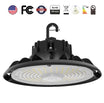
Hykoont GC377 UFO LED High Bay Light — 150W/200W, 150 LM/W, UL & DLC Certified — from $109.00
The GC377 is built around a single premise: deliver the lumens you're paying for, not just the lumens on the box.
At 150 LM/W efficacy, a 150W GC377 produces 22,500 lumens of actual system output — not chip-level lumens, not theoretical maximums. That's verified through UL listing and DLC (DesignLights Consortium) certification, which requires independent third-party photometric testing. DLC doesn't take the manufacturer's word for it. They test it.
Key specs:
- Wattage: 150W or 200W (selectable)
- Efficacy: 150 LM/W
- Color temperature: 4000K or 5000K
- IP rating: IP65 (dust-tight, jet-water resistant)
- Certifications: UL Listed, DLC Certified
- Mounting: Hook, bracket, or pendant
- Price: from $109.00
The IP65 rating matters more than people realize in industrial environments. Dust, humidity, occasional water spray from cleaning operations — these are the things that degrade fixtures over time and cause lumen depreciation to accelerate. The GC377's sealed housing keeps the optics clean and the driver protected.
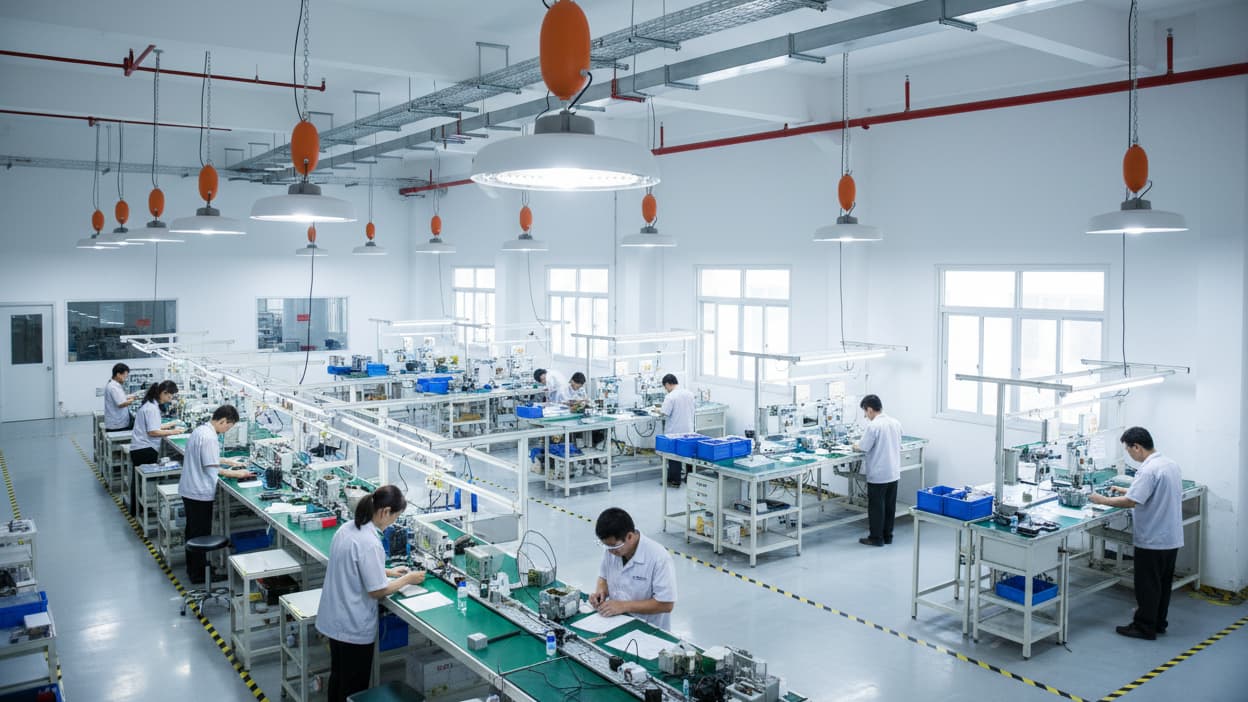
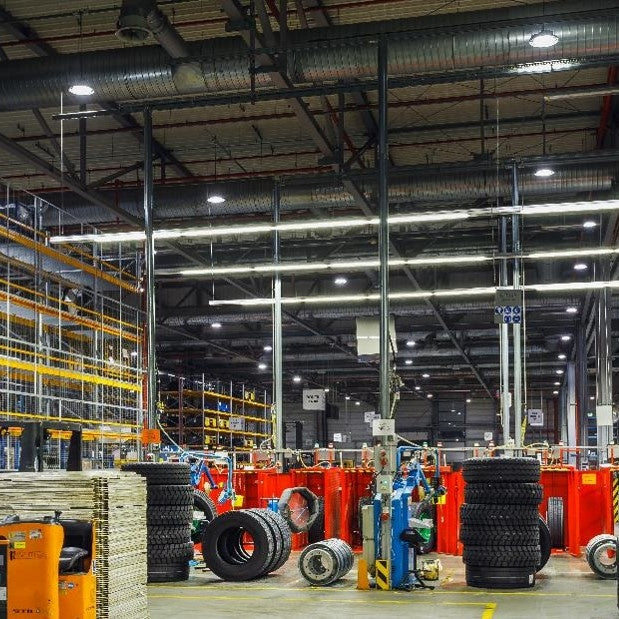
Where it works best: Warehouses, distribution centers, manufacturing floors, auto shops, big-box retail back-of-house, gymnasiums. Mounting height 15–30 feet.
→ Shop the GC377 UFO High Bay Light
Tunable High Bays: When One Color Temperature Isn't Enough
Most facilities have a single lighting need. But some don't.
A cold storage warehouse might want 5000K (crisp, blue-white) for maximum visual acuity during picking operations. The same building's break room or office area might benefit from 4000K (neutral white) for a less clinical feel. A gymnasium used for both athletic events and community meetings might want different light levels for different activities.
That's where tunable UFO high bays come in — and Hykoont's UFO11, UFO12, and UFO07 series are built specifically for this.
Hykoont UFO12: The Flexible Workhorse

Hykoont UFO12 Tunable LED UFO High Bay Light — 80W/100W/150W/240W — from $147.00
The UFO12 covers a wide wattage range — 80W, 100W, 150W, and 240W — making it genuinely useful across different mounting heights and space sizes without needing to stock multiple SKUs.
What makes it stand out is the tunable output. You're not locked into a single wattage or color temperature at installation. That flexibility is valuable in commercial construction and retrofit projects where the final use case might shift between spec and completion.
- Wattage options: 80W / 100W / 150W / 240W
- Tunable color temperature
- Suitable for mounting heights 15–35 feet
- Price: from $147.00
→ Shop the UFO12 Tunable High Bay
Hykoont UFO07: High-Output for Large Spaces

Hykoont UFO07 Tunable LED UFO High Bay Light — 100W/200W/300W — from $240.00
When you're lighting a space with 30–45 foot ceilings — think aircraft hangars, large distribution centers, or arena facilities — you need a fixture that can push serious lumens downward without creating hot spots or dark zones.
The UFO07 at 300W is built for exactly that. The tunable design means you can dial in the right output for the application rather than over-lighting (and over-spending on energy) or under-lighting and creating safety hazards.
- Wattage options: 100W / 200W / 300W
- Tunable color temperature and output
- Designed for high-ceiling applications (25–45 feet)
- Price: from $240.00
→ Shop the UFO07 High-Output High Bay
How to Calculate How Many High Bay Lights You Actually Need
This is where a lot of people get tripped up. They buy based on wattage without doing the footcandle math. Here's a simple framework:
Step 1: Determine your target footcandles (FC)
- General warehouse storage: 10–20 FC
- Active picking/packing areas: 20–30 FC
- Manufacturing/assembly: 30–50 FC
- Fine assembly or inspection: 50–100 FC
Step 2: Calculate your space area
Length × Width = square footage
Step 3: Estimate lumens needed
Target FC × Square footage = Total lumens needed
Step 4: Divide by fixture output
Total lumens ÷ Lumens per fixture = Number of fixtures
Example: A 10,000 sq ft warehouse targeting 20 FC needs ~200,000 lumens. The GC377 at 150W delivers ~22,500 lumens, so you'd need approximately 9 fixtures.

DLC Certification: Why It's Not Just a Badge
The DesignLights Consortium maintains a Qualified Products List (QPL) that utility companies across the US use to determine eligibility for energy efficiency rebates. If your fixture is on the DLC QPL, you may qualify for rebates from your local utility that can significantly offset the purchase price.
For a warehouse doing a full retrofit — say, replacing 50 metal halide fixtures — those rebates can add up to thousands of dollars. The GC377's DLC certification means it's been independently tested and verified to meet minimum efficacy, color quality, and lifetime requirements.
UL listing, meanwhile, is the safety certification that most commercial building codes require. Both certifications together mean you're buying a fixture that's been vetted by parties with no financial interest in making it look good.
Linear vs. UFO: Which High Bay Format Is Right for Your Space?
UFO High Bays (GC377, UFO11, UFO12, UFO07)
- Compact, round form factor
- 360° light distribution
- Better for spaces where fixtures are widely spaced
- Generally better for ceiling heights above 20 feet
Linear High Bays (GC376)
- Elongated form factor, similar to a shop light
- Better for aisle-based layouts (racking, shelving)
- More even distribution along the length of an aisle
- Often preferred for lower ceiling heights (12–20 feet)

Hykoont GC376 150W Linear LED High Bay Light — 22,500 LM, UL & DLC Certified — from $59.00
→ Shop the GC376 Linear High Bay
Real-World Lumen Comparison: LED vs. Metal Halide vs. HPS
| Old Fixture | Wattage | Actual Lumens Delivered | Equivalent LED | LED Wattage | LED Lumens |
|---|---|---|---|---|---|
| Metal Halide | 400W | 18,000–22,000 | GC377 | 150W | ~22,500 |
| Metal Halide | 250W | 12,000–15,000 | GC376 | 100W | ~15,000 |
| HPS | 400W | 20,000–24,000 | UFO12 | 150W | ~22,500+ |
| HPS | 250W | 14,000–17,000 | GC376 | 100W | ~15,000 |
FAQ: Real Lumens & UFO LED High Bay Lights
Q: What's the difference between lumens and footcandles?
Lumens measure the total light output of a fixture. Footcandles measure the illuminance — how much of that light actually lands on a surface. A fixture with 22,500 lumens mounted at 25 feet will deliver fewer footcandles to the floor than the same fixture mounted at 15 feet.
Q: How do I know if a lumen rating is real or inflated?
Look for DLC certification. DLC requires independent photometric testing and publishes verified data on their QPL. If a fixture isn't DLC listed, the lumen rating is self-reported by the manufacturer.
Q: What mounting height is the GC377 designed for?
The GC377 performs best at mounting heights of 15–30 feet. For heights above 30 feet, consider the UFO07 at 200W or 300W.
Q: Can I use UFO high bays outdoors?
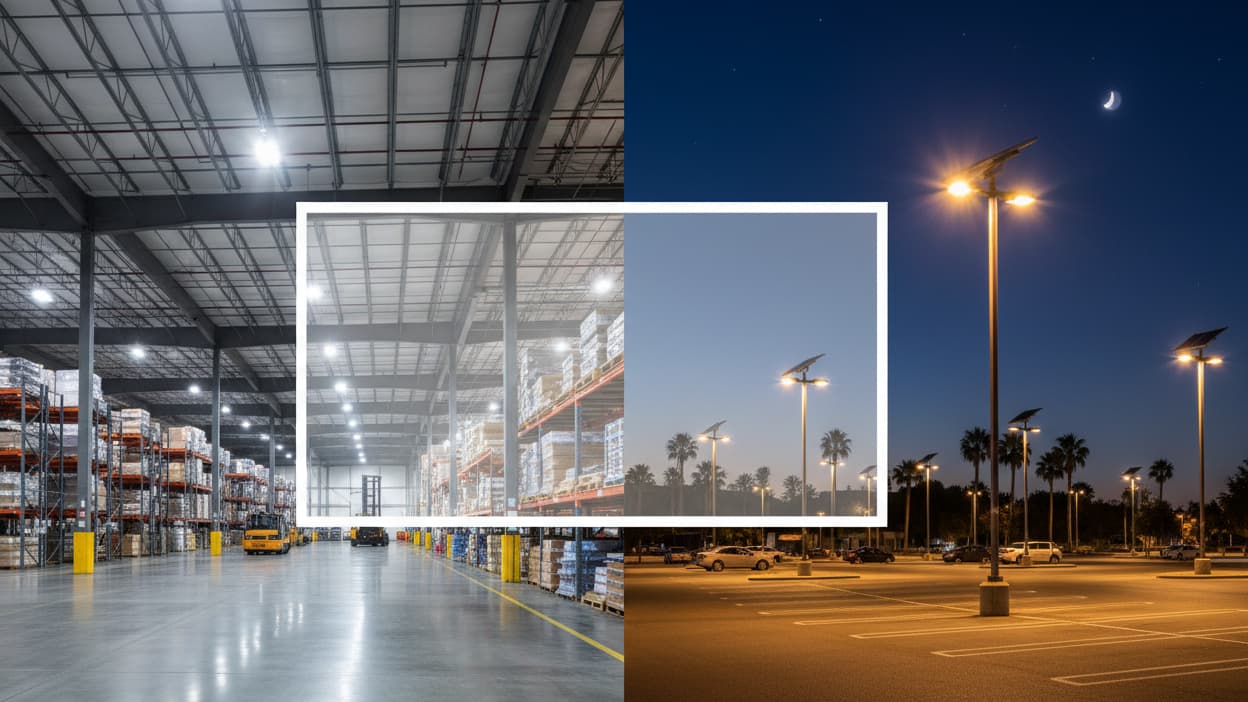
The GC377 is IP65 rated — suitable for covered outdoor areas like loading docks, covered parking structures, or canopies. It's not designed for direct rain exposure without overhead protection.
Q: What does "tunable" mean on the UFO11, UFO12, and UFO07?
Tunable fixtures allow you to adjust color temperature, wattage/output level, or both — either at installation via a selector switch or remotely via a control system.
Q: Do Hykoont high bays qualify for utility rebates?
DLC-certified models (GC377, GC376) are eligible for utility rebates through programs that use the DLC QPL. Rebate amounts vary by utility and state.
Q: How long do LED high bays last compared to metal halide?
Quality LED high bays are rated for 50,000–100,000 hours. Metal halide fixtures typically last 10,000–20,000 hours before significant lumen depreciation.
Q: What's the difference between the GC377 and the UFO11?
The GC377 is a fixed-output, cost-effective DLC-certified fixture ($109.00). The UFO11 is a premium tunable fixture with adjustable output and color temperature ($429.00), designed for applications where flexibility justifies the higher price.
Q: Is 150 LM/W actually good?
150 LM/W is excellent. Standard commercial LED fixtures typically range from 100–130 LM/W. A standard metal halide delivers roughly 75–100 LM/W — before accounting for ballast losses.
Q: Can I get a photometric layout before I buy?
Yes — contact Hykoont with your space dimensions, ceiling height, and target illuminance levels for a photometric layout based on IES file simulation.
Ready to upgrade your facility lighting with fixtures that deliver what they promise? Start with the GC377 UFO High Bay for a cost-effective, DLC-certified solution, or explore the UFO12 and UFO07 for tunable flexibility.


Leave a comment
This site is protected by hCaptcha and the hCaptcha Privacy Policy and Terms of Service apply.