


The $30 Solar Path Light Mistake That's Costing You More Than You Think
Let me guess: You're standing in the outdoor lighting aisle at your local home improvement store, looking at those attractive solar path lights for $25-40 each. They promise easy installation, no wiring, free energy from the sun, and decent illumination. The box shows a beautifully lit pathway. It seems like a no-brainer, right?
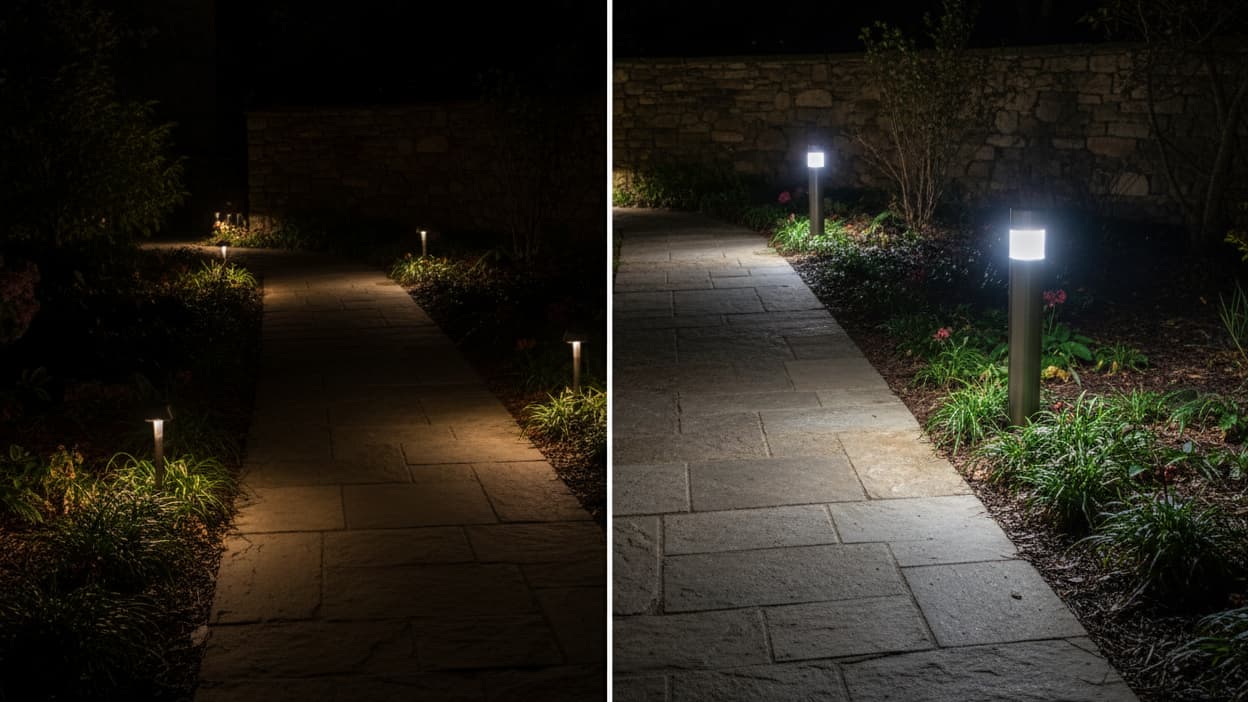
I've had this conversation dozens of times with homeowners who made that purchase, used them for 6-12 months, and then came to me asking why their pathway looks dim and patchy. The solar lights that seemed so bright in the store are now barely glowing. Half of them have stopped working entirely. And the ones that still function provide about as much light as a birthday candle.
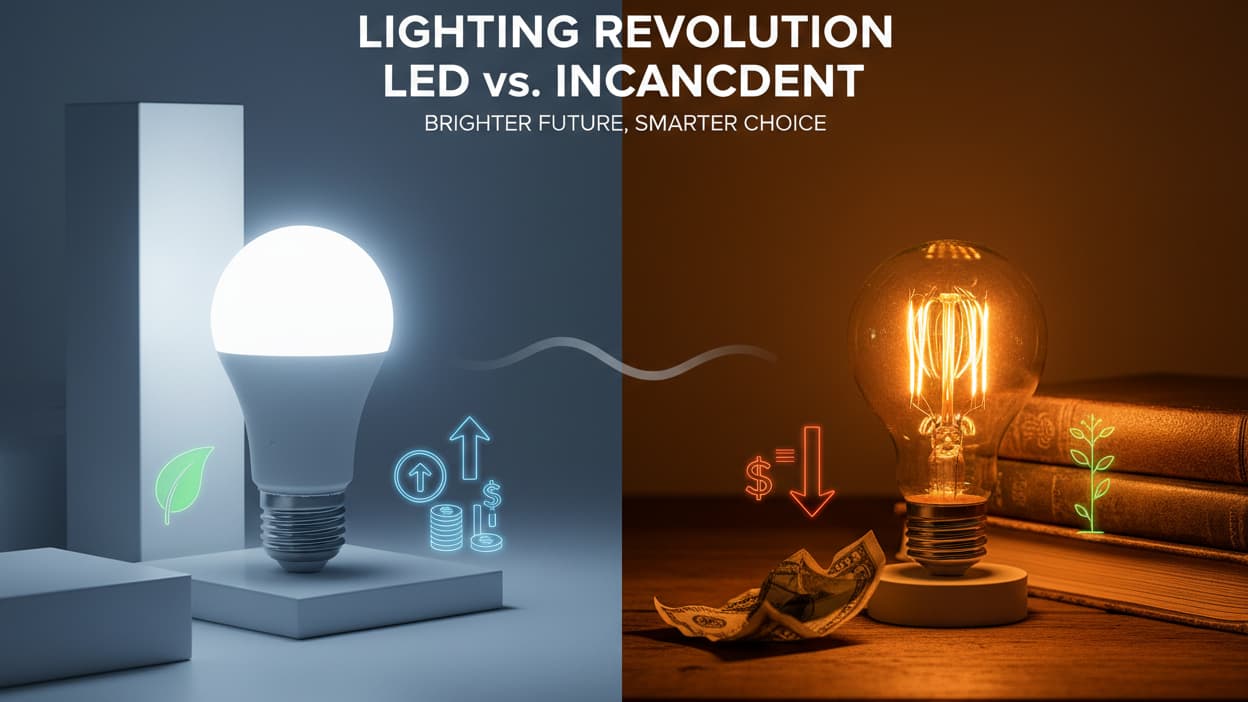
Here's what nobody tells you at the point of sale: solar path lights and professional LED path lights like the Hykoont BD02 LED Bollard Light aren't just different price points for the same product. They're fundamentally different technologies designed for completely different purposes.
This isn't about expensive versus cheap. It's about understanding what you're actually buying and whether it will do what you need it to do. Let's break down the real differences, the hidden costs, and help you make an informed decision.

Understanding Solar Path Lights: What They Actually Are
Before we compare, let's be clear about what solar path lights actually do and how they work:
The Technology Behind Solar Path Lights
A typical solar path light consists of:
- A small solar panel (usually 2-4 square inches)
- A rechargeable battery (typically NiMH, 600-1200mAh)
- An LED bulb (usually 0.5-2 watts)
- A light sensor for automatic on/off
- Plastic housing and stake
During the day, the solar panel charges the battery. At night, the light sensor triggers the LED to turn on, running on battery power until the battery depletes or dawn arrives.
In theory, it's elegant. In practice, there are significant limitations.
The Reality of Solar Path Light Performance
Here's what you actually get with typical solar path lights:
Light Output: 5-15 lumens per fixture. For context, that's about 1% of what the BD02 produces (3,200 lumens). A standard 60-watt incandescent bulb produces about 800 lumens. Solar path lights are dim—really dim.
Runtime: 4-8 hours on a full charge, but only if the battery got a full day of direct sunlight. Cloudy days, shade from trees or buildings, or winter's shorter days all reduce this significantly.
Lifespan: 1-2 years before the battery degrades to the point where the lights barely function. The plastic housing becomes brittle from UV exposure. The solar panels get dirty or damaged.
Reliability: Inconsistent. Some lights in your set will fail within months. Others might last longer. You'll end up with a patchwork of working and non-working lights.

Professional LED Path Lights: The BD02 Approach
Now let's look at what you get with a professional-grade LED path light like the BD02:
The Technology Behind the BD02
The BD02 LED Bollard Light at $315 uses completely different technology:
- High-efficiency LED module producing 3,200 lumens
- 140 lumens per watt efficiency
- Line voltage power (120-277V AC)
- Die-cast aluminum construction
- Professional-grade optics for uniform light distribution
- Tunable wattage (24W/19W/14W)
- Multiple color temperature options (3000K/4000K/5000K)
This isn't a battery-powered decorative light. It's a professional luminaire designed for consistent, long-term performance.

Performance Comparison: Numbers Don't Lie
Let's put them side by side:
Light Output:
- Solar path light: 5-15 lumens
- BD02: 3,200 lumens
- Difference: 200-600x more light
Efficiency:
- Solar path light: 5-10 lumens per watt
- BD02: 140 lumens per watt
- Difference: 14-28x more efficient
Lifespan:
- Solar path light: 1-2 years
- BD02: 50,000+ hours (11+ years at 12 hours/night)
- Difference: 5-11x longer lifespan
Consistency:
- Solar path light: Varies with weather, season, and battery condition
- BD02: Consistent output every night, year-round
The Hidden Costs of Solar Path Lights
Solar path lights seem cheap at $25-40 each, but let's calculate the real cost over 10 years:
Initial Purchase
For a typical 60-foot pathway, you need about 12 solar lights (closer spacing required due to lower output):
- 12 solar lights at $30 each: $360
- Installation: $0 (DIY stake installation)
- Initial cost: $360
Replacement Costs
With a 1.5-year average lifespan, you'll replace them 6-7 times over 10 years:
- Year 1.5: $360
- Year 3: $360
- Year 4.5: $360
- Year 6: $360
- Year 7.5: $360
- Year 9: $360
- Replacement cost: $2,160
Time and Frustration
Each replacement cycle involves:
- Shopping for new lights (2-3 hours)
- Removing old lights (1 hour)
- Installing new lights (2 hours)
- Disposing of old lights (30 minutes)
- Total time per cycle: 5.5 hours
- Total time over 10 years: 33 hours
Value your time at even $20/hour, and that's another $660 in opportunity cost.
Performance Degradation
Even when "working," solar path lights provide inadequate illumination. The safety risk of poorly lit pathways, the aesthetic disappointment, and the reduced property value are harder to quantify but very real.
Total 10-year cost of solar path lights: $3,180+ plus 33 hours of your time

The True Cost of Professional LED Path Lights
Now let's calculate the same 60-foot pathway with BD02 fixtures:
Initial Investment
You need 5 BD02 fixtures (wider spacing due to higher output):
- 5 BD02 fixtures at $315 each: $1,575
- Professional installation: $1,000-1,500
- Permits and inspection: $100-200
- Initial cost: $2,675-3,275
Operating Costs
At 24W per fixture, 12 hours per night:
- Daily usage: 5 fixtures × 24W × 12 hours = 1.44 kWh
- Annual usage: 525.6 kWh
- Annual cost at $0.16/kWh: $84
- 10-year energy cost: $840
Maintenance and Replacement
With a 50,000+ hour lifespan:
- Replacement fixtures needed in 10 years: 0
- Maintenance (cleaning twice yearly): $50 total
- 10-year maintenance cost: $50
Total 10-year cost of BD02 path lights: $3,565-4,165

But Wait—The Value Proposition Changes Everything
Looking at just the numbers, the BD02 costs $385-985 more over 10 years. But you're not comparing apples to apples. You're comparing a dim, unreliable decorative light to a professional illumination system.
What You Actually Get for That Difference
200-600x more light: The BD02 actually illuminates your pathway. You can see where you're walking, identify trip hazards, and navigate safely. Solar lights provide ambiance at best.
Consistent performance: The BD02 works the same on day 1 and day 3,650. Solar lights degrade continuously from the moment you install them.
Zero maintenance hassle: Install once, forget about it. No replacing batteries, no swapping out failed units, no frustration.
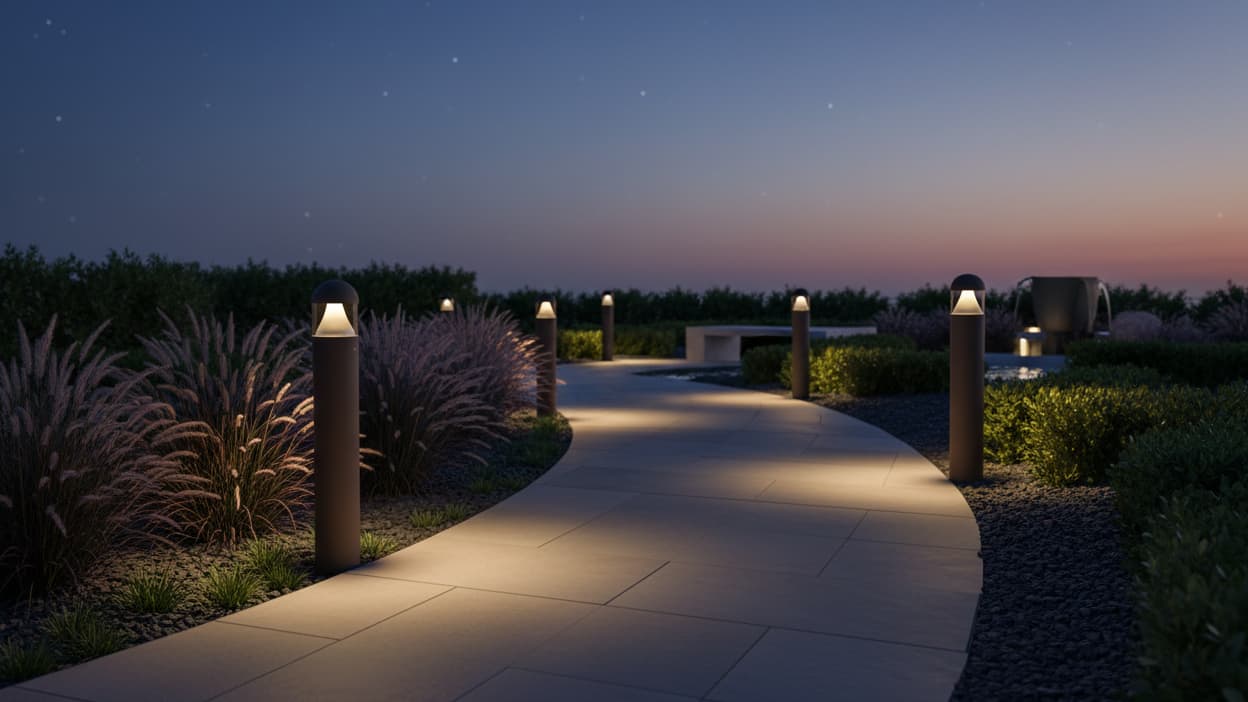
Professional appearance: The BD02 looks like it belongs on a high-end property. Solar lights look like... well, like $30 solar lights.
Property value impact: Professional landscape lighting adds 5-10% to perceived home value. Solar lights add nothing or may even detract if they're visibly cheap or non-functional.
When Solar Path Lights Actually Make Sense
I'm not saying solar path lights are always wrong. There are legitimate use cases:
Temporary or Seasonal Applications
If you're renting and can't install permanent lighting, or if you only need pathway lighting for summer garden parties, solar lights can work. You're not expecting long-term performance, so the limitations don't matter as much.
Decorative Accent Lighting
Want to add a little sparkle to a garden bed or highlight a specific plant? Solar lights can provide decorative accent lighting where the goal is ambiance, not illumination.
Remote Locations Without Power
If you have a pathway far from any electrical source and running wiring is prohibitively expensive, solar lights might be your only practical option. Just understand their limitations going in.
Budget Constraints
If you literally cannot afford professional lighting right now, solar lights are better than nothing. But consider them a temporary solution and plan to upgrade when possible.

When Professional LED Path Lights Are Essential
The BD02 and similar professional fixtures are the right choice when:
Safety Is a Priority
If you have elderly family members, young children, or anyone with mobility challenges, adequate pathway lighting isn't optional. The dim, inconsistent output of solar lights creates genuine safety hazards.
You Want Reliable Performance
If you need lights that work every night, regardless of weather or season, line-voltage LED fixtures are the only reliable option. Solar lights fail exactly when you need them most—during long winter nights and extended cloudy periods.
Professional Appearance Matters
If you're lighting a business, rental property, or high-end residence where appearance and reliability reflect on you professionally, solar lights aren't adequate. The BD02 delivers the consistent, professional results you need.
Long-Term Value Is Important
If you're planning to stay in your home for years and want lighting that will still be functioning a decade from now, professional fixtures are the clear choice. The upfront investment pays off through longevity and performance.

The Environmental Angle: Which Is Actually Greener?
Solar lights seem eco-friendly because they use "free" solar energy. But let's look at the full environmental picture:
Solar Path Light Environmental Impact
- Manufacturing: 12 lights manufactured, shipped, and packaged
- Replacement: 6-7 complete replacement cycles over 10 years = 72-84 total lights manufactured
- Disposal: 72-84 lights in landfills (batteries, plastic, electronics)
- Energy use: Zero operational energy (solar powered)
- Efficiency: Very low (5-10 lumens per watt)
BD02 Environmental Impact
- Manufacturing: 5 lights manufactured, shipped, and packaged
- Replacement: Zero over 10 years
- Disposal: Zero over 10 years (aluminum is recyclable at end of life)
- Energy use: 525.6 kWh per year from grid
- Efficiency: Very high (140 lumens per watt)
The Surprising Conclusion
Even accounting for grid electricity use, the BD02 likely has a lower total environmental impact due to:
- Dramatically fewer units manufactured and disposed of
- Much higher efficiency means less total energy per lumen delivered
- Longer lifespan reduces manufacturing and transportation impacts
- Recyclable aluminum construction vs. landfill-bound plastic
If your electricity comes from renewable sources (solar, wind, hydro), the BD02 is unquestionably greener. Even with fossil fuel electricity, the manufacturing and disposal impacts of constantly replacing solar lights may outweigh the operational energy advantage.
Real-World Scenarios: Which Should You Choose?
Let's look at specific situations and the right choice for each:
Scenario 1: New Homeowner, Tight Budget
Situation: You just bought your first home. Money is tight after the down payment. You want some pathway lighting but can't afford a professional installation right now.
Recommendation: Start with solar lights as a temporary solution, but plan to upgrade. Put aside $50-100 per month, and in 6-12 months, you'll have enough for professional lighting. The solar lights will at least provide some illumination in the meantime.
Scenario 2: Elderly Parents' Home
Situation: Your parents are aging in place. They've had a couple of near-falls on their dark pathway. Safety is the top priority.
Recommendation: BD02 without question. This is a safety issue, not a luxury. The reliable, bright illumination could prevent a serious injury. The $3,000 investment is trivial compared to the cost of a fall-related injury.
Scenario 3: Rental Property
Situation: You own a rental property and want to add pathway lighting to increase appeal and safety.
Recommendation: BD02. The professional appearance adds to property value and rental appeal. The low maintenance means fewer service calls. The 5-year warranty and 50,000-hour lifespan mean you won't be replacing lights between tenants. The investment pays off in higher rent and lower vacancy rates.
Scenario 4: Vacation Home
Situation: You have a vacation home you visit occasionally. You want some pathway lighting for when you're there, but the property sits empty most of the year.
Recommendation: This could go either way. If the property is high-end and you care about appearance and property value, go with the BD02. If it's a casual cabin and you just want basic lighting for occasional visits, solar lights might suffice. Consider that solar lights sitting unused will still degrade, so they won't last any longer than if you used them constantly.
Scenario 5: Commercial Property
Situation: You manage an office building, retail center, or other commercial property. You need reliable pathway lighting for customers and liability protection.
Recommendation: BD02 exclusively. Solar lights are not appropriate for commercial applications. You need consistent, reliable illumination for safety and liability reasons. The professional appearance matters for your business image. The low maintenance reduces operational costs. This isn't even a close call.

Installation Considerations: What You Need to Know
Solar Path Light Installation
Installation is genuinely simple:
- Choose locations with good sun exposure
- Push stakes into ground
- Turn on the lights
- Done in 30 minutes
The simplicity is solar lights' biggest advantage. No electrician, no permits, no wiring.
BD02 Installation
Installation requires professional expertise:
- Electrical planning and design
- Trenching for wiring (if not already present)
- Line voltage electrical work
- Permits and inspections
- Professional installation: $200-300 per fixture
This is more complex and expensive, but it's a one-time investment that delivers decades of reliable performance.
Maintenance Reality Check
Solar Path Light Maintenance
Despite being "maintenance-free," solar lights actually require:
- Regular cleaning of solar panels (monthly)
- Battery replacement every 1-2 years (if you want to extend life)
- Replacing broken or failed units constantly
- Adjusting or re-staking lights that shift or tilt
- Storing lights in winter in harsh climates
The maintenance burden is actually quite high, just spread out in small increments.
BD02 Maintenance
- Clean fixtures twice yearly with damp cloth
- That's it
The sealed construction, professional-grade components, and line voltage power mean there's essentially nothing to maintain.

Frequently Asked Questions
Can I mix solar path lights and LED path lights?
Technically yes, but it's not recommended. The dramatic difference in light output will be visually jarring. If you use both, use them in completely separate areas—solar lights for decorative garden accents, LED path lights for functional pathway illumination. Don't try to use them together on the same pathway.
Will solar path lights work in shaded areas?
Poorly or not at all. Solar lights need 6-8 hours of direct sunlight daily to charge fully. Shade from trees, buildings, or other structures dramatically reduces performance. If your pathway is shaded, solar lights will disappoint you. The BD02 works regardless of sun exposure since it runs on line voltage.
How much does it really cost to run the BD02?
At 24W running 12 hours per night, each BD02 uses about 0.288 kWh per day, or 105 kWh per year. At the national average of $0.16 per kWh, that's $16.80 per year per fixture. Five fixtures cost about $84 annually to operate, or $7 per month. That's less than two fancy coffee drinks.
Can I install the BD02 myself to save money?
Unless you're a licensed electrician, no. The BD02 requires line voltage electrical work (120-277V). DIY installation could violate building codes, void your warranty, create safety hazards, and cause insurance issues if something goes wrong. The professional installation cost is worth it for safety, code compliance, and peace of mind.
Do solar path lights work in winter?
Barely. Winter brings shorter days (less charging time), lower sun angles (less efficient charging), and often cloudy weather (reduced solar input). Snow covering the solar panels stops charging entirely. Cold temperatures reduce battery performance. Solar lights that work adequately in summer often fail completely in winter—exactly when you need pathway lighting most due to early darkness.
What's the brightest solar path light available?
The brightest consumer solar path lights produce about 15-20 lumens. Some commercial-grade solar bollards can reach 50-100 lumens, but they cost $200-400 each—approaching the cost of line-voltage fixtures while still delivering only 2-3% of the light output. If you need serious illumination, solar technology isn't the answer.
How long does the BD02 warranty last?
The BD02 comes with a 5-year limited warranty covering manufacturing defects and premature failure. This is significantly longer than the 90-day to 1-year warranties typical of solar path lights. The warranty reflects the manufacturer's confidence in the product's longevity.
Can I use the BD02 with a timer or smart home system?
Yes. While the fixtures themselves don't have built-in smart features, they can be controlled by any switch, timer, or smart home system that controls the circuit they're wired to. This allows for scheduling, remote control, and integration with other smart home devices. Discuss control options with your electrician during installation planning.
What happens to solar path lights after 2 years?
The rechargeable batteries degrade to the point where they can't hold a charge. The plastic housing becomes brittle from UV exposure and may crack. The solar panels get dirty or scratched, reducing efficiency. The LEDs may still work, but without a functioning battery, the lights won't stay on. At this point, most people replace the entire fixture rather than trying to repair it.
Is there a middle-ground option between solar and line-voltage?
Yes—low-voltage LED path lights (12V systems). They offer better performance than solar lights, easier installation than line-voltage, and moderate cost. However, they still have limitations: voltage drop over distance, transformer capacity limits, and shorter lifespan than professional line-voltage fixtures. For most applications, it's worth going straight to line-voltage for the best long-term value.
The Bottom Line: Making Your Decision
Here's how to think about the solar path light vs. LED path light decision:
Choose Solar Path Lights If:
- You need temporary or seasonal lighting
- You're renting and can't install permanent fixtures
- You want decorative accent lighting, not functional illumination
- You have no access to electrical power and running wiring is impossible
- You understand and accept the limitations and short lifespan
- Budget constraints make professional lighting impossible right now
Choose the BD02 LED Path Light If:
- You need reliable, consistent illumination year-round
- Safety is a priority (elderly users, children, mobility challenges)
- You want professional appearance and performance
- You're planning to stay in your home long-term
- You value low maintenance and long lifespan
- You own commercial property or rental property
- You want lighting that adds to property value
- You can afford the upfront investment for better long-term value
Ready to Invest in Real Path Lighting?
If you've decided that professional LED path lighting is the right choice for your property, the Hykoont BD02 LED Bollard Light delivers exceptional value at $315 per fixture.
What you get:
- 3,200 lumens of uniform, professional illumination
- 140 lumens per watt efficiency
- Tunable wattage (24W/19W/14W) for application flexibility
- Choice of color temperature (3000K/4000K/5000K)
- Die-cast aluminum construction for decades of service
- 50,000+ hour LED lifespan
- 5-year limited warranty
- Professional appearance that enhances property value
Stop replacing cheap solar lights every year. Stop dealing with dim, unreliable illumination. Stop compromising on safety and appearance.
Invest in the BD02 LED Bollard Light and get pathway lighting that actually works.
Questions about your specific application? Our lighting specialists can help you determine the right number of fixtures, optimal placement, and color temperature for your property. We'll help you design a pathway lighting system that delivers professional results within your budget.

Leave a comment
This site is protected by hCaptcha and the hCaptcha Privacy Policy and Terms of Service apply.