


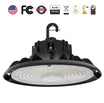
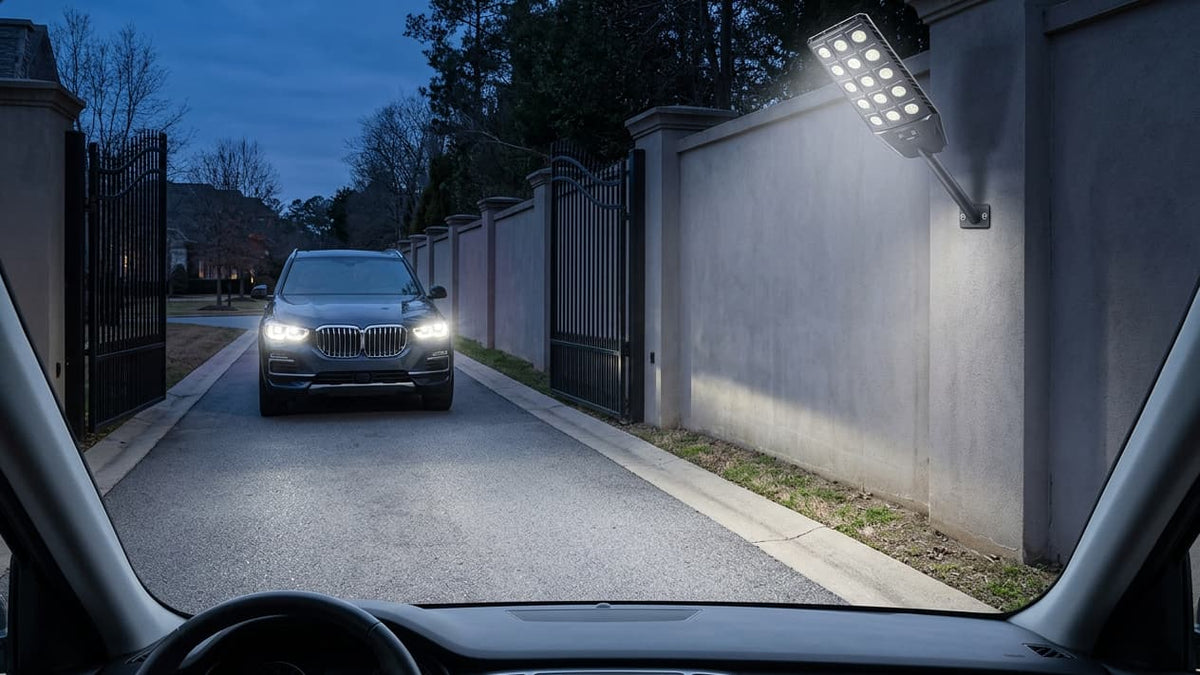
At 8:47 p.m., a driveway is not a lighting specification. It is where you are trying to find the grocery bag that tipped over, check whether the gate latched, and get the dog back inside without stepping into the flower bed. What matters is not how impressive a number looks on a product page. It is whether useful light reaches the places you actually use, and whether the light still has something left when you come home late.
That is the interesting question behind the HYKOONT HY015. Its listed specifications include 15,000 lumens, coverage across 2,000 square feet, a 10W solar panel, and a 9,200mAh battery. Those numbers describe different parts of the same system. None tells the whole story on its own.
If you are shopping for a solar street light for driveway and yard lighting, the battery is a good place to begin. Not because bigger battery numbers automatically mean better lighting, but because stored energy sets the nightly budget. The panel earns that budget during the day. The controller decides how quickly to spend it. The optics decide where the light goes.
Here is a closer look at how those pieces fit together, what a 2,000-square-foot coverage claim actually helps you understand, and when the $85 HY015 makes more sense than moving to a larger solar fixture. This is a specification-based buying guide, not a laboratory runtime test or an installation-specific lighting design.

The driveway is 2,000 square feet. The lighting problem is smaller than that.
A space measuring 40 feet by 50 feet contains 2,000 square feet. So does a narrow 20-by-100-foot driveway. Those spaces have equal area and very different lighting needs. One asks for a reasonably broad pool of light. The other asks the beam to reach much farther down a lane.
Now add a parked SUV, a fence corner, a garage overhang, and a planting bed. Suddenly, square footage is not the most useful description. The question becomes where shadows fall and which areas deserve priority. You might need a clear route from the driver's door to the house, not equal brightness across every inch of lawn.
The HY015 product listing describes coverage across 2,000 square feet. Treat that as a starting point for planning, rather than a promise of identical illumination at every edge. Coverage depends on fixture position, aiming, mounting height, nearby obstacles, and the amount of light you consider useful. The available listing does not provide a site-specific ground-level illuminance map.
This distinction matters because a light can reach an area without making every part of it suitable for detailed work. Walking to a gate, spotting an obstacle, and repairing a mower after dark are different tasks. If you need work-light brightness across an entire paved area, do not choose equipment from coverage area alone.
Before comparing products, stand outside after sunset and identify three points: where people enter, where they change direction, and where they stop. A gate latch, a garage side door, and the space beside a parked car often matter more than the center of the yard. Design around those points first. The square-footage number becomes more useful once you know what you need the light to do.
The number hiding inside 9,200mAh is 29.44Wh
The HY015 lists a rechargeable battery rated at 3.2V and 9,200mAh. Convert milliamps to amps and that becomes 9.2Ah. Multiply nominal voltage by amp-hours and you get nominal stored energy: 3.2 × 9.2 = 29.44 watt-hours.
That is the number worth keeping in mind. Milliamp-hours describe charge capacity, but voltage is needed to compare energy. Two products can show the same mAh figure while storing different amounts of energy if their battery voltages differ. Comparing battery labels without voltage is a little like comparing two fuel tanks without checking the units on the label.
Watt-hours are easier to connect to the night ahead. In a loss-free arithmetic example, 29.44Wh could supply a one-watt load for 29.44 hours or a two-watt load for 14.72 hours. A four-watt load would use that nominal amount in 7.36 hours. These are deliberately simplified examples, not measured HY015 operating modes.
Real lights have conversion losses, control electronics, battery protection limits, and changing conditions. Not every nominal watt-hour becomes usable light output. The HY015 listing does not specify the measured electrical draw of each brightness mode, the exact usable battery window, or a detailed discharge curve. An exact full-brightness runtime cannot be calculated responsibly from the published battery capacity alone.
That does not make the capacity figure unhelpful. It makes it useful in the right way. It tells you that energy management matters. A compact solar light with roughly 29Wh of nominal storage needs to balance brighter periods with lower consumption if it is going to serve a long night.
It also explains why a claim about dusk-to-dawn operation should not automatically be read as maximum output from sunset to sunrise. Dusk-to-dawn describes an operating schedule. Full brightness describes an output state. A light can operate through the night while changing brightness, and the HY015 listing explicitly describes motion-triggered brightening followed by an energy-saving dim mode.

A solar light has a daily income, not an unlimited power supply
The HY015 pairs that battery with a listed 5V, 10W monocrystalline solar panel measuring 171 by 322 millimeters. The light body is listed at 400 by 220 millimeters, approximately 15.7 by 8.6 inches. It is a compact system, not a substitute for an unrestricted electrical supply.
The panel rating describes power under specified rating conditions. It does not mean the battery receives ten watts continuously from sunrise until sunset. Morning and evening light, clouds, orientation, shading, temperature, dirt, and charging losses all affect the energy that reaches storage.
For a simple example, ten watts multiplied by four equivalent hours at rated output equals 40Wh before losses and charge limits. That is an illustration of the calculation, not a prediction for your property. Four hours of clock time outside is not necessarily four equivalent full-output solar hours. A panel sitting in weak winter light may spend a long time outdoors while collecting relatively little energy.
Another useful calculation divides nominal battery energy by panel power: 29.44Wh ÷ 10W = about 2.94 hours. That is only a loss-free energy-equivalent lower bound under continuous rated panel output, not a real charging-time claim. Actual charging depends on the starting charge level, sunlight, controller behavior, and battery charging limits.
The practical question is whether daytime charging can replace what last night used. One bright afternoon can make a solar light look effortless. Several cloudy days reveal whether the installation and operating pattern have enough margin. A well-positioned panel and a sensible brightness schedule usually matter more than an optimistic interpretation of a single sunny-day number.
This is why the answer to how to keep a solar driveway light working through a long night begins before sunset: give the panel unobstructed sun, avoid wasting energy on unnecessary high-output periods, and choose storage appropriate to the site's real demands. Buying a larger battery cannot completely fix a panel location that spends the day under an overhang.
The controller is where the battery budget becomes a lighting plan
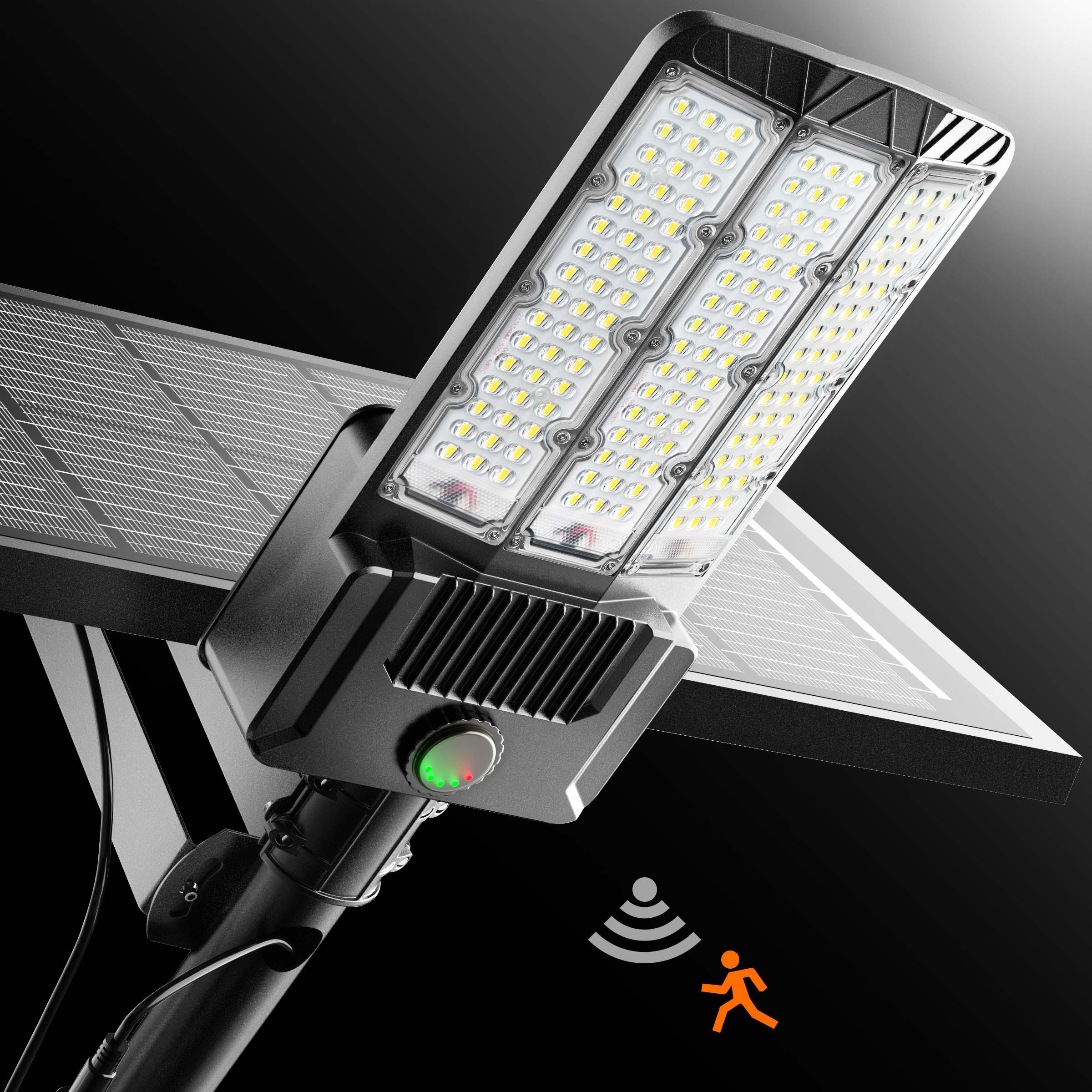
The HY015 listing describes three control functions: automatic light sensing, radar motion detection, and wireless remote control. The useful part is not the length of that feature list. It is the way those functions can keep light available without asking the battery to support the same demand every minute.
Light sensing handles the basic schedule. The fixture activates as daylight fades and turns off when daylight returns. That avoids depending on someone to remember a switch. It does not, by itself, tell you how brightly the fixture runs during every part of the night.
Motion detection handles changes in demand. According to the product description, the HY015 switches to full brightness when motion is detected and returns to an energy-saving dim mode afterward. The listing does not give a complete timing chart or a verified detection-distance map, so it would be misleading to invent a trigger range or an exact high-output duration.
Consider the difference between a quiet residential side yard and an entrance beside a busy public sidewalk. Both might occupy the same area. The quiet yard may have only a few brief periods of activity. The busy entrance can trigger brighter operation repeatedly. That difference changes energy consumption even if the hardware and weather are identical.
Here is a hypothetical illustration. A light using one watt for eleven hours and six watts for one hour would consume 17Wh. A light using six watts for all twelve hours would consume 72Wh. Those wattages do not describe tested HY015 modes; they simply show why time spent at higher output matters so much.
The remote provides a practical way to work with the fixture without repeatedly reaching the housing. Check the included instructions for the actual buttons and available settings rather than assuming every remote-controlled solar light uses the same modes. A useful routine is to start with a conservative setting, observe several nights, and adjust only what the site needs.
If your driveway stays busy until midnight, that is not a failure of motion sensing. It is a different load profile. You may need more stored energy, more charging capacity, multiple lighting points, or another lighting approach. Matching the system to activity is more dependable than expecting a compact battery to behave like a wired circuit.

Fifteen lenses are about placement, not free energy
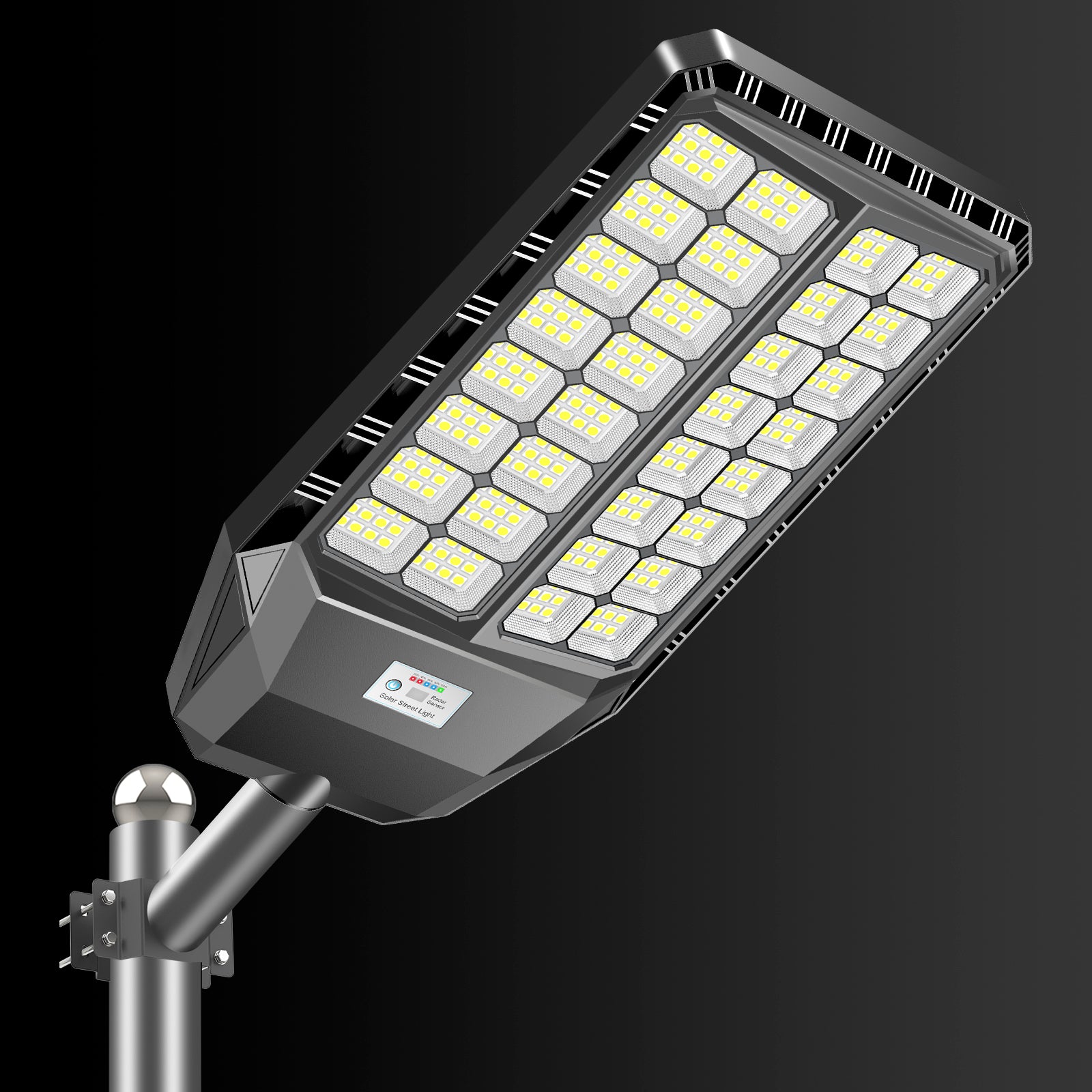
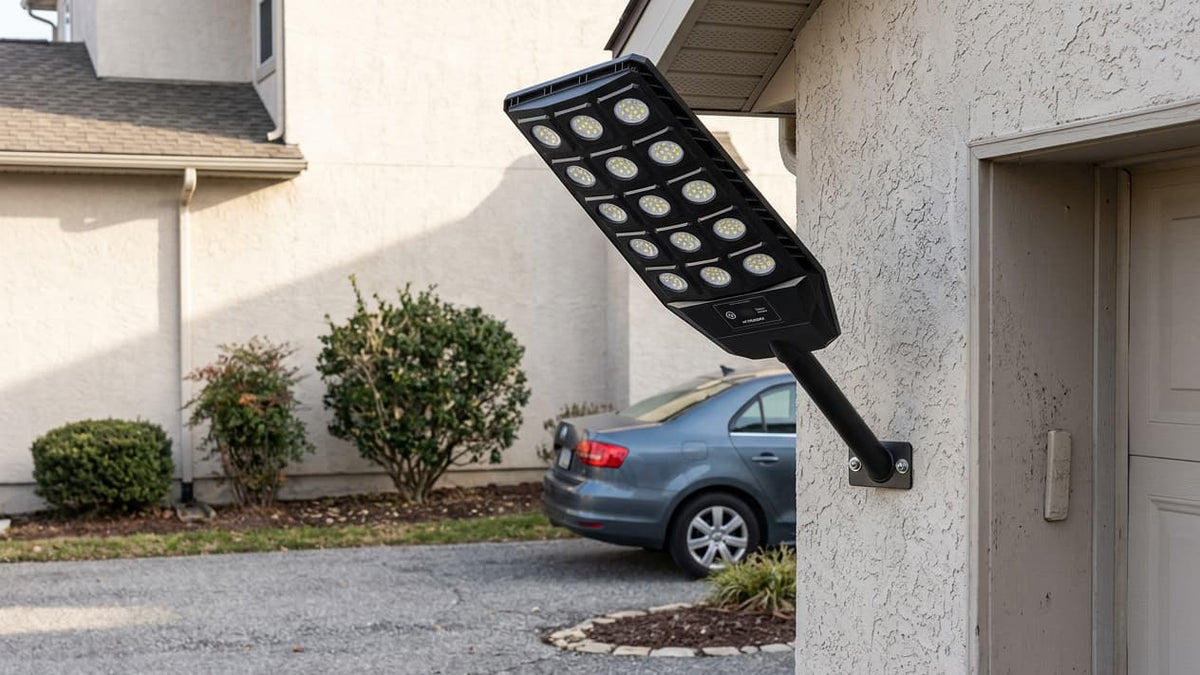
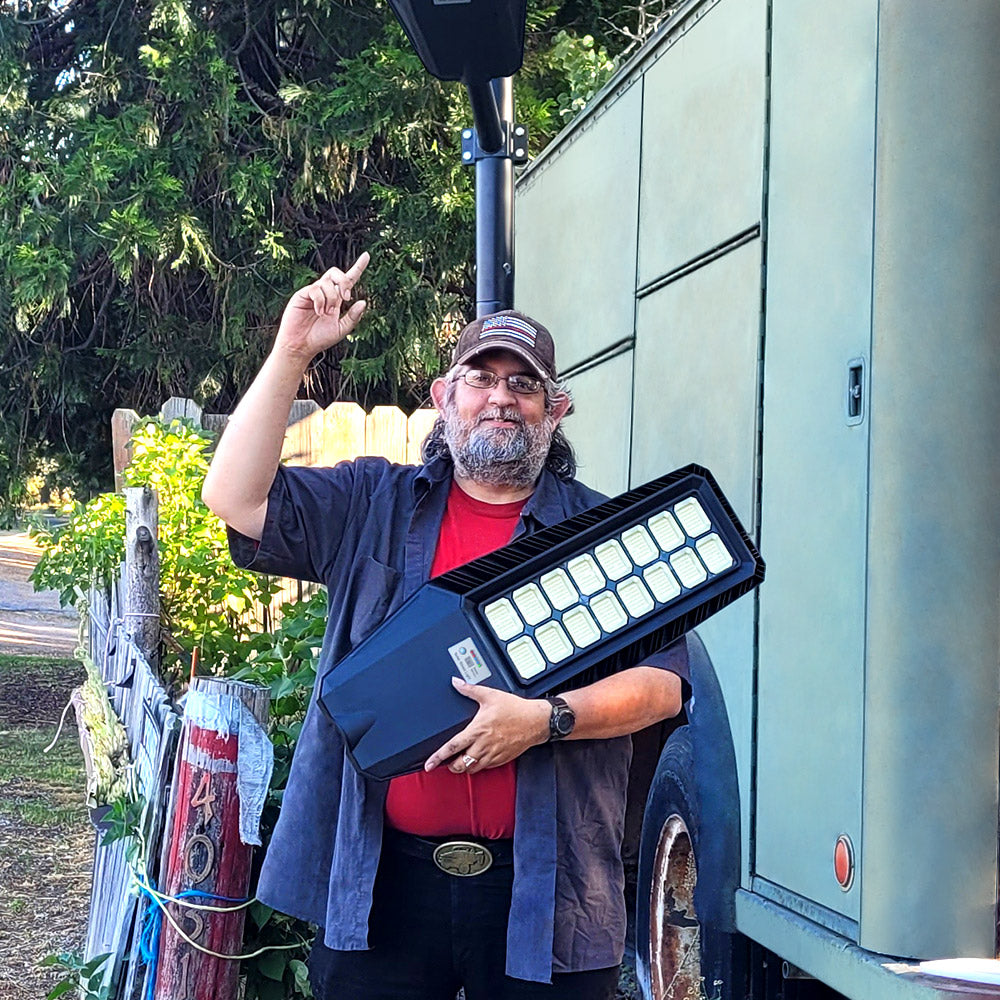
The HY015 has fifteen large optical lenses paired with deep reflector cups and a listed total of 255 high-output 2535 LEDs. The product description emphasizes concentrating the beam and improving throw. That gives the fixture a more specific story than simply putting more LED chips behind a flat cover.
Optics do not create energy. They redistribute light. A lens-and-reflector arrangement can direct more of the available output toward a useful target instead of spreading it where it adds little value. For a driveway or a gate approach, the location of that light can matter as much as the headline lumen figure.
Lumens describe luminous output. Foot-candles and lux describe light arriving on a surface. A product's lumen claim cannot tell you exactly how bright your gate latch will be without information about beam distribution, mounting geometry, and losses between the fixture and the target.
For that reason, the listed 15,000-lumen figure should not be used to reverse-engineer an exact runtime. You would need verified electrical input and output data for each operating state. Likewise, dividing lumens by yard area would not establish a reliable average illumination level, because not all emitted light lands inside a neat rectangle on the ground.
The HY015's stated color temperature is 6500K to 7000K. Expect a cool daylight-white appearance, not the warm look of a porch lantern. That may suit a utility-oriented driveway or side entrance. Around a seating area or bedroom window, you may prefer a different color temperature or a different aiming arrangement.
The listing promotes glare reduction through its optics, but no outdoor fixture is immune to poor placement. Aim for useful ground coverage rather than direct exposure to people's eyes. A beam that looks dramatic from the street is not necessarily the beam that makes your own steps easier to see.
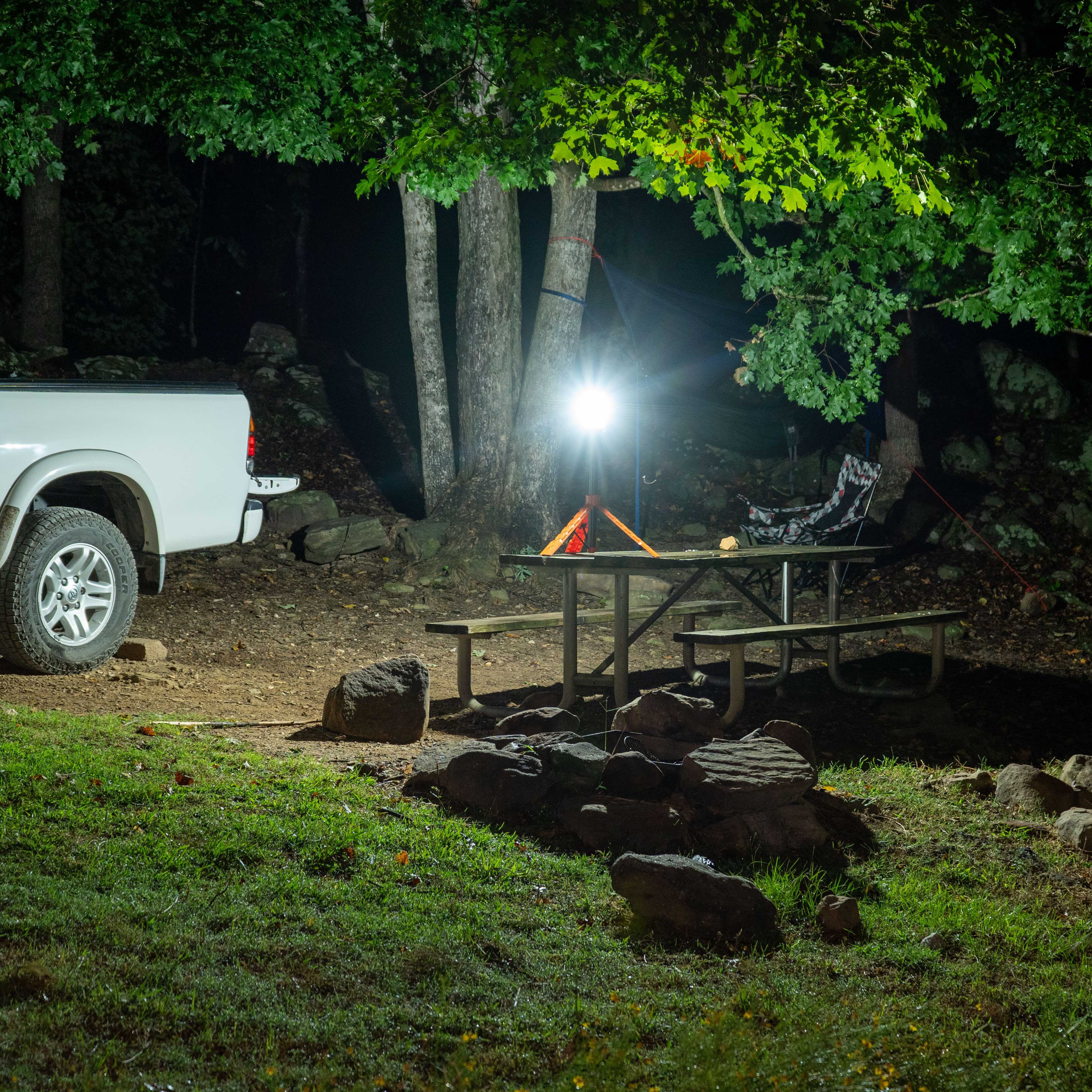
Good lighting is often less theatrical than the product photo suggests. You notice the path, the edge of the driveway, and the gate hardware. You should not need to stare into the light to appreciate it. That is a better standard than judging a fixture by how bright it looks when you look directly at the LEDs.
Three 2,000-square-foot sites, three different answers
The suburban driveway with a sunny garage wall
Imagine an open driveway with a clear view of the sky, a solid mounting surface, and most activity concentrated around arrivals and departures. This is a reasonable situation to evaluate a compact, motion-responsive solar fixture. The aim is useful access lighting without extending an electrical circuit to the mounting point.
The catch is the panel exposure. A wall may be structurally convenient while an eave shades the panel for much of the day. Check the actual solar surface, not just the brightness of the driveway. A sunny patch on the pavement does not prove that the fixture's panel receives the same sun.
Plan the beam around the walk from the car to the door. Check shadows behind the vehicle and near any step. If a single mounting point leaves the important route blocked, another location or an additional fixture may be more useful than demanding a higher output from the same position.
The side yard with a gate and occasional nighttime use
A side yard may benefit from a dim background level with brighter light when someone approaches. Here, the HY015's described motion-and-dim behavior is relevant. You are asking the light to respond to an event rather than maintain a uniformly bright outdoor room throughout the night.
Fence lines and trees complicate charging. So do changes in the seasons. A mounting point that gets direct sun in summer may be shaded once the winter sun sits lower. Look at the panel location with the whole year in mind, especially if winter use is part of the reason for buying the light.
Also consider where the beam ends. A side-yard fixture can face a neighbor's window more directly than a driveway light does. Keep the useful area inside your property and avoid assuming that more spill light automatically creates a better result. Visibility and neighbor comfort should be planned together.
The small business entrance that stays busy
A service entrance or delivery area may seem modest in size but demanding in use. Repeated motion events, late operating hours, and long winter nights can create a much heavier nightly energy requirement than a residential gate. Square footage does not reveal that difference.
For that site, ask how many hours you actually need brighter illumination and what happens during several poor charging days. If the lighting is important to essential operations, have the site assessed rather than assuming one consumer fixture will satisfy every requirement. A larger battery is useful only as part of a suitable overall design.
The HY015 can still be worth evaluating for a limited, supplementary role. But if the job is continuous high-demand lighting across a work area, move the discussion toward measured illumination requirements, charging capacity, and a professionally planned layout. That is a more productive conversation than arguing over the biggest lumen number.

What $85 buys, and what it does not promise
The HY015 is currently listed at $85 USD. Its current product title identifies it as a preorder that ships in one month. Check the product page before ordering, particularly if you need lighting for a specific date. An attractive price is less useful if the arrival timing misses the job.
At that price, the interesting package is the combination of a roughly 29.44Wh nominal battery, a 10W panel, focused optics, light sensing, radar motion response, and a remote. It is not a promise of continuous peak brightness across every part of 2,000 square feet in every season.
Solar charging avoids a grid electricity draw for operating the fixture, but ownership is not literally cost-free. Hardware, mounting, cleaning, future maintenance, and eventual replacement still belong in the decision. Nor should you assign an exact installation saving without knowing the property, the mounting surface, and what a wired alternative would require.
For someone lighting a sunny driveway approach with intermittent use, the HY015 is worth considering on its own terms. For someone expecting a compact fixture to behave like permanent, full-output commercial lighting all night, it is better to reset the brief before buying.
View the HY015 for $85 and check current preorder timing.
Two alternatives worth comparing before you decide
The most useful comparison is not simply small versus large. It is whether another fixture gives you the storage, charging capacity, control, or light appearance your site needs. The following products are active in the current catalog. Prices below were checked on October 16, 2026, and may change; verify the selected configuration before checkout.
HYKOONT TW040: $152 for the one-pack option

The TW040 is listed at $152 for one fixture, with a separate two-pack option listed at $306. Its specifications include a 6V, 48Ah battery, a 6500K color temperature, IP66 protection, and light, time, remote, and radar control. The listed nominal battery figures multiply to 288Wh.
That nominal energy figure is considerably larger than the HY015's 29.44Wh. It does not mean the TW040 will run a fixed number of times longer, because its load and operating modes differ. Battery energy is a comparison tool, not a runtime multiplier that ignores the rest of the system.
The TW040 listing also carries a 56,000-lumen claim. Treat it as the product's stated output, not an independently verified measurement from this article. If you are choosing it for a demanding site, request the information needed for that site rather than assuming the higher number guarantees uniform illumination.
Consider this model when your initial brief is moving beyond a compact residential approach light and you want to compare a larger listed energy reserve. Pay attention to physical size, mounting requirements, and the actual lighting pattern as well as price. A larger fixture still needs a suitable installation.
Shop the TW040 one-pack option at $152 and review its specifications.
HYKOONT YK080 Pro: $365

The YK080 Pro is listed at $365 with a 160Wh battery, a 40W monocrystalline panel, MPPT charging control, and a 3000K to 6500K color-temperature range. Its description lists segmented brightness levels of 100%, 70%, 45%, and 30%, giving the energy-management conversation more detail than a single battery-capacity number.
Those are meaningful differences if you want to compare a larger charging source and more explicitly described staged operation. The color-temperature range is also worth noticing if the HY015's cool daylight-white output does not suit the setting. That is a use-case difference, not just a specification contest.
The product description recommends a mounting height of five to seven meters, roughly sixteen to twenty-three feet. That puts it in a different installation conversation from a small fixture on a convenient residential wall. Check mounting suitability before treating it as a direct swap.
The YK080 Pro listing describes extended operation after a full charge. As with the HY015, any runtime claim needs to be understood alongside brightness schedules and conditions. Its larger battery and panel do not eliminate weather, shading, or the need to match operating demand to charging supply.
Explore the $365 YK080 Pro for its 160Wh battery, 40W panel, and staged lighting controls.
Before drilling holes, spend one day watching the sun
It is tempting to choose the mounting location from the kitchen window and move straight to installation. Give the site a little more attention. Look at the intended panel position in the morning, around midday, and later in the afternoon. Note shadows from rooflines, fences, trees, and neighboring buildings.
Do not infer the HY015's physical layout from the model prefix alone. The current product images show the solar surface on the rear of the housing and illustrate a wall-supported installation. Use the current product instructions to confirm mounting details, orientation, and supplied hardware. Do not plan around an assumed separately positionable panel.
That relationship between the light and solar surface matters. The best direction for illuminating a path may not be the best direction for charging. If a location forces a poor compromise, move the fixture or choose a product layout that better suits the site. Avoid assuming you can independently relocate components unless the actual product supports it.
Choose a sound mounting surface and follow the provided installation instructions. Do not guess fastener suitability from a product photo. Brick, siding, wood framing, and other surfaces have different requirements. When the location or height is outside your experience, have a qualified installer assess it.
After mounting, inspect the beam from the places people actually stand. Open the gate, walk beside the car, and approach from the street. Check whether the fixture creates a glare problem or leaves a step in shadow. Adjust within the product's permitted mounting arrangement rather than trying to solve every problem by increasing brightness.
Finally, separate first-night impressions from ongoing performance. A single evening tells you something about aiming and appearance. It says less about the balance between charging and consumption over a week. Watch the installation through a mix of conditions before deciding that the chosen setting is right.
If it fades before morning, investigate in this order
Start with daytime charging. A panel can look clean from ground level while carrying dust, pollen, or leaves. Nearby growth may introduce a shadow you did not have at installation. Inspect safely and follow the manufacturer's cleaning guidance rather than using aggressive chemicals or climbing into an unsafe position.
Next, look at the night's activity. Has the fixture been responding to much more movement than expected? Is it positioned where passing traffic repeatedly enters the monitored area? The listing does not give enough sensor detail to predict every trigger, so observe the real installation instead of assuming its response pattern.
Then check the selected operating mode against the manual. A setting chosen for a short evening gathering may not be suitable as the everyday schedule. Do not assume a remote command has the same meaning across different solar-light models, even when the buttons look similar.
Consider recent weather and the season. A run of weak charging days can leave less stored energy for the next night. Winter can combine longer darkness with less useful solar input, making the energy balance more demanding from both directions. Avoid judging a winter installation from summer expectations.
If the panel is well exposed and clean, the controls are set appropriately, and the system still cannot meet the required hours, revisit the equipment choice. More charging capacity, more storage, a different layout, or wired lighting may be the right answer. A practical diagnosis is better than repeatedly demanding more brightness from the same limited daily energy budget.
Eight questions worth asking before checkout
1. Can one HY015 light all 2,000 square feet evenly?
The product lists coverage across 2,000 square feet, but that does not establish identical brightness everywhere. Site shape, mounting geometry, obstacles, and the required task all matter. Plan around your important routes and target areas, and request photometric information if you need a quantified lighting design.
2. How much energy does the 9,200mAh battery store?
Using the listed nominal voltage of 3.2V, 9,200mAh equals 9.2Ah and approximately 29.44Wh of nominal energy. Actual usable energy is affected by system losses and battery operating limits. The mAh number should not be compared with another product without also checking voltage.
3. Will it stay at maximum brightness from dusk to dawn?
The listing describes motion-triggered full brightness followed by an energy-saving dim mode. It does not establish uninterrupted maximum-output runtime for an entire night. Exact runtime at a particular setting would require measured power consumption and test conditions that are not provided in the available specifications.
4. How long does the 10W panel take to charge the battery?
Charging time varies with starting charge, sunlight, shading, temperature, and charging behavior. Dividing 29.44Wh by 10W gives a theoretical 2.94-hour energy equivalent before losses, not a real-world charging promise. Follow the product instructions for initial charging and assess solar exposure at your own mounting location.
5. Is the HY015 a warm-white light?
No. Its listed color temperature is 6500K to 7000K, a cool daylight-white appearance. If adjustable warmth matters for your property, compare a model with a suitable documented color-temperature range, such as the YK080 Pro, rather than expecting the HY015 to produce a warm porch-light effect.
6. Can I install it under a shaded roof overhang?
A shaded location can limit charging even when the light itself points toward an open driveway. Evaluate the actual solar surface throughout the day. The current imagery places that surface on the housing, so do not assume you can move a separate panel into the sun without confirming the product's supported configuration.
7. Which model should I compare if my entrance stays busy?
Compare the site's required hours and brightness with products offering a larger energy reserve or charging source. The TW040 lists a 6V, 48Ah battery, while the YK080 Pro lists 160Wh storage and a 40W panel. Neither should be selected solely by battery size; operating load, controls, mounting, and coverage still matter.
8. What is the current HY015 price, and is it ready to ship?
As checked on October 16, 2026, the HY015 is listed at $85 USD, and its title states preorder with shipping in one month. Confirm price and delivery timing on the product page before buying. The TW040 one-pack is listed at $152 and the YK080 Pro at $365 at the same check.
The better buying question is what your night actually looks like
The HY015's most useful story is not that 9,200mAh sounds large or that 2,000 square feet sounds impressive. It is the relationship between roughly 29.44Wh of nominal stored energy, a 10W charging source, motion-responsive operation, and optics intended to direct light toward a useful target.
For a sunny driveway approach or yard entrance with intermittent nighttime activity, that combination deserves a closer look. For continuous high-demand work, poor solar access, or a site with strict illumination requirements, the right answer may be a larger system or a different lighting approach entirely.
Start with the route you need to see, check where the panel will actually get sun, and be honest about how much activity happens after dark. Then choose the fixture. That order makes the purchase less about chasing a number and more about getting a light that fits the place you live.
See the HY015's current $85 listing, product photos, and preorder details.


Leave a comment
This site is protected by hCaptcha and the hCaptcha Privacy Policy and Terms of Service apply.