



You've decided to go solar for your outdoor lighting. Smart move—no trenching for electrical lines, no monthly electricity bills, no permits or electricians. But now you're staring at dozens of options with confusing specs: 300W vs 7000W, 42,000 lumens vs 550,000 lumens, motion sensors vs dusk-to-dawn, monocrystalline vs polycrystalline panels.
How do you know which one is right for your driveway, parking lot, or backyard? What do all these numbers actually mean? And why does one solar light cost $79 while another costs $1,475?
Here's the truth: choosing solar lights isn't about finding the "best" product—it's about finding the right product for your specific situation. A 550,000-lumen commercial street light is overkill for a residential driveway. A 3,000-lumen wall light won't adequately illuminate a parking lot.
In this guide, we'll cut through the marketing hype and technical jargon to show you exactly how to choose solar lights that actually work for your needs. You'll learn what specs matter, what features add real value, and how to match products to applications without overspending or underbuying.

Understanding Solar Lighting Specifications: What Actually Matters
Let's decode the specs so you can make informed decisions.
Lumens: The Only Brightness Number That Matters
Forget watts when it comes to brightness—lumens measure actual light output. Here's a practical reference:
3,000-10,000 lumens: Residential driveways, small yards, entryways
20,000-40,000 lumens: Large driveways, parking areas, commercial entrances
40,000-100,000 lumens: Streets, large parking lots, building perimeters
100,000+ lumens: Major roadways, industrial facilities, large commercial properties
More isn't always better. A 550,000-lumen light in a residential setting will blind you and annoy neighbors. Match lumens to your actual needs.
Wattage: Power Consumption, Not Brightness
In solar lights, wattage indicates the LED power consumption, which correlates with brightness but isn't a direct measure. A 300W LED typically produces 40,000-50,000 lumens. A 7000W LED can produce 500,000+ lumens.
Higher wattage means you need larger solar panels and batteries to power the light all night. This is why high-wattage lights cost more—they require more substantial components.
Solar Panel Type and Size
Monocrystalline panels (15-22% efficiency) perform better in low light and last longer than polycrystalline panels (13-16% efficiency). They cost more but deliver better real-world performance.
Panel size matters as much as efficiency. A larger polycrystalline panel can outperform a smaller monocrystalline panel simply because it has more surface area collecting light.
Battery Capacity and Type
Battery capacity (measured in mAh or Wh) determines runtime. A 6,000mAh battery might power a 20W light for 8 hours. A 48,000mAh battery can power a 300W light all night.
Lithium-ion and LiFePO4 (lithium iron phosphate) batteries outperform older NiMH batteries in cold weather, lifespan, and charge retention. They cost more but are worth it for reliability.
IP Rating: Weather Resistance
IP65 means dust-tight and protected against water jets—good for most outdoor applications. IP66 adds protection against powerful water jets—better for harsh weather or coastal areas.
Don't buy outdoor solar lights with ratings below IP65. They won't survive real weather exposure.

Matching Solar Lights to Applications
Different applications need different solutions. Here's how to match products to purposes.
For Residential Driveways and Yards
You need 20,000-50,000 lumens total, distributed across 2-4 fixtures. Motion sensors save battery by running at low brightness until activity is detected. Dusk-to-dawn operation provides automatic all-night lighting.
Look for lights with adjustable brightness modes so you can optimize for your specific situation. Remote control is convenient for adjusting settings without climbing ladders.
For Commercial Parking Lots
Commercial applications demand reliability and adequate brightness for safety and security. You need 50,000-100,000+ lumens depending on lot size, with lights spaced 30-50 feet apart.
Prioritize lights with large battery capacity for all-night operation, even after cloudy days. Motion sensors can reduce energy consumption while maintaining security.
For Streets and Roadways
Street lighting requires high output (100,000+ lumens), wide coverage, and absolute reliability. These lights run all night, every night, regardless of weather.
Look for commercial-grade construction with die-cast aluminum housings, premium solar panels, and large battery banks. Extended warranties indicate manufacturer confidence in long-term performance.
For Building Perimeters and Security
Security lighting needs bright output, motion detection, and reliable operation. You want lights that deter intruders and provide clear visibility for cameras.
Multiple control modes (motion sensor, timed, constant) give you flexibility to optimize for security vs battery conservation.
The Commercial-Grade Solution: SZ300 Solar Street Light

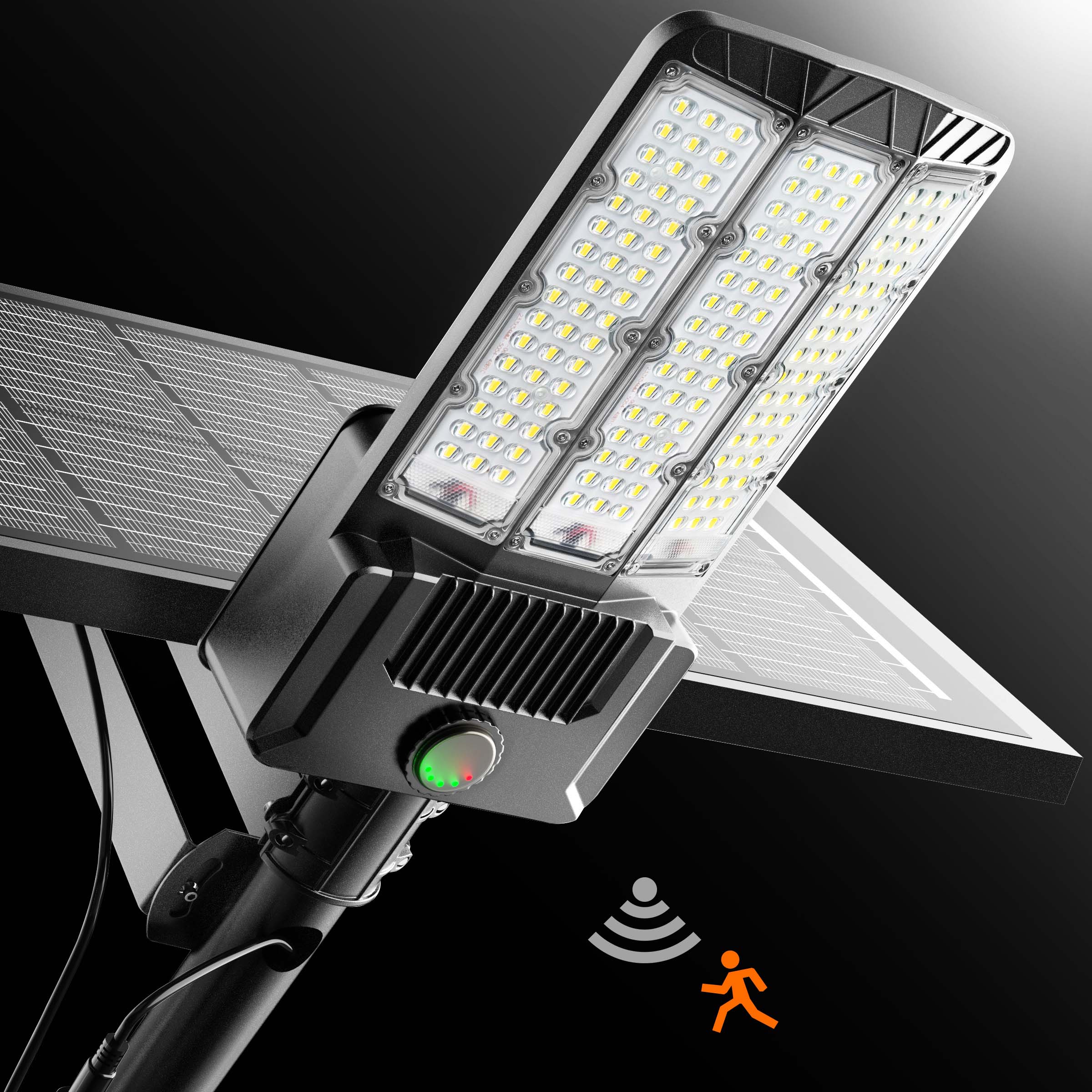
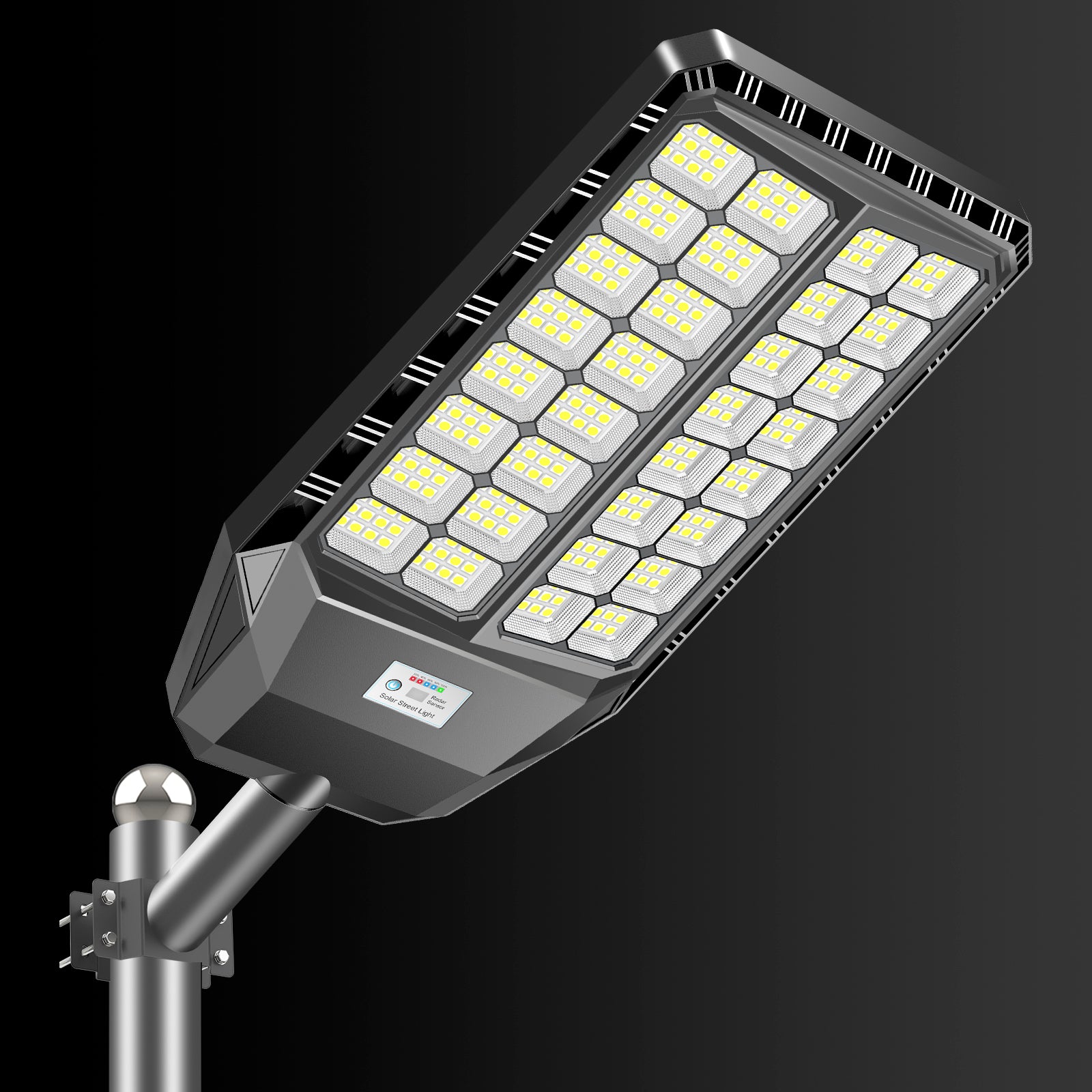
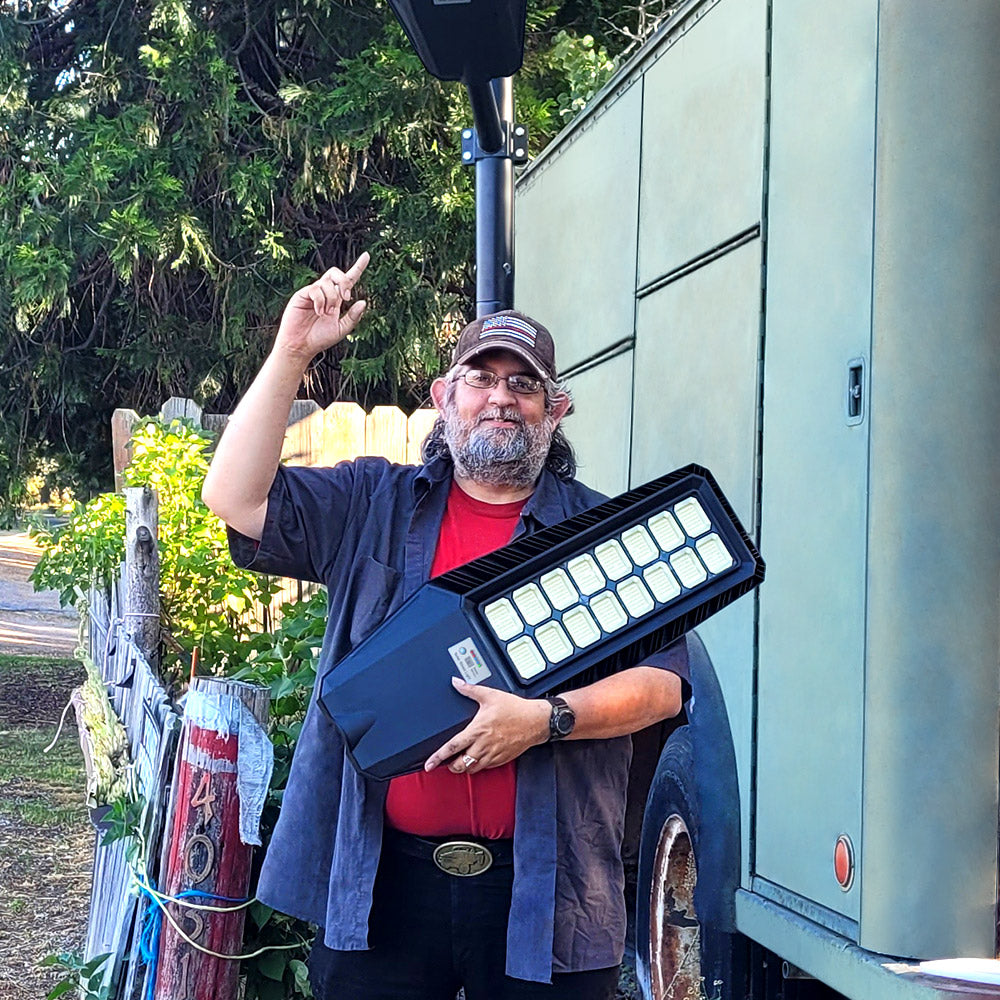
When you need commercial-grade performance, the Hykoont SZ300 Commercial Solar Street Lights step up to the challenge. Priced at $145.00-$293.00 depending on configuration, these lights deliver 60,000 lumens from 400W of LED power.
What sets the SZ300 apart is the die-cast aluminum construction. This isn't plastic or thin sheet metal—it's solid aluminum that dissipates heat effectively and withstands impacts, vibration, and extreme weather. The build quality is immediately obvious when you handle one.
The 35,000mAh battery provides substantial energy storage for reliable all-night operation. Even after 2-3 cloudy days, you'll still have adequate lighting. The 60,000-hour lifespan means this light will outlast most of the vehicles you park under it.
Three control methods (remote, light-sensing, motion sensor) with 9 brightness levels give you unprecedented flexibility. You can fine-tune operation to match your exact needs, optimizing for brightness, runtime, or energy conservation.
The monocrystalline solar panel charges efficiently even in less-than-ideal conditions. IP66 waterproof rating means this light handles anything weather throws at it, from desert heat to arctic cold.
The 3-year warranty backs up the quality. Hykoont knows these lights will perform reliably for years, which is why they're willing to stand behind them.
Use the SZ300 for parking lots, streets, building perimeters, or anywhere you need commercial-grade reliability and performance. This is a light you install once and forget about—it just works, night after night, year after year.
See the SZ300 Commercial Light →
The Ultimate Powerhouse: TW032 Ultra-Bright Solar Street Light

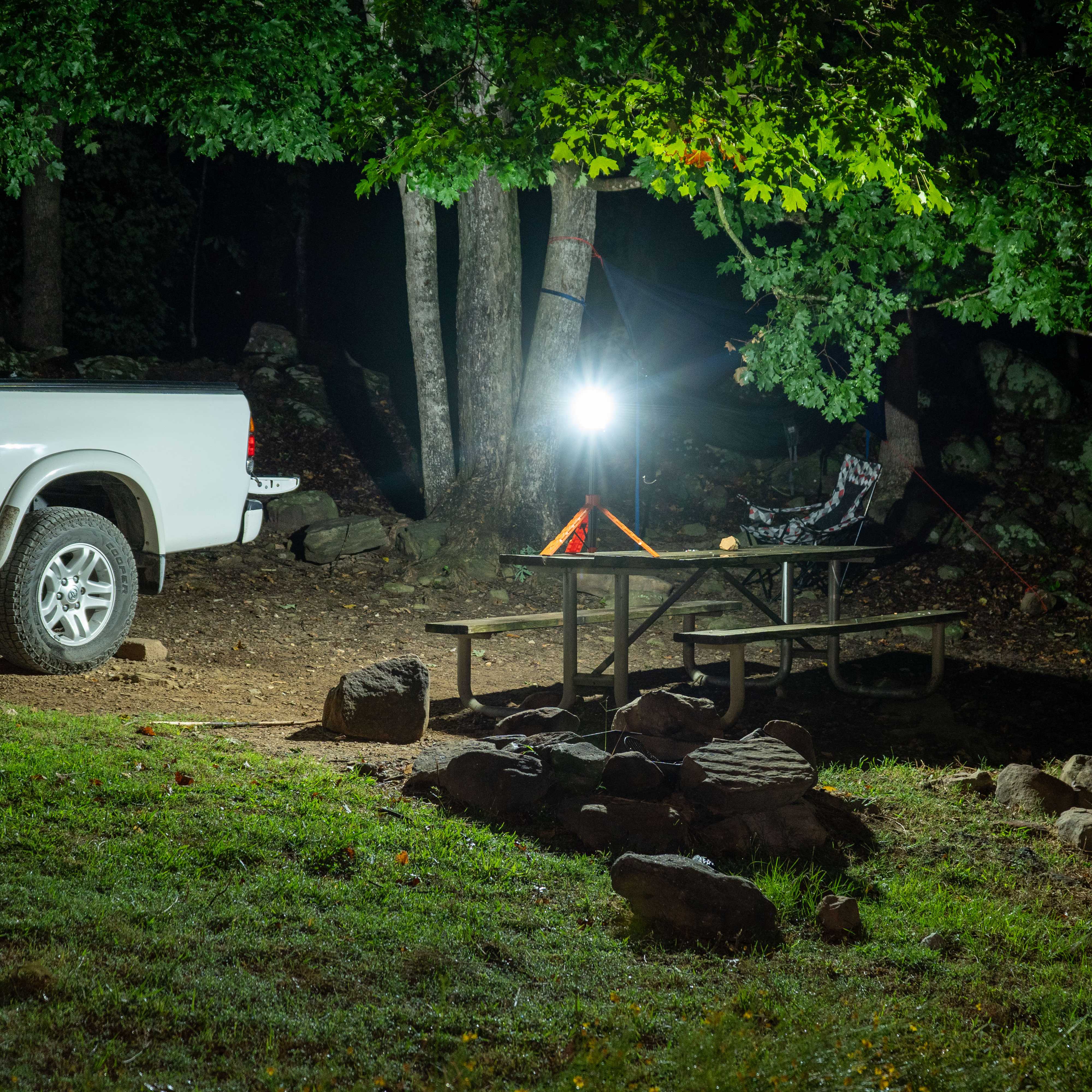
For applications where maximum brightness is non-negotiable, the Hykoont TW032 7000W Solar Street Light delivers an astounding 550,000 lumens. At $129.00-$258.00, it's surprisingly affordable given the performance.
Let's put 550,000 lumens in perspective: that's equivalent to about 40 traditional 100W incandescent bulbs, or roughly what you'd get from a small stadium light. This is serious illumination designed for major roadways, large industrial facilities, or anywhere you need daylight-level brightness at night.
The 384D SMD 5054 LEDs are arranged for optimal light distribution, eliminating dark spots and providing even coverage across large areas. The 3.2V 48AH battery ensures all-night operation even with this massive light output.
Advanced motion control offers four modes: light-sensing for automatic dusk-to-dawn operation, time-based scheduling, remote control for manual adjustment, and radar control for sophisticated motion detection. This flexibility lets you optimize operation for any application.
The 50,000-hour lifespan means this light will run for over 15 years at 8 hours per night. IP66 waterproof rating ensures it handles any weather conditions. The 3-year warranty provides peace of mind for this significant investment.
Who needs 550,000 lumens? Major roadways, large parking lots, industrial yards, sports facilities, or anywhere safety and security demand maximum visibility. This isn't a residential product—it's a commercial/industrial solution that happens to be accessible to anyone who needs serious lighting power.
At $129-$258, the TW032 delivers incredible value for the amount of light you're getting. Compare that to installing and operating traditional high-intensity discharge (HID) street lights, and the solar option pays for itself quickly.
Explore the TW032 Ultra-Bright Light →
How to Calculate Your Lighting Needs
Here's a practical framework for determining how much light you actually need.

Step 1: Measure Your Area
Calculate the square footage you need to illuminate. A typical residential driveway might be 500-1000 sq ft. A small parking lot could be 5,000-10,000 sq ft. A street section might be 20,000+ sq ft.
Step 2: Determine Required Brightness
For general illumination: 10-20 lumens per square foot
For security/safety: 20-40 lumens per square foot
For detailed work or high-security: 40-60+ lumens per square foot
A 1,000 sq ft driveway needing security lighting requires 20,000-40,000 lumens total.
Step 3: Calculate Number of Fixtures
Divide total lumens needed by lumens per fixture. For that 1,000 sq ft driveway needing 30,000 lumens, you could use:
One 42,000-lumen XH300 (overkill but simple)
Two 20,000-lumen fixtures (better distribution)
Three 10,000-lumen fixtures (excellent coverage)
More fixtures generally provide better coverage with fewer shadows, but cost more and require more installation work.
Step 4: Consider Mounting Height
Higher mounting requires more lumens to achieve the same ground-level brightness. Lights mounted 15-20 feet high need 30-50% more lumens than lights mounted 8-10 feet high to achieve equivalent illumination.
Step 5: Account for Efficiency Losses
Dirty solar panels, aging batteries, and LED degradation reduce performance over time. Build in 20-30% extra capacity to maintain adequate brightness as components age.
Installation Considerations for Optimal Performance
Even the best solar lights won't perform well if installed incorrectly.

Solar Panel Positioning
Panels need 6-8 hours of direct sunlight daily for optimal charging. Face panels south (in Northern Hemisphere) with no shade from trees, buildings, or other obstructions.
Angle panels toward the sun: 30-45 degrees works well for most locations. Steeper angles capture more winter sun; flatter angles work better in summer.
For lights with separate panels (like the XH300), position the panel in the sunniest spot even if that's not where you want the light. The cable lets you separate them.
Light Fixture Placement
Mount lights high enough to provide good coverage but not so high that you waste light. For most applications, 12-20 feet is optimal.
Angle lights to illuminate the target area without shining into windows, toward neighbors, or creating glare for drivers.
Space multiple lights evenly to eliminate dark spots. Overlapping coverage is better than gaps.
Wiring and Connections
Use the provided cables and connectors—don't substitute with random wire. Proper connections ensure reliable operation and prevent voltage drops.
Protect connections from weather even if they're rated waterproof. A little extra protection extends lifespan.
Secure cables so they don't flap in wind or get damaged by animals or equipment.
Testing Before Permanent Installation
Temporarily position lights and test for a few nights before permanent mounting. Verify coverage, brightness, and solar panel charging. It's much easier to adjust now than after everything is bolted down.
Maintenance for Long-Term Performance
Solar lights are low-maintenance, but not no-maintenance.

Regular Cleaning
Clean solar panels every 2-3 months with a damp cloth. Dust, pollen, and bird droppings reduce charging efficiency by 20-40%.
Clean light fixtures and lenses annually to maintain brightness. Dirt and grime can reduce light output significantly.
Seasonal Adjustments
In winter, adjust panel angles steeper to capture low-angle sunlight. Clear snow off panels after storms.
In fall, remove leaves and debris that accumulate on panels and fixtures.
Battery Care
Batteries degrade over 3-5 years. When runtime decreases noticeably, it's time for replacement. Some lights have user-replaceable batteries; others require professional service.
In extreme cold climates, bringing lights indoors during the harshest months can extend battery life, though quality lights with LiFePO4 batteries handle cold well.
Monitoring Performance
Pay attention to runtime and brightness. If lights that used to run all night now shut off at 2 AM, something's wrong—probably dirty panels or degraded batteries.
Address issues promptly. Small problems become big problems if ignored.

Frequently Asked Questions
How do I choose between 300W, 400W, and 7000W solar lights?
Match wattage to your application. 300W (40,000-50,000 lumens) works for residential driveways and small commercial areas. 400W (60,000 lumens) suits parking lots and streets. 7000W (550,000 lumens) is for major roadways and large industrial facilities. More wattage means brighter light but also higher cost and larger solar panels/batteries required.
What's the difference between monocrystalline and polycrystalline solar panels?
Monocrystalline panels are 15-22% efficient, perform better in low light, and last longer. Polycrystalline panels are 13-16% efficient and cost less. For solar lights, monocrystalline is worth the extra cost for better real-world performance, especially in areas with variable weather or limited sun exposure.
How long do solar street lights actually last?
Quality solar lights like the Hykoont models last 10-15+ years. LEDs are rated for 50,000-60,000 hours (15-20 years at 8 hours/night). Batteries need replacement after 3-5 years. Solar panels last 20-25 years. The housing and structure should last indefinitely with proper maintenance. Cheap solar lights might only last 1-2 years.
Can solar lights work in winter or cloudy climates?
Yes, quality solar lights work year-round in any climate. They charge from daylight, not just direct sun, though charging is slower on cloudy days. Lights with large battery capacity (like the SZ300 with 35,000mAh) can run multiple nights on one charge, handling extended cloudy periods. In winter, shorter days mean less charging time, so lights might not run as long as in summer.
Do I need motion sensors or is constant light better?
It depends on your application. Motion sensors conserve battery by running lights at low brightness until activity is detected, extending runtime significantly. They're great for security and areas with intermittent use. Constant light is better for high-traffic areas, streets, or anywhere you need continuous illumination. Many lights (like the SZ300 and TW032) offer both modes so you can choose.
How much money do solar lights actually save?
A traditional 400W HID street light running 12 hours/night uses about 4.8 kWh daily, costing $200-300 annually in electricity. Over 10 years, that's $2,000-3,000 per light. Solar lights have zero operating costs after installation. Even a $300 solar light pays for itself in 1-2 years, then continues saving money for another 10-15 years.
What IP rating do I need for outdoor solar lights?
IP65 minimum for any outdoor application—it provides dust-tight protection and handles rain and water jets. IP66 is better for harsh weather, coastal areas, or anywhere lights face extreme conditions. Don't buy outdoor solar lights with ratings below IP65; they won't survive real weather exposure.
Can I install solar street lights myself or do I need a professional?
Most solar lights are designed for DIY installation since there's no electrical wiring involved. You need basic tools, a ladder or lift for high mounting, and ability to work safely at height. The hardest part is usually mounting the pole or bracket securely. If you're mounting lights 15+ feet high or on difficult surfaces, professional installation is safer and ensures proper positioning.
How do I know if my property gets enough sun for solar lights?
You need 6-8 hours of direct sunlight daily on the solar panel location. Observe the area throughout the day—if it's in full sun from mid-morning to mid-afternoon, it's probably adequate. Partial shade (4-6 hours of sun) can work with lights that have large panels and batteries. Full shade won't work. Use a solar pathfinder or smartphone app to assess sun exposure if you're unsure.
What's the difference between a $79 solar light and a $1,475 solar light?
Higher-priced lights use larger solar panels, higher-capacity batteries, more LEDs, better construction materials (die-cast aluminum vs plastic), and advanced features (multiple control modes, premium sensors). A $79 light like the XH300 works great for residential use. A $1,475 commercial light offers features and durability needed for critical applications where failure isn't acceptable. Match the product to your needs and budget.
Making Your Final Decision
Choosing solar lights doesn't have to be complicated. Start with your application, calculate your lighting needs, and match products to requirements.
For residential driveways, yards, and light commercial use, the XH300 at $79 delivers exceptional value. It's bright enough for most applications, well-built, and backed by a solid warranty.
For commercial parking lots, streets, and areas requiring reliable performance, the SZ300 at $145-$293 provides commercial-grade construction and features that justify the higher price.
For major roadways, industrial facilities, or anywhere maximum brightness is essential, the TW032 at $129-$258 delivers astounding performance at a surprisingly accessible price.
All three represent quality solar lighting that actually works—not the disappointing cheap lights that fail after a season. They're investments that provide years of reliable, free illumination.
Ready to choose your perfect solar lighting solution?
- Hykoont SZ300 400W Commercial Solar Street Light - From $145.00
- Hykoont TW032 7000W Ultra-Bright Solar Street Light - From $129.00
Still have questions about which solar light is right for your specific application? Drop a comment below and we'll help you find the perfect match!

Leave a comment
This site is protected by hCaptcha and the hCaptcha Privacy Policy and Terms of Service apply.