





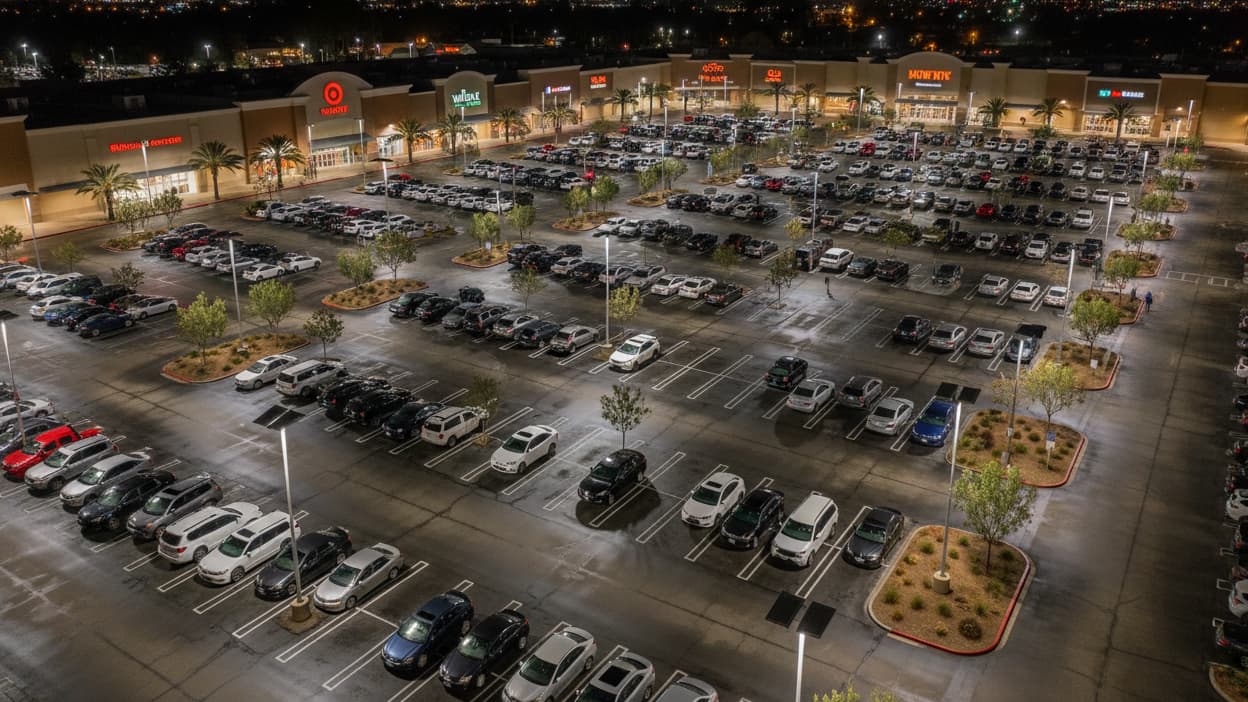
Here's a number that tends to get people's attention: the average commercial parking lot with 15–20 light poles running 250W metal halide fixtures costs somewhere between $350 and $600 per month in electricity — just for the parking lot lights. That's $4,200 to $7,200 a year, every year, for lights that are probably 15 years old and due for replacement anyway.
So when facility managers start asking about commercial solar street lighting for parking lots, it's usually not because they read an article about sustainability. It's because someone finally looked at the utility bill line by line.
This guide is going to walk through the real numbers — what solar costs, what it saves, how long it takes to pay back, and which specific fixtures make sense for different types of commercial parking situations. No fluff, no vague promises about "going green." Just the practical stuff you need to make a decision.
Why Parking Lots Are the Perfect Starting Point for Commercial Solar
Not every commercial lighting application is equally well-suited for solar. Covered parking structures, for example, have obvious solar panel placement challenges. But surface parking lots? They're almost ideal:
Open sky exposure. Surface lots have no overhead obstructions. Every pole location gets full solar access from sunrise to sunset. This maximizes charging efficiency and means you can use smaller, less expensive solar panels to achieve the same battery charge as you'd need in a partially shaded location.
No existing electrical infrastructure to leverage. One of the main arguments for staying grid-tied is "we already have conduit in the ground." In most surface parking lots, that conduit is aging, undersized for modern LED loads, and expensive to maintain. Starting fresh with off-grid solar often makes more financial sense than retrofitting around old infrastructure.
Predictable usage patterns. Parking lots have relatively consistent lighting schedules — dusk to dawn, with peak usage in early morning and evening hours. This predictability makes battery sizing straightforward and allows smart lighting modes (motion sensor + reduced brightness) to extend battery life significantly.
High visibility ROI. When you eliminate the electrical load from a parking lot, it shows up clearly on the utility bill. This makes solar parking lot lighting one of the easiest commercial solar investments to justify to ownership or a board.

The Actual Math: What Does a Parking Lot Lighting Upgrade Cost?
Current Costs: What You're Probably Spending
Let's use a realistic mid-size commercial parking lot as our baseline: 80 spaces, 12 light poles, currently running 250W metal halide fixtures on a dusk-to-dawn schedule (roughly 11 hours per night).
Monthly electricity cost calculation:
- 12 fixtures × 250W = 3,000W = 3kW
- 3kW × 11 hours/night × 30 nights = 990 kWh/month
- At the US commercial average of $0.12/kWh: $118.80/month
- Add demand charges (common in commercial utility billing): often adds 30–50%
- Realistic total: $150–$180/month for this size lot
For larger lots with 20–30 poles, or facilities running higher-wattage fixtures, the $400–$600/month figure is accurate. The headline number isn't exaggerated — it's just a bigger lot than our example.
Solar Upgrade Cost: Off-Grid Option
For our 12-pole lot, using the Hykoont BD006 ($179.00/unit) as the primary fixture:
- 12 × BD006 fixtures: $2,148
- Poles (if replacing existing): ~$1,200–$2,400 (12 poles × $100–$200 each)
- Installation labor (no trenching): ~$2,400–$3,600 (12 poles × $200–$300 each)
- Miscellaneous hardware: ~$300–$500
- Total project cost: $6,048–$8,648
- Less 30% federal ITC: Net cost: $4,234–$6,054
Monthly savings: $150–$180 (eliminated electricity cost)
Simple payback: 24–40 months (2–3.3 years)
After payback, you're looking at 15+ years of essentially free parking lot lighting. The BD006's LED array is rated for 50,000+ hours — that's over 12 years of nightly operation before you'd expect any meaningful degradation.
Solar Upgrade Cost: Grid-Tied Option
For the same 12-pole lot, a grid-tied solar street lighting system would involve:
- LED fixtures (grid-tied, no integrated battery): ~$800–$1,500
- Central solar array + battery bank: ~$8,000–$15,000
- Trenching and conduit (if replacing old): ~$6,000–$12,000
- Electrical permits and licensed electrician: ~$2,000–$4,000
- Utility interconnection (if net metering): ~$500–$2,000
- Total: $17,300–$34,500
The payback period on a grid-tied system for a parking lot with no existing infrastructure is typically 8–15 years — significantly longer than off-grid. Unless you have conduit already in the ground, off-grid wins the parking lot ROI calculation almost every time.

Choosing the Right Fixture for Your Parking Lot
Not all commercial solar street lights are built for parking lot applications. Here's what to look for — and which specific fixtures hit the mark.
Lumen Output: How Much Light Do You Actually Need?
The Illuminating Engineering Society (IES) recommends a minimum of 1.0 foot-candle (fc) average maintained illuminance for general parking areas, with 0.1 fc minimum at any point. For higher-security applications or areas with significant pedestrian traffic, 2.0–3.0 fc average is more appropriate.
At a typical mounting height of 18–20 feet:
- A 20,000-lumen fixture covers roughly 2,000–2,500 sq ft at 1–2 fc
- A 40,000-lumen fixture covers roughly 3,500–4,500 sq ft at 1–2 fc
For an 80-space lot (roughly 24,000 sq ft), you'd need approximately 6–8 fixtures at 40,000 lumens, or 10–12 fixtures at 20,000 lumens. Pole spacing and layout affect this significantly — a lighting designer can run a photometric analysis for your specific lot geometry.
Beam Angle: The Parking Lot Sweet Spot
Parking lots need wide, even coverage with minimal dark spots between poles. A 120-degree beam angle is the standard for parking lot applications — it distributes light broadly in a horizontal plane without wasting lumens upward (which would create light pollution and reduce efficiency).
Avoid fixtures with narrow beam angles (60–90 degrees) for parking lots — they create bright spots directly under the pole and dark zones between poles, which is both a safety issue and an IES compliance problem.
The Off-Grid vs Grid-Tied Decision for Parking Lots
When Off-Grid Wins (Most of the Time)
For surface parking lots, off-grid solar street lighting wins the comparison in the majority of real-world scenarios:
New construction or greenfield sites: No existing electrical infrastructure means no trenching savings to offset battery costs. Off-grid is almost always cheaper to install.
Lots with aging electrical infrastructure: If your existing conduit and wiring is 20+ years old, the cost of bringing it up to code for a grid-tied retrofit often exceeds the cost of going off-grid entirely.
Properties in storm-prone regions: Off-grid solar street lights keep working during grid outages. For retail properties, a dark parking lot during a storm event means lost business and potential liability. Off-grid eliminates that vulnerability.
Properties with high demand charges: Commercial utility billing often includes demand charges based on peak consumption. Eliminating parking lot load entirely (off-grid) removes those fixtures from your demand calculation. Grid-tied systems that draw from the utility during low-solar periods still contribute to demand.
When Grid-Tied Makes Sense for Parking Lots
Existing conduit in good condition: If you have functional underground conduit connecting your poles, grid-tied can leverage that investment and reduce installation cost.
Covered or partially shaded lots: Parking structures, tree-lined lots, or lots with significant shading during peak solar hours may not generate enough solar energy for reliable off-grid operation. Grid-tied provides the utility backup needed.
Lots requiring BMS integration: If your facility management system needs to control and monitor parking lot lighting centrally, grid-tied systems with networked controls are easier to integrate than standalone off-grid fixtures.

Featured Fixtures for Commercial Parking Lot Solar Lighting
Best Overall: Hykoont BD006 — The Parking Lot Workhorse

Price: $179.00
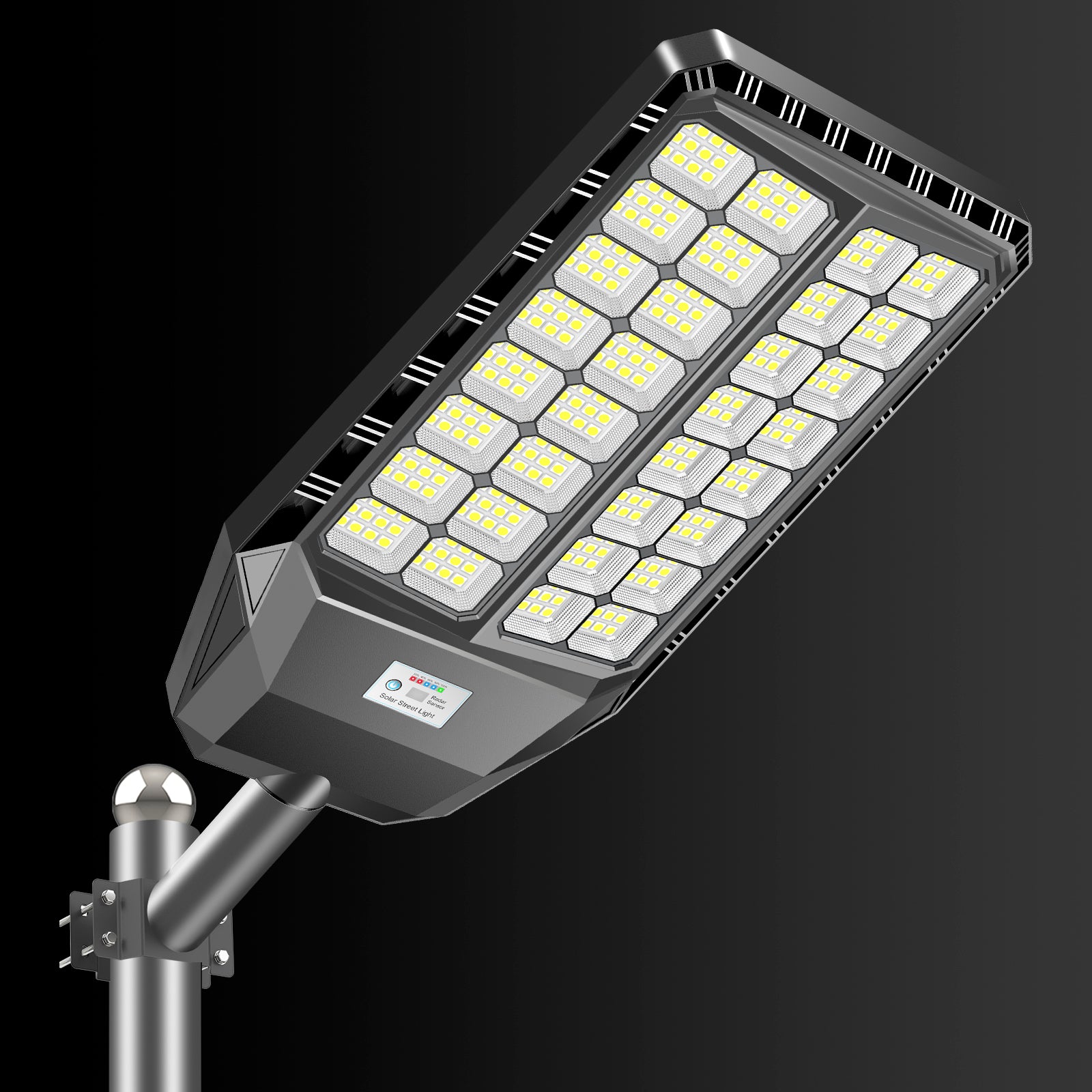
The BD006 is purpose-built for exactly this application. The 40,500-lumen output at a 120-degree beam angle is the right combination for parking lot coverage — bright enough to meet IES standards at standard pole heights, wide enough to minimize dark zones between poles.
The aluminum alloy housing isn't just a spec sheet bullet point — it matters for parking lot installations where the fixture is exposed to vehicle exhaust, road salt spray in northern states, and temperature swings from -20°F to 110°F depending on your location. IP66 waterproofing means pressure washing during lot maintenance won't damage the fixture.
The 18–24 hour illumination rating means the BD006 can run a full dusk-to-dawn cycle on a single day's charge, with reserve capacity for the next night if the following day is overcast. For most US locations, this is sufficient for year-round reliable operation.
Get the BD006 — $179.00 per fixture →
Best Value for Large Lots: Hykoont TW030 2-Pack

Price: $289.00 for 2 fixtures ($144.50 each)
When you're outfitting a large lot with 20+ poles, per-fixture cost matters. The TW030 2-Pack brings the per-unit cost down to $144.50 while delivering 42,000 lumens — actually more output than the BD006 at a lower per-fixture price.
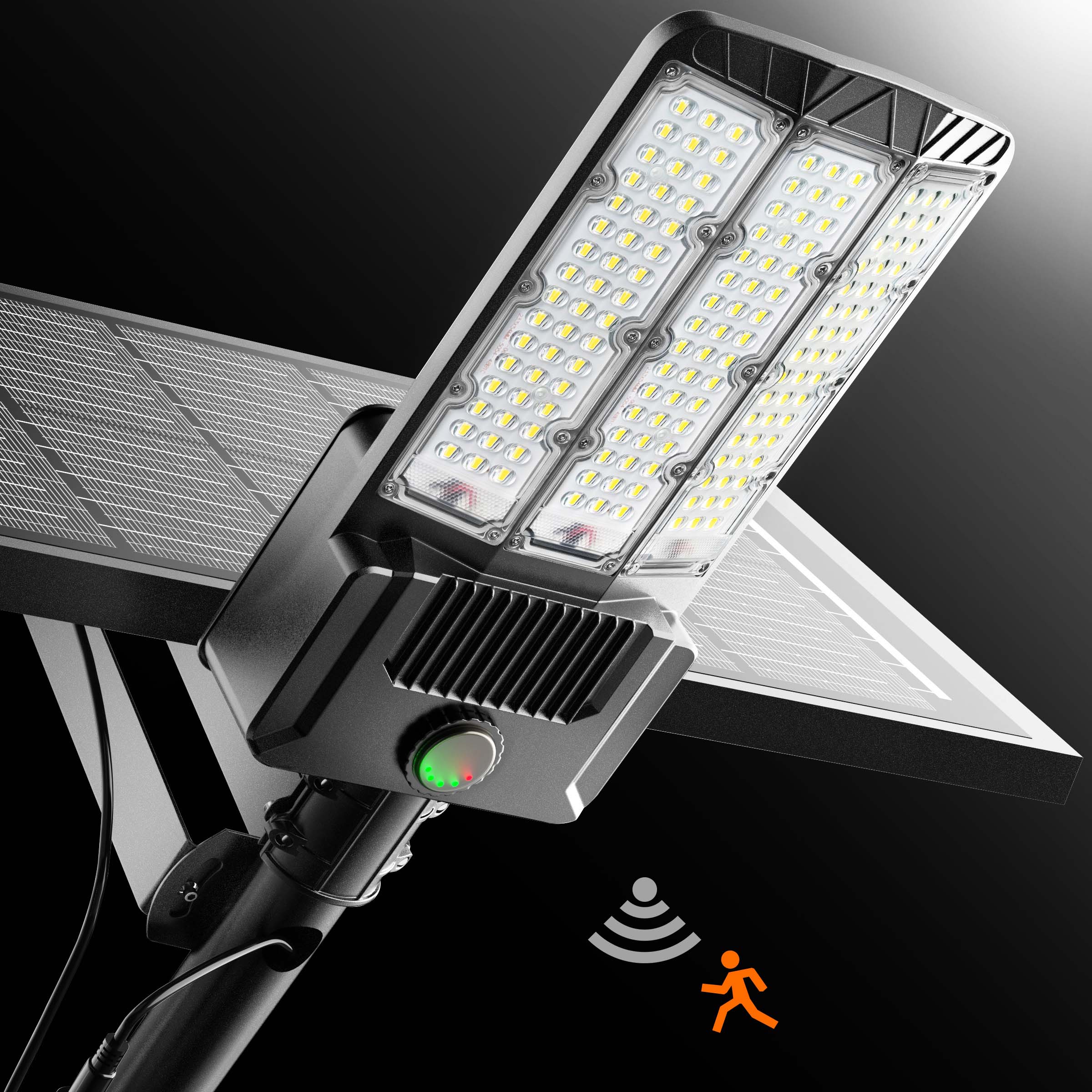
The three lighting modes (motion sensor, dusk-to-dawn, timed) are particularly valuable for large parking lots with variable traffic patterns. A retail lot that's packed at 6pm but nearly empty at 2am can run at full brightness during peak hours and drop to 30% brightness (motion-activated) during off-peak hours, extending battery life and reducing light pollution during low-traffic periods.
For a 20-pole lot, buying 10 TW030 2-Packs costs $2,890 — versus $3,580 for 20 individual BD006 units. That's $690 in savings on fixtures alone, which covers a couple of pole installations.
Get the TW030 2-Pack — $289.00 →
Best for Pilot Programs: Hykoont BM024C

Price: $79.00
Here's a scenario that comes up more than you'd think: a property manager wants to test solar street lighting before committing to a full lot upgrade. Maybe they need to demonstrate ROI to ownership, or they want to see how the fixtures perform through a winter before ordering 20 more.
The BM024C at $79 is the right fixture for that pilot. It's not a watered-down residential product — 26,000 lumens covers up to 3,600 square feet, which is legitimate commercial-grade output. The motion sensor and remote control features are the same as you'd find on higher-priced fixtures. And at $79, you can install 3–4 pilot fixtures for the cost of a single premium unit, giving you better data across multiple locations in your lot.
If the pilot goes well (and it usually does), you have real performance data to justify the full upgrade budget. If you decide to upgrade to BD006 or TW030 fixtures later, the BM024C units can be relocated to lower-priority areas like service entrances or overflow lots.
Start Your Pilot with BM024C — $79.00 →
Best for High-Security Lots: Hykoont BM024 160W 2-Pack

Price: $199.00 for 2 fixtures ($99.50 each)
Hospital parking lots, financial institution lots, and high-traffic retail locations have different requirements than a standard commercial lot. Security camera coverage depends on adequate illumination levels. Liability exposure from poorly lit areas is higher. And these facilities often have 24/7 operations that make motion-sensor dimming less appropriate.
The BM024 2-Pack's 6V-24,000mAh battery with IP66 protection is built for continuous operation. The motion sensor mode can be disabled for full dusk-to-dawn operation at consistent brightness — important when you need reliable illumination for security camera coverage rather than energy-optimized variable brightness.
Get the BM024 2-Pack — $199.00 →
Installation Planning: What You Need to Know Before You Order
Pole Height and Spacing
Standard commercial parking lot pole heights run 18–25 feet. Higher poles cover more area per fixture but require more robust mounting hardware and may need wind load calculations depending on your local building code. For most US locations, 20-foot poles with 40,000-lumen fixtures spaced 60–80 feet apart provide adequate coverage for standard parking lot geometry.
If you're replacing existing poles, check whether the existing pole bases can support the new fixtures. Most commercial solar street lights are heavier than the HPS or metal halide fixtures they replace (due to the integrated solar panel and battery), so structural assessment of existing bases is worth doing before you order.
Solar Panel Orientation
For US installations, solar panels should face south (or within 30 degrees of south) for maximum annual energy production. Most all-in-one solar street lights have adjustable panel angles — set the panel to match your latitude for optimal year-round performance. In the southern US (Texas, Florida, Arizona), a 20–25 degree tilt is appropriate. In northern states (Minnesota, Michigan, Maine), 35–45 degrees maximizes winter charging when the sun is lower in the sky.
Permits and Compliance
For off-grid solar street lights on private property, most US jurisdictions require only a building permit for pole installation — not an electrical permit, since there's no utility connection. This simplifies the permitting process significantly compared to grid-tied installations.
Check your local zoning ordinances for light trespass and glare requirements. Some municipalities have specific limits on how much light can spill onto adjacent properties or public rights-of-way. The BD006's 120-degree beam angle is designed to minimize upward light scatter, which helps with dark sky compliance in jurisdictions that have adopted those standards.
Phased Installation
One underappreciated advantage of off-grid solar street lighting is that you can install it in phases. If your full lot upgrade budget isn't available all at once, you can install 6 fixtures this quarter and 6 more next quarter without any coordination with the utility or electrical contractor. Each fixture is independent — adding more doesn't require modifying the existing installation.
This phased approach also lets you validate performance before full commitment. Install the first phase, run it through a season, confirm the battery performance meets your expectations, then proceed with the remainder.

What Happens in Winter? The Question Every Northern Property Manager Asks
This is the most common concern for commercial buyers in states like Illinois, Ohio, Pennsylvania, New York, and the upper Midwest. And it's a fair question — winter means shorter days, lower sun angles, and potentially snow-covered panels.
Here's the honest answer: quality commercial solar street lights are designed for this. The BD006's 18–24 hour illumination rating is based on a full charge, which in winter might take 2 days of charging rather than 1. The smart power management in these fixtures handles this automatically — they don't just run at full brightness until the battery dies; they modulate output to ensure the light stays on all night even with a partially charged battery.
Snow on the panel is a real issue, but it's usually self-resolving. The panel's dark surface absorbs heat and melts snow faster than surrounding surfaces. In most winter conditions, panels clear themselves within a few hours of sunrise. In extreme cases (heavy wet snow, extended overcast), you may need to manually clear panels — a 5-minute task with a soft brush.
For locations with genuinely severe winters (Minnesota, Wisconsin, upper Michigan), the BC024's 25,000mAh battery with 36-hour reserve provides extra buffer for extended low-solar periods. It's worth the additional investment for those climates.
Frequently Asked Questions
Q: How do I know if my parking lot gets enough sun for solar street lights?
Any surface parking lot in the continental US gets sufficient solar irradiance for off-grid solar street lighting. Even in the cloudiest US cities (Seattle, Portland, Cleveland), annual solar irradiance is adequate for properly sized solar street light systems. The key is choosing fixtures with sufficient battery capacity for your location's typical consecutive cloudy day patterns. For most of the US, 20,000–25,000mAh batteries handle typical winter weather without issue.
Q: Can I mix solar street lights with my existing grid-powered lights?
Yes. Off-grid solar street lights operate completely independently — they don't need to connect to or communicate with your existing electrical system. You can replace some poles with solar fixtures while leaving others grid-connected, or install solar fixtures in new locations without any interaction with existing infrastructure. Many properties run hybrid lots during phased upgrades.
Q: What's the warranty on commercial solar street lights?
Warranty terms vary by manufacturer. For Hykoont fixtures, check the product listing for current warranty terms. Generally, commercial solar street lights carry 2–5 year warranties on the complete fixture, with LED arrays often warranted separately for longer periods. The solar panel is typically the most durable component and often carries a 25-year performance warranty from the panel manufacturer.
Q: Do solar street lights work with existing poles?
Often yes, but it depends on the pole diameter, height, and structural condition. Most commercial solar street lights mount to standard 2–3 inch diameter poles. If your existing poles are in good structural condition and the right diameter, you can often reuse them, which reduces installation cost. Have a structural engineer or qualified installer assess existing poles before reuse — poles that have been in the ground for 20+ years may have corrosion at the base that isn't visible above ground.
Q: How do I handle vandalism or theft of solar panels on parking lot fixtures?
All-in-one solar street lights (where the panel is integrated into the fixture head) are significantly more vandal-resistant than systems with separate ground-mounted panels. The fixture head is mounted 18–25 feet in the air, making panel access difficult without equipment. Tamper-resistant mounting hardware is available for high-risk locations. For lots with significant vandalism history, consider fixtures with steel housings rather than aluminum.
Q: What's the light color temperature for commercial parking lots?
5000K–6500K (cool white/daylight) is standard for commercial parking lot applications. This color temperature provides the best color rendering for security camera footage and creates a perception of brightness that improves safety. Warmer color temperatures (3000K–4000K) are sometimes used for aesthetic reasons in retail or hospitality settings, but cool white is the functional standard for security-focused applications.
Q: Can I get a quantity discount for a large parking lot order?
For large commercial orders (10+ fixtures), contact us directly to discuss volume pricing. The TW030 2-Pack already provides built-in quantity savings at $144.50 per fixture versus individual pricing. For projects requiring 20+ fixtures, additional volume pricing may be available.
Q: How long does installation take for a full parking lot upgrade?
For a 12-pole lot with off-grid solar fixtures, a two-person installation crew can typically complete the project in 2–3 days. This assumes poles are being replaced (not reused) and includes concrete work for new pole bases. If reusing existing poles, installation time drops to 1–2 days. Compare this to a grid-tied installation, which typically takes 1–3 weeks including permitting, trenching, electrical work, and utility coordination.
Q: What happens to the old metal halide fixtures?
Metal halide fixtures contain mercury and must be disposed of as hazardous waste — they can't go in regular dumpsters. Many electrical contractors handle this as part of the removal process. Some municipalities have hazardous waste collection programs. The ballasts in metal halide fixtures also contain PCBs in older units, which require special handling. Factor disposal costs into your project budget — typically $10–$30 per fixture for proper disposal.
Q: Is there a minimum order quantity for commercial solar street lights?
No minimum order quantity — you can order a single fixture to test before committing to a full lot upgrade. This is actually one of the advantages of off-grid solar: you can start with one or two fixtures, evaluate performance, and scale up at your own pace without any system-level constraints.
The Bottom Line for Parking Lot Managers
The math on commercial solar street lighting for parking lots is pretty straightforward once you lay it out. You're spending real money every month on electricity for lights that are probably overdue for replacement anyway. The solar upgrade pays for itself in 2–4 years and then runs essentially free for another 15+ years.
The off-grid vs grid-tied question almost always resolves to off-grid for surface parking lots — simpler installation, faster payback, no utility dependency, and no ongoing electricity cost. The only scenarios where grid-tied makes more sense are lots with existing conduit in good condition or lots with significant shading that limits solar charging.
If you're not sure where to start, the BM024C at $79 is a low-risk way to test the technology in your specific lot before committing to a full upgrade. Install two or three, run them through a season, and let the performance data make the case for the full project.
Ready to Upgrade Your Parking Lot?
Browse our commercial solar street lighting lineup — from pilot-program pricing to full-lot solutions:
BD006 — Best Overall, $179 → TW030 2-Pack — Best Value, $289 → BM024C — Start Your Pilot, $79 →


Leave a comment
This site is protected by hCaptcha and the hCaptcha Privacy Policy and Terms of Service apply.