





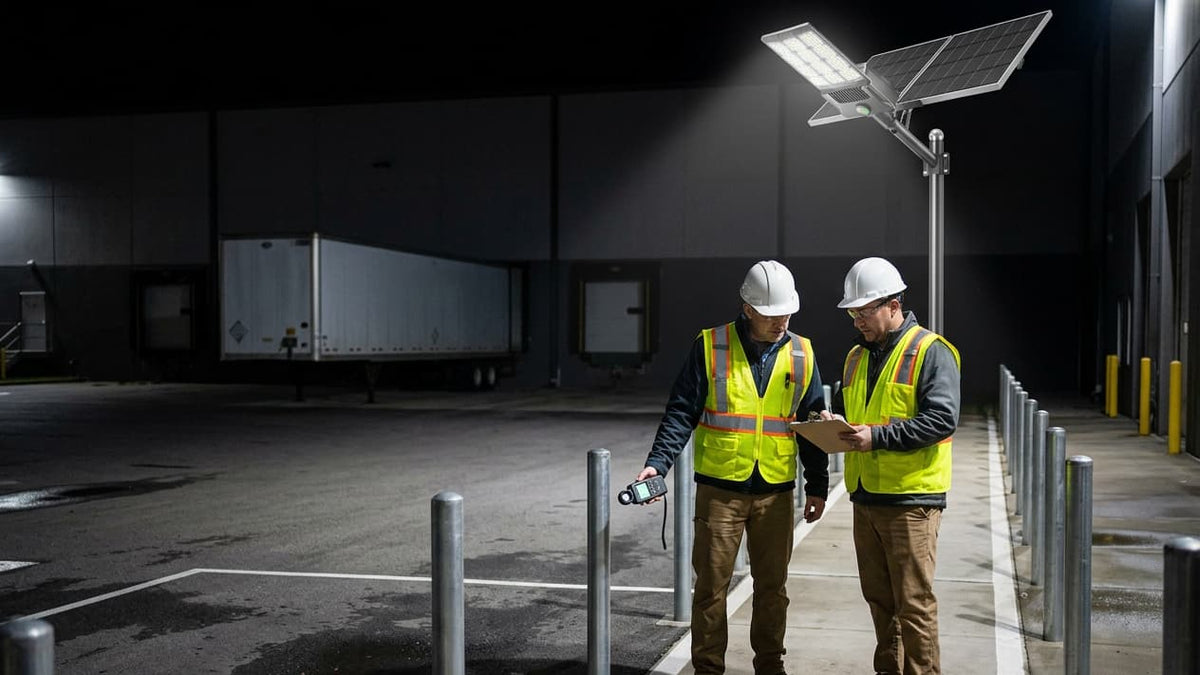
The truck arrives late. A driver steps down from the cab, checks the dock number, and walks toward the shipping office. Somewhere between the trailer and the building, the light disappears.
That is the problem worth solving. Not whether a yard looks bright in a photograph. Not whether one fixture has a bigger number on its product page. The useful question is whether people can see what they need to see, where they actually move, throughout the hours your operation runs.
For a 4,500-square-foot outdoor logistics area, the Hykoont SZ400 is an interesting candidate. Its dedicated product listing advertises 85,000 lumens and coverage across 4,500 square feet. A dual-panel solar arrangement also makes it worth considering when you want fewer installation points without running electrical wiring to each light.
Can one SZ400 replace multiple standard solar lights? Sometimes it can reduce the number of fixtures needed for an open area. It cannot automatically replace several lighting positions around parked trailers, dock doors, corners, and pedestrian routes. Coverage is one part of the decision. Distribution, charging conditions, operating mode, and redundancy matter just as much.
This guide looks at solar street lights for logistics yards from the perspective of a working site, not an empty product-demo lot. We will compare current Hykoont prices, separate broad-area lighting from task lighting, and explain how to test whether one larger fixture is actually the better purchase.
Editorial focus: primary keyword, solar street lights for logistics yards. Long-tail focus, can one SZ400 replace multiple solar lights in a 4,500-square-foot logistics yard? Prices below are USD catalog prices checked October 12, 2026, before any applicable checkout charges or promotions. Listed output and coverage figures are product-page claims, not independent site measurements.
The short answer: fewer fixtures, maybe. Fewer lighting angles, not always.
Picture a clean, open apron outside a small distribution building. There are no tall trailers parked through the middle, no deep canopy, and no separate entrance around the side. A well-positioned SZ400 could be a practical broad-area lighting candidate. One mounting location may be easier to install and maintain than several.
Now park two trailers beside each other. The same fixture can still illuminate the pavement in front of them while leaving a strip of darkness between them. Increasing the output does not change the fact that an opaque trailer blocks light. Moving the fixture or adding another lighting direction may solve the problem more effectively than choosing a brighter head.
That distinction should guide the entire purchase. Consolidate fixtures when they are performing the same broad-area job. Keep separate fixtures when they serve different sightlines, independent routes, or tasks hidden behind obstacles.
For most buyers, the sensible starting point is not “one light versus four.” It is “which zones can share a light, and which cannot?” Once those zones are clear, the fixture count becomes a design decision rather than a guess.

A 4,500-square-foot yard can be three very different lighting problems
A 60-by-75-foot rectangle contains 4,500 square feet. So does a 30-by-150-foot lane. So does a collection of smaller spaces wrapped around a warehouse corner. Those dimensions are illustrative layouts, not specifications for the SZ400.
The first layout gives a single lighting point a reasonable chance of reaching an open surface. The second creates a distance problem: the far end may need a different mounting position. The third creates a line-of-sight problem: a building corner interrupts the light path entirely.
Square footage tells you how much pavement exists. It does not tell you how that pavement is used. A driver backing toward a dock, a worker crossing from employee parking, and a security camera watching a gate each need visibility in different directions.
Before comparing fixtures, sketch the site as it looks during a busy shift. Include the trailers, dumpsters, racks, parked vans, canopies, and doors that are normally present. Then mark where people stand, walk, reverse, inspect equipment, and wait. The empty daytime yard is not the yard you are buying lights for.
This small exercise often reveals why a previous lighting installation disappointed. The lights covered the property outline but missed the working routes inside it. Buying more output without correcting the layout would repeat the same mistake at a higher price.
What makes the SZ400 worth putting on the shortlist?
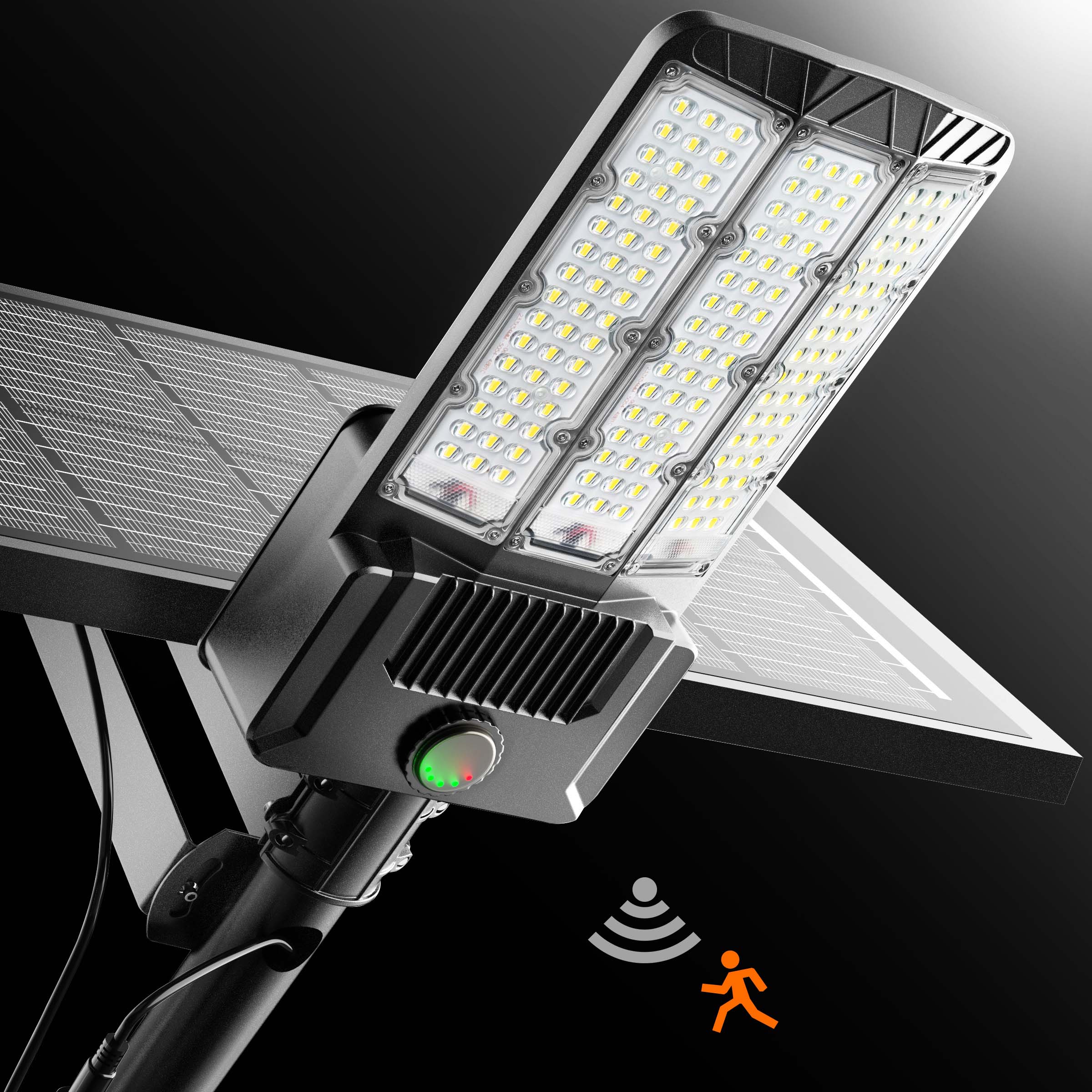
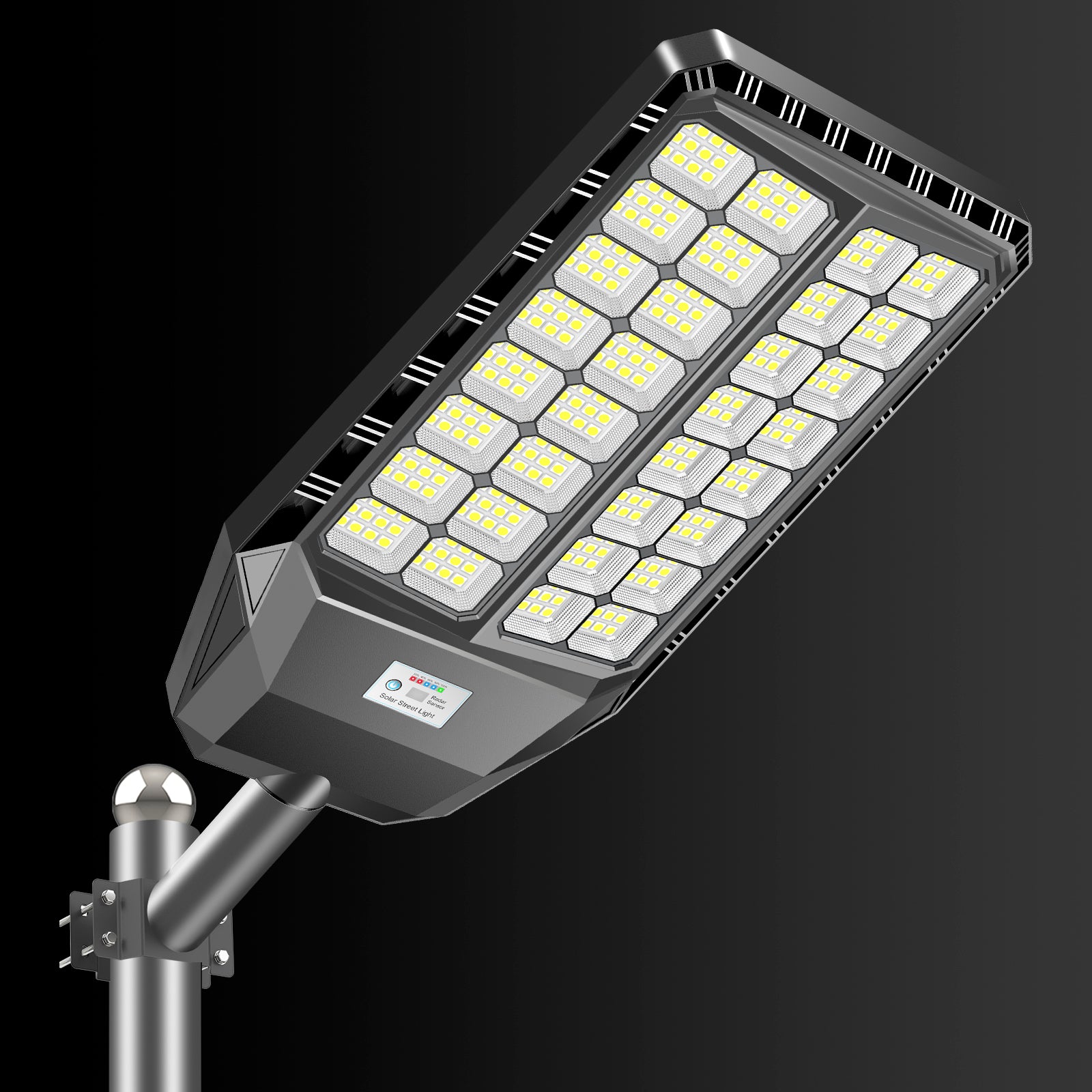
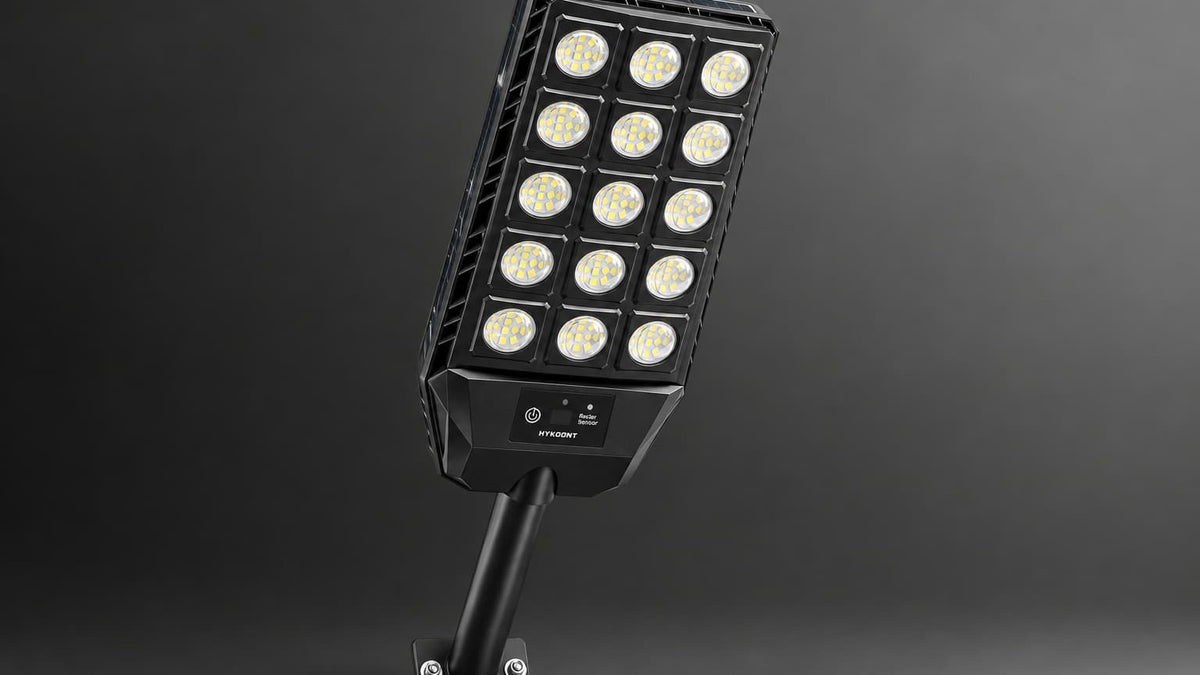
The dedicated Hykoont SZ400 listing describes a commercial solar street light with dual solar panels, a die-cast aluminum housing, and 144 SMD 5054 LED chips. It lists an 85,000-lumen output and a 3.2V, 42,000mAh LiFePO4 battery. The listed solar arrangement is 6V 50W.
Those are catalog specifications. They are useful for identifying the product and asking informed questions, but they are not a substitute for a lighting layout or verified output data. In particular, do not divide the advertised lumen number by another product's advertised number and call the result a replacement ratio.
The more practical attraction is the package concept. A larger solar street light may let you concentrate broad-area illumination at a useful pole position while keeping the solar charging arrangement separate from the LED head. That can be valuable in a yard where the best place to aim light and the best place to collect sunlight are not exactly the same.
The listing also describes dusk-to-dawn activation, radar motion sensing, timer presets, and remote adjustment. These functions give buyers operating choices. They also create a commissioning responsibility: someone has to select a mode that matches the site's actual schedule rather than leaving the system in whichever mode produces the longest advertised runtime.
There are inconsistencies within the current listings regarding charging time, runtime, and weather rating. Before ordering for a commercial site, request the current model documentation and confirm those details. This guide deliberately does not promise a specific all-night full-output duration, consecutive cloudy-day performance, or a single IP rating.

Actual catalog image from the dedicated SZ400 product page. This is a product illustration, not a measured logistics-yard installation.
Shop the dedicated Hykoont SZ400 listing, currently $270 for one light.
The price comparison has a wrinkle you should know about
There are two active buying pages that include the SZ400. The dedicated SZ400 page currently lists a one-pack at $270 and a two-pack at $540. The SZ300/SZ400 series page lists the SZ400 Dual-Panel Pro option at $209 for one and $359 for two.
Those prices should not be blended into one vague “starting at” number. They belong to different listings and pack selections. The available catalog data does not establish that every included component, fulfillment detail, and specification is identical between the two pages. Confirm what is included before treating them as interchangeable offers.
The same series page lists the SZ300 Standard at $129 for one and $249 for two. Its product description positions the SZ300 as a single-panel alternative with a listed 35W solar panel and a 30,000mAh battery. It advertises 60,000 lumens, but that number does not establish equivalent on-site coverage.
Two SZ300 Standard lights from the current two-pack cost $249 in hardware. That is $21 less than one SZ400 on the dedicated $270 page. Against the $209 SZ400 series option, the comparison reverses: one SZ400 costs $40 less than the SZ300 two-pack.
This is why the exact purchase route matters. A blanket claim that “one bigger light always costs less than several smaller lights” is not supported by the current prices. The meaningful comparison includes the selected listing, installation locations, mounting hardware, labor, and the coverage those locations actually deliver.

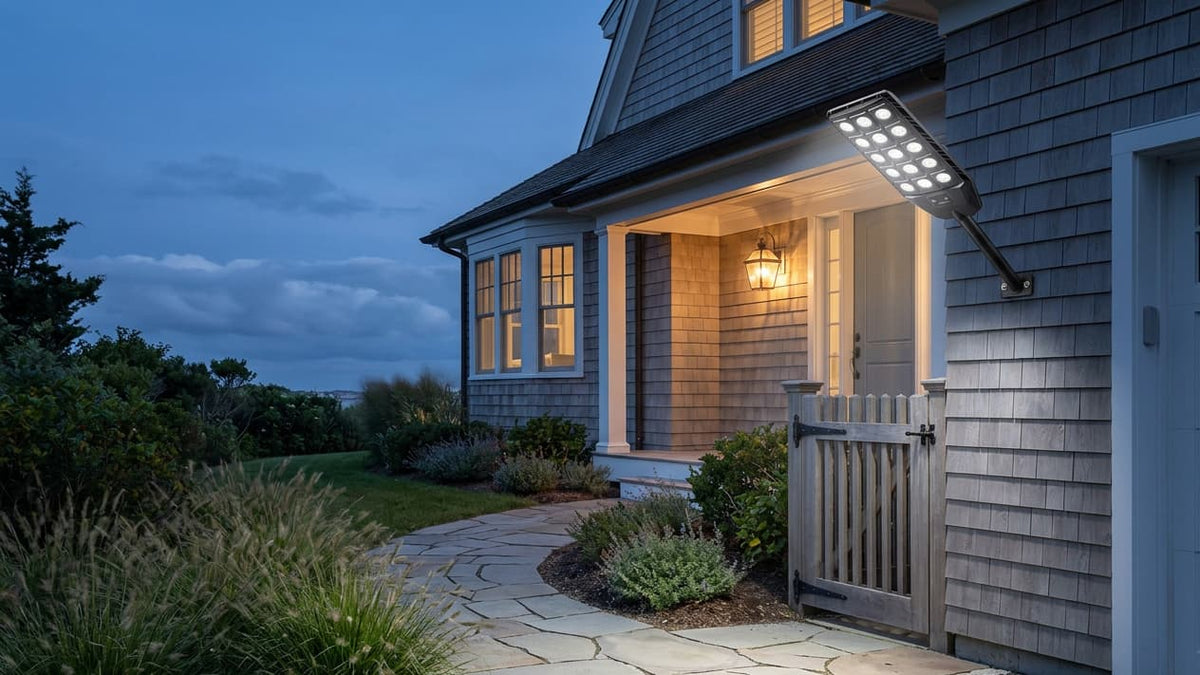
The series page's featured catalog image. Use the model selector to choose SZ300 Standard or SZ400 Dual-Panel Pro; the featured image alone does not verify the selected package.
Compare and shop SZ300 Standard and SZ400 Dual-Panel Pro options.
Why the brightest spot is usually the least useful place to judge a light
Stand directly beneath a fixture and almost any convincing product demonstration looks good. Walk to the far corner, turn toward the dock, or look between parked vehicles, and you learn much more.
A logistics yard needs usable illumination across its working area, not just an impressive pool of brightness. The important locations are often the edges: the crossing near the office, the latch side of a gate, the end of a trailer row, and the transition from open pavement to a covered loading space.
For a commercial evaluation, ask for a photometric layout using your dimensions, mounting positions, and working zones. Where available, request verified light-output information and appropriate photometric files. A qualified lighting professional can use those inputs to evaluate distribution instead of relying on a broad area claim.
The layout should look at the darker measurement points as well as the average. A good average can hide a weak pedestrian route. It should also consider illumination on vertical surfaces, because drivers and workers look at people, doors, signs, and vehicle sides, not only the pavement.
There is no universal mounting height or fixture count in this article. The right arrangement depends on optics, site geometry, obstacles, and the tasks being performed. Raising a light can change its distribution, but it can also increase spill or reduce illumination at particular points. “Higher” is not automatically “better.”
The trailer-shadow test: the quickest way to challenge a one-light plan
If you only do one informal site check before buying, do this: consider the yard with its tallest routinely parked vehicles in place. Trace the direct path from the proposed fixture to the routes behind and beside those vehicles.
Where that path crosses a trailer, container, or building corner, assume there is a shadow problem to investigate. Do not assume the SZ400's higher listed output will make the obstruction irrelevant. More light on the visible side does not create a new lighting angle on the hidden side.
This does not mean every trailer requires its own fixture. It means placement should reflect how the yard fills up. Two lights on different sides of an aisle may create more useful overlapping coverage than one larger light at a single end. A large broad-area fixture plus a smaller entrance light may also be more appropriate than identical fixtures everywhere.
Ask the night-shift team where they hesitate, slow down, or reach for a flashlight. Their answers often identify places that a neat overhead drawing misses. A supervisor's view from the office window may not include the pedestrian gap between two trailers.
And repeat the check with normal parking variations. The yard will not stay frozen in its ideal arrangement. Lighting that only works when every vehicle is parked precisely where the installer expected is not much of a logistics solution.

Solar charging is part of the layout, not an afterthought
The solar panel needs a useful exposure to sunlight. The fixture needs a useful view of the yard. Those goals can compete near a warehouse wall, under a canopy, or beside a taller building.
The SZ400's dual-panel design makes the charging system worth examining, but panel count alone does not tell you the energy harvested at your site. Shade, orientation, weather, soiling, and available daylight still matter. Two shaded panels do not become a reliable charging arrangement simply because there are two of them.
Look at the proposed mounting location at different times of day. A spot that appears sunny during a noon walkthrough may sit in a building's shadow for much of the morning or afternoon. Consider the season when nights are longest and the site's available charging window is least favorable.
That matters especially when the yard operates before sunrise or late into the evening. A solar light must support the operating schedule after collecting energy during the previous daylight period. The most relevant question is not the longest runtime advertised under any setting; it is performance at the brightness and schedule your operation requires.
Before procurement, ask the supplier to clarify panel configuration, battery specifications, charging assumptions, low-temperature operating limits, and the behavior when stored energy becomes low. Obtain answers for the specific model being purchased. Product-family language should not stand in for a confirmed configuration.
Motion mode can save energy, but your shift schedule gets the final vote
The current SZ400 descriptions identify a radar mode with 30% standby brightness and 100% brightness when motion is detected. That may be useful for intermittent activity around a perimeter or a lightly used entrance.
A busy logistics apron is different. If traffic triggers the light repeatedly, its energy use will differ from a quiet site with occasional movement. A long radar-mode runtime claim should not be read as a promise of the same duration at continuous full brightness.
Think about where a person or vehicle first enters the detection area. Workers should not have to walk into a dark route before the system provides the light needed to see it. Test approaches from the actual directions people use, including behind parked vehicles, rather than waving a hand beneath the sensor.
Timer settings also need a practical check. A setting that suits an early closing schedule may be wrong when a delayed truck arrives. Automatic operation is convenient only when it follows the operation you actually run.
Decide the required baseline first, then choose the mode. If a task depends on steady illumination, evaluate a steady setting and the associated energy budget. If the location is truly intermittent, test motion operation. Do not let the most attractive runtime figure make that decision for you.
When one SZ400 is a reasonable candidate
The strongest case is an open, compact outdoor zone with few tall obstructions, a suitable mounting location, good solar exposure, and working routes that stay within the fixture's effective distribution.
For example, an illustrative 60-by-75-foot staging apron might have one main vehicle approach and a pedestrian route along its open edge. If trailers do not regularly divide the area, one SZ400 could be a candidate for a pilot installation. That is a scenario to test, not a prediction that the model will meet every task requirement there.
Another promising situation is a remote open section of a property where several smaller lights were originally proposed mainly to spread broad-area illumination. A larger fixture may reduce the number of mounting assemblies, service points, and places staff must inspect.
The advantage becomes more convincing if there is already a structurally suitable mounting position with an unobstructed view. Avoiding unnecessary new poles can matter financially. But the existing position still has to work for aiming, charging, safe access, and vehicle clearance.
In these cases, ask for the layout and test the light before buying a larger quantity. The opportunity is to simplify a suitable site, not to force an unsuitable site into a one-fixture story.

When multiple lighting points are the better answer
A narrow lane, an L-shaped yard, or a heavily occupied trailer area usually deserves closer attention to distributed light. Independent points can reach routes that one fixture cannot see.
Loading docks add another complication. The broad yard can appear adequately illuminated while the working area near a dock face remains shaded by a canopy or trailer. Treat the open apron and the dock task as related but separate requirements. A solar street light is not automatically a replacement for dedicated dock lighting.
Redundancy matters too. Consolidating several lights into one concentrates the consequence of a fault. If that single fixture needs service, a larger area may lose its planned illumination. Multiple independent fixtures can reduce that particular single-point exposure, though each still needs proper charging and maintenance.
There is also the question of glare. A light positioned to reach a distant corner might sit directly in a driver's line of sight while backing. A different combination of positions and aiming angles may be preferable to one brighter fixture facing the whole site.
The right answer may therefore be one SZ400 for the open section plus separate lighting for a gate, door, or obstructed path. That is not a failed consolidation plan. It is a plan that consolidates only the jobs that can sensibly be combined.
Two other active Hykoont products for a zone-based comparison
BD006: consider it for a separate outdoor section
The Hykoont BD006 solar street commercial light currently costs $179 for one. Its listing describes an aluminum-alloy construction, a separate solar panel, and light, remote, and radar controls.
The page advertises 40,500 lumens and coverage up to 3,000 square feet at a stated 16–20-foot installation height. Treat that as the product's marketing coverage information, not a verified performance result for your yard. It does not establish that two BD006 units will provide twice the coverage or that its published mounting range should be copied into every application.
For comparison purposes, the BD006 is worth considering where a site has a second open section that genuinely needs another lighting position. Its value would come from being in the right place, not merely from adding more listed lumens to the total.
Two individually priced BD006 lights would be $358 in fixture hardware at the current price. That calculation excludes installation and does not claim equivalence with either one or two SZ400 lights. It simply gives a buyer a clear starting number for a distributed-lighting option.

Shop the Hykoont BD006 at the current $179 price and review its installation details.
BC020C: a lower-priced option to evaluate for a distinct smaller zone
The Hykoont BC020C 150W Solar Street Light currently lists a one-pack at $79 and a two-pack at $159. The displayed product name is BC020C, while its actual URL handle contains “bc024c.” The link here uses the full live handle rather than guessing from the name.
Its listing describes light, timer, remote, and radar controls, with an advertised 20,500-lumen output. The page contains inconsistent battery and runtime details, so confirm the current specifications before using those figures in a site energy calculation.
A lower-priced fixture can be worth evaluating for a separate gate approach or side route. That does not mean it is automatically adequate for every such task. The route's visibility requirements, mounting arrangement, shade, and nighttime performance still decide whether it belongs there.
One dedicated-page SZ400 at $270 plus one BC020C at $79 produces a $349 fixture-hardware subtotal. Such a combination might make sense when the first unit serves an open yard and the second addresses a genuinely separate sightline. The example is a budget illustration, not a tested lighting design.

Shop the Hykoont BC020C, currently $79 for one, for a separate-zone evaluation.
The hidden cost is often the second installation location
Fixture prices are easy to compare. Site work takes more effort. An additional mounting location may require a pole, foundation, protective measures, access equipment, or coordination around vehicle movements.
At another site, that second location may already exist and be inexpensive to use. This is why there is no honest universal installation-savings percentage for choosing one larger light. The avoided work has to be real work that your project would otherwise require.
Compare complete installed alternatives. Include the selected lights, mounting structures, foundation work where necessary, labor, equipment access, commissioning, and a reasonable maintenance plan. If those costs are estimated, label them as estimates and use quotes tied to your site.
Solar lighting can avoid a wired electrical connection to the fixture, but it does not avoid structural installation. Nor does it eliminate maintenance. Panels can need cleaning, settings can need adjustment, and batteries or components can eventually require attention.
The best financial outcome is not necessarily the lowest hardware subtotal. It is the lowest sensible total cost for a layout that does the required job. A cheap installation that leaves an important route dark is not a bargain, and an expensive fixture aimed at the wrong pavement is not an upgrade.
A pilot installation should be allowed to fail
That sounds negative, but it is how a pilot earns its value. The purpose is to find weaknesses before the full purchase, not to collect one flattering nighttime photo.
Start by recording the proposed configuration: model, selected listing, mounting location, actual height, aiming direction, panel position, and operating mode. Without that record, you will not know whether a later change in performance came from the product, the settings, or the installation.
Then evaluate the working routes with normal vehicles present. Use consistent measurement points and document the darker locations, not just the center. A lighting professional can help define the measurements and acceptance criteria appropriate to your tasks.
Observe the system near the beginning of the shift and toward the end. A light that performs well shortly after sunset may not behave the same way after a long operating period. Repeat observations after less favorable charging conditions when possible.
Include real users. Ask a driver about glare during backing, a worker about the walk to the office, and the security team about camera footage. Their observations should supplement measured checks, not replace them. A system should work from multiple viewpoints, not only the installer's.
Write the acceptance criteria before the purchase order
A statement such as “light the whole yard” leaves too much room for disagreement. Specify which routes and tasks must be supported, during which operating hours, with which normal obstructions present.
Record the desired operating mode and ask how the supplier expects the unit to perform at that setting. Clarify whether any runtime statement assumes reduced brightness, motion standby, a full initial charge, or particular charging conditions. The answer should describe the model you are buying, not a loosely related series.
Ask about replacement components, service access, warranty terms, and who handles a fault. If maintaining the fixture requires special equipment, account for that before installation. A pole position that is convenient for light distribution can be inconvenient for service during a busy shift.
For camera coverage, review actual recorded footage under the proposed lighting conditions. A bright pavement view does not guarantee useful detail on a moving person's face or a vehicle identifier. Camera settings and fixture position have to be evaluated together.
Do not use this article's illustrative layouts as a compliance assessment or a safety certification. If your site has regulated lighting obligations or critical operations, have the design assessed by qualified professionals against the applicable requirements.
A buying decision you can explain to the rest of the team
Choose the one-SZ400 pilot when the area is compact and open, one position has useful sightlines, charging exposure is credible, and the operating schedule can be supported at the required setting.
Choose a distributed comparison when trailers divide the yard, the site wraps around corners, separate routes need their own light direction, or losing one fixture would create an unacceptable operational gap.
Choose a mixed plan when the open apron and the entrance are clearly different jobs. In that case, a broad-area light and a targeted secondary position may make more sense than either one light everywhere or many identical lights without a purpose.
When discussing the decision, explain the zones first and the products second. “We need another lighting direction beside the trailers” is a stronger justification than “we want more lumens.” “One position covers this unobstructed staging area in the pilot” is stronger than “the page says 4,500 square feet.”
That language keeps the team focused on the result: useful visibility with a manageable installation and maintenance burden. It also gives you a clear reason to change the plan if the yard layout or shift schedule changes later.
Frequently asked questions
1. Can one SZ400 really illuminate a 4,500-square-foot logistics yard?
The dedicated product page advertises coverage across 4,500 square feet. One unit is therefore a candidate for an open-area evaluation, but the claim does not establish uniform illumination at your site. Yard shape, mounting, obstacles, charging exposure, and operating mode all affect the result. Test the actual working area before removing existing lighting points.
2. How many standard solar lights can one SZ400 replace?
There is no verified universal replacement number. “Standard solar light” covers different products, optics, and mounting arrangements. One SZ400 may consolidate fixtures doing the same broad-area job, but it cannot automatically replace lights that reach separate corners or opposite sides of trailers. Compare working-zone coverage rather than advertised lumen ratios.
3. What is the current SZ400 price?
As checked October 12, 2026, the dedicated SZ400 listing is $270 for one and $540 for two. The SZ300/SZ400 series page lists the SZ400 Dual-Panel Pro option at $209 for one and $359 for two. Confirm the selected model, package contents, and current checkout price before purchasing.
4. Is one SZ400 cheaper than two SZ300 Standard lights?
It depends on the listing. The SZ300 Standard two-pack is currently $249. That is less than the dedicated SZ400 one-pack at $270, but more than the series-page SZ400 one-pack at $209. Installed costs may change the comparison further, particularly if two lights need two new mounting structures.
5. Will dual solar panels guarantee performance through cloudy weather?
No panel-count claim should be treated as a guarantee of site-specific cloudy-weather operation. Available sunlight, panel exposure, battery condition, and energy demand matter. Request confirmed charging and autonomy information for your selected configuration, and evaluate performance after less favorable charging conditions rather than relying only on a sunny-day demonstration.
6. Should a logistics hub use radar mode or constant lighting?
Choose according to the task and schedule. Radar operation may suit intermittent perimeter activity, while some working areas need a steady baseline. The listed radar mode changes between standby and triggered output, so its runtime is not equivalent to continuous full-brightness runtime. Test detection approaches and confirm performance at the setting your operation requires.
7. Can a street light replace dedicated loading dock lighting?
Not automatically. A street light may support the open apron while a canopy or trailer blocks light at the dock face. Loading, inspection, and covered working areas may need separate fixtures designed and positioned for those tasks. Assess the dock and the yard separately before deciding which existing lights can be removed.
8. What should I request before ordering?
Ask for current model specifications, verified output data where available, a site-specific layout, mounting requirements, operating limits, runtime assumptions, and service information. The current listings contain conflicting charging, runtime, and weather-rating statements, so obtain the documentation for the exact unit and package you plan to purchase.
9. Which related products are worth comparing?
The active SZ300/SZ400 series page offers a lower-priced SZ300 Standard alternative. The BD006 at $179 and BC020C at $79 for one are additional products to evaluate where the site needs distinct lighting zones. These are comparison candidates, not automatic substitutes for the SZ400 or promises of suitability for every logistics task.
10. What is the most useful first step?
Map the yard with normal trailers and equipment in place. Identify routes the proposed fixture can see and routes it cannot. Then compare a one-SZ400 layout with a distributed option, using clear acceptance criteria and a nighttime pilot. That process gives you a fixture count you can defend rather than a number chosen from a headline.
The goal is not one light. The goal is one less problem after dark.
The SZ400 deserves consideration when a logistics yard has an open area that may benefit from one stronger solar lighting point. Its dedicated listing's 4,500-square-foot coverage claim makes it relevant to this comparison, and the current catalog offers several price and package routes to investigate.
But a yard does not become simpler because its purchase order has fewer line items. Trailers still cast shadows. Corners still interrupt sightlines. Late trucks still arrive after the timer you thought would be sufficient. The winning layout accounts for those things before anyone climbs a pole.
Use one SZ400 where one position can genuinely do the job. Keep separate lighting where separate angles are necessary. Confirm the configuration, test the demanding hours, and compare complete installed costs. That is how you reduce unnecessary fixtures without buying yourself a darker corner.
Review and shop the dedicated SZ400 product page, or compare the SZ300 Standard and SZ400 Dual-Panel Pro selections before choosing the configuration for your pilot.

Leave a comment
This site is protected by hCaptcha and the hCaptcha Privacy Policy and Terms of Service apply.