


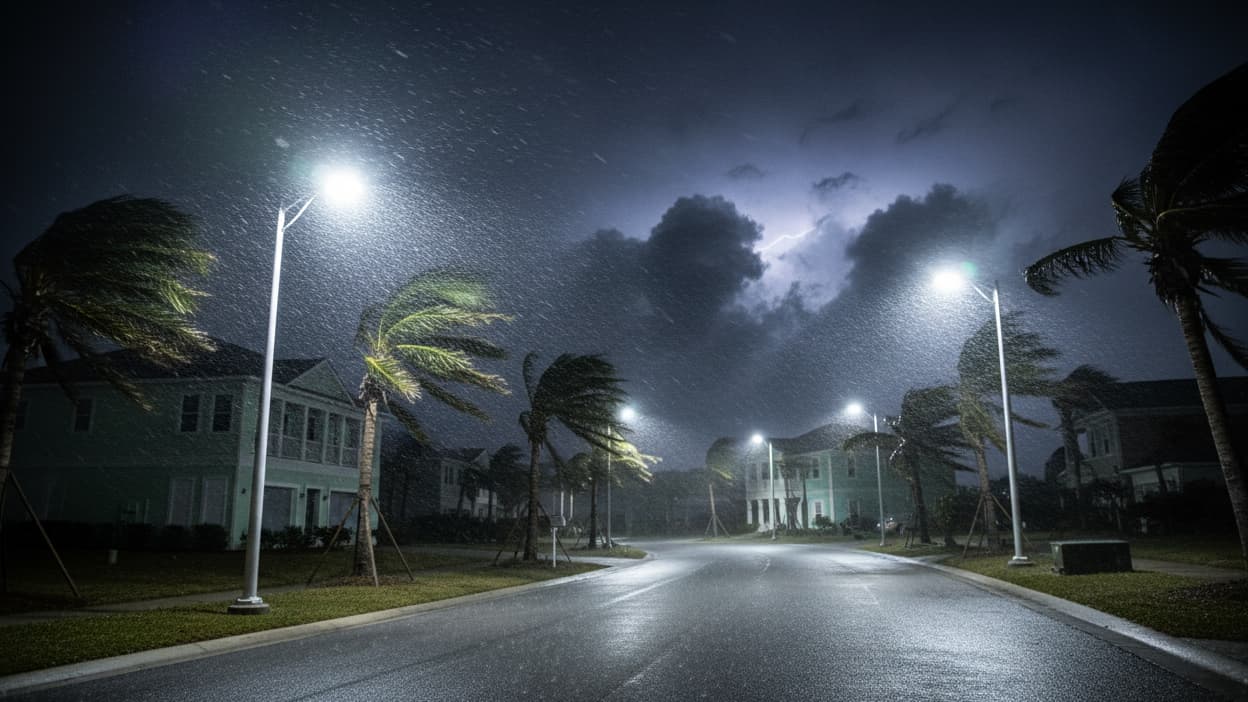
Last hurricane season, a property manager in coastal Georgia watched three of her parking lot lights snap at the pole base during a Category 2 storm. The lights themselves? Fine. The mounting hardware and poles? Gone. She'd bought the cheapest solar street lights she could find online, and the storm found every weakness in about six hours.
That story isn't unusual. What is unusual is knowing what to look for before the storm hits — not after you're filing an insurance claim and waiting six weeks for replacement parts.
This guide is for property managers, HOA boards, facility directors, and contractors who need commercial solar lighting that doesn't just survive a bad storm — it keeps working through one. We'll cover the specs that actually matter, the red flags to avoid, and the specific products worth putting on a pole in hurricane country.
Why Most Solar Lights Fail in High Winds (And It's Not What You Think)
The instinct is to blame the light fixture itself. But in most storm failures, the fixture is the last thing to go. What fails first is almost always one of three things:
- The mounting bracket or arm — undersized hardware that flexes, fatigues, and eventually shears under sustained wind load
- The pole — especially thin-wall steel poles that weren't rated for the actual wind zone they're installed in
- The solar panel connection — panels that act like sails when they're not properly angled or secured, creating torque that works against the entire assembly
The fixture's IP rating (waterproofing) matters, but it's almost secondary to structural integrity. A light rated IP66 that's mounted on a flimsy arm in a 90 mph wind zone is still going to end up in a parking lot at 3 AM.
So let's start with the structural specs — the ones most product listings bury in fine print or skip entirely.
The Specs That Actually Predict Storm Survival
1. Wind Load Rating
This is the single most important spec for storm-prone installations, and it's the one most buyers never ask about. Wind load rating tells you the maximum sustained wind speed the fixture and mounting system can handle without structural failure.
In the US, ASCE 7 (the standard used by most building codes) divides the country into wind speed zones. Coastal Florida, the Gulf Coast, and parts of the Carolinas sit in zones requiring designs for 150–170 mph winds. Inland areas might only need 90–115 mph ratings.
What to look for: fixtures and poles rated to at least 130 mph for coastal installations, with documentation to back it up — not just a marketing claim.
2. IP Rating — And What It Actually Covers
IP65 is the baseline for any outdoor commercial fixture. IP66 is better. Here's the practical difference:
- IP65: Protected against water jets from any direction. Fine for most rain events.
- IP66: Protected against powerful water jets — think driving rain at 60+ mph, or pressure washing during maintenance.
- IP67/IP68: Submersion-rated. Overkill for most pole-mounted lights, but relevant for ground-level fixtures in flood-prone areas.
For hurricane-prone regions, IP66 is the practical minimum for any fixture that's going to stay mounted through a major storm.
3. Housing Material and Wall Thickness
Die-cast aluminum is the standard for commercial-grade solar fixtures, and for good reason — it's corrosion-resistant, dissipates heat well, and holds up to impact. What varies is wall thickness and casting quality.
Thin-wall housings (under 3mm) can crack under the vibration stress of sustained high winds. Look for fixtures that specify die-cast aluminum alloy construction with a minimum 3–4mm wall thickness, or fixtures that have been independently tested for impact resistance.
4. Solar Panel Mounting Angle and Adjustability
Fixed-angle solar panels create a fixed wind profile. In high-wind installations, the ability to tilt the panel to a lower angle (closer to horizontal) dramatically reduces the sail effect during storms. Some integrated all-in-one designs handle this better than split panel/fixture designs because the panel sits closer to the fixture body.
For split-panel designs (where the panel is separate from the fixture), look for mounting hardware that allows the panel to be angled at 10–15° during storm season, then readjusted for optimal solar capture afterward.
5. Battery Enclosure and Thermal Management
Lithium iron phosphate (LiFePO4) batteries handle temperature extremes better than standard lithium-ion. In hurricane country, you're dealing with both heat stress (summer) and the rapid temperature drops that can accompany storm systems. LiFePO4 chemistry is more stable across that range and less prone to thermal runaway — which matters when your fixture is taking a beating in a storm.
Operating temperature range to look for: -20°C to 60°C (-4°F to 140°F). Anything narrower than that is a liability in extreme weather regions.

Pole Selection: The Part Everyone Gets Wrong
The fixture gets all the attention. The pole is where most storm failures actually happen.
For commercial solar street light installations in wind-exposed areas, the pole spec matters as much as the fixture spec. Key considerations:
- Wall thickness: Commercial poles should be minimum 11-gauge (3mm) steel. Thinner than that and you're gambling on wind load.
- Base plate size: Larger base plates distribute load better. For high-wind zones, anchor bolt patterns should be engineered to local soil conditions.
- Height vs. wind load: Every additional foot of pole height increases the moment arm — the leverage the wind has on the base. A 20-foot pole in a 100 mph wind zone needs significantly more robust anchoring than a 12-foot pole in the same zone.
- Galvanized vs. powder-coated: Hot-dip galvanized poles resist corrosion better in salt-air coastal environments. Powder coating looks better but can chip and allow rust to develop at the base over time.
If you're in a coastal county, check whether your local building department requires engineered pole drawings for commercial lighting installations. Many do — and for good reason.
All-in-One vs. Split-Panel Designs: Which Handles Storms Better?
This is a genuine trade-off, not a clear winner.
All-in-one designs (panel integrated into the fixture body) have a lower wind profile and fewer connection points that can fail. They're simpler to install and have fewer parts to lose in a storm. The trade-off is that the panel angle is fixed, and if the fixture is damaged, you're replacing the whole unit.
Split-panel designs allow you to optimize panel angle for your latitude and adjust it seasonally. They also let you replace the panel or fixture independently if one is damaged. The trade-off is more mounting hardware, more connection points, and a higher wind profile if the panel is mounted at a steep angle.
For most commercial installations in hurricane-prone areas, all-in-one designs at lower mounting heights (8–12 feet) tend to perform better in storms. For higher mounting heights (14–20 feet) where you need more battery capacity and panel area, split designs with properly engineered mounting hardware are often the only practical option.

Recommended Products for Storm-Prone Commercial Installations
Here are the Hykoont products that make the most sense for high-wind and hurricane-risk installations, based on their specs, construction, and real-world performance data.
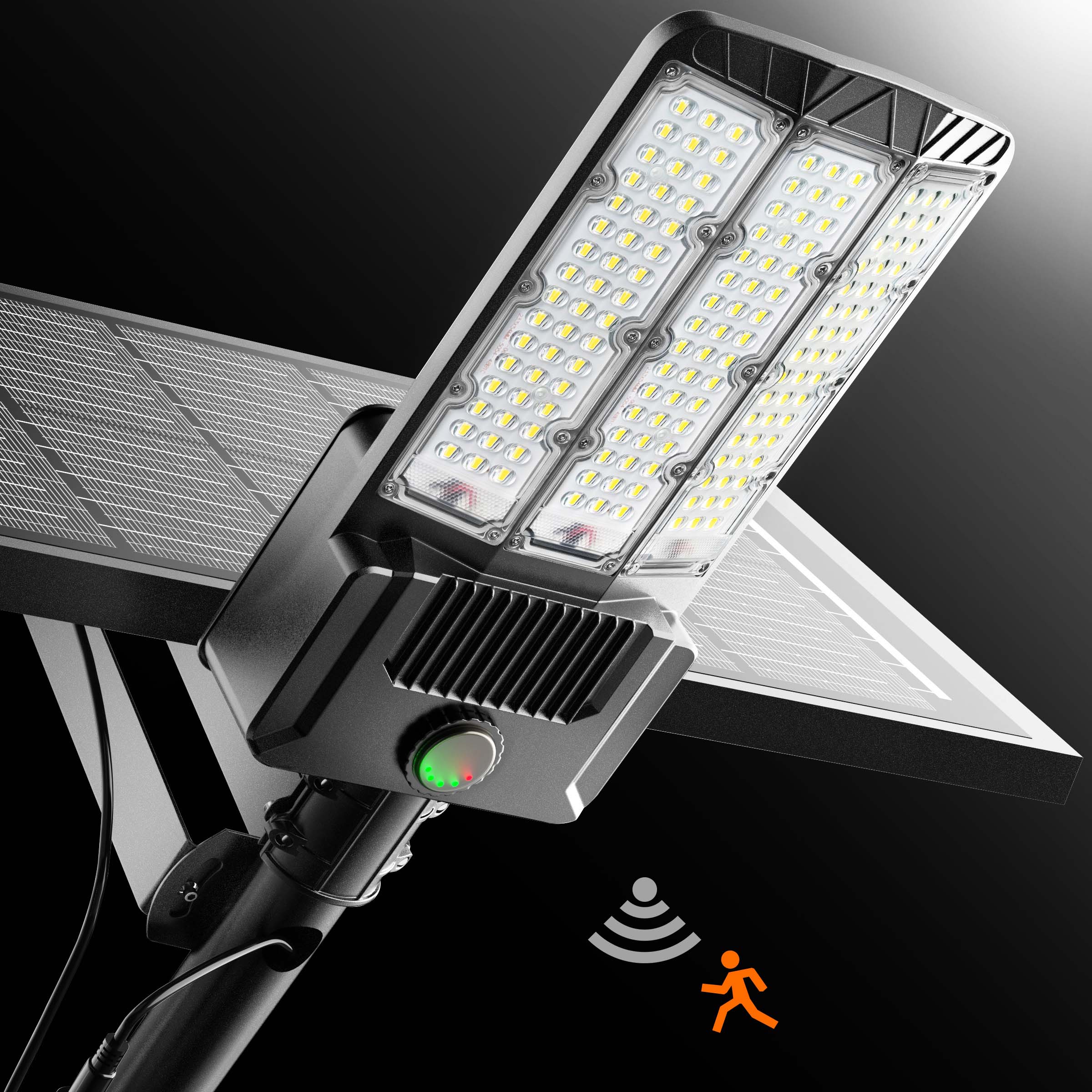
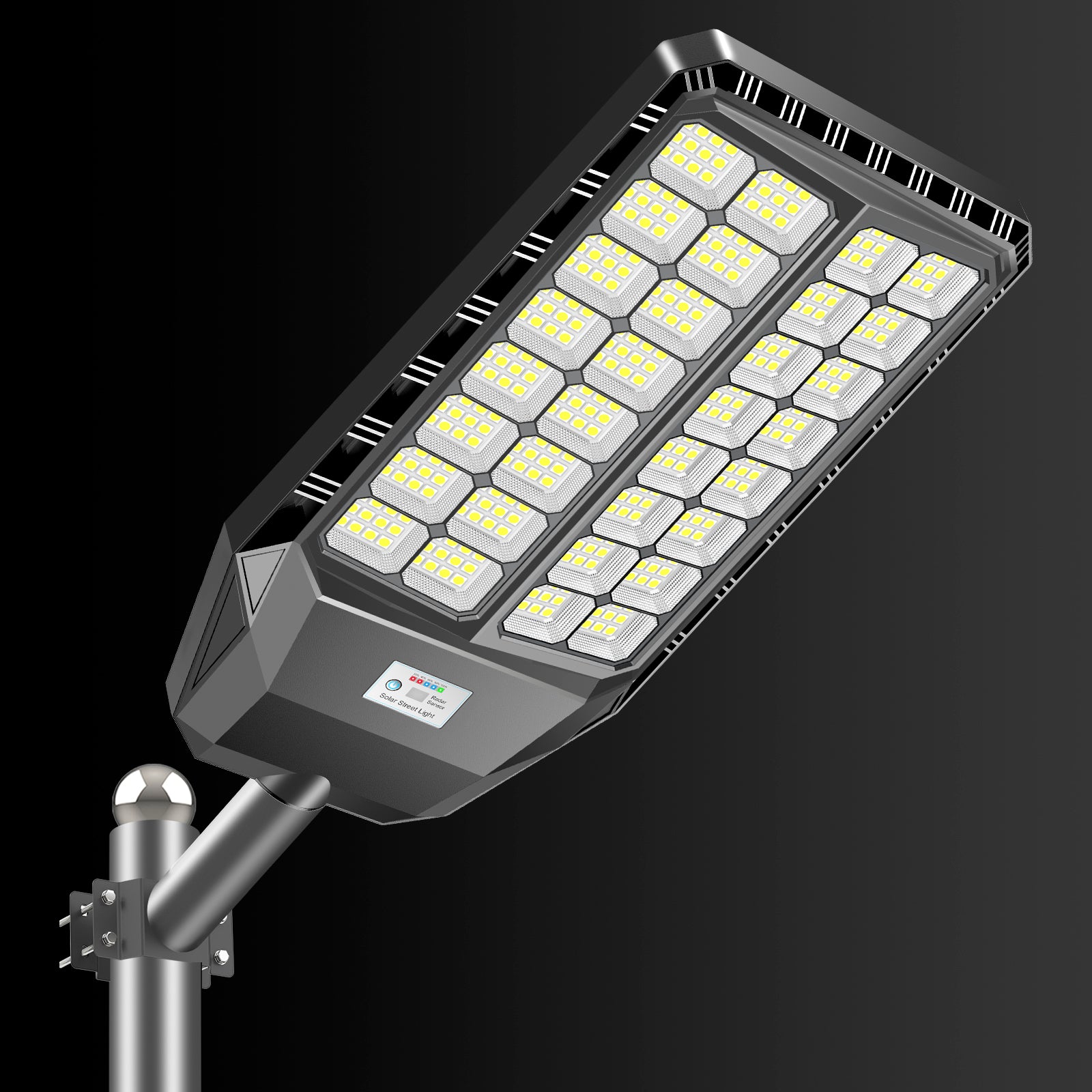
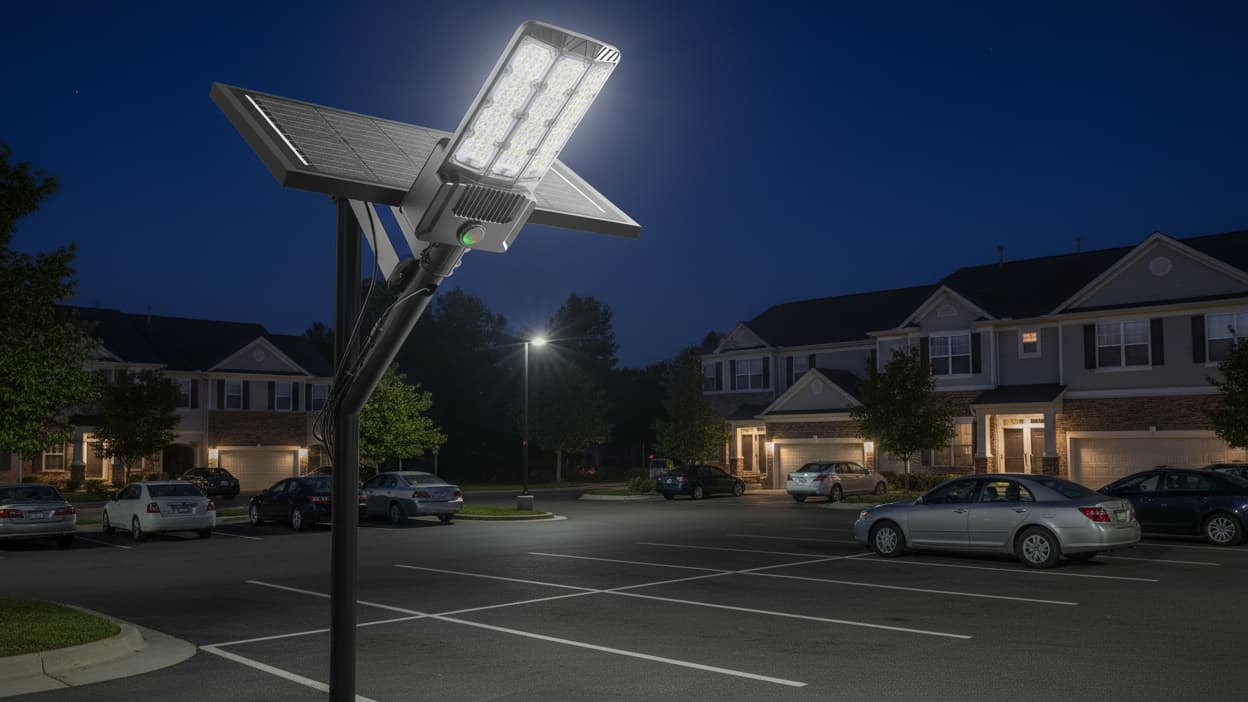
1. HY100 100W Commercial Solar Street Light — Best for High-Capacity Roadway and Parking Lot Applications

The HY100 is built for serious commercial applications — the kind of installation where you need the light to keep working after a storm, not just survive it. The aluminum alloy housing, IP65 rating, and 25.6V 30AH LiFePO4 battery give it the thermal stability and weather resistance that coastal installations demand.
Key storm-relevant specs:
- Die-cast aluminum alloy housing
- IP65 waterproof rating
- Operating range: -20°C to 60°C
- 25.6V 30AH lithium battery — up to 3 days autonomy in cloudy weather
- 150W monocrystalline panel (36V) — high-efficiency capture even in post-storm overcast conditions
- MPPT charging system for optimized recovery after storm cloud cover
- 18,000 lumens output — maintains visibility during and after storm events
- Suitable for 10–12 meter installation heights
- CE, RoHS, ISO-9001 certified | 3-year warranty
Best for: HOA roadways, commercial parking lots, campus perimeter lighting, industrial access roads in coastal regions.
Price: $1,399.00
→ Shop HY100 Commercial Solar Street Light — $1,399
2. HY120 200W Commercial Solar Street Light — Best for Large-Scale Infrastructure in High-Wind Zones

When you're lighting a large commercial property in a hurricane-risk zone and you need the system to keep running through 3 days of post-storm cloud cover, the HY120 is the answer. The 25.6V 45AH battery bank is one of the largest in its class, and the 200W monocrystalline panel recovers charge faster than competing designs when the sun returns after a storm.
Key storm-relevant specs:
- Die-cast aluminum alloy housing
- IP65 waterproof rating
- Operating range: -20°C to 60°C
- 25.6V 45AH lithium battery — 3-day autonomy in overcast conditions
- 200W monocrystalline panel (36V) — fastest post-storm recharge in the lineup
- MPPT charging with intelligent brightness control
- 21,600 lumens — wide 70°+140° beam for maximum area coverage
- Adjustable CCT: 3000K–6500K
- Suitable for 12–14 meter installation heights
- CE, RoHS, ISO-9001 certified | 3-year warranty
Best for: Large commercial parking structures, municipal roadways, campus main drives, industrial facilities in Gulf Coast and Atlantic coastal regions.
Price: $1,914.00
→ Shop HY120 Commercial Solar Street Light — $1,914
Pre-Storm Checklist: What to Do Before Hurricane Season
Even the best fixtures need some preparation before a major storm. Here's what experienced facility managers do in the weeks before hurricane season peaks (typically August–October for the Gulf and Atlantic coasts):
- Inspect all mounting hardware — tighten any loose bolts, check for corrosion at the base plate, look for cracks in pole welds
- Clean solar panels — salt spray and pollen reduce charging efficiency; clean panels charge faster before a storm and recover faster after
- Check battery charge state — fixtures with battery level indicators (like the BD820) make this easy; others may require a voltage check
- Adjust panel angles — if your fixtures allow it, tilt panels to a lower angle to reduce wind load during storm season
- Document fixture locations and specs — if you need to file an insurance claim or order replacements, having model numbers and installation photos saves weeks
- Test all operating modes — make sure motion sensors and auto-dim functions are working before you need them
Post-Storm Recovery: Getting Your Lighting Back Online
After a major storm, the priority sequence for commercial solar lighting is:
- Safety first — don't approach downed poles or fixtures until the area is confirmed clear of other hazards (downed power lines, flooding, structural damage)
- Assess structural damage — poles and mounting hardware before fixtures; a bent pole is a replacement, not a repair
- Clean panels — storm debris, mud, and salt spray on panels can reduce charging efficiency by 30–50%; clean them as soon as it's safe
- Check connections — water intrusion at cable connections is the most common post-storm electrical failure; inspect and reseal any compromised connections
- Allow full recharge cycle — after extended cloud cover, give fixtures 2–3 full sunny days to fully recharge before assessing performance
- Document damage for insurance — photograph everything before cleanup begins
Regional Considerations: Where Storm-Proofing Matters Most
Not every US region has the same risk profile. Here's a quick breakdown of where storm-proofing specs should be weighted most heavily:
Gulf Coast (Texas, Louisiana, Mississippi, Alabama, Florida Panhandle)
Highest hurricane frequency and intensity. Prioritize: maximum wind load ratings, IP66+ waterproofing, LiFePO4 batteries, salt-air corrosion resistance. The HY120 and HY100 are the right choices for permanent commercial installations here.
Atlantic Coast (Florida, Georgia, Carolinas, Virginia)
High hurricane risk with significant storm surge potential in low-lying areas. Same priorities as Gulf Coast, with additional attention to pole anchoring in sandy or flood-prone soils.
Mid-Atlantic and Northeast (Maryland, Delaware, New Jersey, New York)
Lower hurricane frequency but significant nor'easter risk with high sustained winds and heavy precipitation. IP65+ and robust mounting hardware are the priorities; extreme wind load ratings are less critical than in the Gulf.
Inland Southeast (Tennessee, Arkansas, Oklahoma, Kansas)
Tornado risk rather than hurricane risk. Tornado-force winds (EF2+) exceed what any pole-mounted fixture is designed to survive — the goal here is quick recovery, not storm survival. Prioritize fixtures with readily available replacement parts and simple reinstallation.
The Real Cost Calculation: Storm-Proof vs. Budget Fixtures
The property manager in coastal Georgia who lost three lights in a Category 2 storm? She'd paid about $180 per fixture. Replacement cost after the storm — including new poles, hardware, and installation labor — ran about $650 per location. Three locations: roughly $1,950 in storm damage, plus the liability exposure of an unlit parking lot for three weeks while she waited for parts.
A properly specified commercial solar street light for that application — something like the HY100 at $1,399 with engineered mounting hardware — would have cost more upfront. But it would still be standing. And it would have kept the parking lot lit through the storm and the days of grid outage that followed.
The math on storm-proofing isn't complicated. The question is whether you're calculating total cost of ownership or just purchase price.
→ Get a Quote on Storm-Ready Commercial Solar Lighting
Frequently Asked Questions
What wind speed rating should I look for in commercial solar lights for hurricane-prone areas?
For coastal installations in the Gulf Coast and Atlantic regions, look for fixtures and mounting systems rated for at least 130 mph sustained winds. Properties in ASCE 7 high-wind zones (coastal Florida, Gulf Coast) should target 150+ mph ratings with engineered mounting documentation. Always verify that the wind load rating applies to the complete assembly — fixture, arm, and pole — not just the fixture housing.
Is IP65 waterproofing enough for hurricane conditions?
IP65 provides protection against water jets from any direction, which covers most rain events including heavy tropical rainfall. For installations that may experience driving rain at 60+ mph (common in hurricane conditions), IP66 is a better specification. The difference is meaningful: IP66 is tested against more powerful water jets that better simulate hurricane-force rain. For ground-level or low-mounted fixtures in flood-prone areas, IP67 (submersion to 1 meter) is worth considering.
How long will solar lights run during and after a hurricane when there's no sun?
This depends entirely on battery capacity and the fixture's power management system. The Hykoont HY100 and HY120 are rated for up to 3 days of operation in cloudy conditions — which covers most hurricane events and the immediate post-storm period. Smaller fixtures with less battery capacity may only provide 1–2 nights of operation without sun. For critical applications (emergency access routes, security lighting), prioritize fixtures with the largest battery capacity relative to their power draw.
Should I take down my solar lights before a hurricane?
For properly specified and installed commercial fixtures on engineered poles, no — removal is typically more disruptive than leaving them in place. For temporary or residential-grade fixtures, removal before a major storm is advisable. If your commercial fixtures are on adjustable-angle poles, lowering the panel angle before a storm reduces wind load. Always follow local emergency management guidance for your specific area.
What's the difference between all-in-one and split-panel solar street lights for storm resistance?
All-in-one designs (panel integrated into the fixture) have a lower wind profile and fewer connection points that can fail in a storm. Split-panel designs allow for larger panel areas and more battery capacity, but create more wind load if the panel is mounted at a steep angle. For most commercial installations in hurricane-prone areas, all-in-one designs at lower mounting heights (8–12 feet) tend to perform better in storms. For higher mounting heights requiring more capacity, split designs with properly engineered mounting hardware are often necessary.
Do I need a permit to install commercial solar street lights in a hurricane zone?
In most US jurisdictions, yes — commercial outdoor lighting installations require permits, and in high-wind zones, engineered drawings for the pole and foundation are typically required. Many coastal counties have specific requirements for wind-rated installations. Check with your local building department before installation. Engineered drawings add cost upfront but protect you from liability and ensure the installation meets local code.
How do I maintain solar lights in a salt-air coastal environment?
Salt air accelerates corrosion on any metal surface. Key maintenance practices: clean solar panels monthly (salt spray reduces efficiency), inspect mounting hardware quarterly for corrosion, apply dielectric grease to electrical connections annually, and check pole base plates for rust annually. Hot-dip galvanized poles resist salt-air corrosion better than powder-coated poles over the long term. Aluminum alloy fixtures (like all Hykoont commercial models) are inherently corrosion-resistant and require less maintenance than steel housings.
What happens to the solar lights if the panel is damaged in a storm?
For split-panel designs, a damaged panel can be replaced independently without replacing the entire fixture — a significant cost advantage. For all-in-one designs, panel damage typically means replacing the complete unit. When evaluating fixtures for storm-prone installations, ask about panel replacement availability and cost. Hykoont's commercial lineup uses standard panel specifications that are readily available for replacement.
Can commercial solar lights replace grid-tied lights in hurricane evacuation routes?
Solar lights are increasingly used in emergency and evacuation route lighting precisely because they operate independently of the grid. The key requirement is sufficient battery autonomy — at least 3 days of operation without sun — and reliable motion/auto-on functionality. The HY100 and HY120 meet these requirements. However, for designated emergency routes, consult with your local emergency management office about specific lighting standards that may apply.
What's the warranty situation if a hurricane damages my commercial solar lights?
Standard manufacturer warranties (including Hykoont's 3-year warranty) cover defects in materials and workmanship, not storm damage. Storm damage to commercial fixtures is typically covered under commercial property insurance, not product warranty. Document your installation with photos and keep your purchase records — both are essential for insurance claims. Some commercial property policies have specific exclusions for outdoor fixtures; review your policy before hurricane season.
Bottom Line
Storm-proofing your commercial solar lighting isn't about finding the most expensive fixture. It's about matching the right specs to your actual risk profile — wind zone, installation height, application type — and not cutting corners on the mounting hardware that actually determines whether your lights are standing after the storm passes.
The fixtures we've covered here — the HY100, HY120, XH300, XH200, and BD820 — represent a range of applications and price points, all built on the aluminum alloy construction, IP-rated waterproofing, and LiFePO4 battery chemistry that commercial storm-zone installations demand.
If you're specifying a new installation or replacing storm-damaged fixtures, start with the wind load rating and work backward from there. Get the pole and mounting hardware right. And choose fixtures with enough battery autonomy to keep your property lit through the storm and the days of cloud cover that follow.
Shop HY100 Street Light — $1,399 Shop HY120 Street Light — $1,914 Shop XH300 Flood Light — $79

Leave a comment
This site is protected by hCaptcha and the hCaptcha Privacy Policy and Terms of Service apply.