



The forecast says clouds through Friday. Your parking lot still needs lighting on Wednesday night, the delivery gate opens before sunrise on Thursday, and nobody wants to discover the battery limit while backing a truck through the entrance.
So you ask a perfectly fair question: how many consecutive cloudy days can a solar street light handle?
The awkward part is that “three days” can describe several very different experiences. One light might maintain a planned overnight schedule. Another might stay on but reduce its brightness. A third might reach the same number only after starting with a fully charged battery under conditions your property rarely sees.
A day count without those details is like a truck’s range estimate without knowing whether it is towing a trailer.
For solar street lights for parking lots and access roads, the useful answer is not just how long the LEDs remain illuminated. It is how long the system can provide the lighting your site actually needs, followed by how quickly it can rebuild its reserve.
Let’s put the weather claim into practical terms, without pretending that every gray day, battery, or property behaves the same way.
The short answer: there is no universal cloudy-day number
A solar street light’s cloudy-weather endurance depends on its available battery energy, the energy collected during the cloudy period, and the amount consumed each night. Starting charge, temperature, battery condition, and controller behavior affect that balance too.
The three Hykoont models discussed below each have an “up to three days” statement in their product information, but the wording and conditions differ. Those listings do not establish three nights at constant maximum brightness at every American installation.
That distinction is not nitpicking. A fixture operating on a reduced overnight schedule has a different energy requirement from the same fixture expected to run at its highest output until dawn.
Think of the answer as a performance envelope, not a weatherproof expiration date. A well-charged system serving a modest overnight load may have useful reserve. The same equipment starting partly depleted, under heavy shade, with a demanding schedule may have much less.
Before accepting a number, ask what brightness it refers to, how long the nights are, what charging occurred during the test, and what happened after the cloudy stretch ended.

First, define what “handle” means at your property
Imagine two business owners looking at the same light on the third gray night. One says it is working because the fixture is still on. The other says it has failed because employees cannot clearly see the curb beside their cars.
They may both be describing the equipment accurately. They are using different definitions of success.
Staying on is the easiest standard
A light can remain visibly illuminated while delivering much less useful light to the ground. For a distant wayfinding marker, that might be adequate. For a loading area, gate keypad, or pedestrian route, it may not be.
Do not judge cloudy-weather endurance by looking up at the LEDs from a window. Stand at the locations where people need visibility. The route from the back parking spaces to the door matters more than whether the fixture looks bright against a dark sky.
Maintaining a schedule is a more useful standard
A defined lighting schedule tells you what happens through the evening and overnight. You might need stronger illumination while customers leave, followed by a lower but useful level during quiet hours.
If that schedule meets the site’s needs and continues through the expected cloudy period, the system is doing a clear job. Without a schedule, “all night” leaves too much room for assumption.
Maintaining constant output is a different requirement
Some properties need a specified level throughout operating hours, regardless of whether traffic is busy or quiet. That is a more demanding design brief than occasional driveway use.
If constant output is essential, state it before selecting equipment. For a commercial project, have the required illumination and layout assessed by a qualified lighting professional rather than treating a retail runtime statement as a completed design.
A cloudy day is not the same as a day with zero charging
Overcast weather reduces the solar resource available to a panel, but “cloudy” is not one fixed electrical condition. A bright overcast afternoon and a dark storm day can produce different charging results.
That is why it is risky to say that every cloudy day provides a particular percentage of normal charging. The answer depends on local weather, season, panel orientation, obstructions, equipment, and the conditions being compared.
A weather icon on your phone is useful for planning your day. It is not a measurement of the energy entering the battery.
There is also a practical difference between a cloudy-day endurance claim and no-sun autonomy. The first may include some charging during the cloudy period. The second should be defined around an assumed absence of solar input. Ask which one a supplier means.
For a conservative comparison, it can help to examine an explicitly stated no-input scenario. For a real project, the design should also consider the actual local solar resource rather than assuming either perfect sunshine or complete darkness every day.
The key is not choosing the most optimistic or pessimistic story. It is making the assumptions visible so competing systems can be compared on the same basis.

Your battery has a starting line, not just a capacity label
A battery advertised at a certain capacity does not necessarily begin every cloudy stretch fully charged. Yesterday’s operation, recent weather, shading, and the selected mode determine how much reserve is actually available.
Picture a small business that has had several mixed-weather days. Each day adds some energy, but not quite enough to replace the previous night’s consumption. The lights still look normal, so nobody notices that the reserve is gradually shrinking.
Then a three-day cloudy period arrives. The equipment has not received a fresh battery simply because the forecast started counting on Monday. It enters the difficult weather with whatever energy remains.
This is one reason a product can perform differently in two apparently similar three-day tests. The sequence before the test matters.
Nominal capacity is not the whole usable reserve
Battery watt-hours are useful for understanding storage, but the nominal rating is not a promise that every listed watt-hour will reach the LEDs. Battery protection, conversion losses, temperature, aging, and operating limits can reduce the energy available to the lighting load.
Ask for the relevant usable-energy assumptions rather than inventing a universal deduction. Different systems are designed differently, and an arbitrary percentage can create a false sense of precision.
Amp-hours need voltage beside them
An amp-hour label alone is not enough for a meaningful energy comparison. Voltage matters too. The basic nominal relationship is volts multiplied by amp-hours equals watt-hours.
For shopping purposes, having battery energy stated in watt-hours makes comparisons easier. It still needs to be considered alongside the actual nighttime load and operating schedule. A larger storage figure does not automatically mean more nights if the lighting demand rises with it.
The nightly schedule can change the answer more than the weather label
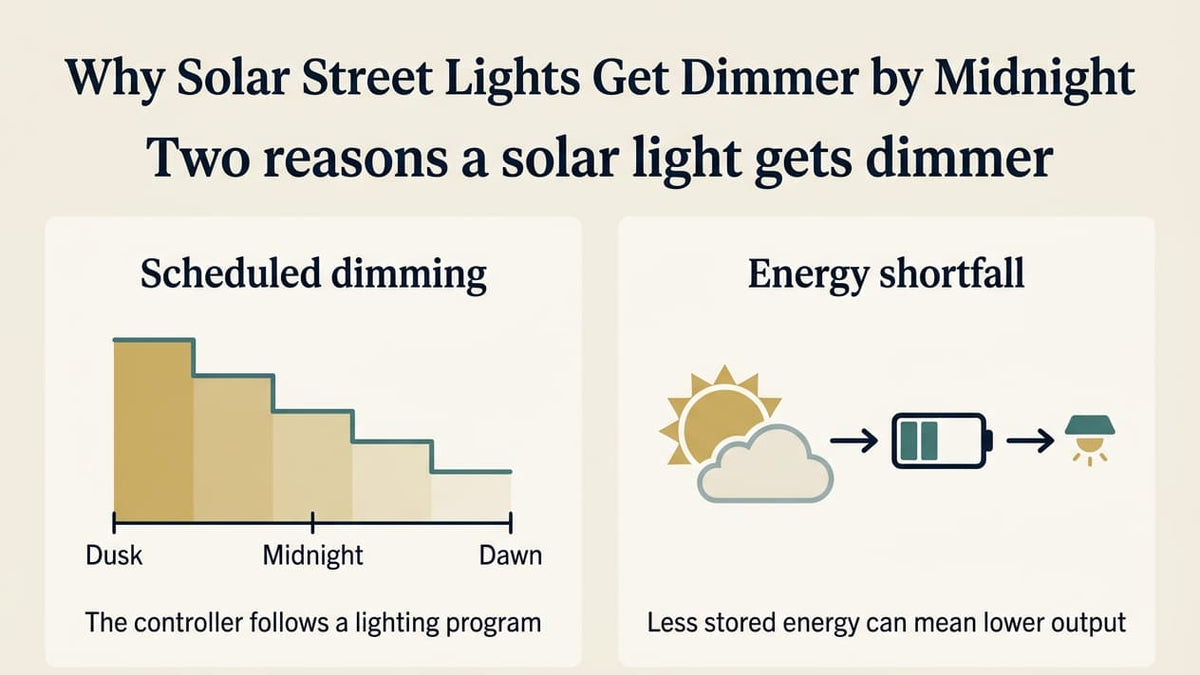
A light running at full output for the entire night has a different energy budget from a light that deliberately steps down after the property closes.
Consider a hypothetical fixture. If its measured electrical load is 20 watts for four hours, that part of the night requires 80 watt-hours. If it then draws 8 watts for another eight hours, that adds 64 watt-hours. The total is 144 watt-hours at the load.
Running that same hypothetical 20-watt load continuously for 12 hours would require 240 watt-hours. The difference comes from the schedule, not a larger battery or a more impressive weather claim.
These are teaching examples, not measured figures for the Hykoont products below. A product’s headline wattage is not enough to establish its actual battery draw under each setting.
Also, a brightness percentage should not automatically be treated as an identical percentage of electrical input. Ask for the applicable operating data when exact energy calculations matter.
Reduced brightness can be sensible, not suspicious
For an entrance used mostly before 10 p.m., a lower overnight stage may be a good way to preserve energy. For a warehouse with late shifts, that same stage might not be acceptable.
The question is whether the program matches the property. A controller that conserves energy is not automatically hiding a weakness, but energy conservation should not be mistaken for constant-output performance.
Motion-based operation needs realistic activity assumptions
If a selected system supports motion-responsive lighting, frequent activity may change energy use compared with a quiet-site scenario. A delivery entrance with trucks arriving throughout the night should not be modeled as an empty driveway.
Check that the specific fixture supports the behavior you want. Do not assume a motion sensor, a custom schedule, or remote programming is included simply because another solar light offers it.

A simple reserve worksheet, without fake precision
You can organize a supplier conversation around four quantities: usable energy at the beginning of the weather event, energy consumed per night, energy added during each day, and the reserve you need to preserve.
When nightly consumption exceeds daytime charging, the battery covers the difference. The bigger that difference, the faster the reserve shrinks.
For example, imagine an entirely hypothetical system begins with 360 watt-hours available for the planned lighting load. It consumes 120 watt-hours each night and receives no charging. It reaches that simplified energy budget after three nights, with no allowance left for uncertainty or additional reserve.
If it instead receives 30 usable watt-hours of charging during each cloudy day between nights, the sequence changes. The timing of those charging periods matters, as do controller limits and whether the starting battery is already full. That is why a simple daily average is a planning aid, not an exact shutdown forecast.
A more reliable design checks the day-by-day sequence and includes the required lighting floor. A system may become unacceptable before the battery is empty if its protective mode reduces the output below what the site needs.
When a supplier provides an estimate, ask them to write down the assumptions beside the result. A modest estimate with clear inputs is more useful than a confident number nobody can explain.
The overlooked question: what happens when the sun returns?
Suppose the light gets through three cloudy nights. That sounds like a success. But what if the next day has only a short sunny window, followed by another gray afternoon?
The system needs enough collection to support upcoming operation and rebuild the energy used during the difficult period. Those are two demands on the same solar input.
This is the difference between surviving a weather event and recovering from one. A large battery can provide reserve, but it cannot manufacture the energy needed to refill itself.
Imagine a hypothetical battery has a 200-watt-hour deficit after poor weather. If the next day’s usable collection exceeds the upcoming night’s demand by only 50 watt-hours, it has recovered just part of that deficit. A sunny-looking day does not automatically mean a full reset.
The exact recovery period depends on the equipment, local conditions, operating schedule, and remaining capacity. Do not convert panel nameplate watts directly into a guaranteed daily charging amount.
For sites that experience repeated cloudy stretches, recovery deserves as much attention as the initial reserve. Ask how the proposed system handles a difficult week, not just a single isolated three-day event that begins with perfect charge.
Why the same light can behave differently across the United States
A solar street light does not operate in an average American climate. It operates at one property, facing one horizon, through a particular season.
A coastal business dealing with repeated overcast mornings has a different collection pattern from an open inland property. A northern site with long winter nights has a different operating demand from the same installation in summer. Neither observation gives an exact runtime by itself.
Local shading can be even more important than a broad regional description. A roofline, evergreen, billboard, or neighboring building may reduce collection at the very hours when the panel would otherwise have useful sun.
Check the seasonal picture. A panel that looks clear at noon in July may receive a different shadow pattern in winter. Do not base a permanent installation on a quick walk around the property during the easiest season.
Snow and soiling add another variable. A panel covered by snow is not equivalent to a clean panel under ordinary cloud. Dirt, leaves, and bird droppings can also make the real installation differ from the conditions assumed in a product claim.
Cold-weather charging deserves its own check. An equipment operating-temperature range does not automatically tell you every battery charging limit. Confirm the model’s charging requirements and protections rather than treating one temperature line as the answer to every winter question.
At a 33-foot mounting height, judge the ground, not the glow
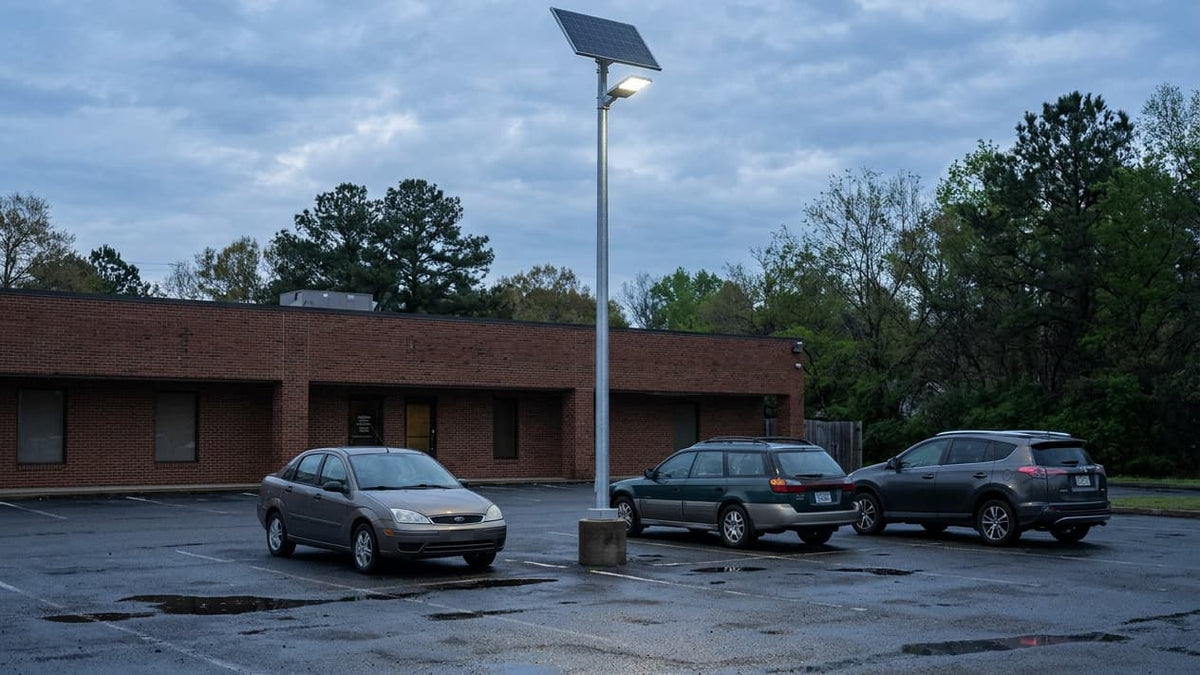
For a commercial installation around 10 meters, or roughly 33 feet, the lamp may look convincingly bright from across the lot while a critical walking route remains underlit. Height makes the distinction between fixture output and useful ground illumination especially important.
Beam distribution, mounting position, tilt, and spacing determine where the available light goes. A cloudy-weather dimming stage can expose a weak layout that was less noticeable during the initial high-output period.
That does not mean every model should be placed at 33 feet. Use the mounting range for the actual product and have the proposed arrangement checked. The HY050 and HY100 listings discussed below describe different recommended height ranges, and the YK080 Pro is listed for a lower range.
For a parking lot, assess the path to the entrance, curbs, turning areas, and parking-space edges. For an access road, assess the route and transitions between fixtures rather than just the bright patch beneath each pole.
Evaluate the layout at the lowest planned operating stage that must still serve the site. Otherwise, you may buy enough battery endurance to maintain a lighting pattern that was never adequate in the first place.

Three active Hykoont products worth comparing
The following models were active and available for purchase when checked for this article. Prices are listed in USD as of November 16, 2026. Check the linked product pages for current pricing, availability, included equipment, and final purchase details.
These are specification-based comparisons, not independent cloudy-weather field tests. The product descriptions provide a starting point for questions; they do not establish a guaranteed result for your property.
YK080 Pro: $365, with an explicit staged-brightness description

The Hykoont YK080 Pro Solar Street Light is listed at $365. Its product information specifies a 160Wh battery, a 40W monocrystalline solar panel, MPPT charging, and segmented brightness levels of 100%, 70%, 45%, and 30%.
The listing describes up to three days of lighting after a full charge. The starting condition matters: after a full charge is not the same as after several already-cloudy days. The segmented brightness description also makes it important to establish which program supports the runtime statement.
This model is worth examining when a managed brightness schedule matches the intended use. Ask how the stages are timed and what happens when battery energy becomes limited. Do not assume the highest advertised output continues unchanged for the whole period.
Its listed mounting-height recommendation is 5–7 meters, approximately 16–23 feet. It should not be treated as interchangeable with a roughly 33-foot commercial installation simply because both products are called solar street lights.
Shop the YK080 Pro and review its current lighting-control details.
HY050: $696, with a 480Wh battery and separate panel

The Hykoont HY050 Commercial Solar Street Light is listed at $696. Its product information specifies a 480Wh battery, an 80W monocrystalline solar panel, MPPT charging, and a listed 9,000-lumen output.
The description includes full-power and time-controlled dimming modes, along with up to three days on a full charge with efficient energy management. That wording should prompt a schedule discussion, not an assumption of three nights at the maximum output.
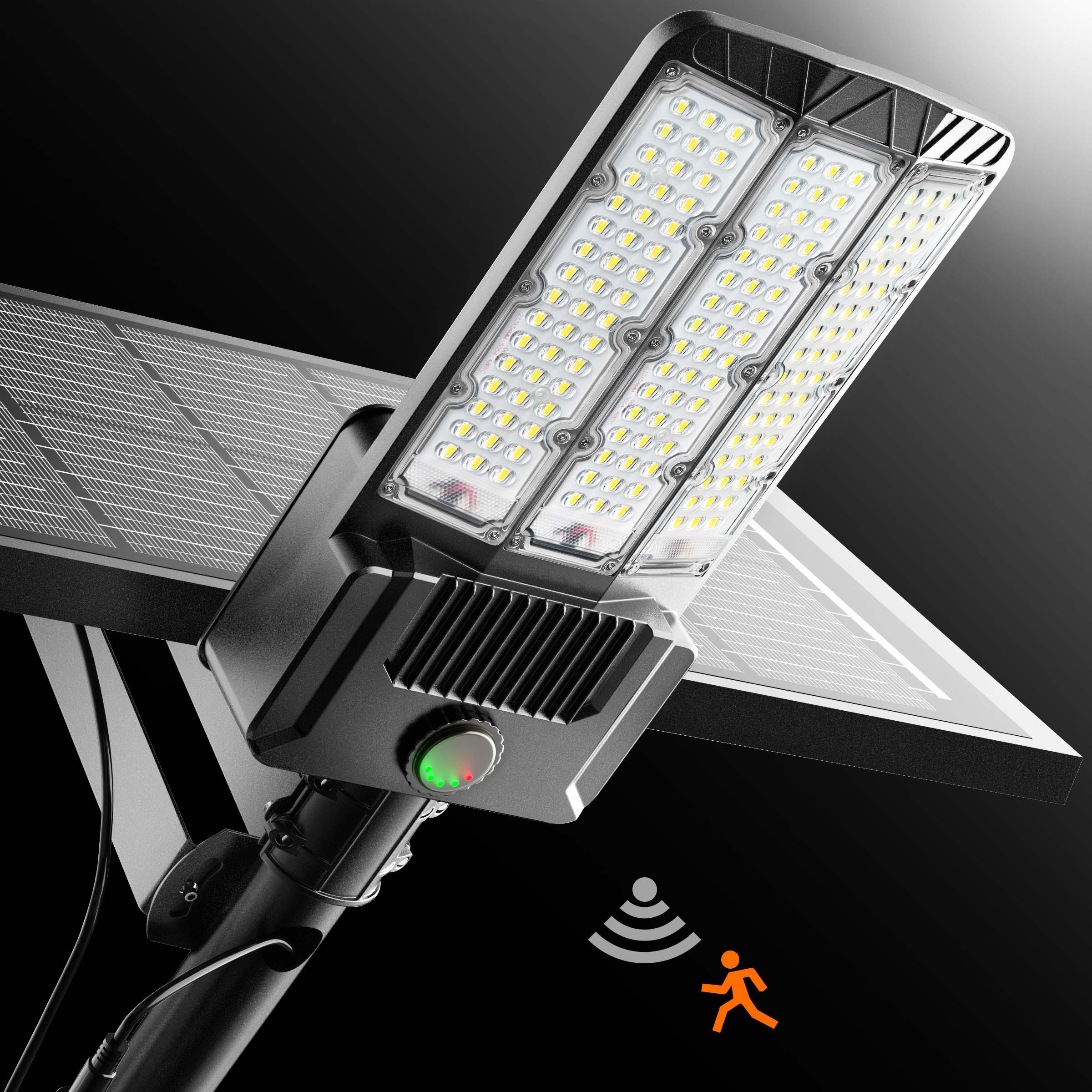
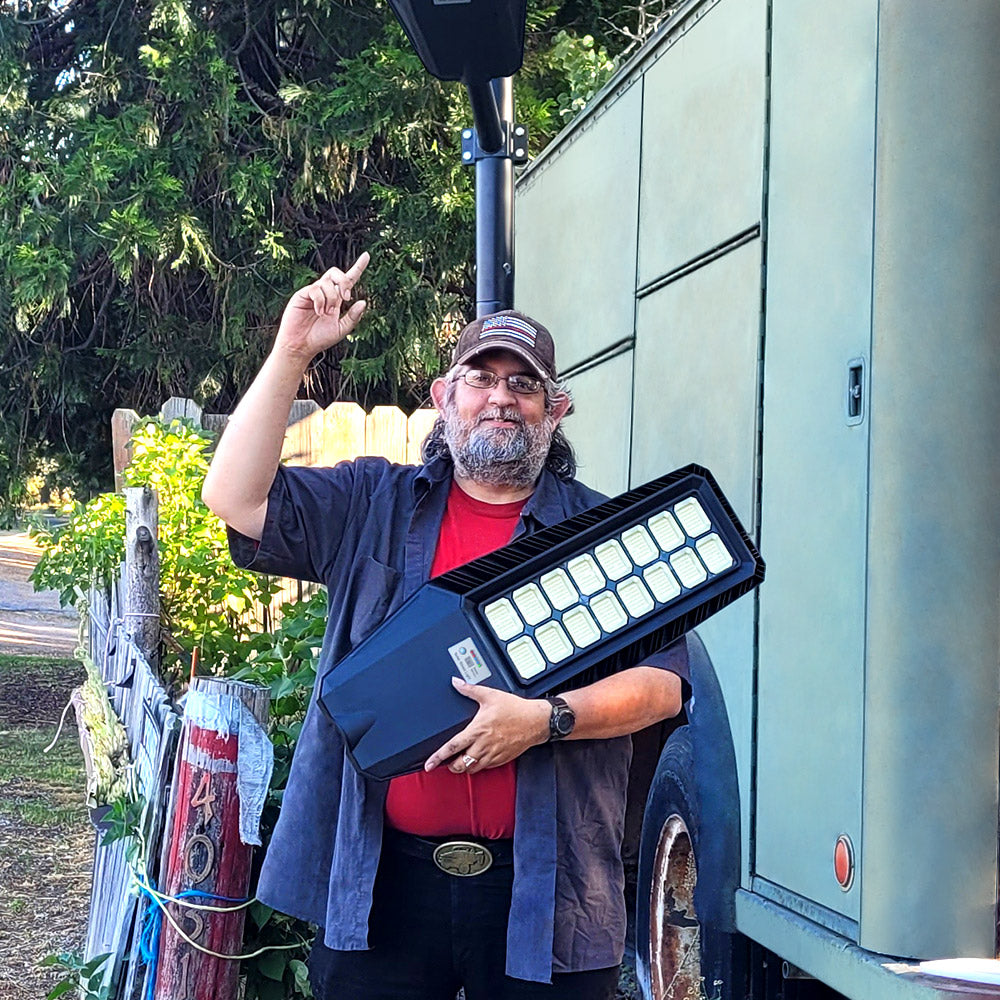
The HY050 uses a separate panel. The product image above shows the light head from two sides, not the complete installed assembly. Panel placement should follow the approved mounting and cable arrangement; a separate panel does not mean unlimited freedom to relocate it.
The listed mounting-height recommendation is 8–10 meters, approximately 26–33 feet. That makes it relevant to the taller commercial installations discussed here, subject to a suitable lighting layout and installation assessment.
Shop the HY050 and compare its battery, panel, and dimming specifications.
HY100: $1,399, with more listed storage and collection capacity

The Hykoont HY100 Commercial Solar Street Light is listed at $1,399. Its product information specifies a 768Wh battery, a separate 150W monocrystalline solar panel, MPPT charging, and intelligent brightness management.
The listing states that it can operate for up to three days in cloudy weather. That is a cloudy-weather statement, not enough information to establish a specific number of zero-input nights at constant output. Confirm the operating program and assumptions for your project.
The HY100 has more listed storage and panel capacity than the other two models here. That does not automatically establish a longer runtime because the intended lighting load also matters. Compare matched operating requirements rather than ranking the products by battery size alone.
Its listed mounting-height recommendation is 10–12 meters, approximately 33–39 feet. The product description contains differing output references, so confirm the current rated output and configuration before using those figures in a lighting design.
Shop the HY100 and confirm the configuration for your commercial site.
What should you do when the forecast turns gray?
If the system is already installed, resist the urge to start changing settings at random. First identify the current mode and review the manufacturer’s instructions. A setting that sounds more powerful may simply consume the available reserve faster.
Check the panel from a safe location for obvious obstruction or soiling. At commercial mounting heights, inspection and cleaning may require qualified access equipment. Do not climb an improvised ladder, walk onto an unsuitable roof, or handle wiring to investigate a weather-related concern.
Record the pattern over several evenings. Note the day’s conditions, turn-on time, selected mode, any step-down in brightness, and whether the important ground locations remain usable. Compare similar fixtures if the site has more than one.
A consistent timed reduction can suggest a program. Earlier reductions after poor collection can suggest an energy constraint. One weak unit among otherwise similar installations calls for an individual inspection rather than blaming the regional forecast.
Use consistent observation positions. Automatic phone exposure can hide differences, so photographs should not be treated as calibrated measurements. A suitable illuminance meter can provide a more useful comparison when used consistently.
If you see damaged wiring, swelling, scorching, or water inside an electrical compartment, stop ordinary troubleshooting and contact qualified support. Do not bypass protections to extract another night of operation.
When a bigger battery is not the first purchase to make
A larger battery can add reserve when properly matched to the system. It does not fix an unsuitable lighting layout, a shaded panel, or a schedule that asks more of the system than the site can replenish.
Before spending more, identify the limiting factor. A battery upgrade aimed at a charging problem may delay the same failure without resolving it. A larger panel aimed at a fixed-program misunderstanding may not change the overnight schedule at all.
Any equipment change needs to be approved for the controller, battery chemistry, voltage, wiring, enclosure, and mounting structure. A connector that fits is not evidence of compatibility.
Also compare installed cost rather than fixture price alone. Taller poles, foundations, access equipment, labor, and future maintenance can affect the project budget. Confirm which components come with the selected configuration instead of inferring the packing list from a photograph.
For essential lighting that must maintain a defined level through extended poor weather, discuss whether solar-only operation is appropriate. A different system design may be a better answer than continually increasing the promised autonomy number.
The questions that make a three-day claim useful
Ask what the system starts with: full charge, a specified state of charge, or a typical operating condition. Ask what charging is assumed during the cloudy period. Then ask for the output schedule, nightly operating hours, and relevant temperature conditions.
Next, ask what counts as the end of the claimed runtime. Is it shutdown, entry into a reduced-output mode, or failure to maintain a stated lighting level? Those are different endpoints.
Finally, ask about recovery. How much collection is needed to replace the deficit while keeping the next night’s lighting running? What happens if another cloudy period arrives before recovery is complete?
You do not need a perfect weather forecast to make a sound purchase. You need clear assumptions, a suitable site assessment, and a product configuration that serves the hours and locations that matter.
Frequently asked questions
1. Can a solar street light really last through three cloudy days?
It can under suitable conditions, but a three-day statement needs context. Starting charge, charging during the cloudy period, lighting schedule, night length, temperature, and battery condition all affect the result. The Hykoont listings discussed here include up-to-three-day statements with different wording, not a universal constant-brightness guarantee.
2. Do solar street lights charge when the sky is overcast?
Solar panels can collect energy under overcast conditions, but the amount varies. Bright overcast and dark storm weather should not be treated as identical. Avoid relying on a fixed charging percentage unless it is tied to relevant measurements or a defined design assumption.
3. Does three days of backup mean 72 hours of continuous lighting?
Not necessarily. A solar street light may operate only at night and may use staged brightness. A claim covering three calendar days or nights is not automatically a claim of 72 continuous hours at full output. Ask for the actual operating hours and program.
4. Will one sunny day fully recharge the battery?
Not always. Recovery depends on the deficit, usable solar collection, charging limits, and the energy needed for the upcoming night. A sunny day may restore only part of the reserve. This is why recovery after poor weather belongs in the buying conversation.
5. Which matters more for cloudy weather, battery size or panel size?
Both matter for different reasons. Storage provides reserve, while collection replenishes energy. The nighttime load determines how quickly that reserve is used. A useful design balances all three rather than choosing the biggest number in one category.
6. Why does my light dim during cloudy weather instead of shutting off?
The controller may be following a scheduled stage or reducing consumption as available energy changes. Check the selected mode and the manufacturer’s explanation of low-energy behavior. The important question is whether the reduced level still meets the property’s lighting needs.
7. Can I install every solar street light at about 33 feet?
No. Follow the specific model’s mounting recommendations and a suitable layout assessment. The HY050 listing recommends 8–10 meters, the HY100 recommends 10–12 meters, and the YK080 Pro recommends 5–7 meters. Those ranges do not make the models interchangeable.
8. Which Hykoont option has the largest listed battery in this comparison?
The HY100 lists 768Wh at $1,399, compared with the HY050’s 480Wh at $696 and the YK080 Pro’s 160Wh at $365. These are checked listing prices and nominal specifications, not a runtime ranking. Load, controls, collection, and site conditions still matter.
9. Should I replace the battery if cloudy-weather performance gets worse?
Investigate first. Battery aging is one possibility, but new shade, soiling, changed settings, longer nights, or charging problems can also explain the change. Give support a record of the mode, weather, installation age, and behavior before ordering compatible replacement parts.
Buy for the third gray night, and the morning after it
The best answer to “How many consecutive cloudy days can it handle?” is a number attached to a clear job. What brightness, for which hours, at which locations, starting from what charge, with what recovery afterward?
That may sound less exciting than a huge backup claim. It is much more useful when the forecast turns ugly.
For your next comparison, start with the property’s required lighting schedule. Check the battery and panel together. Confirm the lowest operating stage, mounting arrangement, and recovery assumptions. Then decide whether the system fits, rather than asking a three-day label to do the work of a site assessment.
A good solar street light should not merely survive the weather on paper. It should keep doing the job you bought it for when the sunny forecast fails to show up.

Leave a comment
This site is protected by hCaptcha and the hCaptcha Privacy Policy and Terms of Service apply.